
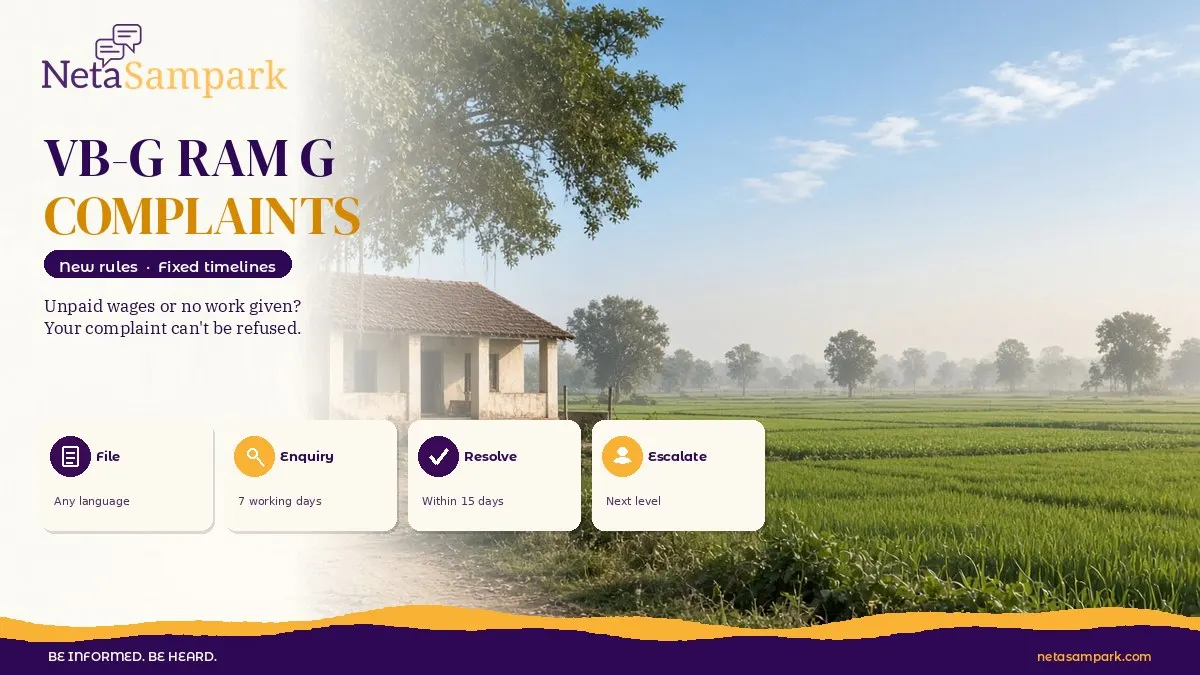
The Ministry of Rural Development notified the VB-G RAM G Grievance Redressal Rules, 2026, announced on 2 November 2026. Complain in person, by speed post, by phone or online. No complaint can be refused over format or language. The enquiry must finish in 7 working days, and the grievance must be resolved in 15 days, or it moves up.
Updated 3 November 2026
Quick facts
| Item | Details |
|---|---|
| Official portal | VB-G RAM G portal and the Ministry of Rural Development |
| Helpline | Your state's designated VB-G RAM G helpline; CPGRAMS as a fallback |
| Fee | Free. No fee to file a grievance |
| Deadline | Enquiry in 7 working days; resolution in 15 days from receipt |
| Documents | Job card number, your name and village, the problem and dates; any muster roll or payment proof |
| Who handles it | Grievance Redressal Officers at Gram Panchayat, Block and District levels |
| Announced | PIB release of 2 November 2026 |
What are the new VB-G RAM G grievance rules?
VB-G RAM G (Viksit Bharat Guarantee for Rozgar and Ajeevika Mission, Gramin) is the rural jobs scheme under the VB-G RAM G Act, 2025, which replaced MGNREGA. Our guide to the 125 days of work explains the basics.
Until now, complaints about the scheme went through a mix of routes. The new Grievance Redressal Rules, 2026 set one clear, time-bound system. Every state has to set it up at three levels:
| Level | Who handles your complaint |
|---|---|
| Gram Panchayat | Designated Grievance Redressal Officer at GP level |
| Block | Designated Grievance Redressal Officer at block level |
| District | Designated officer at district level, overseen by the District Programme Coordinator |
The District Programme Coordinator watches over the whole district and makes sure complaints move through the system and the official digital platform.
What kind of problems can I complain about?
The rules say any person can file a grievance on any matter connected with how the scheme is run. In real life, that covers things like:
• Wages not paid, or paid late
• Wrong amount credited
• Job card not issued, or issued with mistakes
• Demanded work but not given
• Name missing from the muster roll even though you worked
• Face attendance or app problems that stopped your attendance
• Payment going to the wrong bank account
• Someone taking a cut or bribe
• Poor quality or fake works on paper
If you're not sure your wages came, check first using our guide on job card, muster roll and payment status.
How can I file a complaint?
The rules give four channels. Use whichever is easiest for you:
1. In person. Go to the designated Grievance Redressal Officer at your Gram Panchayat, Block or District office and hand over your complaint.
2. By speed post. Send it with proof of delivery. Keep the speed post receipt and tracking number.
3. Online. Through the central Digital Public Infrastructure for grievance redressal designated by the Government of India.
4. By phone. Through a telephone line, helpline or any other mode your state government decides.
Here's the key protection: no grievance can be refused registration because of its format, language, way of submission or any procedural mistake. A handwritten complaint in Hindi, Odia, Telugu or any language is valid. If an official tells you "wrong format, go back", that's against the rules.
What happens after I submit it?
1. Registration. A paper complaint must be entered on the digital platform the same day, or by the next working day at the latest.
2. Acknowledgement. You get a registration number, the date it was received, and the designation of the officer who received it. Online complaints get this electronically. Paper complaints get a paper acknowledgement.
3. Enquiry within 7 working days. The officer can call for records, registers, documents, reports and electronic data.
4. Hearing if needed. You may get a chance to be heard in person or online.
5. Resolution within 15 days of receipt. The officer records findings and takes corrective action.
6. Outcome shared with you. It's recorded on the digital platform and sent to you. Paper complainants get it on paper too.
What if my complaint isn't solved in 15 days?
It doesn't just die. Any grievance not resolved within 15 days gets escalated to the next higher level, through the system your state sets up. The higher authority has to look at it and act. The digital platform keeps tracking it until it's actually resolved.
If you're unhappy with the final order, you can appeal. Appeals follow Schedule I of the VB-G RAM G Act, 2025.
How should I write my complaint?
You don't need a lawyer or fancy language. Just cover these points:
☐ Your name, father's or husband's name, village, Gram Panchayat and block ☐ Your job card number ☐ What the problem is, in simple words ☐ Dates: when you demanded work, when you worked, which week's wages are missing ☐ Name of the work site, if relevant ☐ Your mobile number ☐ Copies (not originals) of any proof: job card page, muster roll, bank passbook, photos ☐ Your signature or thumb impression
Keep a photocopy or photo of the complaint before you hand it over.
What if officials still don't act?
• Ask for your registration number. Without it, there's no proof. Insist politely
• Escalate to the District Programme Coordinator with your registration number
• Use CPGRAMS. Our post on how CPGRAMS works explains filing at pgportal.gov.in
• File an RTI asking for the status and action taken on your grievance. See RTI when a grievance is closed without action
• Raise it at the Gram Sabha. Public discussion often moves things
• Contact your MLA or MP. Find them on NetaSampark
Why do these rules matter?
Wage delays and "no work" complaints have been the biggest pain points in rural jobs schemes for years. Workers often didn't know where to complain, and many complaints were simply never written down. Now there's a clear timeline (7 working days, then 15 days), proof of filing, and automatic escalation. That shifts power a little towards the worker.
The catch: states have to actually appoint officers and set up helplines. If your GP or block hasn't named a Grievance Redressal Officer yet, ask the Programme Officer at the block. Our explainer on face attendance and offline exceptions covers another common reason wages get stuck.
Can someone else file a complaint for me?
Yes. The rules say "any person" can submit a grievance on any matter connected with the scheme. So a family member, a local volunteer, a self-help group member or a ward member can file on behalf of a worker who can't read or travel. Just make sure the worker's name, job card number and the problem are written clearly, and that the registration number is passed back to the worker.
Final reminder
Write it down, get the registration number, and count 15 days. If nothing happens, it should go up a level on its own, but follow up anyway. Nobody can refuse your complaint because of language or format. That's now in the rules.
Frequently asked questions
What are the VB-G RAM G Grievance Redressal Rules, 2026?
Rules notified by the Ministry of Rural Development, announced on 2 November 2026, setting a three-level, time-bound complaint system.
How many days does it take to resolve a VB-G RAM G complaint?
Enquiry within 7 working days and resolution within 15 days from receipt.
Can my complaint be rejected because it's handwritten or in my language?
No. The rules say no grievance can be refused over format, language or manner of submission.
What happens if my grievance isn't resolved in 15 days?
It's escalated to the next higher level and tracked until it's resolved.
Where do I appeal against a VB-G RAM G grievance order?
Appeals follow Schedule I of the VB-G RAM G Act, 2025.
Sources
• PIB: VB-G RAM G Grievance Redressal Rules, 2026 (2 November 2026)
• Ministry of Rural Development
• VB-G RAM G portal, Department of Rural Development
• CPGRAMS