
Bought a product that arrived damaged? Paid for a service that was never delivered? A company refused your refund despite repeated requests?
You have a structured route for escalating a consumer grievance in India.
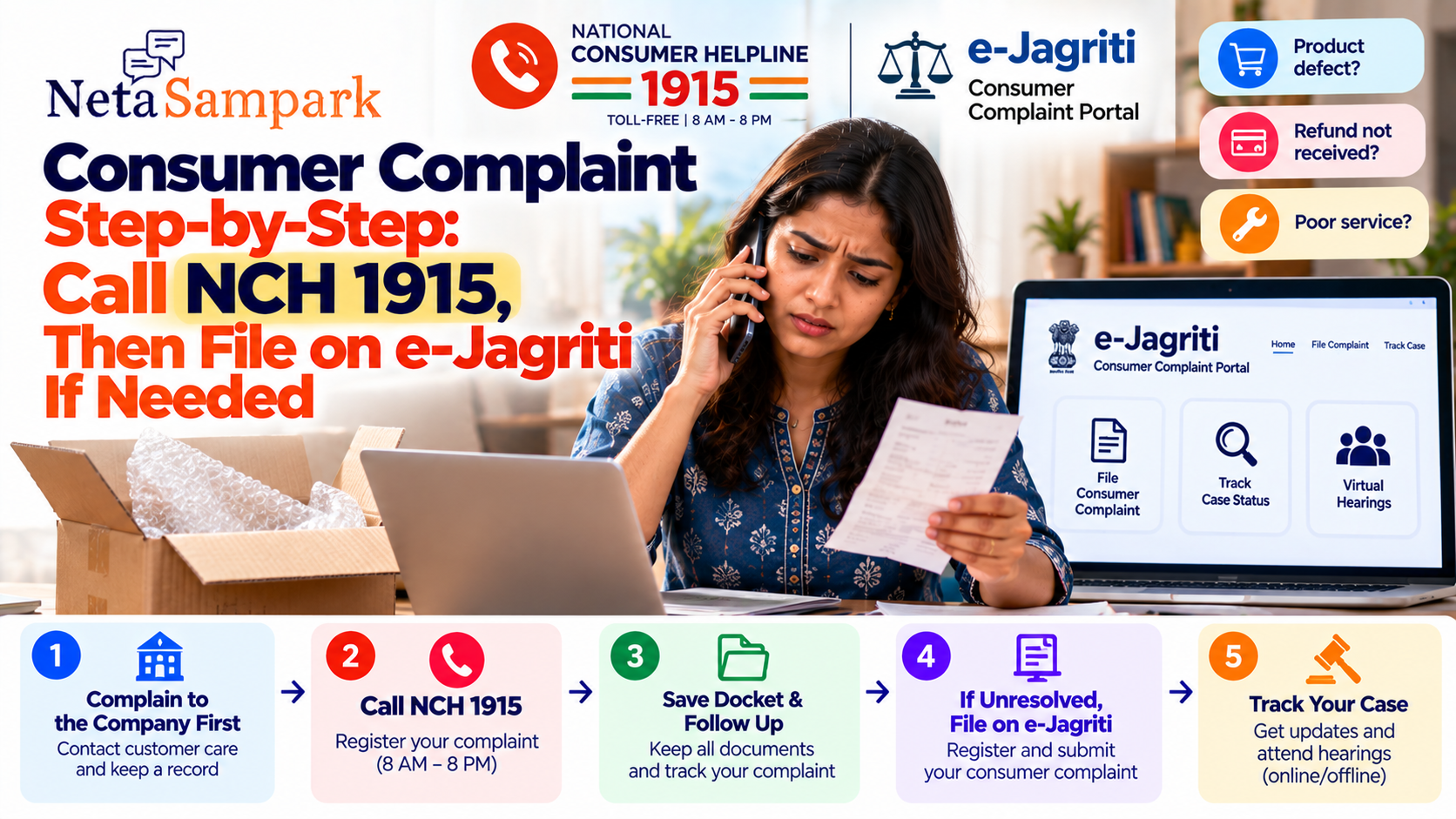
Complain to the business → contact National Consumer Helpline (NCH) at 1915 → keep the docket and evidence → if the issue remains unresolved, consider filing a formal consumer complaint through e-Jagriti.
One important 2026 update: e-Daakhil has been subsumed into the newer e-Jagriti platform. The Department of Consumer Affairs says e-Jagriti has integrated e-Daakhil and other legacy systems and has been available nationwide since 1 January 2025. (Consumer Affairs)
What is the National Consumer Helpline?
The National Consumer Helpline (NCH) is operated by the Department of Consumer Affairs as a pre-litigation grievance-redress mechanism.
It allows consumers to register complaints concerning consumer issues and seek intervention before approaching a Consumer Commission. The Department describes NCH as an alternate dispute-resolution mechanism at the pre-litigation stage. (National Consumer Helpline)
NCH helpline: 1915
The current NCH website lists:
The NCH website currently lists WhatsApp as 8800001915. (National Consumer Helpline)
When should you use NCH?NCH can be useful when you have a consumer dispute involving issues such as:
The NCH portal describes itself as a central registry for consumer grievances and allows consumers to submit supporting documents. (National Consumer Helpline)
Step 1: Complain to the company firstBefore escalating, contact the seller, service provider, manufacturer or platform.
Be specific about what you want.
"The product delivered on 15 September was damaged. I am requesting a replacement or refund."
"Your service is bad. Please solve this."
A clear complaint creates a useful record.
Step 2: Save your evidenceBefore calling 1915, collect everything related to the transaction.
Keep:
☐ Previous complaint/reference numbers
If the dispute involves an online purchase, save the product page and relevant terms if they may later change.
Step 3: Contact NCH at 1915The current NCH website lists 1915 as its toll-free consumer helpline. (National Consumer Helpline)
When speaking to the helpline, explain:
Keep the explanation factual and chronological.
You can also register onlineCalling 1915 isn't the only route.
NCH currently provides multiple channels, including:
The NCH website also provides a facility to track grievances. (National Consumer Helpline)
This can be useful if you want to upload supporting documents and maintain a written record.
Step 4: Save your NCH docket numberAfter registering your grievance, keep the docket number/reference number.
The NCH tracking facility asks for the docket number together with the registered mobile number or email ID. (National Consumer Helpline)
Make a screenshot.
Also save the email/SMS confirmation if one is provided.
What happens after NCH registration?NCH is a pre-litigation grievance mechanism, not the Consumer Commission itself.
The grievance can be taken up through NCH's integrated mechanism and, where applicable, brought to the attention of the concerned company, regulator or other stakeholder.
The outcome could be a response or resolution from the company.
But NCH does not replace a formal consumer case before a Consumer Commission. If you remain dissatisfied, you can consider the formal consumer-dispute route. (National Consumer Helpline)
What if NCH doesn't solve the problem?This is where many consumers stop.
If the issue remains unresolved, you can consider filing a formal complaint before the appropriate Consumer Commission.
The Consumer Protection Act, 2019 provides a three-tier consumer-dispute redressal system:
The Department of Consumer Affairs also provides for online filing and virtual hearings. (Consumer Affairs)
e-Daakhil or e-Jagriti?Important 2026 update
If you search online for e-Daakhil, you may find older instructions.
The current platform is e-Jagriti.
The Department of Consumer Affairs says e-Jagriti integrated legacy platforms including:
and has been available from 1 January 2025. (Consumer Affairs)
So for a new online consumer complaint, use:
rather than looking for the old e-Daakhil filing workflow.
Step 5: Register on e-JagritiThe platform currently provides consumer registration and complaint filing facilities. Its help section includes a dedicated Consumer Complaint (CC) Case Filing guide. (e-Jagriti)
Pay applicable filing fee, if any
What information should you prepare?Before starting an e-Jagriti complaint, organise your information.
Your details
Opposite party details
Transaction details
Relief sought
Don't simply upload dozens of documents without explaining what happened.
Build a simple complaint timelineA timeline can make your case much easier to understand.
10 August: Product purchased — ₹18,500
12 August: Product delivered with defect
16 August: Replacement promised
25 August: No replacement received
5 September: NCH complaint registered
This gives the Consumer Commission a straightforward sequence of events.
What documents should you upload?Your evidence should support the facts stated in your complaint.
A useful document bundle might include:
Purchase evidence
Problem evidence
Communication
Escalation
Other relevant records
Keep the original files safely stored.
Don't exaggerate the complaint"The company deliberately cheated me."
"The company confirmed the refund on 12 September, but the amount had not been credited as of 28 September despite two follow-ups."
The second statement gives specific facts that can be supported by records.
Where can you file?The Consumer Protection Act provides jurisdiction rules for Consumer Commissions.
The Department of Consumer Affairs states that a complaint can be filed before the appropriate commission based on applicable jurisdiction, including the consumer's place of residence/work in the circumstances provided by the law. (Consumer Affairs)
The exact commission also depends on the applicable pecuniary jurisdiction rules, which have changed through amendments/rules.
Under the current 2021 jurisdiction rules, the commission levels are based on the value of goods or services paid as consideration:
CommissionValue of considerationDistrict CommissionUp to ₹50 lakhState CommissionAbove ₹50 lakh to ₹2 croreNational CommissionAbove ₹2 crore
These thresholds come from the Consumer Protection (Jurisdiction of the District Commission, the State Commission and the National Commission) Rules, 2021. (Consumer Affairs)
Don't use older ₹1 crore/₹10 crore thresholds found in older articles. The 2021 rules changed the pecuniary jurisdiction. (Consumer Affairs)
How much does filing cost?The e-Jagriti platform currently displays filing fees based on the value of goods or services paid as consideration.
Value of considerationFiling feeUp to ₹5 lakhNilAbove ₹5 lakh – ₹10 lakh₹200Above ₹10 lakh – ₹20 lakh₹400Above ₹20 lakh – ₹50 lakh₹1,000
The applicable fee for higher-value cases and the relevant commission should be checked on the current e-Jagriti filing interface. (e-Jagriti)
Do you need a lawyer?The consumer-protection framework is designed to allow consumers to approach Consumer Commissions without necessarily having to go through a lawyer.
The e-Jagriti platform provides direct consumer onboarding and complaint filing. (e-Jagriti)
However, if your dispute is complex—for example, involving substantial evidence, complicated contracts, multiple parties or technical legal issues—you may decide to obtain professional legal assistance.
Can you attend hearings online?Consumer-protection rules and the Department's digital system provide for virtual hearings.
e-Jagriti is designed as an end-to-end digital platform supporting online filing, case management, hearings and case tracking. (Consumer Affairs)
The actual procedure for a particular case depends on the Consumer Commission and the orders/instructions applicable to it.
Can you track your case online?e-Jagriti provides case-status and case-history functionality.
Its case-status page allows users to search using a main case number, or using newer case-number/filing-reference information, including an E-Daakhil Reference Number where applicable. (e-Jagriti)
This is another reason to save every filing/reference number you receive.
NCH vs Consumer CommissionThese two steps serve different purposes.
NCHConsumer CommissionPre-litigation grievance mechanismFormal consumer-dispute proceedingManaged by Department of Consumer AffairsQuasi-judicial consumer forumCan contact/converge with companies and stakeholdersCan issue orders under consumer-protection lawUseful first escalationFormal legal remedyDocket/reference numberCase/filing referenceFree NCH grievance mechanismApplicable filing fee may apply
NCH itself describes its role as pre-litigation and says an unsatisfied consumer can approach the appropriate Consumer Commission. (National Consumer Helpline)
A practical escalation ladderFor an ordinary consumer dispute, you can organise the process like this:
LEVEL 1
Contact the seller/service provider
LEVEL 2
Register complaint with NCH — 1915
LEVEL 3
LEVEL 4
If unresolved, consider Consumer Commission
LEVEL 5
LEVEL 6
Track the case and respond to notices
This isn't a requirement that every consumer must complete every step before filing a formal case; it is a practical escalation sequence. NCH is specifically a pre-litigation mechanism, while e-Jagriti handles formal consumer cases. (National Consumer Helpline)
Example: Online shopping refundSuppose you purchased a ₹35,000 appliance online.
The appliance arrives damaged.
Day 1
Day 1
Day 5
The seller refuses replacement/refund.
Day 6
You register a grievance with NCH at 1915.
Day 6
Following days
You keep the company's responses and NCH correspondence.
If unresolved
You can consider a formal consumer complaint through e-Jagriti.
Your evidence package could contain:
That creates a clear documentary trail.
Another example: Service deficiencyImagine you paid a service provider ₹80,000 for a service that was only partly delivered.
☐ Evidence of incomplete service
Then prepare a timeline explaining exactly what was promised, what was delivered and what remains unresolved.
What if the company resolves the issue after NCH?If you receive the refund/replacement/service you requested, update the NCH grievance appropriately.
The NCH portal also provides a feedback facility that asks for the docket number and registered mobile number. (National Consumer Helpline)
Keep the final proof of resolution.
Refund initiated → bank statement shows credit → save statement/screenshot.
Don't rely solely on a verbal promise.
What if the company calls after you file?"Your refund will be processed."
"Please confirm the refund amount and expected credit date by email."
A written record is easier to preserve.
Common mistakes consumers make❌ Calling 1915 without documents
Prepare the basic transaction details first.
❌ Losing the NCH docket number
❌ Using an old e-Daakhil link
For new filings, use e-Jagriti, which has subsumed e-Daakhil. (e-Jagriti)
❌ Uploading random screenshots
Arrange documents logically and label them.
❌ Writing a complaint without a timeline
Explain events in chronological order.
❌ Making unsupported allegations
Stick to facts you can document.
❌ Ignoring notices from the Commission
Once a formal case is filed, monitor the case status and respond within applicable timelines.
Your consumer complaint folderCreate one folder on your phone/computer:
Consumer Complaint — [Company Name]
This makes the process much easier if the dispute continues.
Before filing on e-JagritiTransaction
Problem
Company response
☐ Did I complain to the company?
☐ Do I have the reference number?
NCH
☐ Did I register the grievance?
☐ What was the response/outcome?
Formal complaint
☐ Have I identified the appropriate Consumer Commission?
☐ Have I prepared the parties' details?
☐ Have I prepared the chronology?
☐ Have I calculated the relief I am seeking?
☐ Have I organised the supporting documents?
One important distinctionCalling 1915 doesn't itself start a formal consumer case before a Consumer Commission.
NCH operates at the pre-litigation grievance stage. If you need formal adjudication, the Consumer Commission route is separate. (National Consumer Helpline)
That distinction matters because consumers sometimes assume that obtaining an NCH docket automatically means a court case has been filed.
Official portalsNational Consumer Helpline
National Consumer Helpline — 1915
Use NCH to register and track consumer grievances at the pre-litigation stage. (National Consumer Helpline)
e-Jagriti
e-Jagriti — Consumer Commission filing portal
This is the current unified digital platform for consumer-dispute filing and case management. (e-Jagriti)
Consumer Affairs Department
Department of Consumer Affairs — Consumer Protection
Bottom lineIf a consumer complaint isn't getting resolved, don't rely only on repeated customer-care calls.
Company complaint → NCH 1915 → save docket → follow up → if unresolved, consider formal Consumer Commission proceedings → file through e-Jagriti.
And remember the 2026 platform update:
e-Daakhil has been integrated into e-Jagriti.
For a new online consumer complaint, start with the current e-Jagriti portal rather than an old e-Daakhil workflow. (Consumer Affairs)
Consumer disputes can involve different limitation periods, jurisdictional rules and procedural requirements. For a specific dispute, check the current e-Jagriti/Consumer Commission requirements and consider professional legal advice where the matter is complex.