
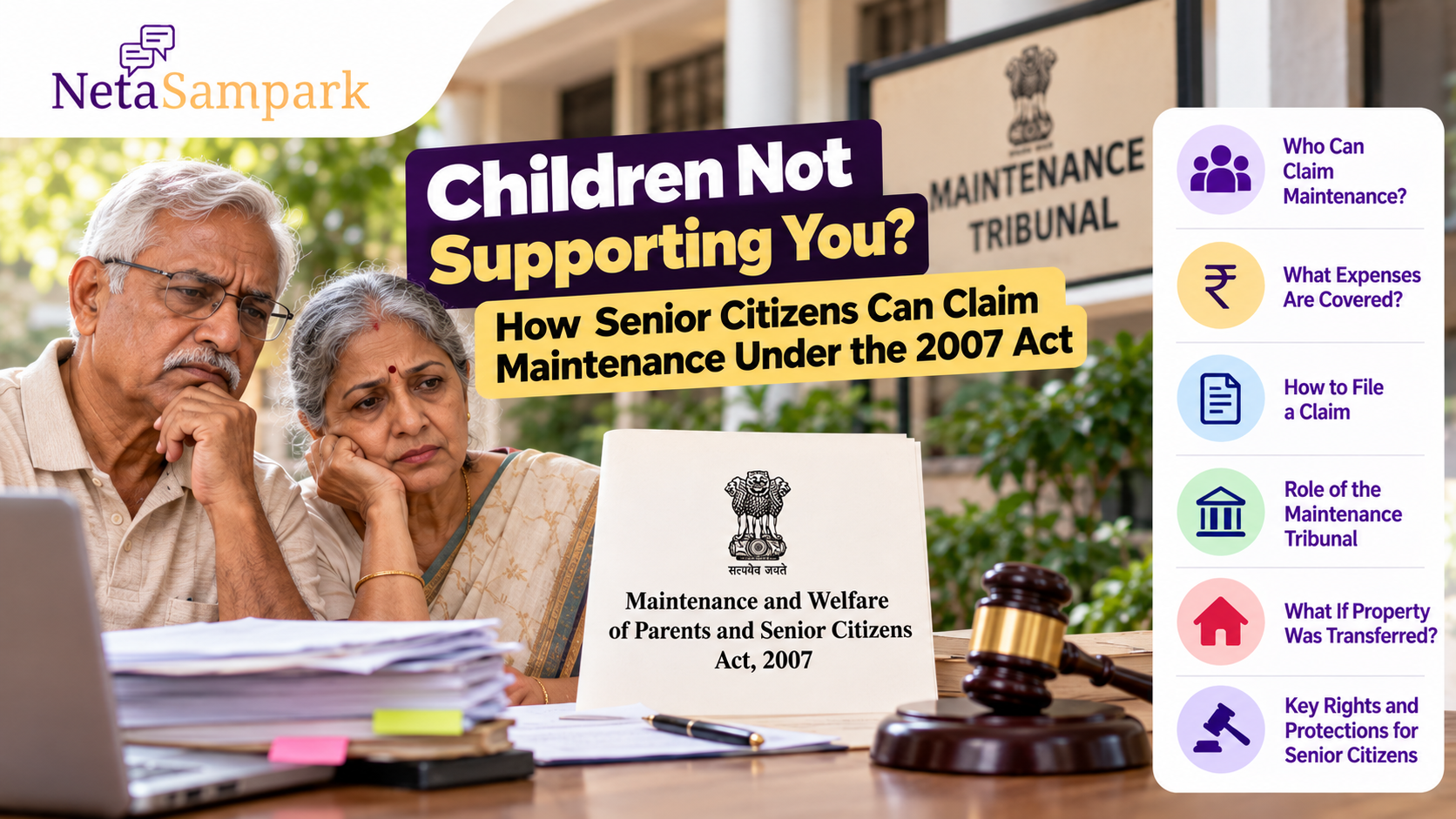
Growing old should not mean being left without food, housing, medical care or basic financial support.
India's Maintenance and Welfare of Parents and Senior Citizens Act, 2007 provides a legal mechanism through which parents and senior citizens who cannot maintain themselves can seek maintenance from their children or, in certain cases, relatives. The Ministry of Social Justice and Empowerment describes the Act as a framework for need-based maintenance and welfare of parents and senior citizens. Social Justice
The law is particularly relevant when a parent is financially dependent, has limited income or property, and their children are neglecting or refusing to provide necessary support.
Here is how the process works.
Who is a senior citizen under the Act?
A senior citizen means an Indian citizen who has attained the age of 60 years or above. The Act also separately recognises a "parent" as a father or mother, including biological, adoptive and step-parents, whether or not they themselves are senior citizens. India Code
This distinction matters.
A parent does not necessarily have to wait until 60 to seek maintenance under the Act if the statutory conditions for a parent are otherwise satisfied.
What does "maintenance" include?
Maintenance is broader than simply receiving a monthly cash payment.
The Act defines maintenance to include:
- Food
- Clothing
- Residence
- Medical attendance and treatment
The purpose is to provide the necessary support for the parent or senior citizen to maintain a normal life. India Code
So a maintenance claim is not necessarily about demanding a particular amount of money. The Tribunal looks at the circumstances and determines the maintenance payable under the Act.
When can a parent claim maintenance from children?Section 4 provides that a parent or senior citizen who is unable to maintain themselves from their own earnings or property can apply for maintenance against one or more of their children who are not minors. India Code
The law covers the parent's need for basic support.
For example, a parent may have:
- No regular income
- A small pension that does not cover living expenses
- Significant medical expenses
- No adequate residential support
- Property that does not generate enough income
The exact circumstances have to be considered by the Maintenance Tribunal.
It is not necessary that all children be included
An application can be made against one or more children.
The Act also provides for other liable persons to be brought into the proceedings where applicable. India Code
What if the senior citizen has no children?The Act also provides protection for a childless senior citizen.
In such cases, maintenance can be claimed against a qualifying "relative" who:
- Has sufficient means, and
- Is in possession of the senior citizen's property or would inherit the property after the senior citizen's death.
Where multiple relatives are liable, the Act provides for maintenance obligations in proportion to the property they would inherit. India Code
This is different from simply saying that every relative of an elderly person automatically has to provide maintenance.
Where do you file the maintenance claim?The claim is made before the Maintenance Tribunal constituted under the Act.
The Act allows the application to be made by:
- The parent or senior citizen
- Another person or organisation authorised by them if they are incapable of making the application themselves
- The Tribunal can also take cognizance on its own in appropriate circumstances. India Code
The exact office, designated authority and filing procedure can vary according to the State's implementation and rules.
So before travelling to an office, check your State Government or district administration's senior-citizen/maintenance tribunal procedure.
What information should you keep ready?There is no single national checklist that fits every State's filing procedure, but a senior citizen should generally keep documents that establish their identity, age, financial circumstances and relationship with the person from whom maintenance is sought.
Useful documents may include:
Personal documents
- Aadhaar or another identity document
- Proof of age/date of birth
- Address proof
- Passport-size photographs, if required
Financial information
- Pension details
- Bank statements
- Income information
- Details of property owned
- Medical expenses
- Regular household expenses
Relationship and family details
- Names and addresses of children
- Proof of relationship, where available
- Details of any financial support previously provided
- Relevant correspondence or messages concerning refusal or neglect
Medical documents
If medical expenses are a major part of the claim, keep:
- Prescriptions
- Hospital bills
- Diagnostic reports
- Treatment estimates
- Insurance information, if applicable
Do not submit original documents unless the authority specifically requires them. Keep copies and retain proof of submission.
Can you ask for interim maintenance?Yes.
While the maintenance proceeding is pending, the Tribunal can order the children or relative to pay an interim monthly allowance to the senior citizen or parent. India Code
This can be important where the applicant is already struggling with everyday expenses and cannot reasonably wait until the final decision.
How much maintenance can the Tribunal order?Under the original central Act, Section 9 states that the Tribunal may order a monthly maintenance allowance at a rate it considers appropriate.
The Act originally provided that the maximum amount prescribed by the State Government could not exceed ₹10,000 per month. India Code
However, readers should be careful with articles that simply state "the maximum maintenance is ₹10,000 everywhere."
The law and subsequent proposed amendments have been the subject of changes and discussion, and State rules also govern implementation. The Department of Social Justice and Empowerment continues to list the 2019 Amendment Bill separately from the existing 2007 Act. Social Justice
Therefore, check the applicable State rules and current Tribunal procedure when filing.
How long can the case take?The Act provides a time-bound framework for deciding maintenance applications.
Under Section 5 of the existing Act, the application is to be disposed of within 90 days from service of notice, with the Tribunal able to extend the period by up to another 30 days in exceptional circumstances, for reasons recorded in writing. India Code
The exact practical timeline can depend on:
- Service of notice
- Appearance of the parties
- Documents
- Evidence
- State-level procedures
- Tribunal workload
So the statutory timeline should not be interpreted as a guarantee that every matter will conclude within exactly 90 days.
Can the Tribunal order maintenance from more than one child?Yes.
An application can be filed against one or more persons liable to maintain the parent.
Where an order is made against more than one person, the Act provides for their continuing liability even if one of them subsequently dies. India Code
The Tribunal will consider the circumstances rather than automatically dividing an amount equally among all children.
What if a child says, "My parent owns a house"?Owning property does not automatically end the issue.
The statutory question includes whether the senior citizen is unable to maintain themselves from their own earnings or property. India Code
For example, owning a house in which the parent lives is not the same as having sufficient regular income to meet food, medical and other living expenses.
The Tribunal considers the circumstances of the case.
What if the parent transferred the house to the child?This is one of the most important protections under the Act.
Section 23 deals with certain property transfers made subject to a condition that the transferee will provide basic amenities and physical needs to the senior citizen.
If the transferee subsequently refuses or fails to provide those basic needs, the Tribunal can, at the option of the senior citizen, declare the transfer void in accordance with the provision. IndiaCode
For example, a parent may have transferred a property to a child with the understanding that the child would provide care and basic support.
If the statutory conditions are satisfied and that support is not provided, Section 23 may become relevant.
Important
Do not assume that every property dispute involving parents and children can automatically be cancelled under Section 23.
The circumstances of the transfer and the conditions attached to it matter.
Property disputes can also involve succession, ownership, registration and other laws, so professional legal advice may be appropriate in complicated cases.
Can an organisation help a senior citizen file?Yes.
If the parent or senior citizen is incapable of making the application personally, the Act permits another person or an authorised organisation to make the application on their behalf. India Code
This can be particularly relevant where an elderly person:
- Has difficulty travelling
- Is seriously ill
- Has mobility limitations
- Cannot manage paperwork
- Needs assistance communicating with authorities
The person assisting should keep written authorisation and copies of all documents submitted.
What happens after you file?A typical maintenance proceeding can involve the following stages:
1. Application
The senior citizen or authorised representative submits the maintenance application to the appropriate Tribunal.
2. Notice
The children or relative against whom the application is filed are given notice.
3. Response and hearing
The parties get an opportunity to present their respective positions.
4. Inquiry
The Tribunal examines the circumstances and determines the maintenance payable.
5. Interim support
Where appropriate, interim maintenance may be ordered while the case is pending.
6. Final order
The Tribunal passes its maintenance order.
7. Payment and enforcement
The order can be enforced under the Act if the amount ordered is not paid. India Code
What if the child does not pay?A maintenance order is not merely a recommendation.
Section 11 provides for enforcement of a maintenance order. The Act states that such an order has the same force and effect as an order under the relevant criminal-procedure maintenance framework and can be executed according to the prescribed procedure. India Code
If payments stop after an order has been passed, the senior citizen should approach the appropriate authority/Tribunal regarding enforcement rather than simply starting the entire process again.
Keep:
- Copy of the maintenance order
- Bank statements
- Payment records
- Details of missed payments
- Any communication concerning non-payment
Yes.
The Act provides for an Appellate Tribunal in each district, constituted by the State Government, to hear appeals against orders of the Maintenance Tribunal. India Code
Section 16 provides a 60-day period for an aggrieved senior citizen or parent to file an appeal, subject to the statutory provisions. India Code
If you are considering an appeal, do not wait until the deadline is close. Check the applicable State procedure and obtain legal assistance where necessary.
Maintenance under this Act is different from a normal family disputeA parent may be reluctant to approach a Tribunal because the matter involves their own children.
But the Act creates a specific legal mechanism for situations where a parent or senior citizen is unable to maintain themselves and their children or qualifying relatives neglect or refuse to provide the required support.
The objective of the law is not simply to settle a family disagreement. It is to address the senior citizen's maintenance and welfare needs. Social Justice
Before filing: prepare a simple one-page recordAn elderly person can make the process easier by preparing a short written summary containing:
My details
- Name
- Age
- Address
- Contact number
My financial position
- Pension/income
- Bank income
- Property
- Monthly expenses
Medical needs
- Existing conditions
- Regular medicines
- Approximate monthly medical expenses
Children/relatives
- Names
- Addresses
- Contact details
- Employment/business information if known
Problem
- What support was requested?
- When was it requested?
- What response was received?
- What expenses are currently unpaid?
Relief requested
- Monthly maintenance
- Medical support, where relevant
- Other applicable relief
Attach supporting documents wherever available.
Don't wait until you have no money leftA maintenance application is intended to address an ongoing need.
If an elderly parent is struggling with food, rent, medical expenses or basic living costs because children or qualifying relatives have stopped providing necessary support, the person should document the situation and approach the appropriate Maintenance Tribunal or seek assistance from a legal-services organisation.
Senior citizens can also approach the Legal Services Authorities in their State or district to ask about available legal aid.
Senior Citizen Maintenance ChecklistStepWhat to do
1Confirm that you fall within the Act's definition of parent/senior citizen
2Document your income and monthly expenses
3Collect medical and other essential bills
4Record the details of children/liable relatives
5Keep evidence of requests for support and refusal/neglect
6Identify the appropriate Maintenance Tribunal
7File the application and keep an acknowledgement
8Ask about interim maintenance if immediate support is needed
9Attend the hearing and provide supporting documents
10Keep the final order and payment records safely
One important point to remember
You do not have to give away your property to your children in exchange for care.
And if property has already been transferred subject to a condition of care and the statutory requirements of Section 23 are met, the Act provides a mechanism through which the Tribunal may address that failure. IndiaCode
The Maintenance and Welfare of Parents and Senior Citizens Act, 2007 remains an important legal route for parents and senior citizens who cannot maintain themselves and are being neglected by children or qualifying relatives. The exact filing office, forms, rules and implementation can differ between States, so citizens should verify the procedure with their State or district authority before filing. India Code