
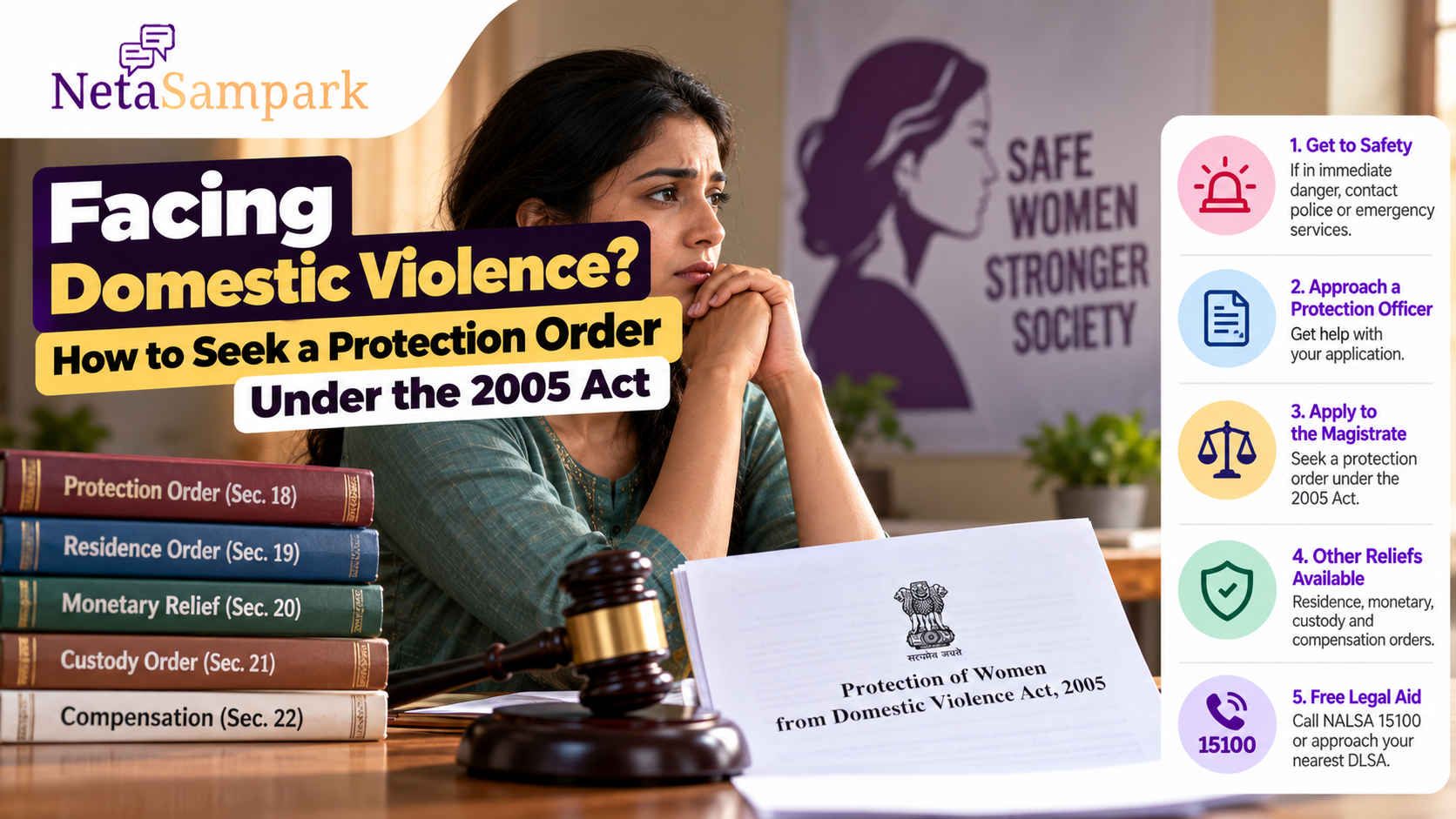
Facing Domestic Violence? How to Seek a Protection Order Under the 2005 Act
Domestic violence is not limited to physical assault. Under India's Protection of Women from Domestic Violence Act, 2005, domestic violence includes physical, sexual, verbal and emotional abuse, as well as certain forms of economic abuse and conduct that threatens a woman's health, safety or well-being. India Code
The Act provides several forms of protection through the Magistrate's Court. A protection order can restrict the respondent from committing violence, contacting the woman, entering her workplace and engaging in other conduct specified by the court. India Code
If you or someone you know is facing immediate danger, contact the local police or emergency services first. The legal process described below is for understanding the remedies available under the Act.
What Is a Protection Order?
A protection order is a court order issued by a Magistrate under Section 18 of the Protection of Women from Domestic Violence Act, 2005.
After hearing the parties and being prima facie satisfied that domestic violence has occurred or is likely to occur, the Magistrate can prohibit the respondent from:
- Committing an act of domestic violence
- Aiding or encouraging domestic violence
- Entering the woman's workplace
- Entering a child's school or another place regularly frequented by the aggrieved person
- Attempting to communicate with her through phone, email, messages or other means
- Dealing with certain jointly held or specified assets without the court's permission
- Causing violence to dependants, relatives or people assisting her
- Carrying out other acts specifically prohibited in the order India Code
The exact restrictions depend on the circumstances of the case and what the Magistrate considers necessary.
What Counts as Domestic Violence?
Section 3 of the Act covers several forms of abuse.
Physical abuse
Examples include:
- Hitting
- Kicking
- Assault
- Use of criminal force
- Other conduct causing bodily pain, harm or danger to health or life
Sexual abuse
The Act includes conduct of a sexual nature that abuses, humiliates, degrades or otherwise violates the dignity of a woman. India Code
Verbal and emotional abuse
This can include:
- Insults
- Humiliation
- Ridicule
- Name-calling
- Repeated threats of physical harm to a person in whom the woman is interested
Economic abuse
The Act also recognises certain forms of economic abuse, including deprivation of financial or economic resources to which the woman is legally entitled or which she requires for necessities. India Code
Therefore, a woman does not have to wait until physical violence occurs before seeking legal protection.
Who Can Seek Relief?
The Act protects an aggrieved person, meaning a woman who is, or has been, in a domestic relationship with the respondent and alleges that she has been subjected to domestic violence.
A domestic relationship can arise when two people:
- Live or have lived together in a shared household
- Are related by consanguinity
- Are related through marriage
- Have a relationship in the nature of marriage
- Are members of a joint family
The Act also recognises the concept of a shared household, which can include a household where the woman lives or has lived in a domestic relationship, subject to the statutory definition. India Code
You Can Seek More Than a Protection Order
A common misunderstanding is that the Domestic Violence Act only provides protection orders.
It does not.
Under the Act, a woman can seek several types of relief.
ReliefWhat it can addressProtection order — Section 18Prevent violence, contact or other prohibited conductResidence order — Section 19Protect residence in the shared household or provide other specified residential reliefMonetary relief — Section 20Financial losses and expenses resulting from domestic violenceCustody order — Section 21Temporary custody of childrenCompensation order — Section 22Compensation for injuries, including mental torture or emotional distressInterim/ex parte order — Section 23Urgent temporary protection while the case is pending
These remedies can be sought together where the circumstances justify them. India Code
Step 1: Record What Is Happening
Before approaching the court, preserve whatever evidence can safely be collected.
Depending on the circumstances, this could include:
- Messages
- Emails
- Call records
- Photographs of injuries or damaged property
- Medical records
- Police complaints
- Bank statements
- Evidence of financial deprivation
- Threatening messages
- Relevant documents
- Names of witnesses
- A dated record of incidents
Do not put yourself at additional risk to obtain evidence.
If someone is monitoring your phone or accounts, consider using a safe device or trusted person's phone when seeking assistance.
Step 2: Approach a Protection Officer
Every state is required to have Protection Officers under the Act.
A Protection Officer can assist an aggrieved person with the legal process, including preparing an application and providing information about available rights and services. The 2006 Rules specifically provide that an aggrieved person can seek the Protection Officer's assistance in preparing and forwarding an application to the Magistrate. IndiaCode by eCourtsIndia
Protection Officers can also coordinate with police and service providers and help connect an affected woman with medical care, shelter and legal assistance where required. WCD Delhi
Step 3: You Can Apply Directly to the Magistrate
You do not have to personally prepare the entire case without assistance.
Under Section 12, an aggrieved woman, a Protection Officer or another person on her behalf can present an application to the Magistrate seeking one or more reliefs under the Act. IndiaCode by eCourtsIndia
The application can therefore request, depending on the circumstances:
- Protection order
- Residence order
- Monetary relief
- Custody order
- Compensation
- Interim or other appropriate relief
The prescribed application format is provided in the Protection of Women from Domestic Violence Rules, 2006. India Code
Step 4: Ask for an Interim or Ex Parte Order If Urgent
You do not necessarily have to wait for the entire case to finish before seeking protection.
Section 23 allows the Magistrate to issue interim orders. Where an application prima facie indicates that domestic violence has occurred, is occurring or is likely to occur, the Magistrate can grant an ex parte order based on the prescribed affidavit. IndiaCode by eCourtsIndia
This can be important where waiting for a full hearing could expose the woman to further violence or intimidation.
The request should clearly explain:
- What has happened
- Why there is an immediate concern
- Whether violence is continuing
- Whether there have been threats
- Whether children or other dependants are at risk
- What specific protection is being requested
What Can an Urgent Protection Order Restrict?
Depending on the facts, the Magistrate can impose restrictions under Section 18 such as prohibiting the respondent from:
Contacting the woman
This can cover personal, oral, written, electronic or telephone communication.
Entering her workplace
The order can restrict entry into the place of employment of the aggrieved person.
Committing further violence
The respondent can be prohibited from committing or aiding domestic violence.
Interfering with specified assets
The order can restrict dealings with certain jointly held or specified assets without the Magistrate's permission.
Threatening people who assist her
The Act allows restrictions relating to violence against dependants, relatives or others assisting the aggrieved person. India Code
The order should be read carefully because its precise restrictions will depend on what the Magistrate actually orders.
What About the Home?
A protection order and a residence order are different remedies.
Section 17 recognises a woman's right to reside in the shared household, regardless of whether she has a title or beneficial interest in it, subject to the Act and applicable judicial orders. The woman cannot simply be evicted or excluded from the shared household except according to law. India Code
Under Section 19, the Magistrate can issue residence-related directions, including restraining dispossession, restricting entry into specified portions of the shared household, preventing disposal or encumbrance of the shared household, or directing alternative accommodation or rent in appropriate circumstances. India Code
So if the immediate problem is being thrown out of the home, tell the Protection Officer or lawyer that you may need a residence order in addition to a protection order.
Can You Ask for Financial Support?
Yes.
Section 20 permits the Magistrate to grant monetary relief for losses and expenses resulting from domestic violence.
Depending on the circumstances, this can address matters such as:
- Loss of earnings
- Medical expenses
- Damage to property
- Maintenance for the woman and children where applicable
- Other financial losses resulting from domestic violence
The exact amount and relief depend on the facts and evidence presented to the court. India Code
What About Children?
If children are involved, the application can also seek a temporary custody order under Section 21.
The Magistrate can make arrangements concerning custody of children during proceedings under the Act, including conditions relating to visitation where appropriate. India Code
If there is a concern that contact with the respondent could harm the child, explain the specific circumstances to the court.
Can You Seek Compensation for Mental Abuse?
Yes.
Section 22 permits the Magistrate to order compensation and damages for injuries, including mental torture and emotional distress, resulting from acts of domestic violence. India Code
This is separate from monetary relief under Section 20.
Where Should the Case Be Filed?
Section 27 provides jurisdiction under the Act.
A Magistrate can have jurisdiction where:
- The aggrieved person permanently or temporarily resides;
- The respondent resides or carries on business or employment; or
- The cause of action arose.
The Act therefore does not necessarily require a woman to return to the place where the abuse originally occurred before seeking relief. India Code
For the correct court in a particular locality, a Protection Officer, DLSA lawyer or local advocate can identify the appropriate Magistrate's Court.
Do You Need a Lawyer?
A lawyer can help, but you should not assume that you must first hire a private lawyer before seeking protection.
Women are eligible for free legal services under the Legal Services Authorities Act. NALSA specifically states that women can approach the nearest legal-services institution for free legal assistance. National Legal Services Authority
You can approach:
- District Legal Services Authority (DLSA)
- Taluk Legal Services Committee (TLSC)
- State Legal Services Authority (SLSA)
- Legal Aid Clinic
- NALSA
The national legal-aid helpline is:
15100
NALSA says the helpline can connect people seeking urgent legal assistance with legal-aid support. National Legal Services Authority
What If You Cannot Afford Legal Help?
A woman is specifically included among the categories entitled to legal services under Section 12 of the Legal Services Authorities Act. National Legal Services Authority
Free legal assistance can include:
- Advice
- Assistance preparing legal documents
- Representation by an advocate
- Court-related assistance
- Certain litigation expenses and process fees, where applicable
You can approach the DLSA at the district court or the appropriate legal-services institution. National Legal Services Authority
What Should You Take With You?
You do not need to wait until you have a perfect file of evidence before seeking help.
Take whatever is safely available.
Personal documents
- Aadhaar or another ID
- Address information
- Marriage-related documents, if available
- Children's documents, if relevant
Evidence
- Photos
- Medical records
- Messages
- Emails
- Call details
- Bank records
- Police complaints
- Previous court orders
- Witness details
Incident information
Write down, if safe:
- Date and approximate time
- What happened
- Who was present
- Any injuries
- Threats made
- Property or financial damage
- Whether children were present
- Whether similar incidents happened previously
A clear chronology can help the Protection Officer or lawyer understand the situation.
What If There Are No Witnesses?
The absence of an eyewitness does not automatically prevent someone from seeking relief.
Domestic violence can occur inside a home without other people being present.
Other evidence may still be relevant, including:
- Messages
- Medical records
- Photographs
- Financial records
- Previous complaints
- Statements
- Other surrounding circumstances
The court will assess the evidence according to the applicable legal procedure.
What If the Respondent Contacts You After the Order?
Read the protection order carefully.
If it prohibits communication or other specified conduct, keep evidence of any alleged breach.
The Protection of Women from Domestic Violence Rules provide that a breach can be reported to the Protection Officer, and the aggrieved person may also report the breach directly to the Magistrate or police. Indian Kanoon
Do not put yourself in danger by confronting the respondent about the alleged breach.
What Happens If a Protection Order Is Violated?
A breach of a protection order or interim protection order is an offence under Section 31.
The Act provides for:
- Imprisonment of up to one year, or
- Fine of up to ₹20,000, or
- Both. IndiaCode by eCourtsIndia
The law also provides that the offence under Section 31 is cognizable and non-bailable. Press Information Bureau
If an order is violated, preserve the evidence and contact the Protection Officer, police or Magistrate as appropriate.
Can Domestic Violence Proceedings Be Kept Private?
The Act permits the Magistrate to conduct proceedings in camera where the circumstances warrant it and either party requests it. India Code
If privacy is a concern, discuss it with the lawyer, Protection Officer or Magistrate.
You Can Seek Other Legal Remedies Too
The Domestic Violence Act does not prevent a woman from using other legal remedies where they apply.
Section 36 expressly states that the Act is in addition to, and not in derogation of, other laws. India Code
A police complaint may therefore be relevant where the conduct also constitutes a separate criminal offence.
A Protection Officer, legal-aid lawyer or advocate can help explain which proceedings may apply to the specific facts.
A Practical Step-by-Step Route
If you are considering a protection order, this is the basic route:
1. Get somewhere safe
If there is immediate danger, contact the police or emergency services and move to a safe location if possible.
2. Preserve evidence safely
Keep messages, medical records, photographs and other relevant documents.
3. Contact a Protection Officer
Ask for assistance under the Domestic Violence Act.
4. Contact legal aid
Call NALSA 15100 or approach the nearest DLSA/TLSC. Women are eligible for free legal aid. National Legal Services Authority
5. Prepare the Section 12 application
The application can request one or more remedies under the Act. IndiaCode by eCourtsIndia
6. Ask for urgent interim protection if necessary
Explain clearly why immediate protection is required and ask about relief under Section 23. IndiaCode by eCourtsIndia
7. Ask for the other reliefs you need
These may include residence, monetary, custody or compensation orders.
8. Keep copies of everything
Save the application, acknowledgement, court orders and evidence.
9. Report any breach
If the protection order is violated, contact the Protection Officer, police or Magistrate promptly. Indian Kanoon
Domestic Violence Protection Checklist
If you are seeking help, keep this checklist:
- Move to a safe place if there is immediate danger
- Contact police/emergency services if necessary
- Preserve evidence safely
- Note dates and incidents
- Contact the Protection Officer
- Approach DLSA/TLSC for free legal aid
- Call 15100 for NALSA legal assistance
- File an application under Section 12
- Ask about a Section 18 protection order
- Ask about an urgent Section 23 interim/ex parte order
- Consider a Section 19 residence order
- Consider monetary relief under Section 20
- Consider child custody under Section 21
- Consider compensation under Section 22
- Keep a copy of every court order
- Report any breach immediately
The Bottom Line
The Protection of Women from Domestic Violence Act, 2005 provides more than one remedy. A woman facing domestic violence can seek a protection order under Section 18, while also asking the Magistrate for residence, monetary, custody or compensation relief where appropriate. India Code
If the situation is urgent, Section 23 allows the Magistrate to consider interim or ex parte protection, so a woman does not necessarily have to wait until the entire case is decided before seeking temporary protection. IndiaCode by eCourtsIndia
If paying for a lawyer is a concern, women are eligible for free legal aid, and NALSA's toll-free helpline is 15100. National Legal Services Authority
This article explains the general legal framework in India and is not a substitute for advice on a specific case. Procedures and local court arrangements can vary, so obtain assistance from the Protection Officer, DLSA or a qualified lawyer for your circumstances.