
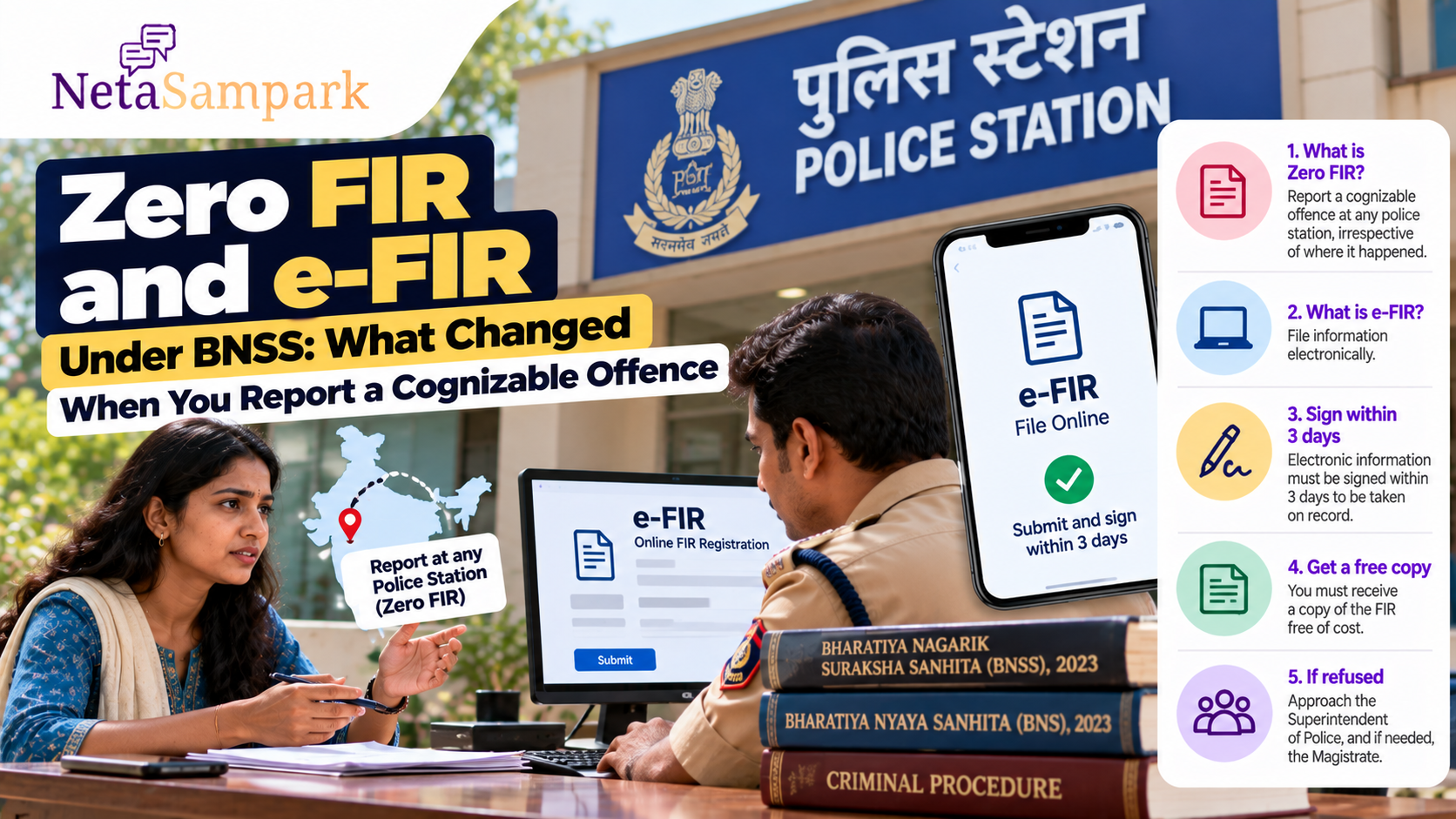
Zero FIR and e-FIR Under BNSS: What Changed When You Report a Cognizable Offence
Reporting a crime does not always mean travelling to the police station where the offence happened.
Under the Bharatiya Nagarik Suraksha Sanhita (BNSS), 2023, which came into force on 1 July 2024, Section 173 expressly allows information about a cognizable offence to be given to the officer in charge of a police station irrespective of the area where the offence was committed. The same provision also recognises information submitted through electronic communication. India Code
These provisions are particularly important for understanding what people commonly call a Zero FIR and an e-FIR.
What Is a Zero FIR?
A Zero FIR is essentially an FIR registered at a police station without waiting for territorial jurisdiction to be settled.
For example, suppose a cognizable offence occurred in Bengaluru, but you are currently in Hyderabad.
You can approach a police station in Hyderabad and provide information about the cognizable offence. Under Section 173(1) of the BNSS, the information can be given irrespective of the area where the offence was committed. India Code
The police station does not have to reject the information simply because the actual offence occurred outside its territorial limits.
The case can subsequently be transferred to the police station having jurisdiction for investigation.
In simple terms
Old practical problem:
"This happened somewhere else. Go to that police station."
BNSS position:
"Information about a cognizable offence can be given at a police station irrespective of where the offence occurred." Ministry of Home Affairs
The Ministry of Home Affairs has specifically described Section 173 as providing for this jurisdiction-neutral reporting of cognizable offences and has referred to it in the context of Zero FIR. Ministry of Home Affairs
What Is an e-FIR?
Section 173(1) of the BNSS also allows information relating to a cognizable offence to be given by electronic communication to the officer in charge of a police station. India Code
This is one of the significant procedural changes under the BNSS.
However, there is an important condition:
You must sign the electronically submitted information within 3 days.
The law says that electronically communicated information is taken on record when it is signed by the person giving it within three days. India Code
The Ministry of Home Affairs reiterated this requirement in August 2026, explaining that an e-FIR or information furnished electronically needs to be signed by the informant within the prescribed three-day period for it to be taken on record. Press Information Bureau
So:
Electronic submission ≠ ignore the signature requirement.
If you submit information electronically, follow the police system's instructions for completing the signature/verification process.
Zero FIR vs e-FIR: They Are Not the Same Thing
These two terms are often used together, but they describe different aspects of reporting.
FeatureZero FIRe-FIR / Electronic communicationMain ideaJurisdiction does not prevent initial reportingInformation can be submitted electronicallyRelevant BNSS provisionSection 173(1)Section 173(1)Where can information be given?Police station irrespective of area where offence occurredTo an officer in charge of a police station through electronic communicationPhysical visit necessarily required initially?Not necessarily; depends on circumstances/processElectronic submission is expressly recognisedSignature requirementWritten information must be signedElectronic information must be signed within 3 daysWhat happens next?Appropriate police process/transfer for investigationPolice take the information on record subject to statutory requirements
The two mechanisms can therefore overlap, but Zero FIR is about territorial jurisdiction, while e-FIR concerns the method of submitting information.
What Is a Cognizable Offence?
These provisions apply to information concerning a cognizable offence.
In general terms, a cognizable offence is one for which the police have the statutory power to arrest without a warrant, subject to the applicable law.
The classification of individual offences is determined by the Bharatiya Nyaya Sanhita (BNS), 2023 and its schedules, as well as other applicable criminal laws.
Not every complaint is a cognizable offence.
If the matter is non-cognizable, a different procedure under Section 174 of the BNSS applies. CyTrain
So the Zero FIR/e-FIR provisions should not be interpreted as meaning that every dispute or complaint automatically becomes an FIR.
What Happens When You Report a Cognizable Offence?
The basic process is:
1. Give the information
You can provide information orally or through electronic communication under Section 173(1). India Code
2. Police record the information
If given orally, the police reduce it to writing and read it over to the informant, who signs it.
If submitted electronically, it must be signed within three days for it to be taken on record. India Code
3. Obtain your copy
Section 173(2) says that a copy of the information as recorded must be provided forthwith and free of cost to the informant or victim. India Code
Keep this copy safely.
4. Investigation follows
Under Section 175, an officer in charge of a police station can investigate a cognizable case without requiring a Magistrate's order, subject to the statutory framework. IndiaCode by eCourtsIndia
5. If another police station has territorial jurisdiction
The matter can be handled according to the applicable jurisdiction and transfer arrangements rather than making the victim start the reporting process again from scratch.
Can You File a Zero FIR at Any Police Station?
Section 173 says information relating to a cognizable offence may be given irrespective of the area where the offence is committed. India Code
For example:
Crime location: Pune
Victim currently located: Delhi
The victim can approach a Delhi police station and provide information concerning the cognizable offence.
The territorial jurisdiction issue can be dealt with through the police process.
Why this matters
This can be especially relevant when:
- The victim has travelled away from the place of occurrence
- The victim is in another state
- The offence occurred during travel
- The exact jurisdiction is initially unclear
- Immediate reporting is important
A victim should not assume that being away from the crime location means they must first travel back before reporting a cognizable offence.
Does a Zero FIR Mean the Investigation Happens Anywhere?
Not necessarily.
The ability to give information irrespective of territorial jurisdiction does not mean every police station automatically becomes the final investigating police station.
Territorial jurisdiction can still matter for investigation and subsequent proceedings.
The important distinction is:
Initial reporting should not be blocked merely because the offence occurred outside that police station's area.
The appropriate police authorities can then deal with the jurisdictional and transfer aspects.
Can You Submit an FIR Through WhatsApp or Email?
This needs some caution.
The BNSS expressly recognises electronic communication, but that does not mean that sending a message to an arbitrary police WhatsApp number automatically completes the entire FIR process.
The relevant police authority and State/UT systems determine how electronic reporting is implemented.
The Ministry of Home Affairs has been working with police organisations on institutionalising e-FIR procedures, including an SOP on Zero FIR & e-FIR. Ministry of Home Affairs
Therefore, if your state police provide an official e-FIR or online complaint facility, use that official channel.
Do not rely on an unverified phone number or social-media account claiming to register FIRs.
The 3-Day Rule for e-FIR Is Important
Suppose you electronically submit information on Monday.
The law requires the information to be signed within three days for it to be taken on record. Press Information Bureau
Therefore:
Submit electronically → Complete the required signature/verification → Keep the acknowledgement.
Don't assume that uploading a complaint and closing the browser completes the entire statutory process.
What Information Should You Include?
When reporting a cognizable offence, provide as much accurate information as you can.
Include:
- Your full name
- Contact details
- Date of the incident
- Approximate time
- Location
- What happened
- Names/details of the accused, if known
- Names of witnesses, if known
- Description of property involved, if relevant
- Injuries suffered
- Threats received
- Documents or digital evidence available
- Vehicle numbers, phone numbers or account details where relevant
Stick to facts that you know.
Do not add information simply because you think it will make the complaint stronger.
Keep Your Evidence Safe
If the offence involves digital communication, preserve the original evidence.
This could include:
- WhatsApp messages
- Emails
- Photographs
- Videos
- Call records
- Transaction records
- Screenshots
- Location information
- Social-media messages
- Documents
- CCTV information
Do not edit or manipulate original files.
If possible, keep copies in more than one secure location.
What If the Police Refuse to Record the Information?
BNSS Section 173(4) provides a specific escalation route.
If the officer in charge of the police station refuses to record the information, the aggrieved person can send the substance of the information in writing and by post to the Superintendent of Police concerned. IndiaCode by eCourtsIndia
If the SP is satisfied that the information discloses a cognizable offence, the SP can:
- Investigate the case personally, or
- Direct a subordinate police officer to investigate. IndiaCode by eCourtsIndia
If that route does not result in registration/investigation, the law provides for approaching the Magistrate.
What Happens If You Need to Approach a Magistrate?
Section 175(3) provides for an application to the Magistrate empowered under Section 210 for an order directing investigation.
There is an important procedural change under the BNSS.
The Supreme Court has noted that the applicant must first approach the Superintendent of Police under Section 173(4) and furnish a copy of that application, supported by an affidavit, when approaching the Magistrate under Section 175(3). The Magistrate can conduct an inquiry if considered necessary and must consider the police officer's submissions before directing investigation. Sci API
Practical escalation route
Police station → Superintendent of Police → Magistrate
Keep copies and proof of each step.
What Is the New Preliminary-Enquiry Rule?
Section 173(3) introduces a specific provision for certain cognizable offences.
Where the alleged offence is punishable with three years or more but less than seven years, the officer in charge may, with prior permission from an officer not below the rank of Deputy Superintendent of Police, conduct a preliminary inquiry to determine whether there is a prima facie case. This inquiry must be completed within 14 days. Alternatively, the police can proceed directly with investigation when a prima facie case exists. India Code
This does not mean that police can routinely conduct a 14-day preliminary inquiry in every cognizable case.
The provision specifically applies to the category of offences carrying the three-year-or-more-but-less-than-seven-year punishment range and requires prior permission from the specified senior officer. Sci API
Does Every FIR Require a Preliminary Inquiry?
No.
The 14-day provision in Section 173(3) is limited to the specified category of cognizable offences.
The statutory provision covers offences punishable with:
3 years or more, but less than 7 years.
It also requires prior permission from an officer not below the rank of Deputy Superintendent of Police. India Code
This is an important distinction because a common misunderstanding is that the BNSS gives police 14 days to decide whether to register every FIR.
It does not.
What About Serious Offences Punishable With 7 Years or More?
Section 173(3)'s specific 14-day preliminary-inquiry mechanism does not cover offences punishable with seven years or more.
The Delhi Police's published training material notes this distinction and explains that the Section 173(3) preliminary inquiry is specifically for offences punishable with three years or more but less than seven years. Delhi Police Training Division
Other legal principles governing registration of cognizable offences continue to apply.
Special Rules for Certain Offences Against Women
Section 173 contains additional safeguards for specified offences against women under the BNS.
Where information concerns the specified offences, it is to be recorded by a woman police officer or woman officer. India Code
The BNSS also provides additional safeguards where the person against whom such an offence is alleged is temporarily or permanently mentally or physically disabled, including recording at the person's residence or another place of choice, in the presence of an interpreter or special educator, with videography and subsequent Magistrate recording as specified by law. India Code
These protections are in addition to the general reporting framework.
Do You Get a Free Copy of the FIR?
Yes.
Section 173(2) provides that a copy of the information as recorded must be given forthwith and free of cost to the informant or victim. India Code
Don't leave the police station without understanding what document you have received.
Keep:
- FIR number
- Police station
- Date
- Sections invoked
- Copy of FIR/information
- Investigating officer's details, where available
If you submitted electronically, save the digital acknowledgement and subsequent communication as well.
Zero FIR Does Not Mean "No Jurisdiction"
This is an important terminology point.
A Zero FIR is commonly understood as an FIR registered without assigning the usual territorial FIR number/jurisdiction at the initial police station, so that the matter can be transferred to the police station with territorial jurisdiction.
The BNSS itself does not create a separate section titled "Zero FIR."
Instead, Section 173 establishes the broader rule that information about a cognizable offence may be given irrespective of the area where the offence occurred. The Ministry of Home Affairs has identified this as the statutory basis relevant to Zero FIR. Ministry of Home Affairs
Zero FIR and e-FIR: A Simple Example
Imagine a person is travelling from Mumbai to Bengaluru.
During the journey, their phone is stolen and they are assaulted.
They reach Bengaluru and want to report the incident.
Zero FIR aspect
They can provide information about the cognizable offence to a police station in Bengaluru even though the incident may have occurred elsewhere, because Section 173 does not make territorial location a prerequisite for giving the information. India Code
e-FIR aspect
If the relevant police system provides electronic reporting, the information can also be submitted electronically, subject to the requirement that the informant sign it within three days. Press Information Bureau
These are two separate conveniences:
Where you report → Zero FIR principle
How you submit → Electronic communication/e-FIR
What You Should Do When Reporting a Cognizable Offence
Use this practical checklist:
At the time of reporting
- Confirm that you are reporting a suspected cognizable offence
- Give the facts clearly and chronologically
- Provide the location, date and time
- Mention accused/witness details if known
- Provide available evidence
- Ask for the FIR/information copy
- Check the FIR number and police-station details
- Save the acknowledgement
If using electronic communication
- Use an official police/government channel
- Complete the required signature within 3 days
- Save the electronic acknowledgement
- Keep copies of submitted documents
If the police station says "wrong jurisdiction"
- Explain that Section 173 covers information about cognizable offences irrespective of the area where the offence occurred
- Request that the information be recorded
- Keep a written record of any refusal
- Escalate to the Superintendent of Police under Section 173(4), if necessary
What Has Actually Changed Under BNSS?
The most important citizen-facing changes can be summarised like this:
IssueBNSS positionTerritorial locationInformation about a cognizable offence can be given irrespective of where the offence occurredElectronic reportingExpressly recognised under Section 173e-FIR signatureElectronic information must be signed within 3 daysCopy of informationMust be provided forthwith and free of cost3–7 year offencesSpecific preliminary-inquiry mechanism, with prior DySP permission and 14-day limitRefusal by police stationWritten approach to SP under Section 173(4)Further refusalMagistrate route under Section 175(3), with additional procedural requirementsCertain offences against womenSpecial recording safeguards
These provisions have been in force since 1 July 2024. Ministry of Home Affairs
One Important Limitation: A Complaint Is Not Automatically an FIR
Submitting information does not mean that every dispute will automatically result in registration of an FIR.
The statutory framework distinguishes between cognizable and non-cognizable offences.
If the facts disclose a non-cognizable offence, Section 174 provides a different process. CyTrain
Similarly, Section 173(3) creates a specific preliminary-inquiry mechanism for the defined category of cognizable offences punishable with three years or more but less than seven years. India Code
So when reporting a crime, focus on providing accurate facts, rather than trying to decide which legal section should be applied yourself.
If You Are the Victim, Keep Your Own Record
Government systems can involve multiple stages, particularly when a Zero FIR is transferred between police jurisdictions.
Keep a simple record containing:
Date of complaint → Police station → FIR number → Sections → Investigating officer → Transfer details → Subsequent communication
Also retain copies of every document you submit.
This becomes particularly useful when the initial reporting police station and investigating police station are different.
The Bottom Line
Under Section 173 of the BNSS, information about a cognizable offence can be given to a police station irrespective of the area where the offence was committed. This is the statutory basis for the jurisdiction-neutral reporting commonly described as a Zero FIR. India Code
The same section expressly permits information to be provided through electronic communication, but an electronically submitted report must be signed within three days for it to be taken on record. Press Information Bureau
If a police station refuses to record information about a cognizable offence, BNSS provides an escalation mechanism through the Superintendent of Police, followed where necessary by an application to the Magistrate under the statutory procedure. IndiaCode by eCourtsIndia
The practical rule for citizens is simple: if you are reporting a cognizable offence, don't assume you must first travel to the place where it happened. Start with the police or official electronic reporting channel available to you, keep the acknowledgement and copy, and use the statutory escalation route if the information is refused.
This article explains the general BNSS framework and is not a substitute for legal advice on a specific case. State police systems and local procedures for electronic reporting can differ, so use the official police/government channel applicable to your location.