If you are following the 2026 Special Intensive Revision (SIR) of electoral rolls, the closing of the claims-and-objections window does not mean the process is over.
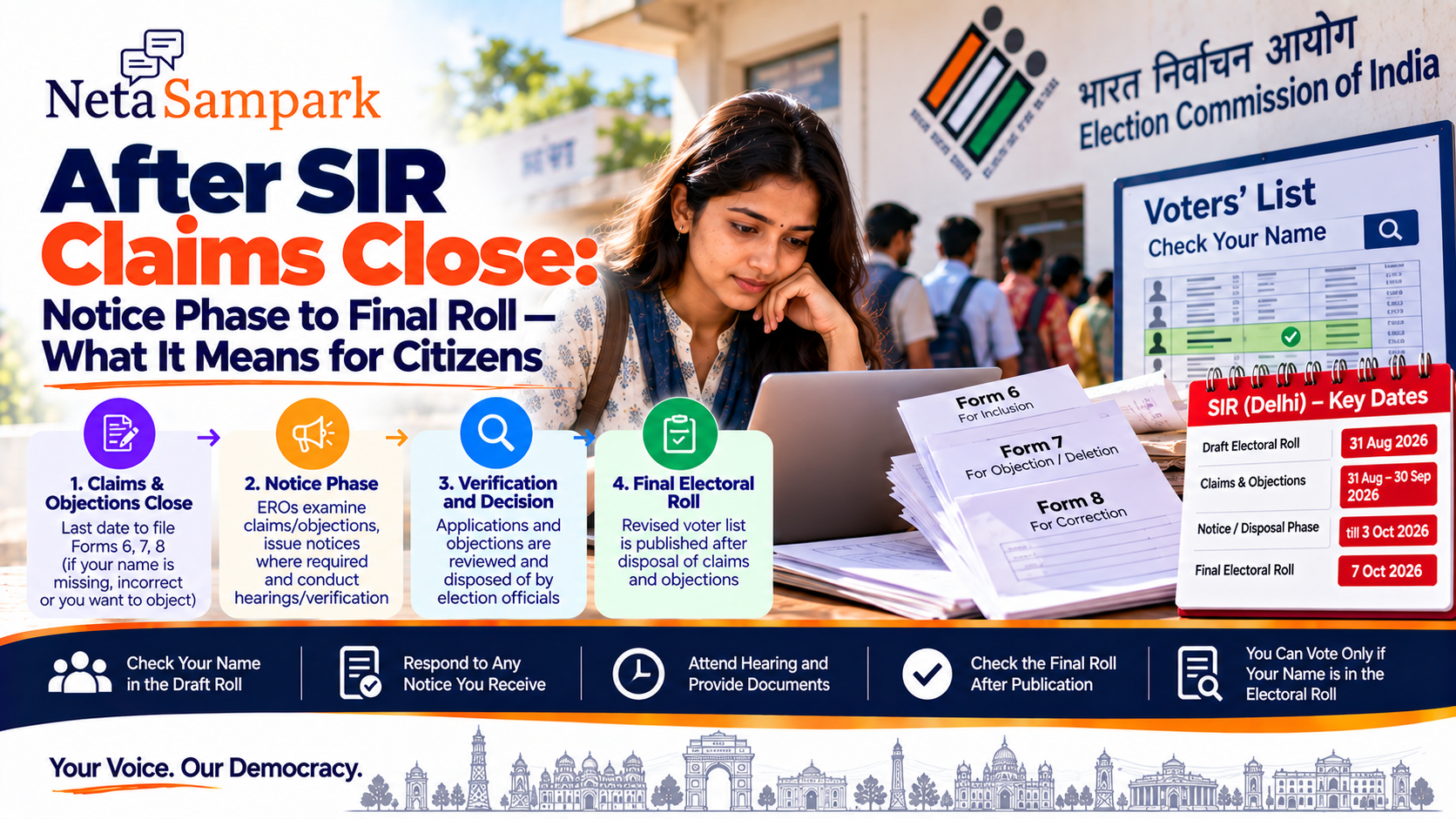
For citizens, the next stage is important: Election Registration Officers (EROs) examine claims and objections, issue notices where required, conduct hearings/verification, and then prepare the final electoral roll.
For Delhi, the draft SIR roll was published on 31 August 2026, and the claims-and-objections period runs until 30 September 2026. The Election Commission's current schedule places the notice/disposal phase through 3 October 2026, with final publication scheduled for 7 October 2026. (Chief Electoral Officer Delhi)
Important: SIR dates are not identical across all states/UTs. The ECI's state-wise schedule should be used for your location. (Election Commission of India)
What happens after claims close?
The process broadly moves like this:
Claims & objections close
↓
ERO examines applications and objections
↓
Notices/hearings where required
↓
Verification and decisions
↓
Final electoral roll
The notice phase is therefore not a second general claims window. It is primarily the stage in which election officials deal with cases requiring verification or a decision.
What is the notice phase?A notice can be issued when the electoral-registration authority needs to give a person an opportunity to respond before deciding an issue concerning an entry.
For example, a person may receive a notice relating to:
- A proposed deletion
- An objection to inclusion
- An unresolved claim
- Verification of eligibility
- Information/documents required to support an entry
The exact reason will depend on the case.
The Delhi CEO website is publishing a list of persons to whom notices have been issued as part of the SIR process. (Chief Electoral Officer Delhi)
A notice does NOT automatically mean deletionThis distinction matters.
Receiving a notice does not by itself mean that your name has been removed from the electoral roll.
It means the election authority is dealing with an issue that requires notice, response, verification or a decision.
If you receive one:
Read the reason → check the deadline → provide the requested response/evidence → attend a hearing if required.
Do not ignore it.
What if your name was already in the draft roll?If your name appears in the SIR draft electoral roll, that is useful, but you should still check the final roll after the revision process is completed.
The ECI's stated objective for SIR is to ensure that eligible citizens are included while ineligible entries are excluded. (Election Commission of India)
The practical citizen action is therefore simple:
Check → respond if contacted → check again after final publication.
What if your name is NOT in the draft roll?For Delhi, the CEO's SIR instructions state that an eligible elector whose name is not found in the draft roll can seek inclusion using Form 6 along with the prescribed declaration during the claims-and-objections period, which runs through 30 September 2026. (Chief Electoral Officer Delhi)
If you have not yet checked the draft roll, do that before the claims deadline.
Don't assume:
"My voter ID exists, so my name must be in the new roll."
The ECI explicitly states that you can vote only if your name appears in the electoral roll. (Election Commission of India)
What if someone objects to your entry?For an objection to an existing entry, Form 7 is the relevant form in the Delhi SIR process. The Delhi CEO lists Form 7 for objecting to a proposed inclusion or seeking deletion of an existing entry. (Chief Electoral Officer Delhi)
If an objection concerns your name, the notice/hearing process is important because it gives the concerned elector an opportunity to respond.
Keep relevant evidence ready and follow the instructions in the notice.
What happens during a hearing?The exact procedure depends on the issue and instructions issued by the ERO.
Generally, the citizen should:
- Read the notice carefully.
- Note the date and place/mode of hearing.
- Identify exactly what is being questioned.
- Carry the requested documents.
- Provide a clear explanation.
- Keep acknowledgement/proof of submission.
Don't submit unrelated documents simply because you have them.
The objective should be to answer the specific issue raised in the notice.
What documents should you keep ready?The required evidence depends on the particular case.
Depending on the issue, you may need information relating to:
- Identity
- Address/residence
- Age/date of birth
- Citizenship/eligibility
- Existing electoral-roll entry
- Previous electoral-roll details
- Family/relative information where relevant
- Documents specifically requested by the ERO
The notice or applicable ECI/CEO instructions should determine what is actually required.
Don't rely on a generic "SIR document list" circulating on WhatsApp.
What if your name appears in an ASDD list?Delhi's CEO website has also published an ASDD list relating to uncollectable forms, including deleted electors and the reason recorded for deletion. (Chief Electoral Officer Delhi)
If you find your name there:
Don't assume the entry is permanently gone without checking the applicable claim/notice process.
Look for:
- Your name
- EPIC details
- Part/serial information
- Reason shown
- Whether a notice has been issued
- Whether a claim can still be filed
Then follow the official process applicable to your case.
What if you receive a notice after submitting a claim?A claim being submitted does not necessarily mean that the application will be accepted automatically.
The ERO may need to:
- Verify information
- Examine supporting material
- Hear an objection
- Resolve conflicting claims
- Make a decision on the entry
So if you receive a notice after filing Form 6, Form 7 or another application, respond to the notice rather than assuming the application is already approved.
Can you still do something after the claims deadline?This depends on what issue you are dealing with and the applicable statutory process.
The important distinction is:
Before the deadline
You can use the designated claims-and-objections process available for the SIR.
During the notice/disposal phase
You may be asked to respond to a notice, provide evidence or attend a hearing.
After final publication
The electoral roll has been finally published, but electoral-roll law continues to provide mechanisms for applications/corrections/deletions depending on the circumstances.
The ECI's voter services include registration, tracking applications and updating electoral-roll details. (Election Commission of India)
So "claims closed" does not mean "no electoral-roll remedy ever exists again."
The most important dates for DelhiFor the current Delhi SIR schedule:
StageDateDraft electoral roll31 Aug 2026Claims & objections31 Aug–30 Sep 2026Notice/disposal phasethrough 3 Oct 2026Final electoral roll7 Oct 2026
The Delhi CEO has separately confirmed the 30 September claims deadline, while the ECI's state-wise schedule specifies 3 October for the notice/disposal phase and 7 October for final publication. (Chief Electoral Officer Delhi)
These dates are for Delhi. Other states/UTs have different SIR schedules.
What should citizens do right now?If you are in a state where the claims window is about to close:
1. Search your name
Use the official electoral-roll search facility.
2. Check the draft roll
Don't rely solely on your physical voter card.
3. Check the ASDD/deletion information where published
Especially if you cannot find your name.
4. If your name is missing
Use the applicable claim/inclusion process before the deadline.
5. If you receive a notice
Respond within the stated timeframe.
6. Save evidence
Keep:
- Application number
- Acknowledgement
- Submitted forms
- Documents
- Notice
- Hearing details
- Decision/response
7. Check the final roll
Do another search after final publication.
Don't wait for election dayThe ECI's voter guidance is straightforward: you can vote only if your name appears in the electoral roll. (Election Commission of India)
Your EPIC/voter card is useful identification, but the electoral-roll entry is what establishes your registration at the polling stage.
So the SIR process is something to check before polling day, not when you reach the booth.
How to search your SIR entryThe ECI's voter-services ecosystem provides facilities to search electoral-roll information, including SIR-related services. (Election Commission of India)
The ECI also provides a dedicated "Search your name in last SIR E-Roll" facility, allowing searches using information such as state, district, Assembly Constituency, polling station and elector details. (Voter Services)
For Delhi, the CEO website provides links to:
- SIR Draft Electoral Roll
- Search Your Name
- ASDD list
- List of persons issued notices (Chief Electoral Officer Delhi)
Think of the process as a decision period.
Draft roll
A working version of the revised electoral roll is published.
↓
Claims & objections
Citizens can seek inclusion, correction or raise objections through the prescribed forms/process.
↓
Notice & verification
Officials examine cases and issue notices/hearings where necessary.
↓
Decisions
Claims and objections are disposed of.
↓
Final roll
The revised electoral roll is published.
This is why the draft roll is not the final roll.
If you are notified, don't ignore itA notice can contain a deadline.
Missing that deadline can affect your ability to respond within that particular proceeding.
If you cannot understand the notice, take it to the relevant BLO/ERO election office or use official voter-support channels for clarification.
Avoid relying on unofficial agents who promise to "fix" your voter record for money.
Citizen checklistBefore claims close
☐ Search your name
☐ Check the SIR draft roll
☐ Check ASDD/deletion information if relevant
☐ Check your EPIC/details
☐ File the appropriate claim or objection if required
☐ Save acknowledgement
During notice phase
☐ Check whether a notice has been issued
☐ Read the reason carefully
☐ Note the response/hearing deadline
☐ Gather only relevant evidence
☐ Attend/respond as instructed
☐ Keep proof of submission
Before the election
☐ Check the final electoral roll
☐ Confirm your polling station
☐ Confirm your electoral-roll entry
☐ Keep your EPIC/approved identification ready
The key takeaway
Claims closing is not the end of SIR.
For citizens, the next phase is about verification, notices, hearings and disposal of claims and objections, followed by publication of the final electoral roll.
For Delhi, the current schedule is:
30 September → claims close
3 October → notice/disposal phase ends
7 October → final electoral roll
(Election Commission of India)
The safest approach is simple:
Check your name now → respond to any notice → keep your acknowledgement → check the final roll.
Official resources
Election Commission of India — Voter Services
Chief Electoral Officer, Delhi
Schedules and procedures vary by state/UT. The Delhi dates above are based on the current ECI/CEO Delhi SIR schedule and should not be applied to another state without checking its official CEO notice.
Related reading
- EPIC vs Electoral Roll: Why Your Voter Card Alone Isn’t Enough to Vote
- SIR 2026 Citizen Timeline: Enumeration, Draft Roll, Claims Window and Final Roll Explained
- Delhi SIR Revised Citizen Schedule: Claims to 30 Sep, Notices to 29 Oct, Final Roll 4 Nov
- EPFO Employees’ Enrolment Campaign 2026: What Left-Out Workers Should Ask Employers Before 31 Oct