
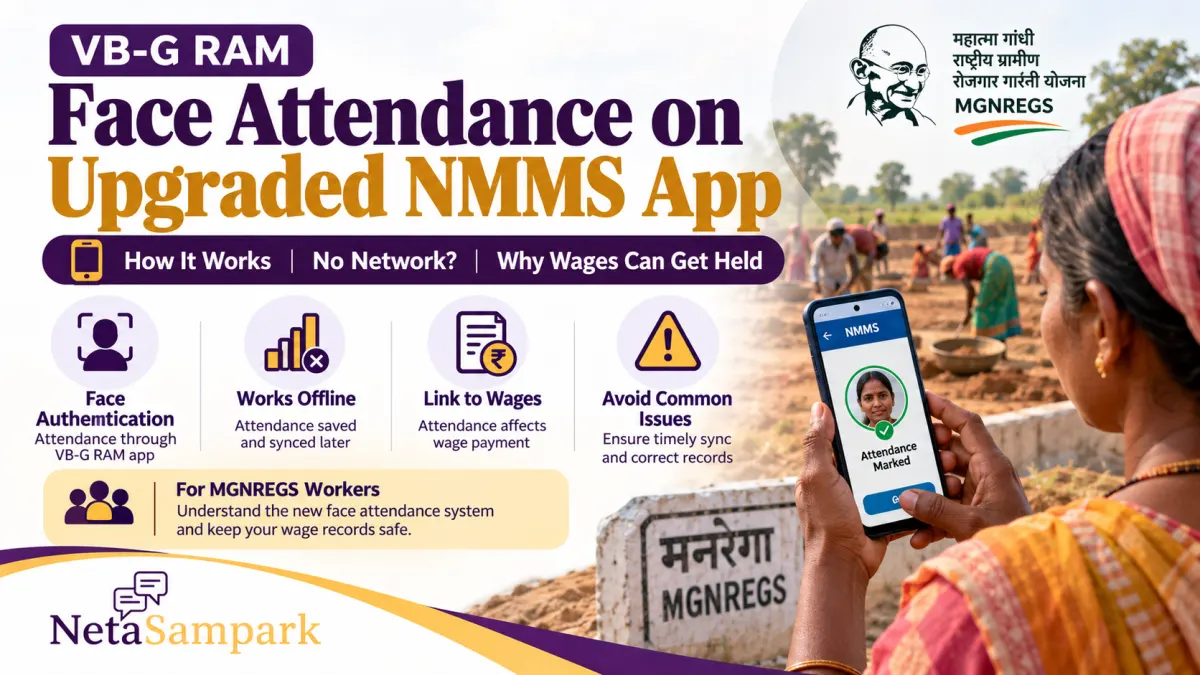
Rural workers registering attendance at government-funded worksites will now use an enhanced version of the National Mobile Monitoring System (NMMS) app under the Viksit Bharat – Guarantee for Rozgar and Ajeevika Mission (Gramin), or VB-G RAM G.
Launched by the Union Ministry of Rural Development on October 23, 2026, the upgraded app introduces stronger device security, improved face verification, safeguards against app tampering and a mechanism for handling genuine attendance failures. The system is designed to reduce impersonation and fraudulent attendance while preserving provisions for workers who face network or technical difficulties.
For workers, mates, Gram Panchayat officials and rural households, three questions matter most: How is face attendance recorded? What happens if the worksite has no mobile network? And why can a wage payment be held even after attendance has been captured?
This guide explains how the system works, what workers should do when something goes wrong and how to raise an attendance or payment grievance.
NMMS app upgrade: Key facts at a glance
| Detail | Information |
|---|---|
| App | National Mobile Monitoring System (NMMS) |
| Latest upgrade announced | October 23, 2026 |
| Programme | VB-G RAM G |
| Technical support | IIT Madras and relevant technical agencies |
| Main attendance method | Face authentication and worksite attendance records |
| Network failure | Offline recording is permitted under the prescribed process |
| Genuine authentication failure | An authorised exception mechanism is available |
| Why wages may be held | Suspicious or repeated photographs, verification issues or other pending checks |
| Wage transfer | Direct Benefit Transfer (DBT) to the worker's bank account |
| Official information | Ministry of Rural Development — PIB |
The app upgrade is intended to strengthen verification, but workers should not be treated as absent simply because a device has a technical problem. The government has stated that offline attendance and an authorised exception process are available for genuine cases.
What is the NMMS app under VB-G RAM G?
The National Mobile Monitoring System app is a government application used to record attendance at eligible rural employment worksites. It captures attendance information alongside photographs, timestamps and geographical information to improve transparency and monitoring.
The system was introduced under the former Mahatma Gandhi National Rural Employment Guarantee Scheme (MGNREGS). The VB-G RAM G Act, 2025 came into force across rural areas from July 1, 2026, replacing the previous legislation under the notified transition. The upgraded NMMS app now supports attendance recording under the new framework.
Under the earlier NMMS arrangement, worksite attendance generally required two time-stamped, geo-tagged photographs each day for covered works, with an exception for individual beneficiary works. The enhanced system adds face authentication and stronger technical safeguards.
The objective is to help establish that the worker is present at the worksite and that attendance records are genuine, rather than allowing attendance to be entered in another person's name.
Official references:
How face attendance works
The face-authentication process is carried out through the official attendance application by an authorised mate or other designated functionary, following the prescribed procedure.
Step 1: The authorised official opens the attendance record
The official accesses the relevant worksite and muster-roll information in the NMMS app. The worker must be correctly listed and available for attendance recording.
Step 2: The worker's face is captured
The app uses the phone's camera to capture the worker's face. The system checks the image against the identity and verification information available to it.
The upgraded version includes liveness detection, designed to distinguish a real person in front of the camera from an old photograph or dummy image. It also incorporates stronger device-level checks and safeguards against cloned or tampered applications.
Step 3: The attendance record is captured
The attendance entry is recorded through the prescribed process. Worksite photographs and related information help establish when and where attendance was captured.
Workers should ask the authorised official to check that their attendance has actually been saved. Seeing the camera open or attempting a face scan is not, by itself, confirmation that a valid record has been registered.
Step 4: Attendance is checked before wages are processed
Attendance is one part of the wage-processing process. Other checks may examine whether photographs are duplicated, whether the recorded work is genuine and whether the amount payable matches the work measured at the site.
This is why a successful face scan and a completed wage payment are two different things.
What happens when there is no mobile network?
Poor connectivity is a practical problem at many rural worksites. The government has specifically provided for offline attendance so that workers are not automatically disadvantaged when a mobile signal is unavailable.
The official position is that attendance can be recorded offline under the prescribed procedure and uploaded once the device reaches an area with network connectivity.
The October 2026 announcement states that offline attendance can be uploaded after the muster roll is closed, following the applicable procedure.
What should the worker do?
If there is no signal at the worksite:
- Report for work as usual. Do not assume that the absence of a mobile signal means your attendance cannot be recorded.
- Ask the authorised mate to use the prescribed offline process. Attendance must still be recorded correctly.
- Confirm that the record has been saved. If possible, ask the mate to verify that the relevant attendance entry is present on the device.
- Allow the official to upload it when connectivity returns. Offline recording does not remove the need for the required upload and subsequent checks.
- Follow up if the record remains missing. Ask the mate or Gram Panchayat to check the attendance report and initiate the prescribed correction or exception procedure if necessary.
Workers should not be expected to personally operate the official attendance system if that responsibility belongs to the authorised worksite functionary.
Does offline attendance mean wages will arrive immediately?
No. Offline attendance is a way to record work when connectivity is unavailable. The record must still be uploaded and pass the required checks before wage processing can be completed.
A delay in uploading may therefore delay later stages of processing, but the absence of a network signal should not automatically be treated as proof that a worker was absent.
What if face authentication fails?
Face authentication can fail for genuine reasons, including technical problems with a phone, difficulty capturing an image or circumstances affecting an older worker or a person with a disability.
The government has said that an authorised exception mechanism is available for such cases. A mate or field-level functionary can submit a request through the prescribed process.
If your face scan repeatedly fails, take these steps:
- Ask the authorised official to retry the capture according to the app's instructions.
- Ensure the camera lens is clean and the face is adequately illuminated.
- Follow any instructions shown by the official application.
- If the problem persists, ask the mate or field official to initiate the applicable exception process.
- Request that the issue be recorded and escalated to the appropriate Panchayat or block-level authority.
Do not assume that repeated failure means you have lost your right to be considered for wages. The exception mechanism exists to address genuine difficulties, although the relevant officials must follow the prescribed process.
Why can wages be held even after attendance is marked?
This is the central issue for workers who see their attendance recorded but do not receive their wages on time.
The Ministry of Rural Development has explained that attendance alone does not automatically trigger payment. The system includes several checks intended to confirm that the attendance and the work claimed are genuine.
1. Duplicate or suspicious photographs
The upgraded system includes an AI-based photo de-duplication module that looks for suspicious or repeated photographs.
If the system detects entries requiring investigation, the wage list and Fund Transfer Order (FTO) can be automatically withheld until the necessary checks are completed.
This is a safeguard against fraudulent entries, but it also means that a genuine worker may need the relevant officials to investigate a flagged record before payment can proceed.
2. Attendance has not been uploaded correctly
If attendance was recorded offline but was not uploaded successfully, the central system may not yet show a complete record.
The worker should ask the mate or Gram Panchayat to check the relevant attendance report and confirm whether the record was uploaded. If it is missing, the officials should follow the authorised process for correcting or resolving the problem.
3. Face verification remains unresolved
A failed or incomplete verification may require a retry or an authorised exception request. Workers facing genuine authentication difficulties should ask the mate or field official to document the issue and follow the prescribed procedure.
4. The work measurement is still pending
The electronic Measurement Book (e-MB) records the actual work performed, as physically measured by the designated technical personnel.
The amount payable is determined using the applicable measurement and wage rules. Therefore, even where attendance has been captured, a pending measurement or a discrepancy in the recorded work may affect the timing or amount of payment.
5. Other payment-processing checks are pending
After attendance and work records are verified, wage processing must proceed through the applicable administrative and financial systems. A pending FTO or other unresolved verification issue can delay the credit to the worker's bank account.
Important distinction: A payment hold does not automatically mean that a worker has committed fraud. It can indicate that a record needs verification. Workers should ask what specific issue is pending and how it can be resolved.
Official reference: Ministry of Rural Development's announcement on NMMS security, offline attendance and wage checks.
How can workers check a missing attendance entry?
If you worked on a particular day but your attendance is missing, report the problem promptly rather than waiting until several wage cycles have passed.
What to ask the mate or Gram Panchayat
Ask the responsible official to confirm:
- Whether your name appears on the relevant muster roll.
- Whether attendance was captured for the date in question.
- Whether the entry was saved and uploaded.
- Whether a face-authentication or technical exception is pending.
- Whether the attendance report shows a discrepancy requiring correction.
The Ministry has previously stated that attendance can be checked through the relevant daily attendance reports. The exact interface may change as the system is upgraded.
If the mate cannot resolve the issue, approach the Gram Panchayat or the designated block-level programme authority. Keep the date of work, worksite details and any acknowledgement or complaint reference available.
How to follow up when wages are delayed
If attendance appears correct but wages have not reached your bank account, ask the responsible officials to identify the stage at which the payment is pending.
A useful follow-up sequence is:
First: Check the attendance record. Confirm that your attendance is present for the relevant date or dates.
Second: Ask whether the work measurement is complete. A pending e-MB or discrepancy in measured work may affect the amount payable.
Third: Ask about the wage list and FTO. Find out whether the wage list has been generated and whether the Fund Transfer Order is pending, withheld for verification or processed.
Fourth: Check your bank account. If the payment has been processed, ask the relevant authority for the transaction details and check with your bank if necessary.
Fifth: Escalate unresolved complaints. Approach the Gram Panchayat, block-level programme officer or district programme authority, as appropriate. Ask for a complaint or acknowledgement number and keep a record of the response.
For official programme information, start with the Ministry of Rural Development's PIB announcements and the relevant state or district rural development authority. Use the grievance channels notified for your area.
What are workers' wage-payment rights under VB-G RAM G?
The VB-G RAM G framework provides for wage employment and time-bound wage payment, subject to the applicable rules and processing requirements.
The government's published FAQ states that wages should be paid weekly or, in any case, no later than a fortnight after closure of the muster roll. It also states that wage seekers are entitled to delay compensation at 0.05% of unpaid wages per day if payment is not made within 15 days from the closure of the muster roll.
Workers should keep the relevant dates and records if a payment is delayed. The applicable entitlement and procedure should be checked against the current rules and the facts of the case.
A digital attendance issue should be reported and resolved through the prescribed process; workers should not simply be told to wait indefinitely without an explanation of what is pending.
Official reference: VB-G RAM G Act — Government FAQ.
What should mates and Panchayat officials do to avoid attendance problems?
The system depends on correct attendance capture and timely resolution of genuine exceptions. Worksite functionaries can reduce avoidable problems by:
- Checking that the correct muster roll and worker details are available.
- Using the official app and an authorised device.
- Capturing attendance according to the prescribed process.
- Recording attendance offline where the official procedure permits it.
- Uploading saved records when connectivity becomes available.
- Reporting repeated authentication failures or device problems promptly.
- Following the authorised exception process rather than marking a genuine worker absent solely because of a technical failure.
- Checking attendance reports and responding to discrepancies before they become payment disputes.
Officials should also explain to workers whether an issue concerns attendance, verification, measurement or the payment stage. These are different problems and may require different remedies.
Frequently asked questions
1. Is face attendance compulsory under VB-G RAM G?
Face-authentication-based attendance is part of the framework announced by the Ministry. The applicable procedure and any authorised exceptions must be followed for the relevant worksite and category of work.
2. Can attendance be marked without internet access?
Yes. The official guidance permits attendance to be captured offline under the prescribed process and uploaded once the device reaches an area with connectivity.
3. Will wages be cancelled if the network is down?
A lack of network connectivity does not, by itself, establish that a worker was absent. Offline attendance and an authorised exception mechanism are available for genuine cases. The attendance record must still be properly saved, uploaded or resolved through the prescribed procedure.
4. Why does the app say attendance is marked but wages are not credited?
Attendance is only one stage of the process. Duplicate-photo checks, work measurement, wage-list generation, FTO processing and other verification steps can affect payment timing.
5. What happens if the face scan does not work for an elderly worker or a person with a disability?
The government has announced an authorised exception mechanism for genuine authentication difficulties, including those involving elderly workers and persons with disabilities. Ask the mate or field official to initiate the prescribed process.
6. What is an FTO?
FTO stands for Fund Transfer Order. It is part of the wage-payment process through which the approved payment instruction is processed for transfer to workers' bank accounts.
7. Can a duplicate-photo alert delay wages?
Yes. The Ministry says that when the system detects suspicious or repeated photographs, the wage list and FTO can be withheld until the required checks are completed. A flag should be investigated; it does not, by itself, prove that every affected worker has acted improperly.
8. How many days can wage payment take?
The government's published VB-G RAM G FAQ states that wages should be paid weekly or no later than a fortnight after the muster roll closes. It also describes delay compensation for payments not made within 15 days, subject to the applicable rules.
9. Where should I complain if my attendance is missing?
Start with the mate and Gram Panchayat, then approach the designated block-level or district programme authority if the issue remains unresolved. Keep the work date, muster-roll details and complaint acknowledgement where available.
Final takeaway
The upgraded NMMS app under VB-G RAM G adds stronger face verification and security checks to digital attendance at rural employment worksites. It is intended to reduce impersonation and fraudulent records while supporting genuine workers who face connectivity or authentication problems.
For workers, the most important points are straightforward:
- Attendance can be recorded offline under the prescribed procedure when the network is unavailable.
- Genuine face-authentication or device failures can be referred through the authorised exception mechanism.
- Attendance being marked does not automatically mean that wages have been released.
- Suspicious-photo checks, pending work measurement or other verification steps can hold the wage list or FTO.
- Workers should ask officials to identify the exact issue and follow it through the Gram Panchayat or the appropriate block or district authority.
Technology can strengthen accountability only when genuine attendance is recorded correctly and technical problems are resolved promptly. Workers should understand how to check their records, ask for a clear explanation of payment delays and use the official grievance process when an issue remains unresolved.
Official sources
- Ministry of Rural Development: Upgraded NMMS app announcement, October 23, 2026
- Government FAQ: VB-G RAM G Act, 2025
- PIB: NMMS attendance, offline recording and exception arrangements
Disclaimer: This article is for general information. Attendance procedures, exceptions, grievance routes and wage-payment rules must be applied according to the latest official instructions and the circumstances of each case.