
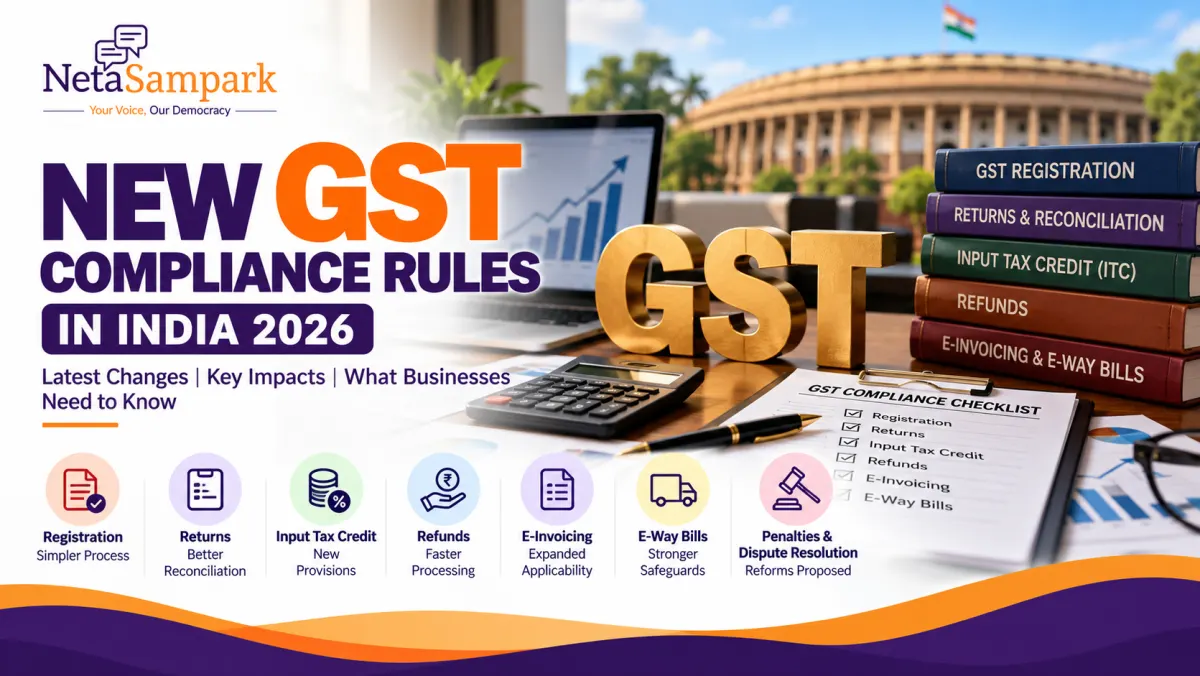
New GST Compliance Rules in India 2026: Latest Changes, ITC, Returns and Refunds
GST Compliance Update 2026 | 57th GST Council Meeting | What Businesses Need to Know
India’s Goods and Services Tax (GST) framework is moving towards simpler registration processes, better return reconciliation, faster refunds and more structured enforcement. The latest major development is the 57th GST Council meeting, held on 8 October 2026, which recommended a series of changes affecting businesses, taxpayers, exporters, e-commerce sellers and tax professionals.
The proposals cover GST registration, input tax credit (ITC), GSTR-3B reconciliation, refunds, e-invoicing, e-way bills, penalties and dispute resolution.
For business owners, the key question is not simply what the government has announced, but which changes are already operational, which are awaiting legal amendments, and what needs to be done to prepare.
This guide explains the latest GST compliance developments as of 25 October 2026.
What Are the Latest GST Compliance Updates in 2026?
The 57th GST Council meeting recommended reforms in several areas.
| Compliance area | Latest development |
|---|---|
| GST registration | Clearer documentation requirements and a simplified application process |
| Registration amendments | Wider use of automatic acceptance of registration changes |
| GST returns | Improved reconciliation between GSTR-1, GSTR-1A and GSTR-3B |
| Input tax credit | Proposed changes to ITC restrictions and refund eligibility |
| GST refunds | Greater automation and faster processing |
| E-invoicing | Proposed extension to certain reverse-charge transactions and imports of services for eligible taxpayers |
| E-way bills | Proposed safeguards around interception and detention of goods |
| Penalties and prosecution | Proposed changes to certain enforcement thresholds and penalties |
| Small businesses | Simplified GST registration proposal for eligible e-commerce sellers |
Important: These are not all changes that businesses can apply immediately. The Council’s recommendations must be read alongside subsequent notifications, statutory amendments, GST portal advisories and applicable effective dates.
Official reference: 57th GST Council meeting — Ministry of Finance.
1 GST Registration: A Simpler Application Process
One of the major proposals concerns making GST registration more predictable and reducing avoidable queries from tax officers.
The GST Council recommended improvements to the registration application and supporting guidance.
What is proposed?
The proposed changes include:
- A comprehensive circular explaining the documents and information required for GST registration.
- Frequently asked questions to clarify common application issues.
- Changes to Form GST REG-01, including structured document-selection options.
- A more user-friendly GST portal with clearer navigation, drop-down lists and contextual guidance.
The objective is to reduce application errors, avoid unnecessary clarification requests and make registration processing more transparent.
Automatic acceptance of registration amendments
The Council also recommended changes to the procedure for amending GST registration details.
Under the proposal, amendments to registration particulars would generally be accepted automatically through the portal, except changes relating to the principal place of business. For taxpayers registered through the specified Rule 14A route, the proposal provides for automatic acceptance of all registration amendments, including principal-place-of-business changes.
The final scope depends on the amendments brought into force.
What businesses should do
Businesses should keep their registration details accurate and ensure that their legal name, business address, bank account, authorised signatories and other particulars are supported by the relevant records.
Do not assume that every amendment is already eligible for automatic approval; check the current portal workflow and applicable rules before submitting an application.
2 GST Registration for Small E-Commerce Sellers
Small sellers using online marketplaces could benefit from another proposed change.
The Council recommended a simplified registration mechanism for eligible suppliers of goods selling through electronic commerce operators in states or Union Territories where they do not have a physical place of business.
The proposal involves declaring the e-commerce operator’s warehouse in the relevant state or Union Territory as the seller’s principal place of business, subject to specified conditions.
Who could benefit?
The proposal is intended for qualifying small sellers who want to expand their sales across state borders without establishing a conventional physical business location in every state.
Eligibility conditions, including the prescribed input tax credit limit and other requirements, will matter.
What sellers should do
Online sellers should continue to check their registration obligations under the existing GST framework. Before relying on the simplified route, confirm whether the relevant rule and portal functionality have been formally implemented and whether the business meets all eligibility conditions.
3 GST Returns: Better Reconciliation Between GSTR-1 and GSTR-3B
Return reconciliation remains one of the most important compliance areas for GST-registered businesses.
The GST Council recommended changes designed to improve consistency between outward-supply statements, tax liability and input tax credit reported in GST returns.
The proposals cover GSTR-1, GSTR-1A, the Invoice Furnishing Facility (IFF), GSTR-3B, the Invoice Management System (IMS) and electronic statements relating to reverse-charge tax and ITC.
What is proposed?
The recommended measures include:
- Improving the reconciliation of GSTR-1, GSTR-1A and IFF with GSTR-3B.
- Introducing an electronic statement for tax paid under reverse charge and ITC claimed.
- Improving the reporting of liability adjustments in GSTR-3B.
- Updating Form GST DRC-03 to capture details of the invoices against which payment has been made.
- Improving the reporting of ITC reversals and subsequent reclaims through an electronic statement.
The Council also recommended an alternative mechanism for correcting certain liability and ITC mismatches, proposed to take effect from the April 2027 return period, subject to the required implementation steps.
Why this matters
Differences between sales invoices, outward-supply statements and tax-payment returns can lead to reconciliation problems, system-generated intimations or disputes.
A more structured system could help businesses identify discrepancies earlier, but it will also make accurate records and timely reconciliation increasingly important.
GST return compliance checklist
Businesses should regularly:
- Reconcile sales invoices with GSTR-1 and GSTR-1A, where applicable.
- Match the tax liability reported in GSTR-3B with the underlying records.
- Review purchase records and supplier invoices before claiming ITC.
- Track ITC reversals and reclaims separately.
- Maintain documentation for reverse-charge transactions.
- Investigate mismatches instead of carrying them forward without explanation.
Businesses should not wait for the proposed April 2027 changes to strengthen their current return-reconciliation processes.
4 Input Tax Credit: Proposed Changes to Restrictions and Refunds
Input tax credit is one of the most significant areas covered by the latest recommendations.
The Council recommended changes intended to improve the flow of eligible ITC and broaden refund eligibility in specified circumstances.
Proposed changes affecting certain expenses
The recommendations include changes to restrictions affecting certain categories, including:
- Outdoor catering.
- Health and life insurance.
- Telecommunication towers.
- Pipelines outside factory premises.
- Free samples.
- Goods destroyed or written off after their shelf life expires, where relevant legal requirements apply.
These proposals do not mean that businesses can automatically claim ITC on every expense in these categories. The precise statutory amendments, conditions and effective dates must be checked before changing an ITC position.
Refund of ITC on input services
The Council recommended allowing refunds of accumulated ITC on input services in specified inverted-duty-structure cases.
The proposed availability date is 1 November 2026, subject to the required amendments and applicable conditions.
An inverted duty structure can arise where the tax rate on inputs is higher than the rate applicable to outward supplies, leading to accumulated ITC.
Refund of ITC on capital goods
The Council also recommended extending refund eligibility for accumulated ITC on capital goods in specified zero-rated-supply and inverted-duty-structure cases.
The proposed availability date is 1 April 2027. The recommendations provide for capital-goods ITC refunds to be spread over 60 months.
Businesses with significant capital expenditure or accumulated ITC should review their tax positions with their advisers before relying on the proposed refund mechanism.
5 GST Refunds: More Automation and Faster Processing
Refund processing is another area where the Council recommended reforms.
The proposed framework aims to reduce manual intervention, make processing more predictable and improve working capital availability for businesses.
Phase 1: Proposed refund measures
The recommendations include:
- Automatic sanction of eligible refunds relating to excess balances in the electronic cash ledger.
- Reducing the acknowledgement or deficiency-memo period from 15 days to 10 days.
- Providing for deemed acknowledgement where the required response is not issued within the prescribed period.
- Provisional automatic sanction of 90% of eligible claims relating to zero-rated supplies and inverted duty structure, based on system risk assessment.
Phase 2: Proposed measures
The second phase includes system-based acknowledgement following verification and automatic sanction of eligible full refunds relating to zero-rated supplies, after adjusting pending dues and applying the prescribed risk-assessment process.
These are proposed process reforms, not a guarantee that every refund will be approved automatically or within a fixed period.
What businesses should prepare
Businesses seeking refunds should maintain:
- Accurate invoices and supporting records.
- Export and other zero-rated-supply documentation, where applicable.
- Correct ITC calculations and reconciliations.
- Evidence supporting the refund category and amount.
- Records of pending dues and previous refund claims.
Automated processing can reduce delays, but incomplete documentation or inconsistencies can still affect a claim.
6 E-Invoicing: Proposed Extension to Additional Transactions
The Council recommended extending e-invoicing requirements to certain additional transaction categories.
The proposal covers domestic supplies received from unregistered persons where tax is payable under the reverse-charge mechanism, as well as imports of services, for taxpayers with aggregate annual turnover of ₹5 crore or more.
The precise scope and implementation depend on the applicable legal provisions and notifications.
What businesses should do
Businesses potentially affected by this proposal should:
- Identify transactions involving reverse charge.
- Review purchases from unregistered suppliers.
- Identify imports of services.
- Check their aggregate annual turnover.
- Assess whether their accounting and invoicing systems can capture the required invoice details.
- Monitor official GSTN advisories and implementation dates.
Do not assume that every reverse-charge transaction or every import of services already requires a new e-invoice under this recommendation. Confirm the operative rules for the transaction concerned.
7 E-Way Bills: Proposed Changes to Goods Interception
The Council recommended measures intended to reduce unnecessary disruption to the movement of goods across states.
The proposals include safeguards relating to the interception of vehicles carrying goods, authorisation requirements and the circumstances in which inspection or detention may take place.
The recommendations also address the treatment of goods and conveyances in transit under the relevant statutory provisions.
What transporters and businesses should do
Businesses moving goods should continue to ensure that:
- E-way bills are generated wherever required.
- Tax invoices or other prescribed documents accompany the goods.
- Vehicle and consignment details are accurate.
- The origin, destination and transport information are consistent.
- Required records are available during transit.
The proposed safeguards should not be treated as permission to transport goods without the prescribed documents.
8 Penalties, Prosecution and GST Enforcement
The 57th GST Council meeting recommended changes to certain enforcement provisions.
Among the proposals highlighted by the government were:
- Raising the prosecution threshold from ₹1 crore to ₹5 crore.
- Reducing the general penalty referred to in the recommendations from ₹25,000 to ₹10,000.
- Removing arrest provisions under GST.
- Standardising aspects of notices, adjudication and appeal proceedings.
The Council also recommended reforms relating to the GST Appellate Tribunal and other dispute-resolution processes.
Does this mean GST non-compliance is no longer a serious risk?
No. These are recommendations concerning specified enforcement provisions, not a general exemption from GST obligations.
Businesses must continue to comply with applicable registration, invoicing, return-filing, tax-payment and record-keeping requirements. The legal consequences of a particular default depend on the provisions in force, the nature of the contravention and the facts of the case.
Before relying on a proposed change to prosecution or penalties, confirm whether the relevant statutory amendment or notification has taken effect.
9 GST Compliance for Exporters and Businesses with Zero-Rated Supplies
Exporters and other businesses making zero-rated supplies may be affected by the proposed refund reforms and related changes.
Zero-rated supplies include exports of goods or services and qualifying supplies to Special Economic Zone developers or units, subject to the applicable law.
The Council recommended changes to refund procedures and eligibility, including specified refunds of accumulated ITC on capital goods and proposed changes to certain export-related provisions.
Practical steps for exporters
Exporters should review:
- The accuracy of export invoices and shipping or service-export documentation.
- Reconciliation between returns and refund applications.
- The eligibility of ITC included in refund calculations.
- Compliance with the applicable zero-rated-supply procedure.
- Any new notifications affecting refund claims or export transactions.
The expanded refund recommendations have specific conditions and proposed effective dates. Businesses should not amend existing refund calculations solely on the basis of the Council’s announcement.
10 GST Annual Returns for FY 2025–26
Another practical compliance development reported in October 2026 is the availability of GSTR-9 and GSTR-9C for FY 2025–26 on the GST portal.
GSTR-9 is the annual return for taxpayers required to file it. GSTR-9C is the reconciliation statement applicable to taxpayers meeting the prescribed turnover criteria.
Businesses should confirm whether they are required to file these forms and verify the applicable due date and any subsequent extensions through official GST portal communications.
Annual return preparation checklist
Before filing, businesses should review:
- Turnover reported in books and GST returns.
- Tax liability and tax-payment reconciliations.
- ITC claimed, reversed and reclaimed.
- Credit notes and debit notes.
- Amendments to previously reported transactions.
- Differences between financial statements and GST returns.
- Any outstanding notices or unresolved mismatches.
Annual return preparation should begin with reconciliations rather than waiting until the filing deadline approaches.
Reference: GST portal and taxpayer advisories.
11 A Practical GST Compliance Checklist for Businesses
The latest recommendations are a useful reason for businesses to review their compliance systems.
| Area | Action to take |
|---|---|
| Registration | Verify GST registration particulars and supporting documents |
| Sales | Reconcile invoices with GSTR-1 and related statements |
| Tax payment | Match GSTR-3B with books and tax-liability records |
| ITC | Review invoice eligibility, reversals and reclaims |
| Reverse charge | Maintain transaction-wise records and evidence of tax payment |
| E-invoicing | Check current applicability and monitor proposed extensions |
| E-way bills | Verify invoice, vehicle and consignment details |
| Refunds | Reconcile claims and retain supporting documents |
| Annual returns | Prepare GSTR-9/GSTR-9C reconciliations, where applicable |
| Regulatory updates | Track CBIC notifications, GST Council announcements and GSTN advisories |
12 Where to Check Official GST Updates
Businesses should use official government sources to verify whether a recommendation has become an enforceable requirement.
- GST Council: Official updates and meeting recommendations
- Ministry of Finance / PIB: 57th GST Council meeting announcement
- GST portal: GST System advisories and updates
- CBIC: Central Board of Indirect Taxes and Customs
For an individual compliance question, check the relevant notification, circular, rule, statutory amendment or portal advisory rather than relying only on a news headline.
Frequently Asked Questions
What are the latest GST compliance changes in India in 2026?
The 57th GST Council meeting on 8 October 2026 recommended reforms involving GST registration, return reconciliation, ITC, refunds, e-invoicing, e-way bills and enforcement. The effective date and legal status vary by proposal.
Have all the recommendations from the 57th GST Council meeting become rules?
No. A Council recommendation does not automatically become an operative legal requirement. Businesses must check whether the necessary statutory amendment, notification or implementation instruction has been issued.
What changes are proposed for GST input tax credit?
The recommendations include changes affecting specified expense categories and expanded refund eligibility for accumulated ITC in certain cases. The precise eligibility and effective dates depend on the final legal provisions.
Is GST e-invoicing being expanded in 2026?
The Council recommended extending e-invoicing to specified domestic supplies received from unregistered persons where reverse-charge tax applies, and to imports of services for taxpayers with aggregate annual turnover of ₹5 crore or more. Businesses should verify the final scope and implementation date before acting.
What should small businesses do now?
Small businesses should maintain accurate invoices, reconcile returns, review ITC, file required returns on time and monitor official announcements. Eligible e-commerce sellers should check the implementation status and conditions of the proposed simplified registration mechanism.
Where can businesses find the official GST rules?
The GST Council website, CBIC website, Ministry of Finance announcements and GST portal advisories are the primary places to verify the applicable requirements.
Conclusion
The latest GST compliance recommendations signal a continued effort to make registration, returns, refunds and dispute resolution more structured and technology-driven.
For businesses, the practical priorities remain accurate documentation, regular return reconciliation, careful ITC review and timely tax payments. The proposed changes could reduce certain administrative burdens and improve refund processing, but the benefits will depend on implementation and the conditions set out in the final legal framework.
The most important step is to distinguish between an announced recommendation and a rule that is legally in force. Businesses should use official notifications and GST portal updates to confirm what applies to their transactions before changing their compliance practices.
This article is for general information and is not a substitute for professional tax advice. GST applicability depends on the relevant law, notifications, transaction details and taxpayer circumstances.