
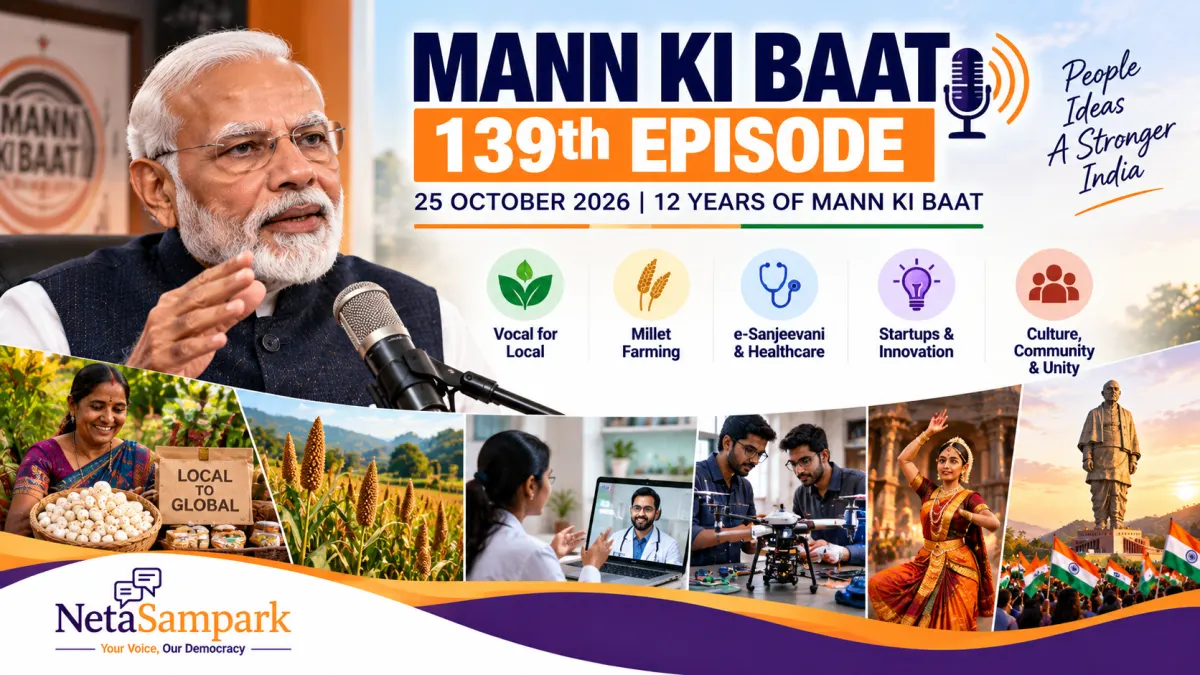
Mann Ki Baat 139th Episode | October 2026 | Latest Highlights and Key Takeaways
Prime Minister Narendra Modi’s 139th episode of Mann Ki Baat, broadcast on 25 October 2026, marked 12 years of the monthly radio programme. The address highlighted stories of grassroots innovation, Indian products reaching international markets, traditional farming practices, healthcare technology, scientific research, and the contributions of ordinary citizens.
The latest episode also focused on the importance of supporting local artisans, preserving traditional knowledge, encouraging young innovators, and connecting India’s cultural heritage with new opportunities.
Mann Ki Baat 139th Episode: Date and Overview
- Episode: 139th
- Broadcast date: 25 October 2026
- Occasion: Twelve years of Mann Ki Baat
- Key themes: Vocal for Local, traditional agriculture, healthcare technology, deep-tech innovation, scientific research, and national unity
In his address, the Prime Minister described the programme as a journey of discovering and celebrating the contributions of people whose work often goes unnoticed. The anniversary episode revisited the programme’s focus on citizen-led initiatives and local achievements.
Read the official transcript of the 139th episode on the Prime Minister of India’s website.
1 Vocal for Local: Indian Products Find International Markets
One of the central themes of the episode was the growing reach of Indian products and the importance of supporting local producers.
The Prime Minister highlighted examples of agricultural products reaching international markets, including makhana from Purnia in Bihar being exported to Greece and arhar dal from Kalaburagi in Karnataka reaching the Maldives.
These examples illustrate how locally produced goods can find customers beyond their immediate regions when production, quality, processing, and market access come together.
The message for consumers was equally direct: purchasing products made by local artisans and producers can help sustain livelihoods and strengthen local economies.
Why this matters
For farmers, small businesses, artisans, and entrepreneurs, access to wider markets can create opportunities to increase sales and diversify income. Product quality remains important, but packaging, branding, and distribution can also influence whether a product succeeds in competitive markets.
2 Tribal Products and Packaging Innovation
The episode highlighted Shabari Naturals, an initiative in Maharashtra that brings products made by tribal communities to market, including honey, mahua, chironji, and bamboo-based goods.
The initiative uses packaging inspired by tribal art. The Prime Minister noted that this packaging received Japan’s Good Design Award.
The example underlines how traditional knowledge and cultural identity can be incorporated into contemporary product design.
For small producers, packaging is more than a container. It can communicate a product’s origin, distinguish it from competing products, and help customers understand the story behind it.
The episode also mentioned a bamboo startup in Karnataka developing packaging materials using bamboo and agricultural residue, connecting local resources with alternative packaging solutions.
3 Khadi and the Continued Focus on Local Artisans
Khadi was another focus of the address. The Prime Minister stated that Khadi Gram Udyog product sales exceeded ₹28 crore on Gandhi Jayanti, an increase of ₹1.5 crore over the previous year.
The example was presented as an indication of continuing consumer interest in Khadi and the benefits that can reach the people involved in making traditional products.
The broader message was to make locally produced goods a more deliberate part of everyday purchasing decisions.
For consumers, this can mean considering products from local artisans, handloom workers, small manufacturers, and regional businesses when shopping for personal use or gifts.
4 Healthcare Technology: e-Sanjeevani Reaches 50 Crore Teleconsultations
Healthcare technology featured prominently in the episode, with the Prime Minister citing approximately 50 crore teleconsultations through the e-Sanjeevani platform.
The programme was highlighted as an example of how digital technology can help connect patients and healthcare professionals.
Teleconsultation can be particularly relevant for people who face geographical barriers to accessing medical advice, although the suitability of remote consultations depends on the patient’s condition and clinical needs.
The example also drew attention to the role of healthcare professionals and public digital infrastructure in expanding access to services.
5 Scientific Research and the Human Brain
The Prime Minister discussed a research initiative focused on understanding the human brain, noting that scientists still face significant unanswered questions about how it functions.
The address referred to the participation of industry, government, IIT alumni, and academia in supporting the research effort. It also mentioned a decision to make data from 100 human brains available as an open-source resource for research across different fields.
The initiative was presented in the context of advancing scientific understanding of conditions such as Alzheimer’s disease and dementia, for which important research challenges remain.
The discussion also highlighted organ donation as an important contribution to medical research, alongside its established role in helping patients who need organ transplants.
The wider takeaway is the importance of collaboration among researchers, institutions, donors, and technology organisations in advancing scientific knowledge.
6 Deep-Tech Startups and Young Innovators
The episode also showcased examples of deep-tech innovation associated with the incubation ecosystem at IIT Madras.
The projects mentioned included:
- An electric vehicle designed to fly over the sea.
- Fast-charging batteries for drones and electric vehicles.
- Applications of artificial intelligence in defence technology.
These examples reflect the range of technical challenges being explored by Indian startups and research teams.
Deep-tech businesses often require specialised research, engineering expertise, testing, and patient investment before their products can reach the market. Incubation centres and partnerships between academia and industry can help provide an environment for developing and testing new ideas.
The address also highlighted the contribution of Indian scientists to global technological progress, including Narinder Singh Kapany, widely known as the Father of Fibre Optics. His 100th birth anniversary falls on 31 October 2026.
7 Millets: Traditional Crops, New Products and Rural Opportunities
Millet cultivation and value addition were important agricultural themes in the address, particularly examples from Meghalaya and Nagaland.
Meghalaya: Creating new products from millets
In Khanduli village in Meghalaya’s West Jaintia Hills district, two women took an initiative to develop products such as cookies, cakes, muffins, and baby food using millets.
The initiative helped create demand for millet-based products and encouraged renewed interest in cultivating the crop.
The episode also mentioned a farmer, Chekjing Sangma, from Sadolpara in the West Garo Hills district, who adopted modern methods of millet cultivation.
Nagaland: Reviving millet cultivation
In Kezoma village in Nagaland’s Kohima district, millet cultivation resumed in 2024 after having stopped for more than a decade. The village subsequently held its first millet festival in 2025.
These examples show how traditional crops can create new economic opportunities when combined with product development, local entrepreneurship, and community participation.
Millets are also part of broader conversations about agricultural diversity and food systems. Their long-standing place in regional food cultures offers opportunities to preserve local knowledge while exploring new consumer markets.
8 National Unity and Run for Unity on 31 October
The Prime Minister referred to the upcoming birth anniversary of Sardar Vallabhbhai Patel on 31 October, observed nationally as Rashtriya Ekta Diwas, or National Unity Day.
He encouraged people to participate in the annual Run for Unity with family, friends, and members of their communities.
The address connected the occasion with the broader idea of strengthening unity and recognising the contributions of those who helped shape the country.
National Unity Day provides an opportunity for educational institutions, community organisations, and local administrations to organise activities that encourage participation and reflect on the importance of national integration.
9 Maharishi Valmiki and the Continuing Relevance of the Ramayana
The episode also referred to Maharishi Valmiki’s birth anniversary, observed on 26 October in the context of the address.
The Prime Minister discussed the continuing relevance of the Ramayana and the values associated with its stories, including perseverance, compassion, service, and social harmony.
He referred to episodes involving Lord Ram, Mata Shabari, and Nishadraj to illustrate the importance of respecting relationships and taking everyone along.
The discussion connected cultural heritage with values that continue to influence social and community life.
What Were the Major Takeaways from Mann Ki Baat 139?
The 139th episode brought together several themes that affect different parts of Indian society.
For farmers: Local crops can find new markets through processing, product development, and stronger distribution networks.
For artisans and small businesses: Product design, packaging, and branding can help communicate the value of locally made goods.
For young entrepreneurs: Deep-tech research and startup incubation offer avenues to explore advanced technologies, although commercial success depends on further development and execution.
For healthcare: Digital platforms can expand access to consultations, while research partnerships can contribute to longer-term scientific progress.
For communities: Traditional knowledge, cultural practices, and local initiatives can remain relevant when communities find ways to adapt them to changing needs.
These themes reflect the episode’s emphasis on connecting local initiatives with wider opportunities.
Frequently Asked Questions
When was the 139th episode of Mann Ki Baat broadcast?
The 139th episode of Mann Ki Baat was broadcast on Sunday, 25 October 2026.
What were the main topics discussed in the latest Mann Ki Baat?
Major themes included Vocal for Local, agricultural exports, tribal products and packaging, Khadi sales, e-Sanjeevani teleconsultations, brain research, deep-tech startups, millet cultivation, and National Unity Day.
What did the Prime Minister say about e-Sanjeevani?
The Prime Minister cited approximately 50 crore teleconsultations through e-Sanjeevani, highlighting the role of digital technology in healthcare access.
Which local products were mentioned in the episode?
Examples included makhana from Purnia in Bihar, arhar dal from Kalaburagi in Karnataka, tribal products from Maharashtra, and bamboo-based packaging developed by a Karnataka startup.
Why were millets discussed in Mann Ki Baat?
The episode highlighted initiatives in Meghalaya and Nagaland that are reviving millet cultivation and creating new products from traditional grains.
Where can I read the full Mann Ki Baat transcript?
The official transcript is available on the Prime Minister of India’s website.
Conclusion
The 139th episode of Mann Ki Baat highlighted how local enterprise, traditional knowledge, science, and technology can contribute to India’s social and economic development.
From agricultural products finding international markets to rural communities reviving millet cultivation, the examples showed different ways people are adapting local resources and skills to changing opportunities.
The episode also placed healthcare technology, scientific research, and youth-led innovation alongside cultural heritage and national unity.
For listeners, the key themes offer several points for reflection: how local products can be supported, how traditional practices can evolve, and how community initiatives can connect with broader development goals.
Read the official address: Mann Ki Baat 139th Episode — Prime Minister of India
Sources
- Prime Minister of India — Official transcript of the 139th episode
- Press Information Bureau — English rendering of the Prime Minister’s address, 25 October 2026