
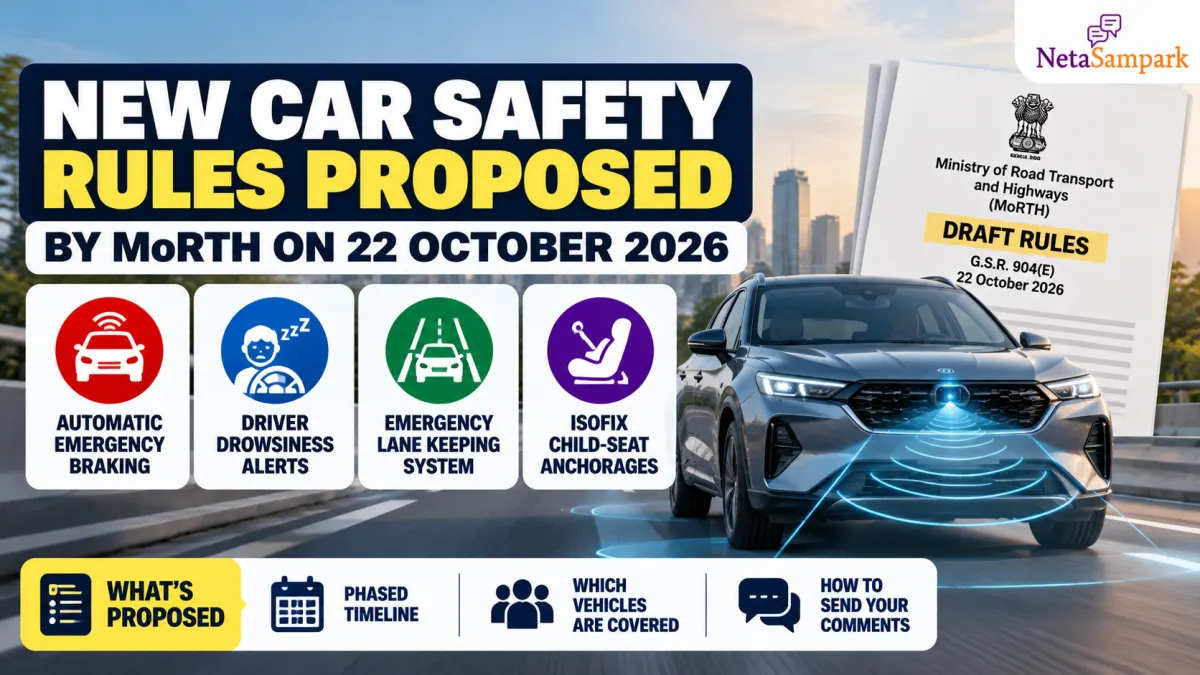
India may introduce a new set of vehicle-safety requirements covering automatic emergency braking, driver drowsiness warnings, emergency lane-keeping systems and child-seat anchorages. The Ministry of Road Transport and Highways (MoRTH) has published draft amendments to the Central Motor Vehicles Rules, 1989, inviting public objections and suggestions.
The draft notification, G.S.R. 904(E), dated 19 October 2026, was published in the Gazette of India on 22 October 2026. It proposes a phased rollout, with some requirements starting in 2027 and the passenger-car automatic emergency braking mandate extending to 2032.
These are proposed rules, not a blanket requirement already in force for every new car. The final requirements will depend on the government's consideration of public comments and the rules ultimately notified.
1 What has MoRTH proposed?
The draft covers several vehicle-safety systems and standards.
| Proposed requirement | Main proposal | Proposed timeline |
|---|---|---|
| Advanced Emergency Braking System (AEBS) | Mandatory on M1 passenger vehicles | New models from 1 October 2030; all models from 1 October 2032 |
| AEBS standard compliance | M1 and N1 vehicles already equipped with AEBS must meet AIS-185 | From 1 October 2028 |
| Driver Drowsiness and Attention Warning System | Requirements for equipped passenger vehicles and mandatory fitment for specified M1 transport vehicles | Standard compliance from 1 October 2027; mandatory fitment for specified transport vehicles from 1 October 2029 |
| Emergency Lane Keeping System (ELKS) | Standard compliance for equipped M1 vehicles and mandatory fitment for specified M1 transport vehicles | From 1 October 2027 for equipped vehicles; 1 October 2029 for specified transport vehicles |
| Automatic Command Steering Functionalities (ACSF) | Standard compliance and mandatory fitment for specified transport vehicles | From 1 October 2027 and 1 October 2029, respectively |
| ISOFIX and i-Size child-seat anchorages | Requirements under AIS-182 for specified anchorage systems and seating positions | New models from 1 October 2027; all models from 1 October 2028 |
| Luggage retention | Compliance with IS 15546:2005 | New models from 1 April 2028; all models from 1 October 2028 |
| Steering effort | Compliance with AIS-193 for covered motor vehicles | From 1 October 2027 |
Source: Draft G.S.R. 904(E), Gazette Tracker with Gazette text and TeamLease RegTech's notification summary.
The vehicle category, manufacturing date, model status and whether a system is already fitted can affect the applicable requirement. The dates in the table are proposed dates under the draft.
2 Automatic emergency braking: What changes for cars?
Advanced Emergency Braking Systems (AEBS) use vehicle sensors and control systems to detect a potential collision and apply the brakes when the driver does not respond adequately. Depending on the circumstances, the system may help avoid a collision or reduce its severity.
Under the draft, the requirements would be introduced in stages.
- 1 October 2028: M1 and N1 vehicles manufactured on or after this date, if equipped with AEBS, would need to comply with AIS-185.
- 1 October 2030: New M1 passenger-car models manufactured on or after this date would need to be fitted with AEBS conforming to AIS-185.
- 1 October 2032: The proposed requirement would extend to all M1 models manufactured on or after this date, including models already in production.
M1 generally refers to passenger vehicles carrying no more than eight passengers in addition to the driver. N1 broadly covers goods vehicles with a maximum mass not exceeding 3.5 tonnes.
The proposed mandate does not mean that every car currently on Indian roads must be retrofitted with automatic braking. The draft specifies manufacturing-date requirements for covered vehicles.
3 Driver drowsiness alerts: Who would be covered?
Driver Drowsiness and Attention Warning Systems monitor indicators of driver fatigue or inattention and provide warnings when the system detects a potential problem.
The draft proposes that:
- M1 vehicles equipped with such systems from 1 October 2027 comply with AIS-184.
- Specified M1 vehicles registered as transport vehicles and manufactured from 1 October 2029 be fitted with a system conforming to AIS-184.
The transport-vehicle provision is particularly relevant to vehicles used for commercial passenger transport, subject to the exact legal classification and registration requirements.
A drowsiness warning is an assistance feature, not a guarantee that a driver is alert. Drivers must still stop and rest when tired.
4 ISOFIX and i-Size: What the child-seat proposal means
ISOFIX is a standardised system of anchorages used to secure compatible child-restraint seats to a vehicle. Top-tether anchorages provide an additional attachment point for compatible seats. i-Size refers to a child-restraint framework associated with specified seating positions and compatibility requirements.
The draft proposes that M1 vehicles with ISOFIX anchorages, ISOFIX top-tether anchorages and i-Size seating positions meet the requirements of AIS-182 according to the phased schedule:
- New models: From 1 October 2027.
- All models: From 1 October 2028.
This is a technical compliance proposal for the relevant systems and seating positions. It should not be interpreted as saying that every vehicle must have every type of child-seat anchorage regardless of the wording of the final rule.
For parents, the practical takeaway remains important: use a child restraint appropriate to the child's size and compatible with the vehicle, and follow the restraint and vehicle manufacturers' installation instructions.
5 Emergency lane keeping and automatic steering
The draft also covers two related technologies.
Emergency Lane Keeping System (ELKS) can help keep a vehicle within its lane by intervening when the system detects an unintended departure and its conditions for intervention are met.
Automatic Command Steering Functionalities (ACSF) concern steering functions controlled or commanded by an automated system.
The proposal sets AIS compliance requirements for M1 vehicles equipped with these functions from 1 October 2027. It also proposes mandatory fitment of the specified systems on covered M1 transport vehicles manufactured from 1 October 2029.
These systems have different functions and should not be confused with fully autonomous driving. They do not remove the driver's responsibility to control the vehicle.
6 Luggage retention and steering standards
The draft includes requirements beyond driver-assistance technology.
Luggage retention
M1 vehicles would need to meet the luggage-retention requirements of IS 15546:2005 under this proposed schedule:
- New models manufactured from 1 April 2028.
- All models manufactured from 1 October 2028.
Luggage-retention provisions address the risk of baggage moving dangerously during sudden braking or a collision.
Steering effort
The draft proposes AIS-193 steering-effort requirements from 1 October 2027 for covered motor vehicles. It excludes motorcycles, invalid carriages and three-wheelers that do not have a steering wheel.
The draft also specifies AIS-193 compliance for M1 vehicles equipped with ACSF and proposes mandatory ACSF fitment for specified M1 transport vehicles from October 2029.
7 How to send comments or objections to MoRTH
The draft invites members of the public and other affected stakeholders to submit objections and suggestions. This is an opportunity for vehicle owners, consumer groups, road-safety organisations, engineers, manufacturers and other interested people to identify practical concerns or recommend improvements.
The notification states that comments must be received before the end of the 30-day consultation period measured from when the Gazette notification was made available to the public.
Step 1: Read the complete draft
Start with the notification, not just a news summary.
Review the proposed amendments to Rules 96, 98, 124, 125 and 125-Q of the Central Motor Vehicles Rules, 1989.
Step 2: Identify the provision you want to comment on
Make your submission specific. For example, you might comment on:
- The proposed phase-in dates for AEBS.
- The testing and compliance requirements for driver-warning systems.
- ISOFIX and i-Size anchorage compliance.
- The practical implementation of lane-keeping systems.
- The proposed requirements for transport vehicles.
- Whether additional clarification is needed for a technical standard or vehicle category.
If you represent an organisation, identify the relevant technical or public-interest experience that supports your submission.
Step 3: Write a clear, evidence-based submission
A useful submission should include:
- Your name or organisation's name.
- Contact details.
- The notification number: G.S.R. 904(E).
- The rule or clause you are commenting on.
- Your objection or suggestion.
- The reason for your position.
- Supporting evidence, examples or proposed wording, where available.
If you disagree with a timeline, explain the specific problem and propose a workable alternative. If you support a provision, explain the safety benefit or implementation consideration behind your view.
Step 4: Send it to the address specified in the Gazette
The notification directs submissions to:
Additional Secretary (MVL, Transport & Road Safety)
Ministry of Road Transport and Highways
Transport Bhawan, Parliament Street
New Delhi – 110 001
The Gazette also specifies an email address for objections and suggestions. Because email addresses in third-party reproductions may be masked, copy the exact email address from the original Gazette notification before sending your submission. Do not rely on an unverified address from a repost or social-media message.
Step 5: Keep proof of submission
For an email submission, retain the sent message, attachments and any delivery acknowledgement. For a postal submission, retain the dispatch receipt and tracking details.
The Ministry's notice says objections and suggestions received within the consultation period will be considered. Submitting a comment does not guarantee that the proposal will be changed.
8 What can ordinary car buyers do now?
The proposed requirements are years away for several systems, and the notification remains a draft. Buyers should not assume that a car currently on sale is non-compliant merely because it does not have every feature listed in the proposal.
When comparing vehicles, you can still ask dealers and manufacturers:
- Does the vehicle offer automatic emergency braking, and what situations can it detect?
- Does it have a driver-drowsiness warning, and how does the system alert the driver?
- Are ISOFIX and top-tether anchorages provided, and where are they located?
- Is an emergency lane-keeping system available?
- Which safety features are standard and which are optional on the exact variant?
- What are the limitations of each driver-assistance feature?
Ask for the feature list for the specific model and variant. Similar names can describe different functions, and the presence of a feature alone does not establish compliance with a particular AIS standard.
Frequently asked questions
Are automatic emergency brakes mandatory on all new cars now?
No. This notification is a draft. It proposes AEBS for new M1 models from 1 October 2030 and all M1 models from 1 October 2032, subject to the final rules.
Will existing cars need to be retrofitted?
The draft sets manufacturing-date requirements. It does not state a general requirement to retrofit all existing cars already on the road.
What is the proposed deadline for comments?
The Gazette provides a 30-day consultation period measured from when the published notification was made available to the public. The notification was published on 22 October 2026; check the original Gazette for the applicable closing date and send comments well before the deadline.
Can an individual submit a comment?
The notification invites objections and suggestions from any person. An individual can submit a reasoned comment on a proposed provision.
Where can I read the original notification?
Start with the Gazette text for G.S.R. 904(E) and verify the document through the eGazette of India or the MoRTH website.
Official and reference links
- Ministry of Road Transport and Highways: https://morth.nic.in/
- eGazette of India: https://egazette.gov.in/
- G.S.R. 904(E), draft Central Motor Vehicles Rules amendment: Read the notification text
- TeamLease RegTech summary: Review the draft's provisions
- NDTV Profit explainer: Automatic emergency braking in cars
Final takeaway
MoRTH's 22 October 2026 draft proposes a phased set of vehicle-safety requirements, including automatic emergency braking for passenger cars, driver-drowsiness warnings, emergency lane keeping, child-seat anchorages and luggage retention.
The most important distinction is that the proposals are not yet final rules. Read G.S.R. 904(E), identify the provisions relevant to you, and send specific, evidence-based comments to the address stated in the original Gazette within the consultation period.