
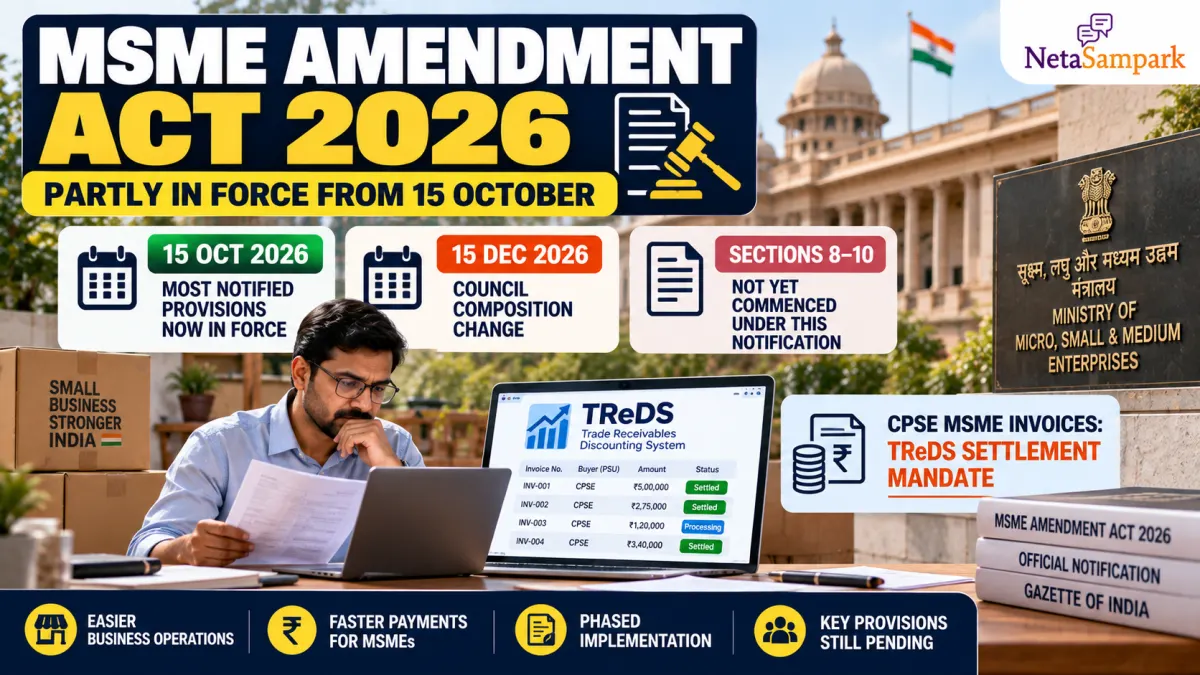
India’s Micro, Small and Medium Enterprises Development (Amendment) Act, 2026 is now being implemented in phases. Some provisions came into force on 15 October 2026, another set concerning the composition of Micro and Small Enterprises Facilitation Councils is scheduled to commence on 15 December 2026, and important dispute-resolution provisions remain outside the commencement notification issued so far.
For small businesses, the changes cover MSME classification, registration, institutional oversight, payment systems and the framework for resolving delayed-payment disputes. Another important development is the separate government mandate requiring operating Central Public Sector Enterprises (CPSEs) to route settlement of invoices for goods and services purchased from MSMEs through the Trade Receivables Discounting System (TReDS).
The distinction matters: the Amendment Act’s commencement dates and the separate TReDS mandate are related to MSME policy, but they are not the same legal notification.
This guide explains what has commenced, what changes for MSME owners, what businesses should check now and which provisions still require a commencement notification.
MSME Amendment Act 2026: Key dates at a glance
| Date | What it means |
|---|---|
| 13 August 2026 | The Amendment Act received presidential assent. |
| 15 October 2026 | Sections 2–7, 11 and 13–17 commenced under the notified schedule. |
| 15 December 2026 | Section 12, concerning the composition of Micro and Small Enterprises Facilitation Councils, is scheduled to commence. |
| Not specified in the October commencement notification | Sections 8–10 have not been brought into force by that notification. |
The commencement dates are set out in Notification S.O. 5575(E), dated 12 October 2026. The notification appoints different commencement dates for different provisions rather than bringing the entire Act into force on one day.
You can consult the Ministry of MSME’s official website and the e-Gazette of India for the Act and commencement notifications.
What changed from 15 October 2026?
The provisions that commenced on 15 October cover several areas of the MSME Development Act, 2006. Their practical effect depends on the relevant section and any rules, notifications or administrative arrangements that apply to it.
1. Changes to MSME definitions and administration
The amendments update parts of the statutory framework, including definitions and the role of the Development Commissioner within the Ministry of MSME.
For businesses, the important point is that the amended law provides a revised statutory framework for administering MSME policy. It does not mean every business must immediately change its registration or classification solely because the commencement date has arrived.
Businesses should check their current Udyam details and follow any specific government notification or portal instruction that applies to their enterprise.
2. MSME classification remains linked to investment and turnover
The Amendment Act revises the statutory provisions governing classification of micro, small and medium enterprises, using investment in plant, machinery or equipment and turnover as the basis.
However, the commencement notification does not itself announce a new set of numerical classification limits. Do not assume that the category thresholds have automatically changed merely because the amended provision has commenced.
For the applicable limits and registration requirements, refer to the official Udyam Registration portal and the latest government notifications.
3. Digital registration and voluntary registration provisions
The amendments address the statutory framework for MSME registration, including free and voluntary digital registration.
Businesses should continue to use official government channels for Udyam-related processes. Be cautious of private websites that charge fees while presenting themselves as the official registration portal.
If your enterprise already has Udyam registration, retain your certificate and verify your enterprise details. Make changes only through the applicable official process.
4. Changes affecting Facilitation Councils and institutional arrangements
The amendments address the institutional framework for Micro and Small Enterprises Facilitation Councils, which play a role in resolving eligible delayed-payment disputes.
Not all related changes take effect on the same date. The amendment to Council composition under Section 12 is scheduled for 15 December 2026.
Businesses should therefore distinguish between provisions already in force and changes that are scheduled for a later commencement date.
TReDS and PSU payments: What MSME suppliers need to know
One of the most significant developments for small suppliers is the government’s move to route payments for MSME purchases by operating Central Public Sector Enterprises through TReDS.
The Ministry of MSME announced the mandate in July 2026 following a notification issued on 30 June 2026. It requires operating CPSEs to route the settlement of invoices for goods and services procured from MSMEs through TReDS platforms authorised by the Reserve Bank of India.
This is a separate measure from the commencement notification for the MSME Amendment Act.
Read the Ministry of MSME’s official press release on the TReDS mandate.
What is TReDS?
TReDS stands for Trade Receivables Discounting System. It is an electronic platform framework that helps MSME suppliers obtain financing against eligible trade receivables from buyers.
In a typical transaction:
- An MSME supplies goods or services to a buyer.
- The supplier raises an invoice.
- The invoice and related details are processed through the TReDS platform under its applicable procedures.
- The buyer accepts or confirms the relevant invoice or factoring unit.
- A financier may offer funding against the receivable.
- Settlement takes place under the applicable platform and transaction terms.
TReDS can help suppliers access working capital without waiting until the original invoice due date, where financing is available and the transaction qualifies. It is not a grant or automatic government payment.
Does this mean every PSU invoice will be paid immediately?
No. The mandate creates a prescribed settlement route for covered CPSE–MSME transactions. It does not mean every invoice is automatically approved, financed or paid on the day it is uploaded.
Suppliers should continue to maintain purchase orders, delivery records, invoices, acceptance documents and payment follow-ups. If an invoice is disputed or rejected, the supplier should obtain the reason and follow the buyer’s and platform’s prescribed process.
Does TReDS apply to every private company?
The specific mandate discussed here covers operating CPSEs and their purchases from MSME suppliers. It should not be interpreted as a blanket rule that every private company must use TReDS for all MSME invoices.
The coverage of any other buyer category depends on the applicable law and notifications. Businesses should check the exact scope of the relevant mandate before assuming it applies to a private buyer.
What should an MSME supplier do now?
If your business supplies a CPSE:
- Confirm that your Udyam registration and enterprise details are current.
- Ask the buyer’s procurement or accounts team how covered invoices will be routed through TReDS.
- Check which RBI-authorised TReDS platform or platforms the buyer uses.
- Ensure invoices, purchase orders and delivery or acceptance records are accurate.
- Follow the platform’s onboarding, invoice-submission and acceptance procedures.
- Keep track of invoice status, financing offers and settlement references.
- Escalate rejected or disputed invoices through the buyer’s official grievance process.
TReDS is designed to improve receivables financing and payment transparency. It does not remove the need to comply with the transaction’s documentation and acceptance requirements.
What is still pending under the Amendment Act?
The October commencement notification does not bring every provision of the Amendment Act into force.
Sections 8, 9 and 10 have not been assigned a commencement date under Notification S.O. 5575(E). These provisions concern important delayed-payment dispute-resolution and enforcement reforms.
That means businesses should not treat those changes as already operational simply because the Amendment Act received presidential assent in August.
The practical position is:
- Sections 2–7, 11 and 13–17: commenced on 15 October 2026 under the notification.
- Section 12: scheduled to commence on 15 December 2026.
- Sections 8–10: no commencement date appointed by that notification.
This is a statement about the scope of the cited notification, not a guarantee that no later notification has been issued. Before relying on a particular legal change, check the latest Gazette publications and applicable rules.
Why does this matter for delayed-payment disputes?
MSME suppliers often face delays in receiving payment for goods and services. The statutory framework under the MSMED Act provides mechanisms for eligible micro and small enterprises to pursue delayed-payment disputes, including through the Micro and Small Enterprises Facilitation Council.
But when an amendment changes dispute-resolution procedures, the legal commencement date matters. Businesses should not assume that a new timeline, procedure or enforcement mechanism is available until the relevant provision has commenced and any necessary implementation requirements have been satisfied.
If you are dealing with an overdue invoice, preserve the contract, purchase order, invoice, proof of delivery, correspondence and payment records. Seek advice on the provisions that are currently in force rather than relying on a summary of provisions that are still pending.
What does the amendment mean for Udyam-registered businesses?
For existing micro, small and medium enterprises, the immediate priority is to distinguish between statutory changes that have commenced and operational requirements that still depend on separate notifications or implementation.
A practical checklist:
- Verify your Udyam registration and enterprise information.
- Check the current investment and turnover criteria applicable to your classification.
- Review official MSME notifications rather than relying only on news summaries.
- If you supply a CPSE, ask about its TReDS onboarding and invoice-settlement process.
- Keep purchase orders, invoices, delivery records and acknowledgements organised.
- Track delayed payments and preserve correspondence with buyers.
- Check the commencement status of Sections 8–10 before relying on the new dispute-resolution provisions.
- Review any subsequent notifications about Facilitation Councils and implementing rules.
Businesses should not make a classification change, alter a legal claim or assume a new payment deadline solely on the basis of a headline.
Frequently asked questions
Did the entire MSME Amendment Act 2026 come into force on 15 October?
No. Notification S.O. 5575(E) brought Sections 2–7, 11 and 13–17 into force on 15 October 2026. Section 12 is scheduled for 15 December 2026, while Sections 8–10 were not assigned a commencement date by that notification.
Does the amendment automatically increase the MSME turnover limit?
The commencement notification does not itself specify new numerical classification thresholds. Check the latest applicable government notification and the official Udyam portal for the limits in force.
Must CPSEs use TReDS for MSME invoices?
The separate government notification dated 30 June 2026 requires operating CPSEs to route settlement of invoices for goods and services procured from MSMEs through RBI-authorised TReDS platforms, subject to the applicable scope and procedures.
Does TReDS guarantee immediate payment?
No. TReDS supports the electronic processing of trade receivables and can enable financing, but invoice acceptance, financing availability and settlement follow the applicable transaction and platform procedures.
Can an MSME use TReDS when a private company is the buyer?
TReDS platforms can support eligible transactions involving different buyer categories, depending on the platform and applicable rules. The specific government mandate discussed here is for operating CPSEs buying from MSMEs; it should not be read as a universal requirement for every private buyer.
Are the new delayed-payment dispute provisions already effective?
Sections 8–10 were not brought into force by the October commencement notification. Check for subsequent Gazette notifications before relying on those amendments.
Where can I verify the Act and commencement dates?
Start with the Ministry of MSME, the e-Gazette of India and the official PIB release on the TReDS mandate.
The bottom line
The MSME Amendment Act, 2026 is being implemented in phases—not as one all-at-once change. The provisions specified in the October notification commenced on 15 October, the Facilitation Council composition change is scheduled for 15 December, and Sections 8–10 remain outside the scope of that commencement notification.
For MSME suppliers, the separate TReDS mandate for operating CPSEs is an important development in invoice settlement and access to working capital. The practical next step is to verify your registration details, understand the payment process used by your buyers and monitor official notifications for the provisions that have not yet commenced.
This article is for general information and is not legal advice. Verify the current Gazette notifications, statutory provisions and applicable rules before making compliance or dispute-resolution decisions.