
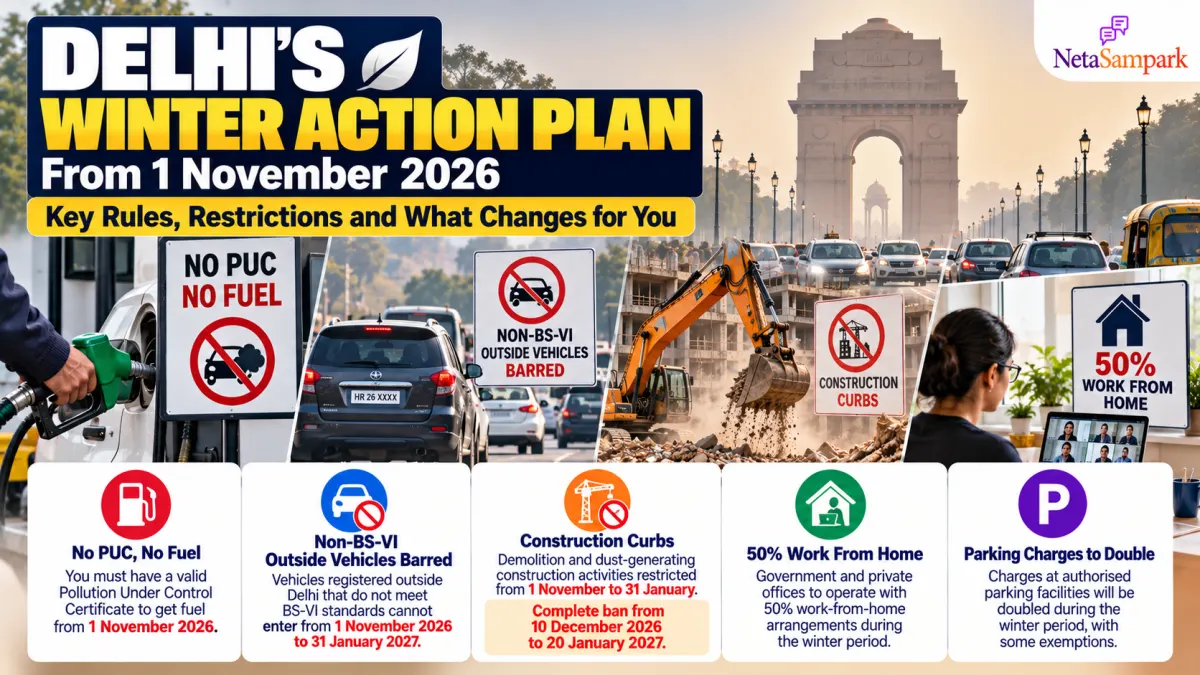
Delhi is preparing for another winter of poor air quality, with new restrictions aimed at reducing vehicle emissions, construction dust and traffic congestion. From 1 November 2026, residents, commuters, businesses and construction operators will face several measures under the capital’s winter pollution action plan.
The key changes include a “No PUC, No Fuel” rule, restrictions on vehicles registered outside Delhi that do not meet BS-VI emission standards, construction and demolition curbs, and a 50% work-from-home arrangement for offices.
The measures are intended to reduce pollution before winter air quality deteriorates further. Here is what they mean for your vehicle, workplace, building project and daily commute.
Delhi Winter Action Plan 2026: Key dates and rules
| Measure | What you need to know |
|---|---|
| Winter action plan | 1 November 2026 to 28 February 2027 |
| No PUC, No Fuel | Vehicles must have a valid Pollution Under Control Certificate to obtain fuel under the applicable enforcement rules |
| Outside-Delhi vehicles | Non-Delhi-registered vehicles below BS-VI standards face entry restrictions from 1 November 2026 to 31 January 2027 |
| Construction and demolition | Dust-generating demolition and outdoor civil construction activities restricted from 1 November to 31 January, subject to specified exemptions |
| Complete construction ban | A stricter prohibition is scheduled for 10 December 2026 to 20 January 2027, subject to permitted exceptions |
| Work from home | 50% work-from-home arrangements for government and private offices under the announced winter measures |
| Parking charges | Charges at authorised parking facilities are set to double during the winter period, subject to exemptions |
The Delhi government’s plan operates alongside applicable directions from the Commission for Air Quality Management (CAQM). Restrictions and exemptions should be checked against the latest official orders.
Sources: Press Information Bureau and Commission for Air Quality Management.
1 No PUC, No Fuel: What vehicle owners must do
A Pollution Under Control Certificate (PUCC) records whether a vehicle meets the applicable emissions requirements.
Under the fuel restriction, vehicles without a valid PUCC can be refused fuel at petrol pumps. Enforcement is intended to use automatic number plate recognition (ANPR) systems and checks at fuel stations.
What should you do before 1 November?
- Check the expiry date on your current PUC certificate.
- If it has expired or is about to expire, arrange an emissions test at an authorised PUC centre.
- Keep the certificate available digitally or in another accepted format.
- Verify that your vehicle registration details match the certificate.
- Do not assume that a booking or an expired certificate is sufficient.
You can check PUC-related services through the official Parivahan portal.
Important: The PUC rule and the restrictions on older outside-Delhi vehicles are separate measures. A valid PUC does not automatically exempt a vehicle from an applicable BS-VI entry restriction.
2 Non-BS-VI vehicles registered outside Delhi: Who is affected?
From 1 November 2026 to 31 January 2027, vehicles registered outside Delhi that do not meet BS-VI emission standards are to be restricted from entering the capital under the announced winter plan.
The measure is aimed at limiting the entry of more polluting vehicles during the winter period.
Which vehicles are exempt?
The announced plan provides exemptions for specified categories, including CNG and electric vehicles. Emergency vehicles such as ambulances and fire services, along with other eligible essential vehicles, are also covered by exemptions under the applicable directions.
Check the final official order for the precise vehicle categories and conditions.
What should commuters do?
If you regularly travel to Delhi from Haryana, Uttar Pradesh, Rajasthan or another state:
- Check your vehicle’s registration state and emission standard.
- Confirm whether your vehicle falls under the restriction.
- Check the latest exemptions before travelling.
- Consider the Metro, buses, carpooling or another permitted mode if your vehicle is covered by the restriction.
Do not assume that every vehicle registered outside Delhi is prohibited. The announced restriction concerns outside-Delhi vehicles below BS-VI standards, subject to the applicable exemptions.
3 Construction and demolition restrictions
Construction dust is another source of particulate pollution in Delhi. The winter plan introduces advance restrictions instead of relying only on emergency action after air quality worsens.
From 1 November to 31 January
Dust-generating demolition activities and outdoor civil construction activities are to be prohibited, subject to specified exemptions, including permitted essential public infrastructure work.
Authorities will also intensify monitoring of construction sites and dust-control compliance.
From 10 December to 20 January
A stricter, complete ban on construction and demolition activities is scheduled for this period, subject to the exemptions and permissions specified by the authorities.
This means that builders, contractors, property owners and redevelopment agencies should not assume that all work permitted during the earlier period will remain permitted during the stricter window.
What should property owners and contractors do?
- Check the applicable construction category and exemptions.
- Confirm the latest restrictions with the relevant authority before starting or continuing work.
- Follow dust-control requirements wherever work is permitted.
- Ensure construction material and debris are handled and transported according to applicable rules.
- Keep relevant permissions and compliance records available for inspection.
For the latest construction and demolition pollution-control directions, check the CAQM website.
4 What does 50% work from home mean?
The winter plan includes a 50% work-from-home arrangement for government and private offices to reduce commuting and traffic-related emissions.
In practical terms, offices covered by the arrangement will need to organise staffing so that the required share of employees works remotely under the applicable instructions.
This is not the same as a general holiday or a blanket closure of every workplace.
What employees should do
Ask your employer or HR department how the arrangement will operate in your organisation. Confirm:
- Which employees are expected to work remotely.
- How attendance and shifts will be scheduled.
- Whether your role requires physical presence.
- What arrangements apply to essential services and other exempt categories.
What employers should do
Employers should review the applicable government directions, identify any exemptions and prepare a workable attendance schedule. They should communicate the arrangements to staff before implementation.
The aim is to reduce the number of daily commuters and ease congestion during a season when pollution can become severe.
5 Office timings will also be staggered
Alongside work-from-home arrangements, the government has announced staggered office timings to reduce peak-hour congestion.
The published winter measures specify different schedules for Delhi government offices and Municipal Corporation of Delhi (MCD) offices. Private employers should check the instructions applicable to their workplaces.
If you commute daily, confirm your organisation’s revised schedule and consider using public transport or sharing journeys where possible.
6 Parking charges are set to double
The winter plan also includes doubling parking charges at authorised parking facilities during the winter period to discourage unnecessary private vehicle use.
The announced measure includes exemptions for specified facilities, including parking facilities owned and managed by the Delhi Metro Rail Corporation (DMRC).
Before parking, check the displayed tariff and any exemption that applies to the facility. Do not assume that the same parking rate will apply at every location.
7 What happens if air quality gets worse?
Delhi’s winter action plan operates alongside the Graded Response Action Plan (GRAP), coordinated by CAQM for Delhi-NCR.
GRAP introduces additional restrictions depending on the severity of air pollution. Depending on the stage and applicable directions, measures can affect construction, vehicle use, industrial operations and other activities.
The winter plan therefore does not mean that every restriction will remain identical throughout the season. Additional measures may be activated or modified as air quality changes.
Check the CAQM website for current GRAP orders and implementation updates.
8 How can residents report pollution violations?
If you notice a suspected violation, record the location, date and nature of the issue. Where safe and appropriate, keep photographs or other supporting evidence.
You can then approach the relevant authority:
| Problem | Where to seek help |
|---|---|
| Suspected construction dust violation | Relevant municipal or construction enforcement authority |
| Open waste burning | Municipal body or relevant pollution-control authority |
| Industrial pollution | Delhi Pollution Control Committee or the responsible regulator |
| Vehicle-related pollution enforcement | Delhi Transport Department or the relevant enforcement authority |
| Current GRAP restrictions | Commission for Air Quality Management |
Use official grievance channels and retain any complaint reference number for follow-up. Avoid entering unsafe sites or confronting people who may be violating the rules.
9 Official links to bookmark
- Delhi government winter pollution updates: Delhi Government
- Official winter action plan announcement: Press Information Bureau
- GRAP and pollution-control directions: CAQM
- PUC and vehicle services: Parivahan
- Delhi Pollution Control Committee: DPCC
Check these sources before making travel, construction or workplace decisions because detailed orders and exemptions can change.
Final takeaway
Delhi’s winter pollution plan introduces several changes from 1 November 2026: valid PUC certificates for fuel access, restrictions on specified non-BS-VI vehicles registered outside Delhi, construction and demolition curbs, staggered office timings, 50% work-from-home arrangements and higher parking charges.
The restrictions do not apply identically to every vehicle, workplace or construction project. Exemptions and implementation conditions matter.
Before November begins, check your PUC certificate, confirm whether your vehicle is affected, ask your employer about attendance arrangements and verify construction permissions. Staying informed can help you avoid disruption while supporting the wider effort to improve Delhi’s winter air quality.