
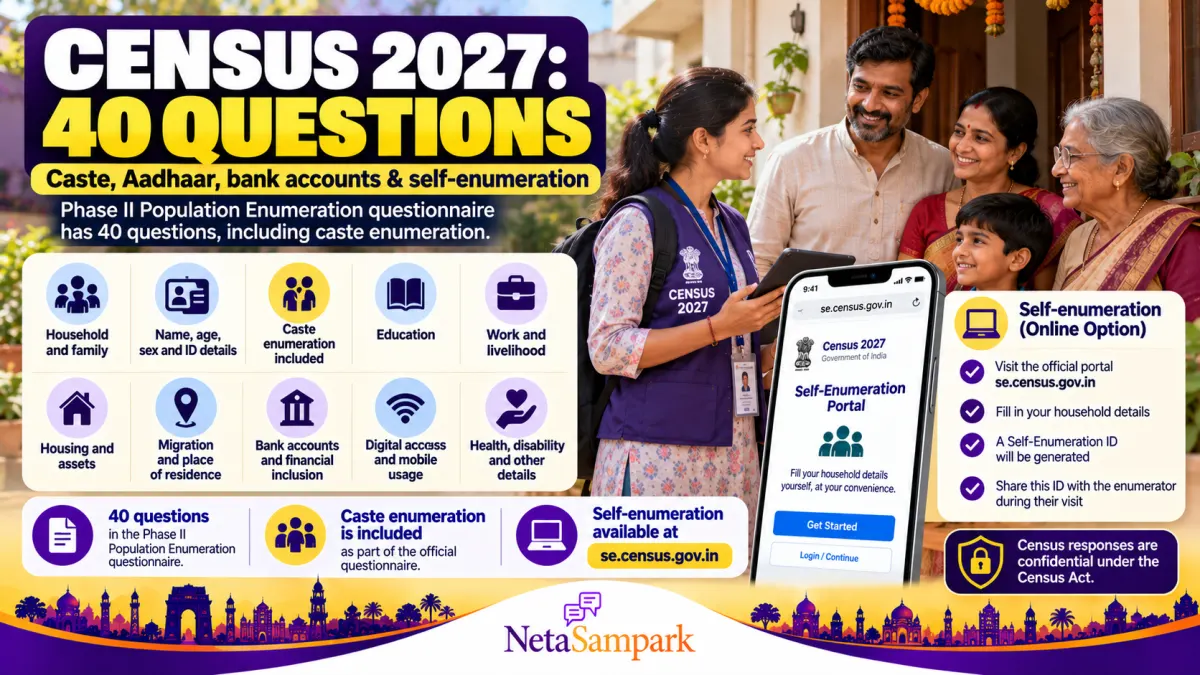
Census 2027: All 40 Questions on Caste, Aadhaar, Bank Accounts and How Self-Enumeration Works
India’s Census 2027 introduces a 40-question Population Enumeration questionnaire, covering personal details, caste, education, employment, migration and selected identity-document information. For the first time since Independence, caste details will be collected as part of the regular Census.
The Registrar General and Census Commissioner of India notified the questionnaire on 14 August 2026. Residents can also use the official online self-enumeration facility during the period notified for their area.
Official links: Census of India | Self-Enumeration Portal
Census 2027: Key Details
| Detail | Information |
|---|---|
| Conducting authority | Office of the Registrar General and Census Commissioner, India |
| Total Phase II questions | 40 |
| Caste enumeration | Included |
| Aadhaar and mobile number | Asked for, where available |
| Bank accounts | Total number of accounts |
| Self-enumeration | Available during notified local windows |
| Online portal | se.census.gov.in |
| Data confidentiality | Protected under the Census Act, 1948 |
All 40 Questions in Census 2027
The following is a plain-language guide to the notified questionnaire. The exact wording and applicable sub-questions may differ from these summaries.
A. Personal and Family Details
| No. | Information requested |
|---|---|
| 1 | Name of the person |
| 2 | Relationship to the head of the household |
| 3 | Sex |
| 4 | Date of birth and age in completed years |
| 5 | Current marital status |
| 6 | Age at marriage |
| 7 | Name of spouse |
| 8 | Nationality, as declared |
| 9 | Religion |
| 10 | Scheduled Caste (SC), Scheduled Tribe (ST) status and caste |
| 11 | Father’s particulars |
| 12 | Mother’s particulars |
| 13 | Disability status |
B. Language, Education and Employment
| No. | Information requested |
|---|---|
| 14 | Mother tongue and other languages known |
| 15 | Literacy and digital literacy status |
| 16 | Whether attending an educational institution |
| 17 | Highest educational level attained and stream or discipline |
| 18 | Whether the person worked at any time during the previous year |
| 19 | Category of economic activity |
| 20 | Occupation |
| 21 | Nature of industry, trade or service |
| 22 | Class of worker, such as employer, employee or other worker categories |
| 23 | Non-economic activity, where applicable |
| 24 | Whether seeking or available for work, where applicable |
| 25 | Travel to the place of work |
C. Migration and Residence
| No. | Information requested |
|---|---|
| 26 | Place of birth |
| 27 | Place of last residence |
| 28 | Reason for migration |
| 29 | Duration of stay in the current village or town since the last migration |
| 30 | Permanent residential address |
D. Children, Health and Identity Details
| No. | Information requested |
|---|---|
| 31 | Number of children surviving at present, for specified categories of women |
| 32 | Number of children ever born alive, for specified categories of women |
| 33 | Number of children born alive during the previous year, for currently married women |
| 34 | Place of COVID-19 vaccination |
| 35 | Total number of bank accounts |
| 36 | Mobile number, if available |
| 37 | Aadhaar number, if available |
| 38 | Voter ID number, if available |
| 39 | Passport number, for Indian passport holders |
| 40 | Whether the person has a driving licence |
Note: Some questions apply only to particular groups. For example, the fertility questions are not asked of every respondent. Check the official questionnaire for the complete wording.
What Does the Caste Question Mean?
Question 10 covers SC/ST status and caste. The Census will collect caste information as declared by the respondent rather than relying solely on a pre-filled list of caste names.
Answer accurately and follow the enumerator’s instructions. Do not assume that the Census form is the same as an application for a caste certificate or reservation benefit.
Why Are Aadhaar and Bank Accounts Being Asked About?
The questionnaire includes Aadhaar number and mobile number, where available, and asks for the total number of bank accounts held by the person.
This does not mean an enumerator needs your bank password, ATM PIN, UPI PIN, OTP, CVV, account balance or transaction history. Never disclose those credentials.
The inclusion of identity details in a Census questionnaire does not turn the exercise into a banking or identity-verification service.
How Self-Enumeration Works
Self-enumeration allows eligible residents to enter their Census information online before the enumerator’s visit.
- Visit the official Self-Enumeration Portal.
- Select the available language and follow the portal’s instructions.
- Enter the required household and individual details.
- Review the answers carefully before submitting.
- Save the Self-Enumeration ID (SE ID) generated after successful submission.
- Share that ID with the enumerator during the subsequent visit so the submitted information can be verified.
The portal supports 16 languages, including English, Hindi, Kannada, Tamil, Telugu, Bengali and Marathi.
Important: Self-enumeration windows are location-specific. Check the portal or your district administration’s Census notice for the dates applicable to your area. Online submission does not necessarily eliminate the follow-up visit.
Is Census Information Confidential?
Yes. Information collected under the Census Act, 1948, is subject to statutory confidentiality protections and is collected for Census purposes.
To protect yourself from impersonation:
- Check the official identity card of anyone claiming to be a Census enumerator.
- Use only the official Census website for self-enumeration.
- Do not share OTPs, banking credentials or unrelated financial information.
- Ask your local Census office if you are unsure about a request.
Frequently Asked Questions
How many questions will Census 2027 ask?
The Phase II Population Enumeration questionnaire contains 40 questions.
Will caste be recorded?
Yes. Caste enumeration is included in the notified questionnaire.
Will I have to provide my Aadhaar number?
The questionnaire asks for Aadhaar number, if available. Follow the official form’s instructions and never share Aadhaar OTPs or other authentication credentials.
Will the enumerator ask for my bank account number and password?
The questionnaire asks for the total number of bank accounts. It does not require your banking passwords, PINs or OTPs.
Can I complete Census 2027 online?
You can use self-enumeration during the period notified for your area at se.census.gov.in. The enumerator will subsequently verify the submission.
Final Takeaway
Census 2027’s 40-question schedule covers personal details, caste, education, work, migration, children and selected identity information. Prepare accurate answers, keep your Self-Enumeration ID if you submit online, and verify that anyone visiting your home is an authorised enumerator.
For the latest questionnaire and local schedule, rely on the official Census of India website and the Self-Enumeration Portal.