
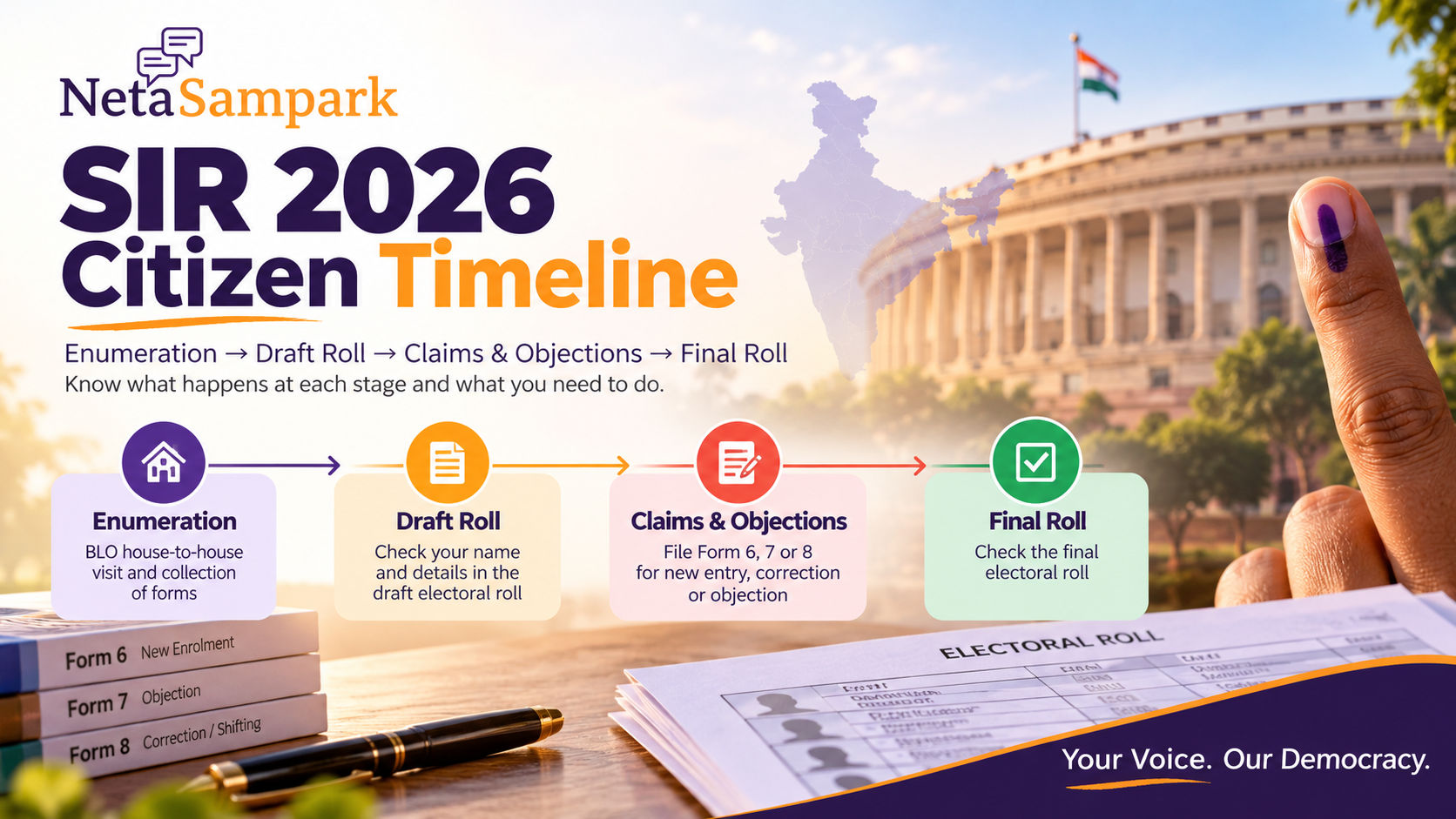
Quick take: The Election Commission of India’s Special Intensive Revision (SIR) 2026 follows a defined sequence: BLO house-to-house enumeration → draft electoral roll → claims and objections → notice/hearing and verification where required → final electoral roll. The dates are state-specific, so do not apply one state’s deadline to another. The current ECI schedule places different states in different SIR phases. (Election Commission of India)
For citizens, the practical rule is simple: check the draft roll, note the claims deadline for your state, and keep your application/notice reference numbers.
1 What happens during SIR?
SIR is a more intensive electoral-roll revision than an ordinary summary revision.
The broad citizen journey is:
Enumeration → Draft Roll → Claims & Objections → Verification / Hearings → Final Roll
During enumeration, BLOs conduct house-to-house visits and distribute/collect Enumeration Forms. The ECI has also provided for online submission of forms in the applicable SIR process. (Election Commission of India)
The important point: the draft roll is not the final roll.
Publication of the draft starts the next stage where citizens can check their entries and file claims or objections.
2 Stage 1 — House-to-house enumeration
During the enumeration phase, your BLO (Booth Level Officer) may visit your household.
Keep these details handy:
- EPIC / voter ID
- Current address
- Family members' electoral-roll details
- Enumeration Form, where applicable
- Previous electoral-roll information if required by your state's SIR process
The ECI's SIR instructions state that BLOs conduct house-to-house visits and that electors can submit completed forms through the BLO or online. (Election Commission of India)
Important
Do not assume that not receiving a BLO visit automatically means your name is safe.
After the enumeration stage, check the electoral roll yourself.
3. Stage 2 — Draft electoral rollThe ECI then publishes the draft electoral roll for the relevant state.
This is the point where every household should perform its own check.
The ECI's voter services system provides electoral-roll search facilities and a dedicated SIR interface, including options to search previous SIR rolls. (Voters ECI)
Check every family member separately
Verify:
- Name
- EPIC number
- Age / date of birth
- Relative's name
- Address
- Assembly Constituency
- Polling station
- Part number
- Serial number
- Whether the entry appears at all
Don't stop after finding the head of the household.
4. Stage 3 — Claims and objectionsIf something is wrong, this is the stage to act.
Depending on the problem, the appropriate electoral-roll application can include:
Name missing / new enrolment → Form 6
Correction or shifting → Form 8
Objection to an ineligible/dead/duplicate entry → Form 7
The ECI's elector services specifically provide online registration, application-status tracking and correction/shifting services. (Election Commission of India)
Keep the acknowledgement
After submitting an application:
- Save the reference number.
- Screenshot the successful submission.
- Download any acknowledgement available.
- Track the application status.
- Keep copies of documents submitted.
A screenshot of the submitted application can be useful if you later need to discuss the case with the BLO/ERO.
5. Stage 4 — Notice, verification and hearingNot every elector will necessarily face the same verification process.
The ECI's SIR instructions provide for notice to electors who could not be linked with previous SIR electoral rolls, after draft publication, so that their eligibility can be ascertained. (Election Commission of India)
If you receive a notice:
Read the notice itself first.
Check:
- Why the notice was issued
- Which documents are requested
- Submission method
- Hearing date, if any
- Hearing location
- Officer/contact details
- Last date for response
Do not rely on a WhatsApp message or a generic social-media checklist when the actual notice gives different instructions.
6. What happens if your name is missing?A missing name in the draft roll does not mean you should simply wait for the final roll.
The ECI has explicitly provided that electors unable to submit their Enumeration Forms during the enumeration period may apply through Form 6 with the prescribed declaration during the claims and objections period, in the applicable SIR process. (Election Commission of India)
So the citizen sequence is:
Check draft → confirm absence → file the appropriate claim → save acknowledgement → track it.
7. Every state's SIR calendar is differentThis is one of the easiest mistakes to make.
For example, the ECI's current 2026 schedule lists:
State/UT groupDraft rollClaims & objectionsFinal rollOdisha, Mizoram, Sikkim, Manipur5 Jul 20265 Jul–4 Aug6 SepUttarakhand14 Jul14 Jul–13 Aug15 SepAndhra Pradesh, Arunachal Pradesh, Haryana, Chandigarh21 Jul21 Jul–20 Aug22 SepTelangana, Punjab31 Jul31 Jul–30 Aug1 OctKarnataka, Meghalaya, Maharashtra, Jharkhand, Delhi5 Aug5 Aug–4 Sep7 OctNagaland20 Sep20 Sep–20 Oct22 NovTripura21 Oct21 Oct–20 Nov23 Dec
These dates come from the ECI's published SIR 2026 schedule; subsequent state-specific revisions should always be checked before publication or action. (Election Commission of India)
Do not copy Delhi's deadline into Karnataka, or Nagaland's deadline into another state.
8. The 10-minute household SIR checkDo this once every adult is available.
Step 1
Open the official ECI voter-service system.
Step 2
Search each person's name.
Step 3
Check the draft electoral roll where the SIR draft has been published.
Step 4
Write down:
EPIC + Part No. + Serial No. + Polling Station
Step 5
If anything is missing or incorrect, identify the appropriate application.
Step 6
Save the reference number after submission.
Step 7
If a notice arrives, photograph it and calendar the deadline immediately.
9. What to keep in the SIR folderCreate one physical folder and one phone folder containing:
- EPIC copy
- Current electoral-roll screenshot
- Part/serial details
- Enumeration acknowledgement, if available
- Form/application reference numbers
- SIR notice, if issued
- Documents submitted
- Submission acknowledgement
- BLO/ERO contact details
- Hearing date and venue
For older family members, keep a printed copy.
10. Don't confuse these three situationsName appears correctly
Keep the details and monitor the final roll.
Name appears but information is wrong
Use the appropriate correction/shifting process.
Name is absent from the draft
Check the claims process and file the appropriate enrolment claim rather than waiting for the final publication.
The ECI provides separate services for registration, application tracking and updating electoral-roll details. (Election Commission of India)
11. What happens after claims close?The ERO processes claims and objections and undertakes the required verification / notice / hearing work.
The result is the final electoral roll.
That means the calendar is not:
“Draft published → nothing to do → final roll.”
It is:
Draft published → citizen checks → claim/objection if necessary → verification/hearing where applicable → final roll.
The ECI's published schedules explicitly provide a separate period for notice/disposal alongside the claims-and-objections period. (Election Commission of India)
12. Check the final roll tooEven after filing an application, don't assume the matter is finished.
When the final roll is published:
Search again.
Confirm:
- Your name
- EPIC
- Part
- Serial number
- Polling station
The ECI voter-service system also provides electoral-roll downloads and search facilities. (Voters ECI)
13. If the portal says nothingDon't immediately conclude that your name has been deleted.
Try:
- EPIC search
- Name + relative details
- State/district/AC search
- Part-wise electoral-roll PDF
- SIR-specific search where available
- Your state CEO website
- BLO/ERO
- Voter Helpline 1950
The ECI specifically lists voter-roll search through its electoral-search system and the 1950 helpline. (Election Commission of India)
14. Keep the SIR calendar on your phoneCreate four reminders:
BLO/enumeration check
↓
Draft roll publication
↓
Claims & objections closing date
↓
Final roll publication
The exact dates should come from the ECI/state CEO schedule applicable to your state, not a generic national reminder. (Election Commission of India)
Mini scenario
Ravi's family has four registered electors.
The draft roll is published. Ravi checks only his own name and finds it.
His mother's entry is missing.
Instead of waiting for the final roll, the family checks the state's claims procedure, submits the appropriate application, saves the reference number and tracks it.
When the final roll is published, they search again.
That second check closes the loop.
The SIR citizen rule
Don't treat the draft roll as the final answer.
Check the draft.
Check the claims deadline.
Respond to notices.
Keep your acknowledgement.
Check the final roll.
And use the official ECI/state CEO channels for the dates and forms applicable to your state.
Be Informed. Be Heard.
Sources checked: Election Commission of India SIR 2026 schedule and instructions; ECI Voter Services / Citizen Service Portal; ECI elector guidance. (Election Commission of India)