
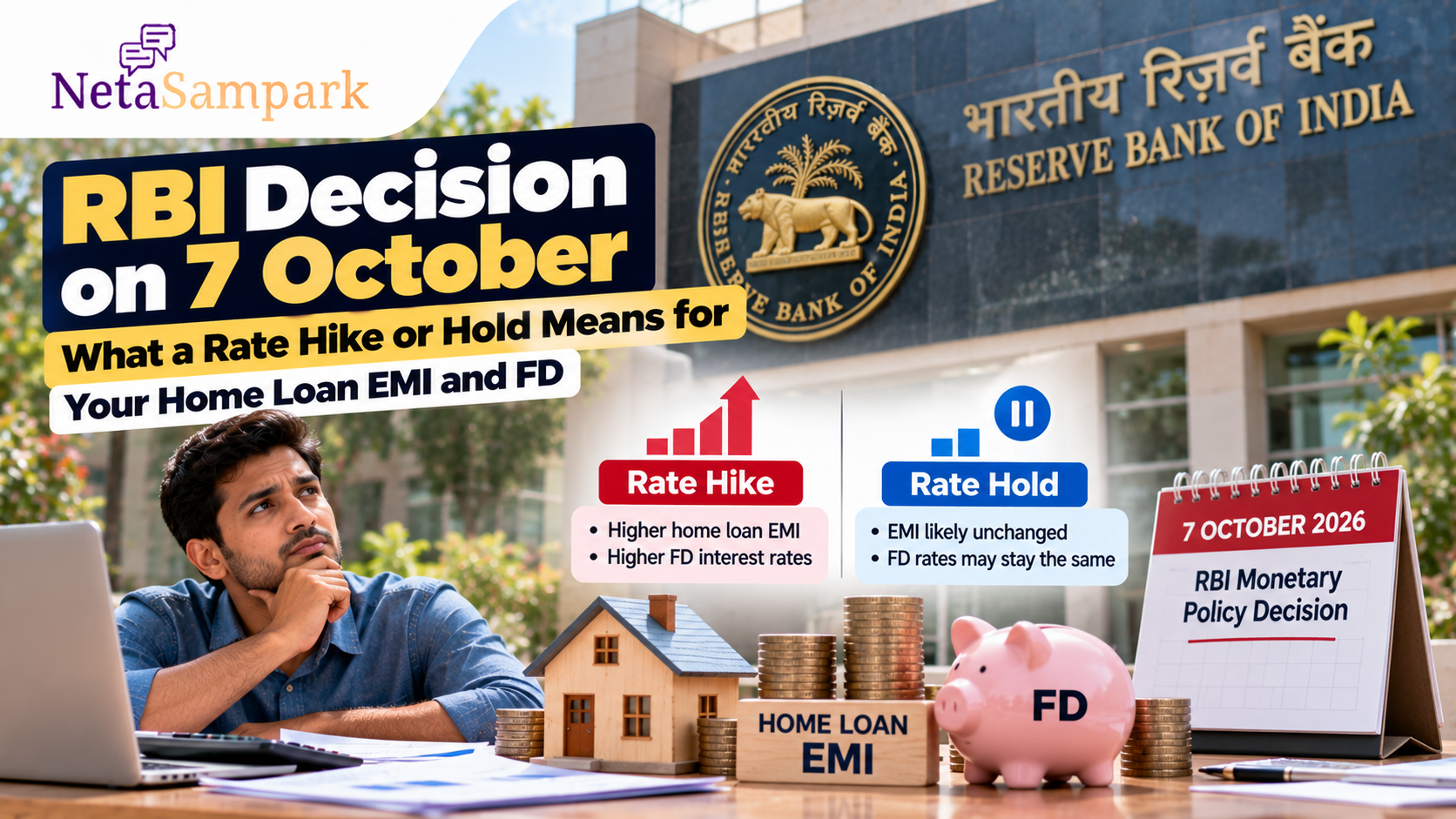
RBI Decision on 7 October: What a Rate Hike or Hold Means for Your Home Loan EMI and FD
The Reserve Bank of India’s next Monetary Policy Committee (MPC) meeting is scheduled for 5–7 October 2026, with the policy decision due on 7 October. The repo rate currently stands at 5.25%, after the RBI kept it unchanged in August for the fourth consecutive review. TrackRBI
For ordinary households, the announcement matters for two familiar products: home loans and fixed deposits (FDs).
A repo-rate change does not automatically change every loan or FD rate on the same day. The effect depends on the benchmark attached to your loan, the reset date, and how your bank responds on deposits.
Here is what borrowers and savers should watch.
What Is the RBI Repo Rate?
The repo rate is the policy rate at which the RBI provides short-term liquidity to banks against eligible securities.
When the RBI changes the repo rate, it can influence the cost of funds in the banking system and, in turn, lending and deposit rates.
The RBI's current policy repo rate is 5.25%. Its Standing Deposit Facility rate is 5.00% and the Marginal Standing Facility rate is 5.50%. Reserve Bank of India
The October meeting is particularly important because the RBI has maintained a neutral policy stance, meaning the MPC has not committed itself to a particular direction for the next rate move.
What Happens If the RBI Hikes the Repo Rate?
Suppose the RBI raises the repo rate by 25 basis points, or 0.25 percentage points.
The impact can broadly look like this:
| Product | Possible effect of a rate hike |
|---|---|
| Floating-rate home loan linked to an external benchmark | Loan rate may rise after the applicable reset |
| Fixed-rate home loan | Normally no immediate change to the contracted rate |
| New home loans | Banks may revise lending rates |
| Existing FD | Rate normally remains as contracted until maturity |
| New FD/reinvestment | Banks may revise rates depending on funding conditions |
| Savings account | Bank decides whether and how to change the rate |
The important point is that a repo-rate hike does not mean your EMI automatically increases by exactly 0.25%.
Your bank's benchmark, spread and reset mechanism determine what happens to your loan.
Home Loan Borrowers: Check Your Benchmark First
If your home loan is floating-rate and linked to an external benchmark, the RBI's repo rate can have a relatively direct effect.
RBI rules require banks to link floating-rate retail and MSME loans to an external benchmark. Permitted benchmarks include the RBI repo rate and specified Treasury Bill yields. The interest rate under an external benchmark system must be reset at least once every three months. Reserve Bank of India
So, before worrying about the October decision, find these three details in your loan statement:
- Current interest rate
- Benchmark used
- Next reset date
For example, a loan might be described as:
Repo rate + bank spread = your lending rate
If the benchmark rises and the spread remains unchanged, the lending rate can rise correspondingly.
But your actual EMI impact also depends on whether your lender changes the EMI, remaining tenure, or both.
A 25-Basis-Point Hike Can Matter Over a Long Loan
Consider an illustrative example.
Suppose you have:
- Outstanding home loan: ₹50 lakh
- Remaining tenure: 20 years
- Current interest rate: 8.00%
- Rate after a 25-basis-point increase: 8.25%
At 8%, the EMI is approximately ₹41,822.
At 8.25%, the EMI would be approximately ₹42,598 if the remaining tenure stays at 20 years.
That is a difference of roughly ₹776 a month.
Your actual increase can be different because your outstanding principal, remaining tenure, benchmark, reset date and lender's EMI/tenure policy may all differ.
This is why a small percentage-point change can matter significantly when a loan has many years remaining.
Your EMI May Not Increase Immediately
This is one of the most important points for borrowers.
If the RBI announces a change on 7 October, your home-loan interest rate may not change on 8 October.
Your loan agreement determines when the rate is reset.
For external-benchmark loans, the reset must occur at least once every three months, but the specific reset mechanism and date form part of the loan terms. Reserve Bank of India
Your lender may also adjust the loan tenure rather than immediately increasing the EMI.
So check your next loan statement rather than assuming the EMI will change immediately after the RBI announcement.
What If the RBI Keeps the Repo Rate Unchanged?
If the RBI holds the repo rate at 5.25%, there is no policy-rate increase to pass through to floating-rate loans.
For borrowers, this generally means there is no new repo-driven increase from the October decision itself.
However, your EMI can still change for other reasons, including:
- A previous rate change reaching its reset date
- A change in the bank's spread where contractually permitted
- A benchmark reset
- Changes already scheduled under your loan agreement
A rate hold therefore does not necessarily mean every borrower's EMI will remain identical.
What Does the RBI Decision Mean for FDs?
The relationship between the repo rate and fixed deposits is less direct.
Banks are free to set their domestic term-deposit rates, subject to RBI rules. Reserve Bank of India
That means:
Repo rate hike ≠ automatic 25-basis-point FD-rate hike.
Banks consider several factors, including:
- Demand for deposits
- Credit growth
- Liquidity
- Funding requirements
- Competition from other banks
- Expected future interest rates
- Tenure of the deposit
Therefore, a rate hike may create conditions for banks to reconsider deposit rates, but the final FD rate is decided by the bank.
What Happens to an FD You Already Have?
An existing fixed deposit generally continues at the rate agreed when you booked it until its maturity, subject to the terms of that deposit.
For example, if you booked a three-year FD at 7% and the bank subsequently raises its rate for new three-year deposits, your existing FD does not normally get repriced to the new rate.
The important date for an FD investor is therefore often the maturity date.
When your FD matures, compare the prevailing rates across banks before renewing it.
What If You Are Planning to Open an FD?
This is where the October decision can become relevant.
If banks raise deposit rates after a tightening cycle, new depositors may eventually see higher rates.
But there is another risk: waiting for a higher rate can also mean missing today's rate if rates move in the opposite direction.
Instead of looking only at the RBI announcement, compare:
- Current FD rate
- Tenure
- Senior-citizen rate, if applicable
- Premature withdrawal rules
- Payout frequency
- Bank's deposit-insurance coverage
- Your liquidity requirement
Do not select an FD solely because its headline interest rate is higher.
Rate Hike vs Rate Hold: What Changes for You?
| RBI decision | Floating home loan | New FD | Existing FD |
|---|---|---|---|
| Rate hike | Lending rate may rise after reset | Banks may raise rates | Usually unchanged until maturity |
| Rate hold | No new repo-driven increase | Banks may keep rates unchanged or adjust independently | Usually unchanged |
| Rate cut | Lending rate may fall after reset | Banks may reduce new-deposit rates | Existing FD generally remains at contracted rate |
The actual effect depends on your bank and product.
Home Loan Borrowers Should Check This Before 7 October
You do not need to wait for the RBI announcement to understand your exposure.
Open your latest loan statement and record:
- Outstanding principal
- Current interest rate
- Benchmark
- Spread
- Next reset date
- Remaining tenure
- Current EMI
Then calculate what a 0.25-percentage-point change would mean for your loan.
This gives you a much clearer picture than simply reading headlines saying "RBI hikes rates" or "RBI holds rates."
Should You Prepay Your Home Loan Before the Decision?
There is no universal answer.
Before making a large prepayment, consider:
- Your current loan rate
- Remaining tenure
- Emergency fund
- Other outstanding debt
- Prepayment terms
- Expected returns from alternative uses of the money
- Whether your loan is fixed or floating
A rate decision on 7 October should not by itself force an immediate financial decision.
For many borrowers, the more useful exercise is to understand how sensitive their own loan is to a rate change.
What FD Investors Should Do Before the Announcement
If you have money waiting to be invested, make a simple list:
Money needed within 1 year:
Prioritise liquidity and compare short-tenure deposits.
Money you can lock for several years:
Compare current rates with your expected cash-flow requirements.
Existing FD nearing maturity:
Check current rates before automatically renewing with the same bank.
Large deposit:
Compare rates, tenure and safety rather than chasing the highest advertised percentage.
Remember that FD interest is taxable according to your applicable tax rules.
Don't Confuse the Repo Rate With Your Bank Rate
The RBI's repo rate is a policy rate, not the rate that appears on your home-loan statement or FD certificate.
Your home-loan rate may be:
External benchmark + spread
Your FD rate is determined by your bank's deposit-rate schedule.
That is why two customers can see different outcomes after the same RBI announcement.
What to Check on 7 October
Once the MPC decision is announced, look for these five things:
- Repo rate: Did it move from 5.25%?
- Policy stance: What stance did the MPC retain?
- RBI's inflation outlook: What risks did it highlight?
- RBI's growth outlook: How does it assess economic activity?
- Bank response: What happens to lending and deposit rates in the following days and weeks?
The RBI's scheduled October MPC meeting runs from 5 to 7 October 2026, so 7 October is the key date for the policy announcement. TrackRBI
Home Loan + FD Checklist
Before the October policy:
☐ Check your home-loan benchmark
☐ Note your next reset date
☐ Check your outstanding principal
☐ Calculate the impact of a 0.25% rate change
☐ Check your current FD maturity dates
☐ Compare current FD rates before renewal
☐ Don't assume an existing FD rate will change
☐ Don't assume an EMI changes immediately after the RBI announcement
The Bottom Line
The 7 October RBI decision matters, but the headline repo rate is only the starting point.
For a floating-rate home loan, the key question is how your benchmark and reset mechanism respond. For an FD, the key question is how your bank changes rates for new or renewed deposits.
So when the RBI announces its decision, check your own loan agreement and FD terms rather than assuming that a 25-basis-point move will automatically translate into the same change in your EMI or FD return.