
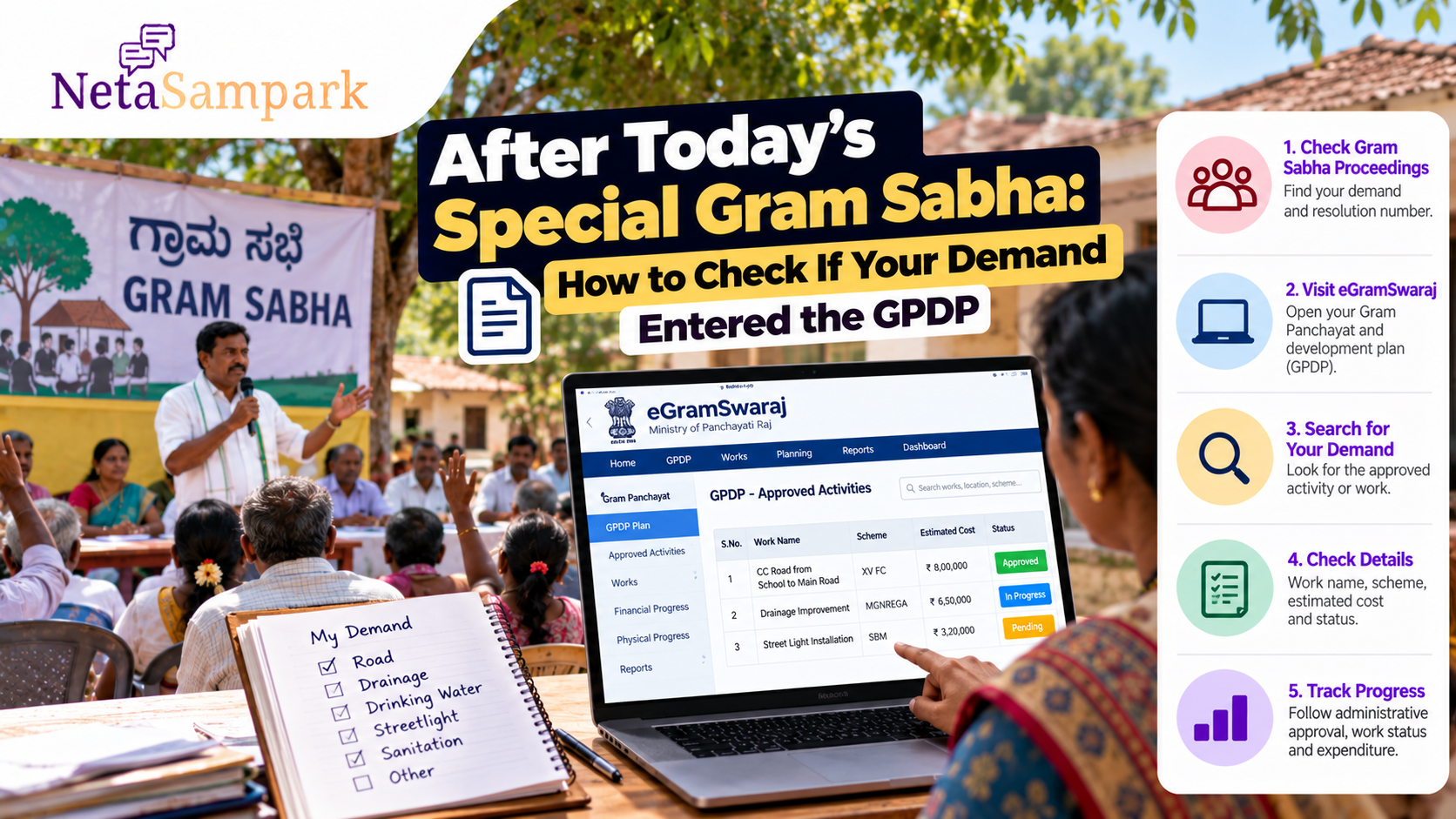
After Today’s Special Gram Sabha: How to Check If Your Demand Entered the GPDP
If you raised a road, drainage, drinking-water, streetlight, sanitation, housing, livelihood or other development issue in today’s Special Gram Sabha, the discussion itself is not the final step.
Your demand needs to move through the Panchayat planning process before it becomes an approved activity or work.
The 2 October 2026 Special Gram Sabhas are part of the People’s Plan Campaign, “Sabki Yojana, Sabka Vikas”, through which Gram Panchayats are preparing development priorities for the next planning cycle. The Ministry of Panchayati Raj has asked Panchayats to use citizen participation and feedback to identify local needs and priorities. TwStalker
The key question now is:
Did your demand actually enter the Panchayat plan, or was it only discussed in the meeting?
Here is how to follow it.
First: Understand What “Entered the GPDP” Means
There are several stages between making a demand and seeing a project on the ground.
A simplified process looks like this:
Citizen raises issue
↓
Gram Sabha discusses the demand
↓
Demand/priority is included in Panchayat planning
↓
Panchayat prepares and approves the development plan
↓
Approved activities are entered into eGramSwaraj
↓
Administrative/technical approvals and funding
↓
Work begins
↓
Progress and expenditure are recorded
The Ministry of Panchayati Raj describes eGramSwaraj as the system used for decentralised planning, work-based accounting and monitoring. It specifically states that works approved in the Gram Sabha are entered as activities on eGramSwaraj by Panchayati Raj Institutions. Panchayat Raj Ministry
So “the Sarpanch said yes” is not the same thing as “the work is in the GPDP.”
Step 1: Write Down Exactly What You Asked For
Before checking any online record, keep a written note of your demand.
For example:
“Repair and blacktop the road from the school to the main junction in Ward 4.”
Or:
“Construct a drainage line along the 200-metre stretch near the anganwadi.”
Record:
- Your Gram Panchayat
- Ward number
- Village/hamlet
- Date of the Gram Sabha
- Nature of the demand
- Exact location
- Approximate length/area, if relevant
- Name of the scheme suggested, if one was discussed
- Any resolution or agenda number mentioned during the meeting
If you submitted a written application, keep a copy or photograph of it.
This makes it much easier to identify the corresponding activity later.
Step 2: Check the Gram Sabha Proceedings
The first document to ask for is the Gram Sabha proceedings/minutes.
This is important because a demand can be discussed during the meeting without being accepted as a priority.
Look for:
- Your issue in the proceedings
- Resolution number
- Whether the demand was accepted
- Whether it was recommended for inclusion in the development plan
- Any proposed scheme or funding source
- Any beneficiary list, if applicable
If the Panchayat maintains an attendance register and resolution book, these records can also help establish what was discussed.
Ask the Panchayat One Simple Question
Instead of asking:
“Will you fix this?”
ask:
“What is the resolution number under which this demand was included in the Panchayat plan?”
That question moves the conversation from a verbal assurance to a record.
Step 3: Check eGramSwaraj
The next important place to check is eGramSwaraj, the Ministry of Panchayati Raj's digital platform.
Open eGramSwaraj through the Ministry of Panchayati Raj
The Ministry says eGramSwaraj brings together Panchayat planning, work progress and financial information, and includes citizens as one of its intended user groups. Panchayat Raj Ministry
The platform can therefore become an important way to check whether an approved activity has moved into the digital planning and implementation record.
What You Are Looking For
Depending on the stage of planning and the information published for your Panchayat, look for entries relating to:
- Your Gram Panchayat
- Planning year
- Development plan
- Approved activities
- Works/projects
- Scheme or funding source
- Estimated cost
- Administrative approval
- Technical approval
- Physical progress
- Financial expenditure
Don't worry if your exact wording from the Gram Sabha does not appear.
A demand such as “fix the broken village road” may appear in the system under a formal work description such as “CC Road from X to Y” or another technical description.
Step 4: Match the Location, Not Just the Name
This is one of the easiest ways to make a mistake.
Suppose your demand was:
“Drainage from the temple to the school.”
You find an activity online called:
“Drain improvement work – ₹8 lakh.”
That does not automatically prove it is your demand.
Check:
Location + work type + estimated amount + implementing Panchayat
together.
If the location corresponds to the area discussed in the Gram Sabha, you have stronger evidence that the demand has moved into the plan.
Step 5: Don't Expect Every Demand to Appear Immediately
This is particularly important after today's meeting.
The 2 October Special Gram Sabha is part of the planning process, rather than a promise that every issue raised that day will immediately appear as an approved eGramSwaraj work.
The Ministry's eGramSwaraj description explains that the Gram Sabha proposes a plan of works and that approved works are subsequently entered as activities by Panchayats. Panchayat Raj Ministry
Therefore, if you check immediately and cannot find your demand, that does not by itself prove that it was rejected.
The plan may still be moving through:
- Consolidation of Gram Sabha suggestions
- Panchayat-level planning
- Prioritisation
- Approval
- Budget allocation
- Entry into the digital system
The Ministry has also published specific guidance for Panchayat Planning for FY 2026–27 on eGramSwaraj. Panchayat Raj Ministry
GPDP vs Work Entry: Know the Difference
There are at least three different things citizens often call “the plan.”
1. Demand
You raise an issue.
Example:
“Please repair the road.”
2. Development-plan priority
The Panchayat includes the requirement in its planning process.
Example:
“Road connectivity improvement – Ward 4.”
3. Approved activity/work
The requirement becomes a specific activity that is entered into the system and can move toward implementation.
Example:
“CC road from Government School to Main Road – 350 metres.”
The third stage is much easier to track because it can have details such as cost, scheme, approvals and progress.
What If Your Demand Is Missing?
Don't immediately assume it has been rejected.
Go back to the Panchayat and ask:
“Was this demand included in the Gram Sabha proceedings?”
Then:
“Was it recommended for inclusion in the GPDP?”
And finally:
“If approved, what is the eGramSwaraj activity number or work name?”
These three questions establish where your request stopped.
If They Say “It Was Not Approved”
Ask:
Why?
The reason could be:
- Outside Panchayat jurisdiction
- Insufficient funds
- Different department responsible
- Duplicate work already sanctioned
- Technical feasibility issue
- Priority given to another requirement
- Beneficiary eligibility issue
- Requirement to use a particular government scheme
Ask whether the reason can be recorded or provided in writing.
Some Issues May Belong to Another Department
Not every village problem is a Gram Panchayat work.
For example, depending on the state and local administrative structure, responsibility could fall to:
- Rural development department
- Public Works Department
- Rural water supply agency
- Electricity utility
- Education department
- Health department
- Block administration
- District administration
If the Gram Sabha identifies the issue but another department is responsible, ask:
“Has this demand been forwarded to the responsible department, and what is the reference number?”
That gives you another tracking point.
If Your Demand Is for a Beneficiary
Individual or family-benefit demands work somewhat differently.
Examples include:
- Housing assistance
- Individual sanitation facilities
- Livelihood support
- Pensions
- Agricultural assistance
- Other scheme benefits
For these, inclusion in a GPDP does not necessarily mean automatic approval for the benefit.
You may still need to satisfy the relevant scheme's eligibility requirements and submit the required application/documents.
For example, Panchayat-level beneficiary projects can require separate applications and supporting documents. A current Panchayat example shows beneficiary projects being handled through prescribed applications and eligibility documentation. Chirakkara Panchayat
Ask for the Resolution Number
This is probably the most useful thing you can do after the Gram Sabha.
A resolution number gives you something concrete to follow.
Keep a note like this:
| Detail | Your record |
|---|---|
| Gram Panchayat | __________ |
| Ward | __________ |
| Gram Sabha date | 2 October 2026 |
| Demand | __________ |
| Resolution No. | __________ |
| Proposed scheme | __________ |
| Estimated cost | __________ |
| eGramSwaraj activity | __________ |
| Responsible department | __________ |
| Current status | __________ |
Once you have this information, following up becomes much easier.
What “Approved” Does Not Mean
Even if your demand appears in eGramSwaraj, don't assume that construction will start immediately.
An activity can still require:
- Technical approval
- Administrative approval
- Funding
- Work order
- Implementing agency
- Procurement or execution process
The Ministry's description of eGramSwaraj separates planning, technical/administrative approval, physical progress and financial progress. Panchayat Raj Ministry
So there is an important difference between:
“Included in the plan”
and
“Work has started.”
How to Check Whether Work Has Actually Started
Once the activity appears, keep checking its status.
Look for information relating to:
Planned → Approved → In progress → Completed
Where available, also check:
- Sanctioned amount
- Expenditure
- Physical progress
- Completion status
- Asset information
This is where eGramSwaraj becomes more useful than simply asking for verbal updates.
The Ministry says the system is designed to support end-to-end digitisation from development-plan creation through geo-tagged physical progress and financial tracking. Panchayat Raj Ministry
Take a Screenshot
If you find your work online, save a screenshot showing:
- Panchayat name
- Work/activity name
- Financial year
- Activity/work number
- Amount
- Status
Keep it with your Gram Sabha documents.
If the status later changes, you have a dated record of what was shown earlier.
A Simple Follow-Up Timeline
You don't need to visit the Panchayat every day.
Use this approach:
Today — 2 October
Record your demand and Gram Sabha resolution details.
After the proceedings are prepared
Obtain/check the relevant minutes or resolution.
During plan preparation
Ask whether the demand has been recommended for the GPDP.
After activities are entered
Search eGramSwaraj for the corresponding work.
After approval
Track sanction, cost and implementation status.
During execution
Check physical progress against the approved work.
After completion
Check whether the work is marked completed and whether the expected asset/work exists on the ground.
What to Do If Nobody Gives You an Answer
Start with the Gram Panchayat office.
Ask for the:
- Gram Sabha proceedings
- Relevant resolution number
- Panchayat development-plan entry
- eGramSwaraj activity/work number
- Current status
If the issue is not handled at the Panchayat level, ask the Panchayat Secretary/PDO or appropriate Block-level official which authority is responsible.
For a formal information request, citizens can also use the applicable Right to Information process to seek records such as approved proceedings, resolutions and relevant planning documents.
Your 5-Minute Citizen Check
After today's Gram Sabha, save these five questions on your phone:
1. Was my demand recorded?
2. What is the Gram Sabha resolution number?
3. Was it recommended for the GPDP?
4. What is the corresponding eGramSwaraj activity/work number?
5. What is its current implementation status?
If you can answer all five, you are no longer relying only on a verbal promise.
The Bottom Line
A demand raised in a Gram Sabha is the beginning of the tracking process, not the end.
The Ministry of Panchayati Raj's eGramSwaraj system is intended to connect Panchayat planning with approved activities, progress reporting and financial information. Panchayat Raj Ministry
So after today's 2 October 2026 Special Gram Sabha, don't stop at “the Panchayat agreed.”
Get the resolution number, check the planning record, and then look for the corresponding eGramSwaraj activity.
That is how you can tell whether your village demand moved from a discussion in the Gram Sabha toward an actual development-plan commitment.