Loudspeakers After 10 PM During Navratri 2026? What the Noise Rules Say and How to Complain
Navratri celebrations often mean garba, devotional programmes, community events and loudspeakers continuing into the night. But “it is a festival” does not automatically mean that loudspeakers can operate all night.
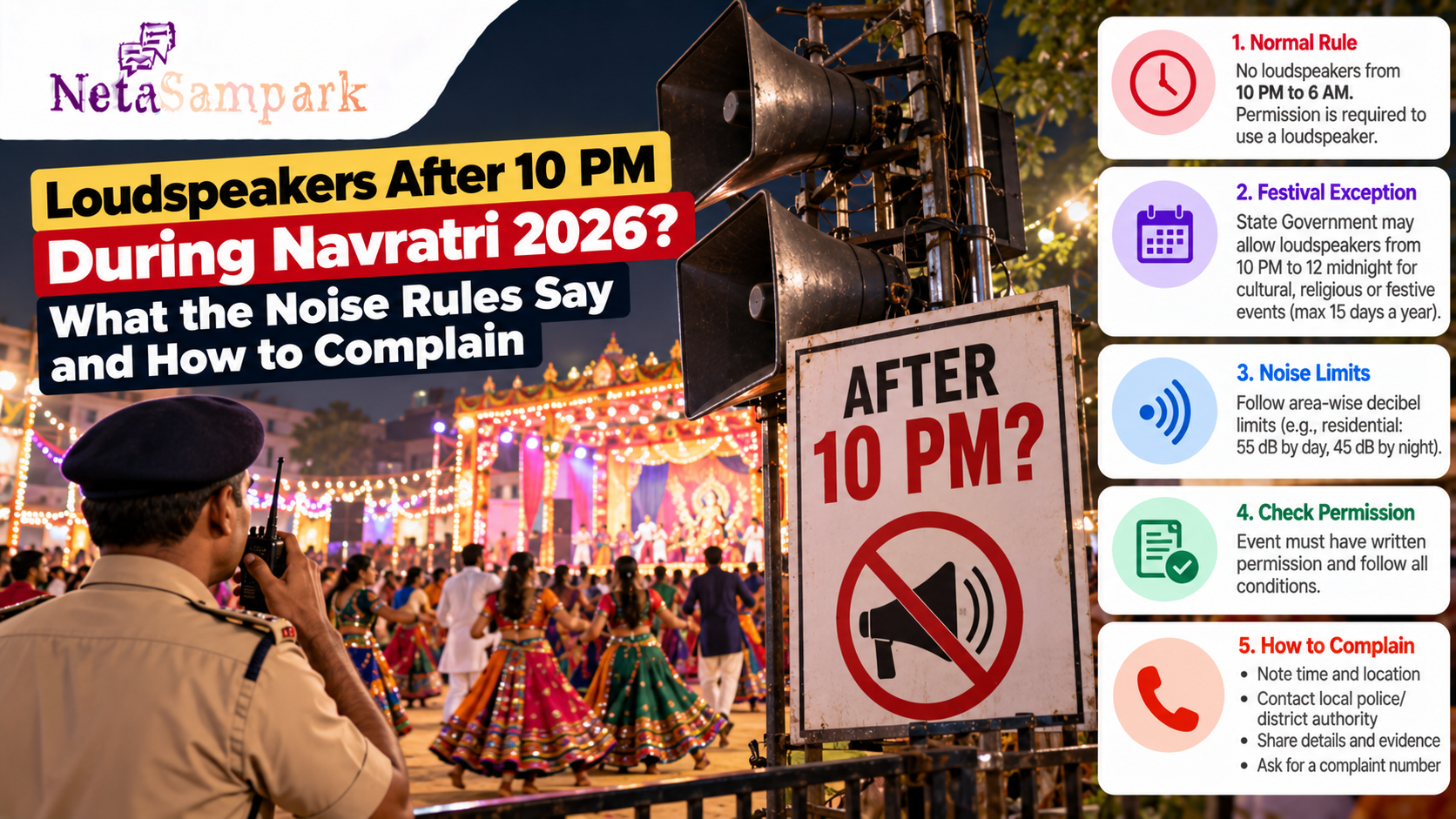
Under India's Noise Pollution (Regulation and Control) Rules, 2000, the normal night-time restriction runs from 10 PM to 6 AM. A loudspeaker or public-address system also requires written permission from the competent authority. Central Pollution Control Board
There is, however, a specific festival exemption: a State Government may allow loudspeakers during 10 PM to midnight on cultural, religious or festive occasions for a limited duration, subject to conditions and a maximum of 15 days in a calendar year. The relevant State Government or authorised district authority is expected to specify the exempted dates in advance. Central Pollution Control Board
So if a Navratri event is using loudspeakers after 10 PM, the key question is not simply “Is Navratri going on?” It is:
Was that particular night officially exempted, and does the event have the required permission?
What is the normal 10 PM rule?
The Noise Rules define:
- Day time: 6 AM to 10 PM
- Night time: 10 PM to 6 AM
As a general rule, loudspeakers and public-address systems cannot be used during night hours, except in specified closed-premises situations or a public emergency. Central Pollution Control Board
This means that a loudspeaker continuing at 10:30 PM is not automatically legal simply because the event began before 10 PM.
The restriction applies to its use during the night period.
Can Navratri get an exemption after 10 PM?
Yes, potentially — but not automatically.
Rule 5(3) allows a State Government to permit loudspeakers and public-address systems during 10 PM to 12 midnight for cultural, religious or festive occasions of limited duration, subject to conditions and a maximum of 15 days in a calendar year. Central Pollution Control Board
This is important because two different statements are often confused:
“The rules allow festival exemptions.”
and
“Every festival can use loudspeakers until midnight.”
The first is correct.
The second is not.
The exemption has to be actually exercised by the competent State/district authority for specified dates, and the event remains subject to the applicable conditions.
What about 12 midnight?
Even when a festival exemption is granted, the central rule's exemption window is 10 PM to midnight.
It is not a general permission to continue loudspeaker use throughout the night.
Therefore:
9:30 PM
Normally within the permitted daytime period, but the loudspeaker still requires written permission.
10:30 PM
Normally restricted unless the particular date is covered by a valid festival exemption.
11:45 PM
Could be permitted if the date has been officially exempted and all conditions are met.
12:15 AM
The festival exemption under Rule 5(3) does not extend beyond midnight.
That does not mean every noise after midnight automatically becomes a criminal offence in every circumstance; enforcement depends on the source, applicable rules/orders and facts. But a Navratri exemption cannot simply be stretched beyond its stated midnight limit.
Does a loudspeaker need permission even before 10 PM?
Yes.
This is another point frequently missed.
Rule 5(1) says a loudspeaker or public-address system cannot be used except after obtaining written permission from the authority. Central Pollution Control Board
So:
10 PM is not the time when permission becomes necessary.
Permission is required for the use of a loudspeaker/public-address system in the first place.
The 10 PM rule deals with the additional restriction on night-time use.
What are the noise limits?
The Rules prescribe different ambient noise standards depending on the area.
| Area/Zone | Day: 6 AM–10 PM | Night: 10 PM–6 AM |
|---|---|---|
| Industrial | 75 dB(A) | 70 dB(A) |
| Commercial | 65 dB(A) | 55 dB(A) |
| Residential | 55 dB(A) | 45 dB(A) |
| Silence zone | 50 dB(A) | 40 dB(A) |
These are ambient noise standards, not a simple rule saying that a loudspeaker can be turned up to that number. Central Pollution Control Board
For a public-place loudspeaker/public-address system, the Rules also provide that the noise level at the boundary of the public place should not exceed 10 dB(A) above the applicable ambient standard or 75 dB(A), whichever is lower. India Code
So a venue cannot justify excessive volume simply by saying:
“We have permission to use the loudspeaker.”
Permission does not erase the applicable noise-control conditions.
What is a silence zone?
A silence zone is a specially regulated area around certain sensitive premises.
The Rules refer to areas around institutions such as:
- Hospitals
- Educational institutions
- Courts
A silence zone has to be notified by the competent authority; it is not automatically created merely because a hospital or school happens to be nearby. Central Pollution Control Board
Noise restrictions are particularly stringent in such areas.
If a Navratri stage, procession or loudspeaker is near a notified silence zone, check whether additional restrictions apply.
Does religious freedom mean there can be unlimited loudspeaker use?
No.
The Supreme Court has repeatedly dealt with noise pollution in the context of religious and cultural activities.
In Church of God (Full Gospel) in India v. K.K.R. Majestic Colony Welfare Association, the Supreme Court held that a religious activity cannot claim an unrestricted right to create noise that disturbs others. Sci API
The Court has also recognised the importance of maintaining restrictions on night-time noise and has considered the statutory festival exemption within that framework. Sci API
The practical takeaway is:
The festival can continue. Religious activity can continue. But noise-control laws still apply.
What if the organisers say, “The police gave us permission”?
Ask what permission was actually granted.
A permission to hold a cultural or religious programme is not necessarily the same thing as permission to use a loudspeaker during restricted hours.
Depending on local procedure, there may be separate conditions concerning:
- Loudspeaker/public-address system
- Event timing
- Sound level
- Route
- Traffic
- Public safety
- Fire safety
- Crowd management
The relevant written permission and conditions matter.
What if the loudspeaker is still running after midnight?
If a Navratri exemption applies, the central festival exemption only covers the period between 10 PM and midnight. Central Pollution Control Board
If the sound continues after midnight, you can report the ongoing violation to the local enforcement authority.
You don't have to personally determine the exact legal classification before complaining.
Give the authorities:
- Exact location
- Date
- Time
- Nature of the sound
- Whether it is continuing
- Approximate distance from your home
- Whether it appears to be a loudspeaker/public-address system
- Any available photo/video evidence, if safely obtained
Can you complain even if you don't know the decibel level?
Yes.
This is important.
Rule 7 specifically permits a person to make a complaint where the noise exceeds the prescribed ambient standard by 10 dB(A) or more or where there is a violation of the Rules concerning night-time restrictions. India Code
So you do not need to own a professional sound meter before reporting a loudspeaker operating during a prohibited period.
If you know that a loudspeaker is operating at 11:30 PM, report:
“Loudspeaker/public-address system is being used after 10 PM at [location]. Please verify whether the date is covered by a valid Rule 5(3) exemption and whether the event has the required permission and complies with applicable noise limits.”
That is much stronger than simply saying:
“The music is too loud.”
Who can you complain to?
The Noise Rules define the enforcement “authority” to include a District Magistrate, Police Commissioner or other designated police officer not below the rank of Deputy Superintendent of Police, depending on the applicable arrangement. Central Pollution Control Board
In practice, for an ongoing loudspeaker disturbance, the most immediate route is usually the local police/emergency control room, especially when the violation is happening at that moment.
You can also approach the relevant:
- District administration
- Police authority
- State Pollution Control Board
- Pollution Control Committee, where applicable
- Other authority designated under local rules
The appropriate channel can vary by State and city.
If the noise is happening right now
Don't wait until the next morning if the problem is an ongoing night-time disturbance.
Step 1: Note the time
Write down:
10:15 PM, 10:45 PM, 11:30 PM, 12:15 AM, etc.
The timing can be important.
Step 2: Note the exact location
For example:
“Community hall beside XYZ Road, Ward 12.”
A landmark can help police locate the source quickly.
Step 3: Make a complaint
Use the local police control room/official complaint channel.
If your city has an online civic or police complaint system, you can use that as well.
Step 4: Ask for a complaint/reference number
Save it.
Step 5: If it continues, update the complaint
Tell the authority that the sound is still continuing and give the latest time.
Should you record a video?
You can preserve evidence from a safe location, provided doing so does not create a confrontation or put you at risk.
Useful evidence can include:
- Short video showing the source/location
- Timestamp
- Photographs of the event from a safe public/private location
- Screenshots of online event announcements
- Copies of permission notices, if publicly displayed
- Complaint/reference number
You do not need to approach the organisers or argue with them to collect evidence.
Your safety is more important than obtaining a recording.
What should you write in the complaint?
You can keep it simple.
Sample complaint
Subject: Complaint regarding loudspeaker use after 10 PM
Loudspeaker/public-address system is being used at [exact location] on [date] and is continuing after 10 PM. The sound is causing disturbance to residents in the surrounding area.
Please verify whether this date is covered by any notified festival exemption under Rule 5(3) of the Noise Pollution (Regulation and Control) Rules, 2000, and whether the organisers have the required written permission and are complying with applicable noise limits and conditions.
Kindly take appropriate action if there is a violation.
Location:
Date/time:
Contact details, if required:
This wording is useful because it asks the authority to verify the legal position, rather than making a claim you may not be able to prove yourself.
What if the police say, “It is Navratri, so it is allowed”?
You can politely ask:
“Could you please confirm whether this particular date is covered by the State's notified festival exemption and whether the event has the required permission?”
That is a reasonable question.
The Noise Rules do not create a blanket provision saying all Navratri nights are exempt. The State Government may permit the additional 10 PM–midnight use subject to the conditions in Rule 5(3). Central Pollution Control Board
What if the organisers have a valid exemption?
Then the situation is different.
A valid festival exemption can permit loudspeaker/public-address use between 10 PM and midnight on the specified dates.
But the organisers still have to comply with the terms and conditions imposed to reduce noise pollution. Central Pollution Control Board
So an exemption is not necessarily:
“Anything goes until midnight.”
The applicable sound limits, written permission and other conditions still matter.
What if the event is inside a closed hall?
The Rules specifically provide an exception for night-time use of loudspeakers/public-address systems inside closed premises for communication within places such as auditoria, conference rooms, community halls and banquet halls. Central Pollution Control Board
But this should not be misunderstood as permission to blast sound from a closed hall into the neighbourhood.
If the sound is escaping into surrounding residential areas at an excessive level, the applicable noise standards and enforcement provisions remain relevant.
Can a resident complain about a private party too?
Yes, the Noise Rules are not limited to Navratri programmes.
They regulate noise from various sources.
For privately owned sound systems, the Rules provide that the peripheral noise level at the boundary of the private place should not exceed the applicable ambient noise standard by more than 5 dB(A). India Code
So a loud residential party is not automatically exempt simply because it is happening on private property.
What if the complaint is about drums rather than a loudspeaker?
The rules cover more than electronic loudspeakers.
The restrictions and enforcement provisions address various sound-producing instruments and activities, including amplified sound and other sources of noise. India Code
If the problem is a drum procession, DJ, amplifier, band or another sound source, describe the actual source when making the complaint.
Don't confront the organisers
If the event is close to your home and the sound is disturbing you, it can be tempting to walk over and argue with the organisers.
That is usually unnecessary.
Instead:
Document → complain → save the complaint number → follow up.
If the event is large, crowded or emotionally charged, avoid direct confrontation.
What residents should remember during Navratri 2026
| Question | Answer |
|---|---|
| Is 10 PM the normal night cut-off? | Yes |
| Can loudspeakers be used without written permission? | No |
| Can States allow festival use after 10 PM? | Yes, subject to Rule 5(3) |
| Maximum festival exemption period? | 15 days in a calendar year |
| How late can that exemption extend? | Up to midnight |
| Does every Navratri night automatically qualify? | No |
| Can residents complain about night-time violations? | Yes |
| Do you need your own sound meter? | No |
| Should you confront organisers? | No — use official channels |
The underlying rules and enforcement framework come from the Noise Pollution (Regulation and Control) Rules, 2000. Central Pollution Control Board
The bottom line
Navratri does not automatically cancel India's night-time noise rules.
The normal position is that loudspeakers/public-address systems cannot be used during 10 PM–6 AM, and their use requires written permission. A State Government can, however, permit use between 10 PM and midnight on specified cultural, religious or festive occasions for a maximum of 15 days in the year, subject to conditions. Central Pollution Control Board
So if a loudspeaker is running after 10 PM during Navratri 2026, don't assume either that it is definitely illegal or definitely legal.
Check whether that date has been officially exempted, whether the organisers have the required permission, and whether the applicable noise conditions are being followed.
If the sound is continuing and causing a night-time disturbance, record the location and time, contact the local police/enforcement authority, ask for a complaint number and preserve your evidence.
The law protects the right to celebrate — but it also recognises the public's right to reasonable peace and protection from excessive noise. Sci API