
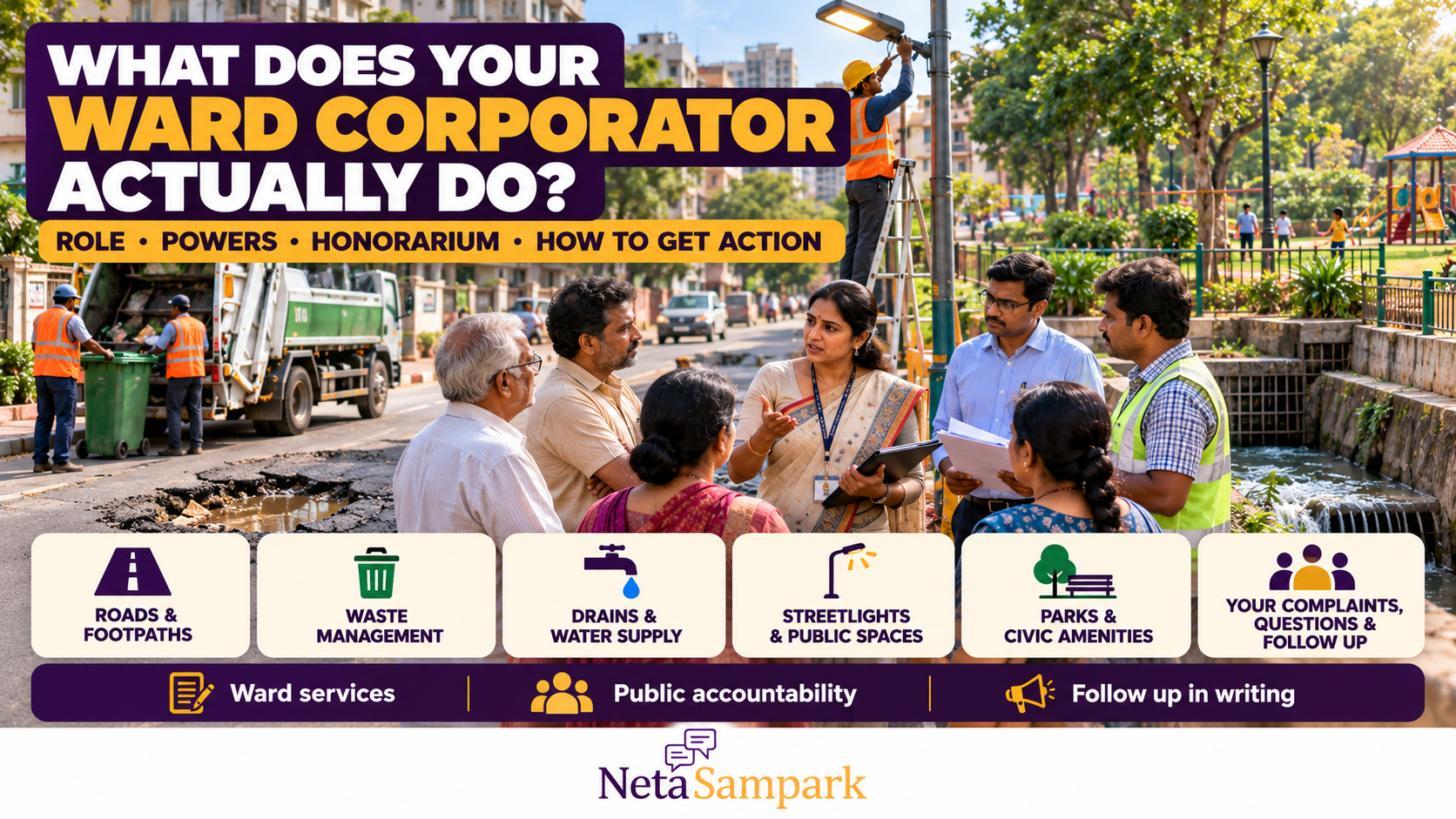
What Does Your Ward Corporator Actually Do? Role, Powers, Honorarium and How to Get Them to Act
A garbage pile sits outside your apartment for days. A streetlight has stopped working. The road outside your home is full of potholes, or rainwater keeps flooding your street.
You complain in your residents’ WhatsApp group. Someone says, “Ask your corporator.” But what can a ward corporator actually do? Can they order officials to fix a road, sanction development work, or force a department to act? And how much do they get paid?
Your ward corporator is one of the elected representatives closest to your everyday civic problems. But the role has limits: a corporator represents residents, raises local issues and helps hold the municipal administration accountable; municipal officials generally carry out the work.
Here is how the system works, with Bengaluru and Karnataka examples, and a practical way to get a complaint taken seriously.
1 Who is a ward corporator?
A ward corporator—also called a municipal councillor—is an elected representative of a ward within a municipal corporation.
A city is divided into wards for local representation. Residents registered as voters in a ward elect a representative to the municipal corporation, subject to the applicable election law and ward structure.
The corporator represents the ward’s interests in the municipal council and raises concerns about local services, infrastructure, budgets and civic administration.
In Bengaluru, the familiar term “BBMP corporator” comes from the former Bruhat Bengaluru Mahanagara Palike structure. Karnataka’s Greater Bengaluru governance framework provides for city corporations under the Greater Bengaluru Authority. The exact corporation, ward boundaries and administrative contacts residents should use depend on the applicable arrangements in their area.
A corporator is not the same as:
- An MLA: Represents an Assembly constituency in the Karnataka Legislative Assembly.
- An MP: Represents a parliamentary constituency in Parliament.
- A municipal commissioner: A senior administrative official responsible for implementing municipal decisions and overseeing the corporation’s administration.
- A ward engineer or health inspector: An official responsible for particular civic services or technical and operational work.
If your streetlight is broken, your corporator can help raise and follow up on the issue. The relevant municipal department or contractor normally has to carry out the repair.
2 What does a corporator actually do?
A corporator’s responsibilities extend beyond attending council meetings. The job involves representing residents, scrutinising local works and raising questions about how civic services are delivered.
Roads, footpaths and public infrastructure
Corporators can raise concerns about:
- Potholes and damaged roads.
- Broken footpaths and unsafe pedestrian crossings.
- Poorly maintained public infrastructure.
- Incomplete or delayed municipal works.
- Unsafe road conditions that need the relevant authority’s attention.
They can ask the administration to inspect a location, raise the issue in the appropriate forum and follow up on a complaint.
However, not every road belongs to the municipal corporation. A road may fall under a state public works department, a development authority, a national highway authority or another agency. Identifying the responsible agency is often the first step towards getting the problem fixed.
Garbage collection and sanitation
Corporators can raise issues such as:
- Missed garbage collection.
- Waste dumped in public places.
- Overflowing community bins.
- Poor sanitation and cleaning.
- Delayed removal of waste.
- Problems affecting public health.
Municipal sanitation staff and contractors generally perform the operational work. A useful complaint includes the exact location, the type of waste, how long the problem has continued and whether it is recurring.
Stormwater drains and flooding
Drainage problems are especially important before and during the monsoon.
A corporator can raise concerns about blocked drains, damaged drain covers, waterlogging and neglected maintenance. The responsible engineering or stormwater-drain department must assess the site and arrange work within its authority.
For flooding caused by a major drain, lake outlet or infrastructure under another agency, the corporator may need to coordinate with that agency rather than act alone.
Streetlights and public safety
Broken streetlights, dark stretches and unsafe public spaces can be raised with the municipal administration.
Provide the pole number if one is visible, the nearest landmark and a photograph taken safely. If the streetlight is part of a network maintained by a separate electricity or infrastructure agency, the complaint may need to be directed there.
Parks, lakes and public spaces
Depending on ownership and the local administrative structure, corporators can raise concerns about:
- Poorly maintained parks.
- Damaged play equipment.
- Uncollected litter.
- Encroachment on municipal land.
- Neglected public spaces.
- Maintenance of public amenities.
Ownership matters. A lake or park may be managed by a separate authority, so ask which department is responsible before assuming that the corporation controls it.
Local development priorities
Corporators can help identify and advocate for ward-level priorities, such as road repairs, drainage improvements, public amenities and sanitation projects.
They may participate in council, standing committee and ward committee processes, as applicable. These forums can be used to raise concerns about project selection, budgets and implementation.
But a proposal is not the same as an approved project. Funding, administrative approvals, technical feasibility, procurement and the relevant department’s authority can all affect whether and when work happens.
3 What powers does a corporator have?
The precise powers depend on the state’s municipal legislation and the city’s governance structure.
Under the Bruhat Bengaluru Mahanagara Palike Act, 2020, Section 94 describes councillors’ powers, including drawing the proper authority’s attention to neglect in executing corporation work, waste of corporation property and the needs of a locality. It also provides for raising matters connected with corporation administration and representing the ward’s interests.
That distinction is important: a corporator has formal powers to raise civic issues and represent residents, but is not personally the executive authority for every municipal service.
| What a corporator can do | What usually requires administrative action |
|---|---|
| Raise a complaint about neglected civic work | Inspect and execute the repair |
| Ask questions about municipal administration | Provide the technical or official response |
| Advocate for ward development priorities | Approve and release funds under the applicable process |
| Follow up with the relevant department | Assign staff or contractors to perform the work |
| Raise concerns about delays and poor service | Take disciplinary or contractual action through authorised officials |
| Participate in ward and council processes | Issue permits or enforce regulations through the competent authority |
A corporator’s influence can be useful, especially when an issue needs coordination or public accountability. But the representative cannot lawfully bypass every technical, financial or statutory requirement.
4 What is a ward committee, and why should residents care?
A ward committee is a local governance forum intended to connect residents, elected representatives and the municipal administration.
Under Karnataka’s municipal framework, ward committees have roles relating to local development priorities, civic services and monitoring municipal programmes. Bengaluru’s Greater Bengaluru governance legislation also provides for ward committee functions, including preparing ward development proposals and plans, inviting public participation and monitoring the use of funds allocated for ward-level work.
A functioning ward committee can help residents move beyond individual complaints towards shared priorities.
For example, if several streets have recurring flooding, residents can ask that the problem be discussed as a ward-level issue rather than treating each incident as unrelated.
Residents can ask:
- When is the next ward committee meeting?
- How can residents submit an item for the agenda?
- What development priorities have been proposed for the ward?
- Which projects have been approved and funded?
- What progress has been recorded against those projects?
- Where can residents access meeting notices and minutes?
The applicable meeting procedure and access arrangements can vary. Check the relevant city corporation’s official channels for current notices, rules and contact details.
5 How much honorarium does a corporator receive?
A corporator generally receives an honorarium, fees or allowances as determined under the applicable state law and government decisions. The amount should not be assumed to be the same across every city or state.
In Karnataka, the legal framework provides for honoraria, fees or allowances for municipal corporation members. For Bengaluru, the former BBMP council’s corporators were reported to have received ₹7,500 per month before the transition to the Greater Bengaluru governance structure.
That historical amount should not be treated as a verified current payment rate for every corporator under the new city corporations. Changes in governance arrangements, government decisions and the applicable corporation rules can affect the amount.
To verify the current rate, look for the latest government order or official disclosure from the relevant city corporation or Karnataka’s Urban Development Department. Ask for the monthly honorarium, applicable allowances and the order under which they are paid.
Is an honorarium the same as a salary?
Not necessarily. The law may describe the payment as an honorarium, fees or allowances rather than a conventional employee’s salary. The exact entitlement depends on the applicable legislation and government decisions.
The fact that a corporator receives an honorarium does not mean residents are paying for a personal favour when they request civic work. Municipal services are delivered through public institutions and approved budgets, not through private payments to an elected representative.
Never pay a corporator or an intermediary for a promise to get routine civic work done. If anyone demands money in exchange for official action, preserve the evidence and consider reporting the matter to the appropriate vigilance or law-enforcement authority.
6 Your corporator has not responded. What should you do?
Repeatedly sending “Please fix this” messages in a WhatsApp group may not create a traceable complaint. A stronger approach is to document the issue, send it to the right department and keep a record of every follow-up.
Step 1: Identify the exact problem
Record:
- The street name and nearest landmark.
- The ward, if known.
- The date you first noticed the issue.
- A clear photograph or short video.
- The impact on residents, pedestrians or public health.
- Any earlier complaint number.
For example, “There is a drainage problem” is less actionable than “The stormwater drain beside the bus stop on X Road has been blocked for six days, causing water to overflow onto the footpath.”
Step 2: File a complaint with the responsible authority
Use the official complaint channel of the relevant municipal corporation or department. Choose the category that best matches the problem and save the acknowledgement or ticket number.
If the issue is outside municipal jurisdiction, ask which agency is responsible and submit the complaint there as well.
For Bengaluru, start with the official website or grievance channel of the city corporation responsible for your area. Do not assume that an older BBMP contact number or portal still handles every issue under the revised governance structure.
Step 3: Send the complaint to your corporator
Share the complaint number, location and evidence with the corporator’s office.
Ask for a specific action rather than a general assurance. For example:
“Please help get this complaint inspected by the responsible department and share the officer or department handling it, along with the expected next step.”
This makes it easier to distinguish a representative’s follow-up from the department’s actual response.
Step 4: Follow up in writing
If the issue remains unresolved, reply to the original complaint or submit a written reminder. Include the original ticket number and explain what has happened since the first report.
Ask for:
- The current status.
- The department or officer responsible.
- Whether an inspection has taken place.
- The reason for any delay.
- The next action and expected timeline, if available.
Keep your language factual. A clear paper trail is more useful than an argument.
Step 5: Escalate if there is no action
Use the department’s formal escalation or grievance-redressal process. If a complaint is closed without resolving the problem, explain why the closure is unsatisfactory and provide updated evidence.
For Bengaluru, verify the current escalation structure through the relevant city corporation’s official website. A complaint about a municipal road, a water-supply interruption and an electricity fault may each require different escalation channels.
If you need records such as inspection reports, work orders, sanctioned estimates or action-taken reports, you can consider filing an application under the Right to Information Act, 2005, with the appropriate public authority. RTI can help obtain records; it is not a substitute for an urgent service complaint.
7 A complaint template residents can copy
Use this template for a complaint to the municipal department, with a copy to your ward corporator.
Subject: Request for action on [civic issue] at [location]
Dear Sir/Madam,
I am reporting a civic issue at [exact location and nearest landmark] in [ward/locality].
Problem: [Describe the issue clearly.]
First noticed on: [Date]
Impact on residents: [Explain the inconvenience, safety risk or public-health concern.]
Previous complaint number: [Reference number, if any]
I request that the responsible department inspect the location, take the necessary action and provide the complaint status and next steps in writing.
Photographs and supporting details are attached.
Please acknowledge this complaint and share the reference number for future follow-up.
Regards,
[Your name]
[Contact details, if you wish to provide them]
Keep a copy of the message and attachments. Avoid publishing personal information about residents or staff unnecessarily.
8 What residents should expect from a good corporator
A responsible corporator does not have to personally repair every pothole or clear every drain. The role is to represent residents, raise legitimate issues, engage with the administration and seek accountability for municipal services.
Residents can reasonably ask their representative to:
- Explain which authority is responsible for an issue.
- Help route complaints to the right department.
- Raise recurring problems through appropriate municipal forums.
- Share information about ward priorities and approved projects.
- Follow up on unresolved complaints.
- Communicate what has been done and what remains pending.
At the same time, residents should expect honest explanations when a project needs approval, funding or action from another agency. An assurance that “it will be done” is not the same as an official work order or completed repair.
Frequently Asked Questions
Can a corporator order a municipal engineer to repair my road?
A corporator can raise the issue with the proper authority, represent the ward and follow up through the applicable process. The responsible department must carry out the work under its legal and administrative powers.
Can a corporator sanction funds for my street?
A corporator can advocate for local priorities and participate in ward or council processes. Whether funds are approved and released depends on the applicable budget, scheme, delegation of powers and administrative procedures.
Can I complain directly to the corporator without filing a municipal complaint?
Yes, you can contact your representative directly. However, filing an official complaint creates a reference number and a record that can be used for follow-up and escalation.
What if the corporator is not responding?
Keep the complaint on record with the responsible department, follow the official grievance process and send the corporator a written reminder with the complaint number. Escalate through the relevant authority if the issue remains unresolved.
Does a corporator handle every problem in a ward?
No. Municipal corporations handle many local services, but roads, water, electricity, lakes, transport and other infrastructure may be controlled by different agencies. Confirm the responsible authority for the specific issue.
The bottom line
Your ward corporator is a key link between residents and the municipal administration, but the role is not unlimited. Corporators can represent your ward, raise civic failures, participate in development planning and follow up on unresolved complaints. Municipal departments and other competent authorities generally have to approve, organise and execute the work.
For residents, the most effective approach is straightforward: document the problem, file an official complaint, share its reference number with your corporator, follow up in writing and escalate through the correct authority if nothing changes.
Official references
- Bruhat Bengaluru Mahanagara Palike Act, 2020 — Karnataka Act No. 53 of 2020
- Greater Bengaluru governance legislation — Karnataka Act No. 36 of 2025
- BBMP official Acts and Bye-laws page
- BBMP Council information and historical disclosures
Note: Municipal powers, ward boundaries, complaint channels and honorarium rates can change. Residents should confirm the latest applicable law, government orders and administrative arrangements with the responsible city corporation.