
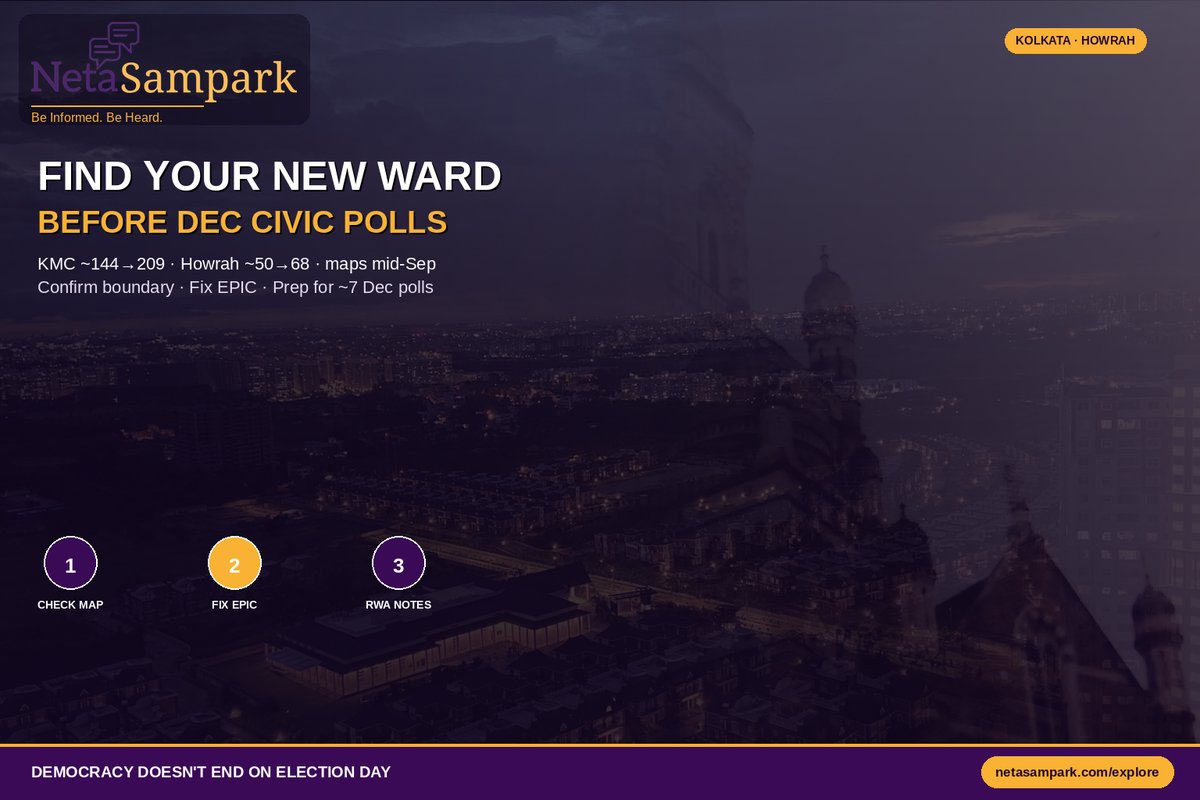
Quick take: When ward boundaries change, your address doesn't move—but your ward number can.
That matters because your ward determines which councillor represents you, which ward-level issues you should track, and sometimes which polling station or electoral-roll details you need to verify.
If you live in Kolkata or Howrah and ward delimitation has changed your neighbourhood, don't wait for election day to discover that your old ward number is no longer correct.
The safest approach is simple:
Find your address → identify the new ward → verify it against the official map/notification → check your electoral-roll details → save the result.
What ward delimitation actually means
Ward delimitation is the process of redrawing the boundaries of electoral wards.
A municipal corporation may divide an area differently because of:
- population changes,
- expansion of the city,
- administrative changes,
- creation or alteration of wards,
- boundary rationalisation,
- changes in municipal jurisdiction.
The important point for residents:
Your old ward number is not necessarily your new ward number.
A neighbour living two streets away may remain in one ward while your building moves into another.
Don't assume the previous councillor is still your ward representative.
Kolkata and Howrah are two different municipal systemsDon't treat them as one election map.
Kolkata
The relevant civic body is the Kolkata Municipal Corporation (KMC).
Howrah
The relevant civic body is the Howrah Municipal Corporation (HMC).
Their ward maps, notifications and administrative processes are separate.
So when searching for your ward, first establish:
Am I inside KMC or HMC?
Then use the corresponding official ward information.
Step 1: Start with your exact addressDon't search only:
"New Kolkata ward list"
That can produce old maps, political graphics and news articles from different delimitation exercises.
Write down:
- House / building number
- Road / street
- Locality
- Post office
- PIN code
- Police station, if known
- Existing ward number
For apartments and housing societies, use the actual municipal address, not just the society's informal name.
Step 2: Record your old ward numberYour old ward number is useful even if it is no longer correct.
You may find it on:
- previous municipal tax documents,
- voter information,
- old electoral-roll entries,
- property records,
- water/sewerage correspondence,
- previous councillor communications.
Write:
Old ward: ___
Then leave a separate blank:
New ward: ___
Do not overwrite the old number.
You may need both when comparing older complaints, election records or municipal documents.
Step 3: Find the official delimitation notificationThis is the document that matters.
Look for the official notification/map published by the appropriate authority.
For Kolkata, check the relevant Kolkata Municipal Corporation / West Bengal government / State Election Commission material.
For Howrah, check the corresponding Howrah Municipal Corporation / West Bengal government / State Election Commission material.
News reports can tell you that delimitation happened.
The official notification tells you where the boundary actually runs.
Step 4: Don't rely on the ward number aloneThis is one of the easiest mistakes.
Suppose someone tells you:
"You're in Ward 74."
That isn't enough.
You need to know why your address falls inside Ward 74.
A delimitation order may describe boundaries using:
- roads,
- lanes,
- canals,
- rivers,
- railway lines,
- municipal boundaries,
- plot or administrative references,
- neighbouring wards.
Read the boundary description carefully.
If your street forms the boundary between two wards, don't guess based on which side "looks closer."
Boundary roads deserve extra attentionImagine:
North side of Road X → Ward A
South side of Road X → Ward B
A resident may reasonably assume the entire road belongs to one ward.
It may not.
If your property sits near a newly drawn boundary, verify the exact location using the official map and electoral-roll information.
Step 5: Use the electoral roll as your second checkThe municipal ward map tells you the administrative boundary.
Your electoral-roll entry tells you where your voter record sits.
Use both.
Check:
- Name
- EPIC number
- Assembly constituency
- Part number
- Serial number
- Polling station
- Ward/local area information where shown
If your address is in a newly delimited ward but your voter information still appears inconsistent, don't wait until polling day.
Contact the appropriate election authority and ask how the electoral-roll record is being updated.
Don't confuse Assembly constituency with municipal wardThis is particularly important in Kolkata and Howrah.
You can have:
Lok Sabha constituency
↓
Assembly constituency
↓
Municipal corporation
↓
Municipal ward
These are different boundaries serving different electoral purposes.
Your Assembly constituency does not tell you your municipal ward automatically.
And your municipal ward does not tell you your Lok Sabha constituency.
When checking a civic election, use the municipal ward information, not simply the Assembly constituency name.
What if your old councillor says you're still in their ward?Verify independently.
Councillors, resident groups and local political workers may continue using old ward numbers because:
- they have years of local material,
- old complaint records use the previous number,
- residents still recognise the old number,
- new maps have not yet become common knowledge.
That doesn't make the information authoritative.
The notification and official election records should be your reference point.
What if two websites show different ward numbers?Don't panic.
First check the date.
One may show:
- an old delimitation,
- a proposed boundary,
- a draft notification,
- a final notification,
- an older election map.
For election purposes, you want the latest legally operative arrangement applicable to the upcoming civic election.
Look for words such as:
Draft
Proposed
Final
Notification
Published
Effective
A draft map is not necessarily the final map.
Build your own ward-proof folderOnce you identify your new ward, save four things.
1. Official map
Screenshot or PDF.
2. Notification
Save the relevant government/election notification.
3. Your electoral-roll information
Keep your EPIC and current voter details.
4. Address evidence
Keep one recent municipal/property/utility document showing your address.
Now you have a small evidence pack.
If someone disputes your ward later, you're not starting from a WhatsApp message.
The five-minute family checkIf several family members live at the same address:
Check everyone.
Don't assume that because one person's voter entry looks correct, every family member's record is identical.
Create a table:
Family memberEPICOld wardCurrent wardPolling stationCheckedPerson 1__________________☐Person 2__________________☐Person 3__________________☐
This becomes especially useful for elderly family members who may not regularly check electoral information.
What changes when your ward changes?Potentially, several things become important.
Your councillor
Your elected ward representative changes according to the new ward structure and election result.
Your ward-level civic contacts
Municipal ward offices and local administrative contacts may change.
Your civic accountability records
Old complaints remain historical records, but new complaints should use the current administrative details where required.
Your election information
Candidate lists, ward numbers and polling arrangements need to be checked against the new structure.
The key principle:
Don't carry yesterday's ward number into tomorrow's election paperwork without checking.What does NOT automatically change?
Ward delimitation does not mean you suddenly need to:
- change your Aadhaar,
- change every bank record,
- change your PAN,
- create a new voter identity,
- move your house registration.
A boundary change is primarily an electoral/administrative boundary change.
If another document needs updating because of a separate address or administrative change, follow that department's rules.
Don't start changing identity documents simply because your ward number changed.
If you're a tenantTenants should do the same check.
Your civic representation is tied to your electoral/address records—not to whether you own the apartment.
Keep:
- current address proof where applicable,
- voter details,
- EPIC,
- ward information.
If you've moved recently, don't assume your previous ward remains valid.
If your building is split near a boundaryThis is where residents should coordinate.
Ask:
Which house numbers are on each side?
Create a small list:
PropertySide of boundaryWard12ANorth___12BNorth___13South___14South___
If something doesn't make sense, take the list to the appropriate election/municipal office and ask for written clarification.
Don't settle a boundary dispute through a society WhatsApp poll.
After you find the new ward, find the new representativeBefore the election, you may be dealing with:
- delimitation officials,
- election authorities,
- existing councillors,
- municipal officers.
After the election, your elected representative will be determined by the result.
That's when your ward number becomes particularly useful.
Your civic issue should read:
Ward ___ — Road X — Complaint #1234
not:
"Somewhere near the old Ward 58."
Specificity makes follow-up easier.
Start a new ward issue registerOnce the new boundary is confirmed, create:
Ward ___ — Civic Issues
Track:
- issue,
- location,
- complaint number,
- date filed,
- responsible department,
- councillor follow-up,
- promised date,
- resolution.
This creates continuity from delimitation → election → representation → accountability.
What if you cannot find your new ward online?Use the official channels rather than guessing.
Try, in order:
- State Election Commission information
- Municipal corporation website
- Official delimitation notification/map
- Electoral-roll search
- Local election office
- Municipal ward office
When asking an official, give the complete address.
Don't simply ask:
"Which ward is this area?"
Ask:
"Please confirm the current municipal ward for House No. ___, Road ___, Locality ___, PIN ___ under the final delimitation applicable to the upcoming civic election."
That's a much easier question to answer accurately.
The neighbourhood testOnce you've identified your ward, ask three neighbours independently:
"What ward are you in?"
If all three give the same answer, good.
If you get:
58
72
old 58
new 72
that's your signal to check the official map again.
Neighbour knowledge is useful for spotting confusion.
It isn't the final authority.
Don't throw away your old recordsYour old ward number remains useful for historical information.
Keep it.
A five-year-old complaint may say:
Ward 41.
Your current ward might be:
Ward 57.
That doesn't mean the old complaint disappeared.
It means the administrative geography changed.
When escalating a historical issue, mention both:
"Previously Ward 41; now Ward 57 following delimitation."
That one sentence can save an official from wondering why your documents appear inconsistent.
Delimitation checklistBefore civic polling:
☐ Confirm KMC or HMC
☐ Write down your full address
☐ Record your old ward number
☐ Find the latest official delimitation notification
☐ Check the official ward map
☐ Confirm boundary streets carefully
☐ Check your electoral-roll entry
☐ Record your new ward number
☐ Confirm polling-station information separately
☐ Save screenshots/PDFs of the official sources
☐ Check elderly family members' records
☐ Update your civic issue register
If your ward changed, start fresh—but don't lose historyThink of delimitation as a reset of the map, not a reset of your civic memory.
Your new ward needs:
A new representative
A new contact list
A new issue tracker
But your old complaints, photographs and correspondence are still evidence.
Keep them.
The simplest rule
Before the next Kolkata or Howrah civic election, don't ask only:
"Who is my councillor?"
First ask:
"Which ward am I actually in?"
Then verify:
Ward → electoral roll → polling station → candidates → result → representative.
That chain is far more reliable than a forwarded election graphic.
Where NetaSampark fits
Delimitation changes who represents your address.
NetaSampark's representative layer can help you keep that information organised once the current ward structure and elected representatives are established.
The useful sequence is:
Know your ward.
Know your representative.
Know your municipal department.
Know your complaint number.
A changed boundary shouldn't mean a lost civic connection.
Be informed. Be heard.
Non-partisan civic explainer. Ward boundaries, final notifications, electoral-roll arrangements and polling details can change. Always verify your address against the latest official West Bengal State Election Commission and relevant municipal corporation information before polling.