
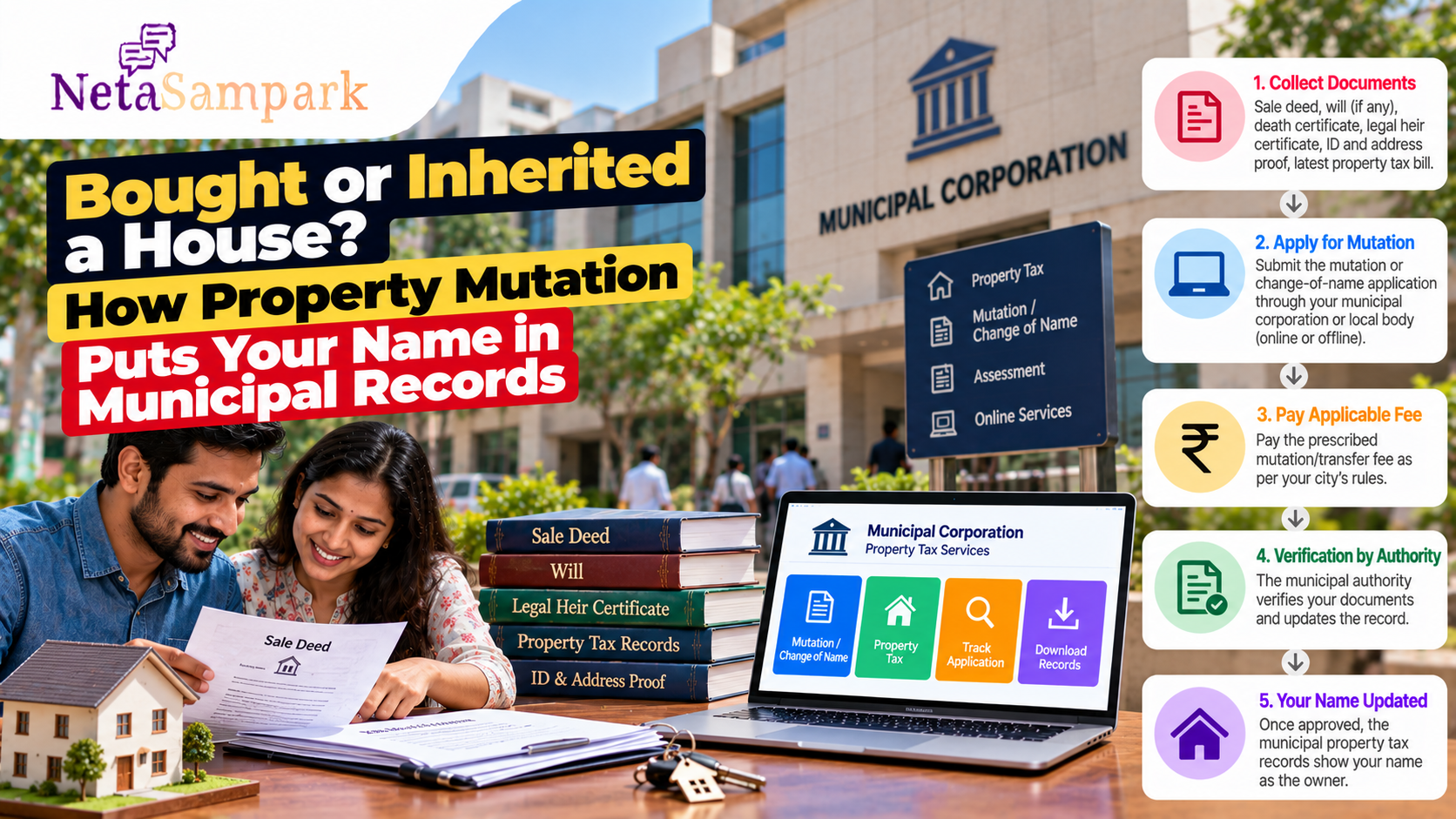
Bought or Inherited a House? How Property Mutation Puts Your Name in Municipal Records
Buying or inheriting a house does not automatically mean the municipal property-tax records will immediately show your name.
After acquiring a property, you may need to apply for mutation, transfer of property, or change of name with the relevant municipal authority. This updates the local body's records to reflect the new owner or person responsible for property-tax payments.
But there is an important distinction: mutation is an administrative record update; it is not, by itself, proof of ownership or title. The Supreme Court has repeatedly held that mutation entries are primarily for fiscal purposes and do not confer title.
What is property mutation?
Property mutation is the process of updating government records after a property changes hands.
Depending on the State or local authority, you may see terms such as:
- Property mutation
- Change of name
- Transfer of property
- Transfer of assessment
- e-Change of Name
- Mutation of property-tax records
The terminology differs, but the basic purpose is the same: update the authority's records after a sale, inheritance, gift, partition or another legally recognised transfer.
Why should you get the record changed?
Updating the municipal record can help ensure that:
- Property-tax bills are associated with the appropriate person.
- The municipal database reflects the current ownership/assessment details.
- Future property-tax transactions are easier to complete.
- You have an administrative record of the acquisition.
- Future sale, transfer or other property-related processes have consistent records.
For urban properties, this can be particularly important because the municipality may maintain a separate property-tax database even when the registered title document is held by the registration authority.
Mutation does not create ownership
This is the most important point to remember.
A mutation entry does not replace your sale deed, gift deed, succession documents or other title documents.
For example, if you purchased a house through a registered sale deed:
Registered sale deed → establishes the legal transaction
Municipal mutation → updates the municipal/property-tax record
Similarly, if you inherited a property:
Succession/inheritance documents → establish the basis of your claim
Mutation → updates the relevant administrative record
The Supreme Court has reiterated that mutation entries do not themselves create or extinguish title. Where there is a genuine ownership dispute, the appropriate legal forum may need to determine the underlying rights.
Bought a house? Here's what to do
If you purchased a house, your principal acquisition document will ordinarily be the registered sale deed.
The general process is:
Sale deed registered → Apply for mutation/change of name → Document verification → Record updated → Property-tax record reflects the change
Registration and municipal mutation may be separate processes, depending on the State and local authority.
The Department of Land Resources notes that mutation procedures are administered through the relevant State/UT systems and that some States provide online facilities.
Inherited a house? The process can be different
Inheritance does not normally involve a sale deed between the deceased owner and the heir.
Depending on the circumstances and local rules, you may need documents such as:
- Death certificate
- Will, if applicable
- Legal-heir or surviving-member certificate
- Succession-related documents
- Probate or letters of administration, where required
- Court order, where applicable
- Existing ownership documents
- Identity and address proof
- Latest property-tax records
The exact requirements depend on the State, municipality and manner of succession.
What if there is a Will?
A Will can form part of the documentation supporting an inheritance-based mutation.
However, mutation itself does not decide whether a disputed Will is legally valid or conclusively determine title.
If another heir challenges the Will or ownership, the dispute may require determination by the appropriate court.
Documents to keep ready
If you bought the property
Keep:
- Registered sale deed
- Registration details
- Previous title document, where available
- Property ID/assessment number
- Latest property-tax receipt
- Identity proof
- Address proof
- PAN, where required
- Application form
- No-dues certificate, if required by the local authority
If you inherited the property
Also keep:
- Death certificate
- Will, if applicable
- Legal-heir/succession documents
- Probate or court documents, where applicable
- Documents establishing the deceased person's ownership
Always check your municipality's current document list because requirements are not uniform across India.
How to apply for property mutation
1. Identify the correct authority
First determine which authority maintains the relevant record.
It could be:
- Municipal Corporation
- Municipality
- Nagar Panchayat
- Revenue Department
- Development authority
- Panchayat/local body
- Other designated property-tax authority
For an urban house, the municipal authority may handle property-tax mutation, while the State revenue department may separately maintain land records.
2. Find your property ID
Look at the existing property-tax bill.
You may find:
- Property ID
- Assessment number
- Holding number
- Khata number
- UPIC
- Account number
- Door number
Keep this number ready before starting the application.
3. Check for an online service
Many local authorities now provide online mutation or change-of-name facilities.
For example, the Municipal Corporation of Delhi provides an online Mutation/e-Change of Name in Municipal Record service.
If your municipality does not offer an online facility, follow its prescribed offline process.
4. Enter the property details
You may need to provide:
- Existing owner's name
- New owner's name
- Property address
- Property identification number
- Sale deed details
- Registration date
- Acquisition details
- Applicant's contact information
For inherited property, provide the relevant succession information instead.
5. Upload the documents
Upload or submit the documents requested by the authority.
Check that:
- Names are consistent.
- Property numbers are correct.
- Documents are readable.
- Sale-deed or succession details are entered correctly.
6. Pay the applicable fee
Some municipalities charge a mutation or transfer fee.
There is no single nationwide mutation fee. The amount depends on the applicable State or local-body rules.
Use the official municipal portal or office to verify the current fee.
7. Save the acknowledgement
After submission, save:
- Application number
- Acknowledgement
- Payment receipt
- Submitted form
- Uploaded documents
Use the application number to track the status if an online tracking facility is available.
What happens after you apply?
The authority may verify:
- Property details
- Acquisition/succession documents
- Applicant identity
- Property-tax records
- Outstanding dues
- Possible objections
- Any discrepancies in the application
If the documents are satisfactory, the authority can update the relevant record.
If there is a problem, you may be asked to provide additional documents or clarification.
What if the property-tax record still shows the previous owner?
If you have already purchased the property but the municipal database continues to show the previous owner, apply for the relevant mutation/change-of-name service.
Keep proof of:
- Sale or inheritance
- Property-tax payments
- Mutation application
- Acknowledgement
- Correspondence with the authority
Don't assume that registration of the sale deed automatically updates every municipal database.
What about unpaid property tax?
Check the property's tax position before and after the transaction.
If there are outstanding dues, ask the municipality:
- Which period the dues relate to.
- Who is liable under local rules.
- Whether the dues must be cleared before mutation.
- Whether a no-dues certificate is required.
Do not assume that mutation automatically clears previous tax liabilities.
What if there are several heirs?
Suppose a parent dies leaving a house to three children.
The municipal authority may need documents showing the succession and the persons entitled to the property.
If all heirs agree, the administrative process may be relatively straightforward.
If the heirs disagree about ownership, shares or the validity of a Will, mutation proceedings generally should not be treated as a substitute for resolving the underlying title dispute.
Mutation vs registration
| Process | Main purpose |
|---|---|
| Sale/gift/other title document | Records the legal transaction or basis of transfer |
| Registration | Registers the applicable instrument |
| Mutation | Updates relevant government/municipal records |
| Property-tax assessment | Records the property for municipal taxation |
| Record of Rights | Relevant State land/revenue record |
The exact relationship between these records varies across States because land administration is primarily handled at the State/UT level.
A house can have multiple government records
A single property may appear in several databases.
For example:
Registration Department
Records the registered transaction.
↓
Revenue/Land Records Department
May maintain land and mutation records.
↓
Municipal Corporation
Maintains property-tax/assessment records.
↓
Utility providers
Maintain electricity, water and other service records.
Updating one record does not necessarily update all the others.
What if your mutation application is rejected?
First check the reason.
Possible issues include:
- Missing documents
- Name mismatch
- Incorrect property number
- Incomplete inheritance documents
- Outstanding requirements
- Existing objection
- Wrong application category
- Title dispute
- Application filed with the wrong authority
If it is a documentation issue, correct it and resubmit if permitted.
If there is a genuine dispute over ownership, succession or title, the appropriate appeal, revenue proceeding or court remedy may be required depending on the applicable State law.
What mutation can and cannot do
| Mutation can | Mutation cannot |
|---|---|
| Update the administrative record | Automatically create ownership |
| Update property-tax records | Replace a registered sale deed |
| Identify the person associated with the property for tax purposes | Resolve a title dispute |
| Reflect an acquisition or succession in the relevant record | Cure defects in the underlying title |
| Help maintain consistent property records | Substitute for a court's determination of disputed ownership |
The Supreme Court has consistently distinguished mutation from title.
Property mutation checklist
If you bought the house
- Registered sale deed available
- Property ID/assessment number noted
- Latest property-tax receipt obtained
- Tax dues checked
- Correct municipal authority identified
- Mutation/change-of-name application filed
- Required documents submitted
- Applicable fee paid
- Application number saved
- Status tracked
- Updated property-tax record obtained
If you inherited the house
- Death certificate obtained
- Will checked, if applicable
- Legal-heir/succession documents collected
- Probate/court documents obtained where required
- Previous ownership documents located
- Property-tax record checked
- Mutation application submitted
- All relevant heirs correctly reflected
- Updated record obtained
Check the updated record
Once the mutation is approved, don't stop at the approval message.
Check that the updated record contains:
- Correct name
- Correct property address
- Correct property ID
- Correct assessment details
- Correct tax liability
- Correct correspondence information
A small spelling or property-number error can create complications during a future sale, inheritance or other property transaction.
Where should you start?
For municipal property-tax mutation, start with the official website of the municipal corporation or local body where the property is located.
For land/revenue mutation, use the relevant State/UT land-records portal or revenue office. The Department of Land Resources provides links and information concerning State/UT land-record systems.
Do not assume that a national portal or generic mutation form applies to every property in India.
Bottom line
If you buy or inherit a house, check whether the municipal property-tax record has been updated to reflect your name.
The usual process is:
Collect documents → Identify the authority → Apply for mutation/change of name → Pay applicable fee → Verification → Check the updated record
Most importantly, keep the distinction clear:
Your title document establishes the legal basis of your ownership; mutation updates the relevant government record.
A mutation entry by itself does not confer title or settle a disputed ownership claim.