Voting gives citizens the power to choose their representatives. But democracy does not stop once the election is over.
An MP, MLA, corporator or panchayat representative continues to represent citizens throughout their term. They interact with communities, respond to concerns, raise issues, support development efforts and communicate with the people they represent.
But how do citizens evaluate that performance?
Is it based on popularity? Social media followers? Political party? Speeches? Personal opinion?
A better approach is to look at multiple dimensions of representation.
NetaSampark provides citizens with a structured way to do exactly that: rate their Neta across 10 important performance factors and provide additional feedback based on their experience.
Why Should You Rate Your Neta?
Most citizens interact with politics primarily during elections.
They vote, results are declared, and daily life continues.
But the performance of an elected representative affects citizens between elections too.
A representative may be excellent at communicating but difficult to reach. Another may be highly accessible but weak at following up on public issues.
A single question such as “Do you like your Neta?” cannot capture these differences.
That is why NetaSampark looks at several dimensions of citizen experience.
The goal is simple:
Move from political opinion to structured citizen feedback.
How NetaSampark's Rating System Works
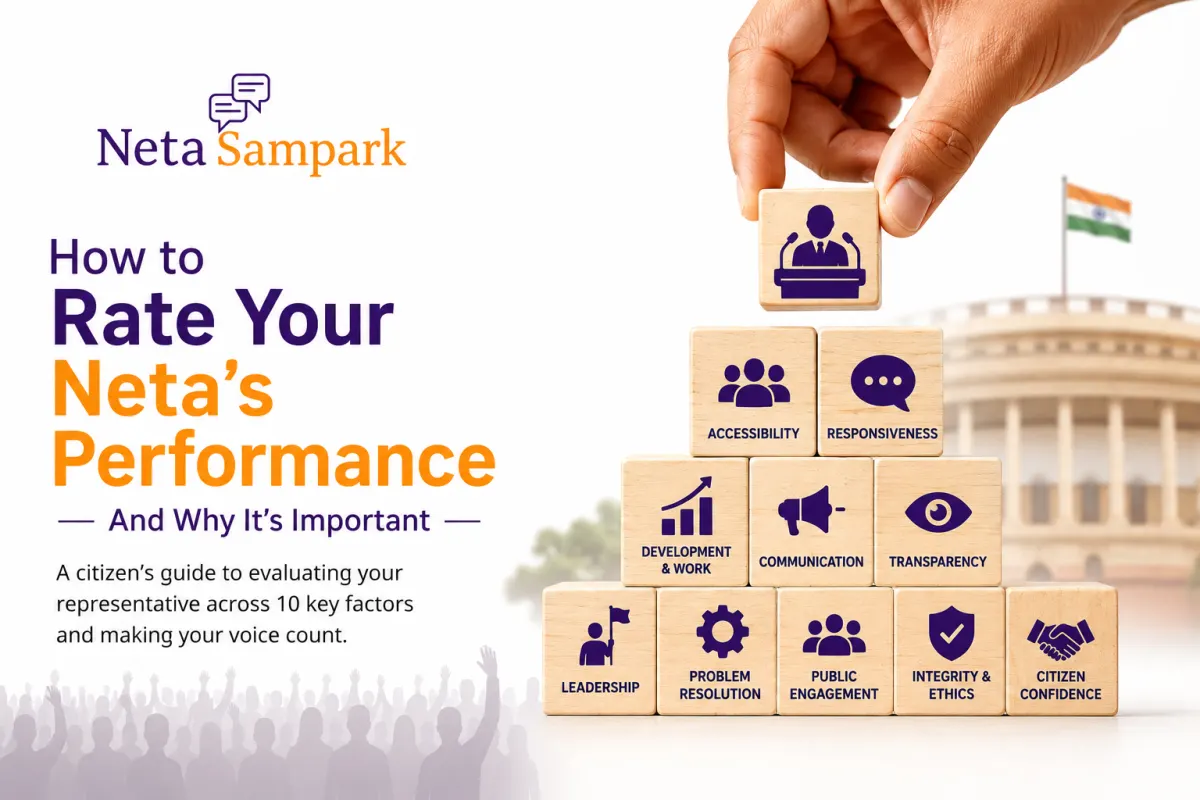
NetaSampark uses 10 detailed rating parameters.
Each parameter is rated on a scale of 1 to 10.
Once all 10 factors are rated, the platform automatically calculates an Overall Rating out of 100.
The 10 factors are:
- Accessibility
- Responsiveness
- Development & Work
- Communication
- Transparency
- Leadership
- Problem Resolution
- Public Engagement
- Integrity & Ethics
- Citizen Confidence
The overall rating is then categorised as:
- 1–39 — Needs Work
- 40–69 — Average
- 70–100 — Excellent
The important part is that the overall score is not simply a popularity vote. It is built from the citizen's ratings across these 10 areas.
1 Accessibility
How easy is it to reach your Neta?
Representation starts with accessibility.
Consider your experience trying to reach the representative or their office.
Ask yourself:
- Are contact details available?
- Is there an office or recognised channel for citizens?
- Can citizens submit concerns?
- Are there opportunities to meet or communicate?
- Is the representative's team reasonably accessible?
You don't need to expect your Neta to personally answer every message.
The question is whether citizens have a meaningful and practical way to reach the representative or their team.
How should you rate it?
1/10 might mean you find it extremely difficult to reach the representative.
10/10 might mean the representative or their office is consistently accessible and easy to approach.
Rate based on your genuine experience.
2 Responsiveness
How quickly does your Neta respond to citizens?
Being reachable and being responsive are two different things.
A representative may have a phone number, office or social-media account but still provide little or no response to citizen concerns.
Consider:
- Does your Neta acknowledge issues?
- Does their office respond?
- Do you receive updates?
- Is there follow-up?
- Does someone explain what can or cannot be done?
Remember that responsiveness does not mean promising to solve every problem.
A good response can also involve directing the issue to the appropriate authority or explaining the next step.
3 Development & Work
How well is your Neta working for constituency development?
Citizens can consider the visible work and initiatives associated with their representative's responsibilities.
Depending on the position, this can mean different things.
An MP, MLA and local-government representative do not have identical powers or responsibilities.
Consider:
- Attention to constituency needs
- Development initiatives
- Work on important local concerns
- Follow-through on commitments
- Efforts to improve conditions in the constituency
The key is to evaluate the representative according to the role they actually hold.
Don't expect one elected representative to personally control every government project.
4 Communication
How effectively does your Neta communicate with citizens?
Citizens need information to understand what their representative is doing.
Consider:
- Does the representative provide regular updates?
- Are important issues communicated clearly?
- Are citizens informed about developments?
- Does the representative explain their position on important matters?
- Is communication useful rather than simply promotional?
Being active on social media is not automatically the same as good communication.
The real question is:
Does the communication help citizens understand what is happening?
5 Transparency
How transparent is your Neta in actions and decisions?
Transparency helps citizens understand the work of their representative.
Consider whether your Neta:
- Communicates about ongoing work
- Provides updates on commitments
- Explains decisions where appropriate
- Shares relevant public information
- Communicates progress and challenges
Transparency does not mean that every internal discussion must be public.
It means citizens should have reasonable access to information that helps them understand what their representative is doing and why.
6 Leadership
How strong is your Neta's leadership?
Leadership is more than popularity.
A strong leader may demonstrate:
- Initiative
- Responsibility
- Consistency
- Ability to bring people together
- Willingness to address difficult issues
- Clear direction during problems
- Commitment to constituency concerns
Ask yourself:
When an important issue arises, does this representative demonstrate leadership?
Do not confuse a large following or strong political support with leadership performance.
7 Problem Resolution
How effectively are public issues solved?
Citizens often judge representatives by what happens when they raise a real problem.
Think about the journey:
Issue raised → Response → Follow-up → Outcome
Not every issue will be under the direct control of an elected representative.
A road issue may belong to a municipal authority. A government-service issue may belong to a department. A law-and-order issue may involve the police.
Therefore, the question isn't:
“Did my Neta personally fix everything?”
Instead ask:
Did my Neta or their office make a meaningful effort to address, escalate or follow up on the issue?
8 Public Engagement
How well does your Neta engage with the public?
Representation should continue beyond election campaigns.
Consider:
- Public meetings
- Constituency visits
- Community interactions
- Listening to citizen concerns
- Engagement outside election periods
- Opportunities for citizens to communicate
A representative who regularly listens to citizens may have a better understanding of changing community needs.
9 Integrity & Ethics
How would you rate the honesty and integrity of your Neta?
This is an area where citizens should be especially careful.
Do not base a rating on:
- Rumours
- Forwarded messages
- Unverified social-media claims
- Personal attacks
- Political propaganda
Instead, consider your genuine experience and reliable, verifiable information.
A low rating should not become an excuse for making unsupported allegations.
The purpose of NetaSampark's rating system is responsible citizen feedback, not defamation.
10 Citizen Confidence
How much confidence do you have in your Neta?
This is the broadest question in the rating system.
After considering the other nine factors, ask yourself:
How much confidence do I have in this representative to represent citizens effectively?
Your answer may be influenced by your experience with their:
- Accessibility
- Responsiveness
- Work
- Communication
- Transparency
- Leadership
- Problem resolution
- Public engagement
- Integrity
But citizen confidence should not simply mean political loyalty.
You can support a political party and still believe its representative needs to improve.
You can disagree with a representative politically and still recognise good performance.
Why Rate All 10 Factors?
A single overall score can hide important differences.
Imagine two representatives both receive an overall score of 75.
One might score highly on accessibility and public engagement but poorly on transparency.
Another might score highly on development and problem resolution but be difficult for citizens to reach.
The detailed ratings help reveal these differences.
That is why NetaSampark asks citizens to consider all 10 factors rather than relying on one general question.
The Overall Rating
After you rate all 10 parameters from 1 to 10, NetaSampark automatically generates your overall score out of 100.
The score provides a simple way to understand your overall assessment:
1–39: Needs Work
Your assessment indicates significant areas where the representative needs improvement.
40–69: Average
Your assessment is mixed or moderate, with both strengths and areas for improvement.
70–100: Excellent
Your assessment indicates strong performance across the factors you considered.
The number is only one part of the picture.
The reasoning behind the number matters too.
Don't Rate Your Neta Based Only on Political Preference
One of the biggest challenges in political ratings is bias.
A supporter may automatically give their representative a high score.
An opponent may automatically give them a low score.
Neither approach produces useful feedback.
Try separating two questions:
Who do I support politically?
and
How well do I think this representative is performing?
They don't have to have the same answer.
A structured rating allows citizens to recognise both strengths and weaknesses.
Rate What You Know
You don't have to pretend to know everything about your representative.
If you've personally interacted with their office, you can evaluate that experience.
If you've followed their constituency work, you can consider what you've observed.
If you haven't encountered a particular aspect of their work, don't invent an opinion.
An honest “I don't know” is better than an arbitrary rating.
Citizen ratings become more valuable when they are based on genuine experience and reasonable knowledge.
Use the Feedback Section
NetaSampark also allows citizens to provide optional written feedback.
There are two important questions:
What do you appreciate most about your Neta?
This gives citizens an opportunity to recognise good work.
What can your Neta improve?
This allows citizens to provide constructive criticism.
For example, instead of writing:
“Worst Neta ever.”
A more useful comment would be:
“The representative's office is accessible, but I would like to see more regular updates on unresolved local issues.”
The second statement provides something the representative can actually learn from.
Ratings Should Be Respectful
Political disagreement is normal in a democracy.
Personal abuse is not constructive civic feedback.
When rating your Neta:
- Be honest
- Be specific
- Avoid personal attacks
- Don't spread unverified allegations
- Don't rate based solely on political affiliation
- Consider the representative's actual responsibilities
- Base your feedback on your experience and reliable information
The objective is to make citizen feedback useful and credible.
Citizen Ratings Create a Feedback Loop
Traditionally, the relationship between citizens and representatives can become very active around election time and much quieter afterward.
A rating system can help create a continuous feedback loop:
Citizens experience representation → Citizens provide feedback → Representatives understand citizen perception → Areas for improvement become visible → Citizens continue to evaluate performance.
This doesn't replace elections.
It complements them.
Ratings Are Not the Same as an Election Result
An important distinction is that a NetaSampark rating is citizen feedback, not an election.
An election determines who is elected according to the applicable electoral process.
A citizen rating expresses how an individual citizen assesses a representative's performance.
One should not be treated as a substitute for the other.
The value of the rating lies in creating another channel for citizens to express their experience.
Why This Matters for Representatives
Citizen ratings aren't only useful for voters.
They can also give representatives a different kind of feedback.
A representative may discover that citizens appreciate their development work but want better communication.
Another may find that citizens consider them accessible but want stronger follow-up on unresolved problems.
That information can help representatives understand the citizen experience of their leadership.
Think Beyond Election Day
The most important idea behind citizen ratings is simple:
Your relationship with your elected representative should not end after you cast your vote.
Stay informed.
Observe performance.
Raise issues.
Ask questions.
Follow up.
Recognise good work.
Suggest improvements.
And when you have enough information and experience to make a fair assessment, rate your Neta.
Before You Submit Your Rating
Take a moment to ask yourself:
✓ Am I rating performance rather than political preference?
✓ Is my rating based on my experience or reliable information?
✓ Have I considered the representative's actual responsibilities?
✓ Am I avoiding rumours and unsupported claims?
✓ Can I explain why I gave this score?
If the answer is yes, you're contributing meaningful citizen feedback.
Your Voice Matters Beyond Voting
Democracy is not only about choosing representatives.
It is also about maintaining a relationship between citizens and the people who represent them.
A vote gives you a voice at the ballot box.
A citizen rating gives you another opportunity to express how you experience that representation.
With NetaSampark, you can look beyond party labels and popularity and consider 10 different dimensions of performance.
Accessibility. Responsiveness. Development & Work. Communication. Transparency. Leadership. Problem Resolution. Public Engagement. Integrity & Ethics. Citizen Confidence.
Then add your own perspective.
Because ultimately, the question isn't simply:
“Who is my Neta?”
It is:
“How well is my Neta representing me?”
Rate thoughtfully. Stay informed. Stay engaged.
Be Informed. Be Heard.
Official sources
Confirm fees, dates and eligibility on the official page before you act.