
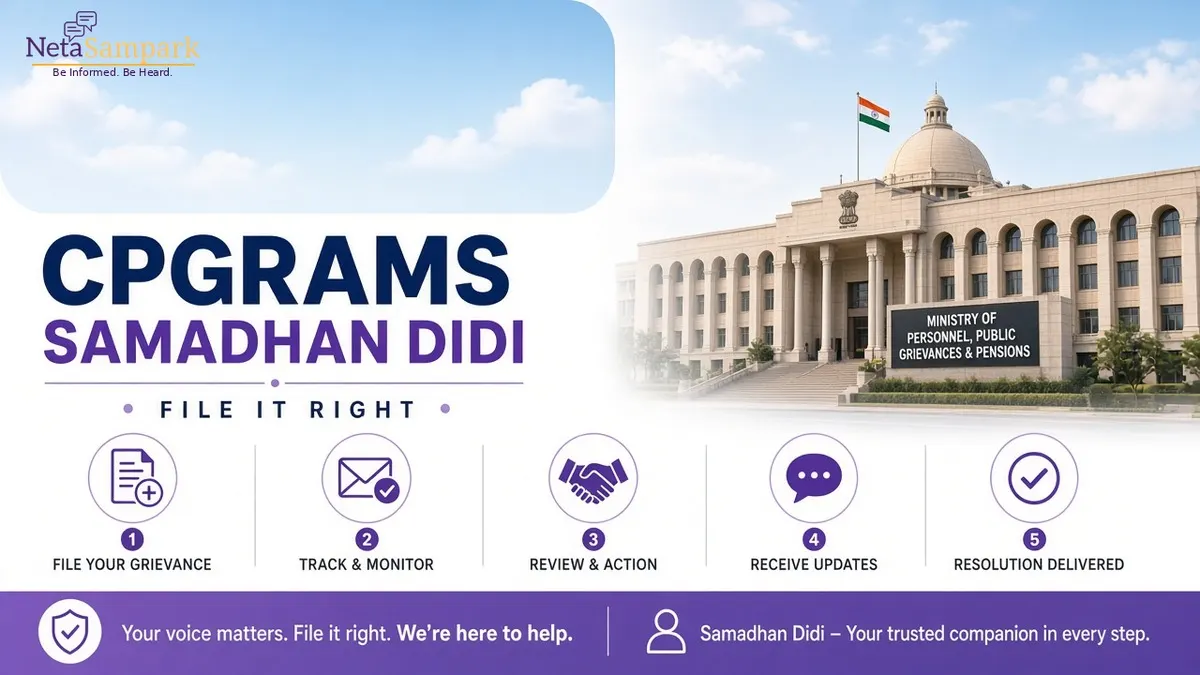
CPGRAMS Explained: How to File a Government Grievance, Track It and Appeal a Poor Resolution
Most “nobody listens” stories do not begin with a lack of government channels. They often begin with a complaint that was filed in the wrong place, without enough information, or without a clear record of what the citizen actually wants.
That is where CPGRAMS — the Centralised Public Grievance Redress and Monitoring System — can help.
CPGRAMS official portal is the Government of India's online platform for lodging and tracking public-service grievances. It is connected to Central Government ministries and departments as well as State and Union Territory governments, and citizens can track complaints using the registration ID issued after filing. (CPGRAMS)
In 2026, CPGRAMS also gained a new voice-first interface: Samadhan Didi, an AI-enabled voice chatbot developed by the Department of Administrative Reforms and Public Grievances (DARPG) in collaboration with BHASHINI. It allows citizens to describe a grievance by voice in any of the 22 Eighth Schedule languages currently supported. (Press Information Bureau)
But technology cannot compensate for a badly written complaint.
The most effective approach is simple:
File clearly. Save the number. Track the response. Appeal when appropriate.
What Is CPGRAMS?
CPGRAMS stands for Centralised Public Grievance Redress and Monitoring System.
It is a 24×7 online platform through which citizens can lodge grievances relating to service delivery by public authorities. The official portal says it is connected to all Ministries and Departments of the Government of India and to State governments, with role-based access for the concerned authorities. (CPGRAMS)
CPGRAMS can be accessed through:
- the CPGRAMS website
- the CPGRAMS mobile application
- integration with UMANG
- Common Service Centres (CSCs)
The system provides a registration number that can be used to track the grievance. (CPGRAMS)
It is important to understand what CPGRAMS is designed to do.
CPGRAMS is primarily about grievance redressal.
For example:
- a government pension is delayed
- a scholarship benefit has not been received
- a government certificate or service is stuck
- a public-service application has not been acted upon
- a government scheme benefit has been denied or delayed
- an issue already raised through an appropriate department has not been satisfactorily addressed
The exact route depends on the department and the nature of the service.
What CPGRAMS Is Not
CPGRAMS is not a universal complaint box for every problem.
The official portal specifically lists certain matters that are not taken up for redress through CPGRAMS, including:
- RTI matters
- court-related or sub-judice matters
- religious matters
- certain government-employee service matters, subject to the conditions specified by the portal (CPGRAMS)
That distinction matters.
Need information?
Consider RTI.
Need a government service grievance addressed?
Consider the appropriate grievance mechanism, including CPGRAMS where applicable.
Need immediate emergency assistance?
Use the appropriate emergency service rather than waiting for an online grievance system.
Should You File Locally First?
In many situations, yes.
If your streetlight is broken, start with the relevant municipal or local-body complaint system if one exists.
If a State Government scholarship is delayed, check the relevant State department or service portal.
If a Central Government service has failed, the concerned Central ministry/department's grievance mechanism may be appropriate.
CPGRAMS can then provide an additional grievance-redressal route where appropriate.
The Government's own CPGRAMS guidelines describe the system as functioning within a broader grievance-redressal structure, including cases where CPGRAMS provides another opportunity after earlier grievance disposal. (CPGRAMS)
The practical rule is:
Use the channel closest to the service first when that channel exists. Escalate when the problem remains unresolved.
The New Option: Samadhan Didi
One of the biggest changes to CPGRAMS in 2026 is Samadhan Didi.
The Government launched the AI-enabled CPGRAMS voice chatbot on 30 May 2026. It was developed by DARPG in collaboration with BHASHINI. (Press Information Bureau)
The CPGRAMS portal currently describes Samadhan Didi as a voice-based utility for lodging grievances and states that it supports the 22 Eighth Schedule languages. (CPGRAMS)
The system is designed to make filing easier for people who may find traditional government forms difficult to navigate.
According to the Government's description, Samadhan Didi can:
- accept grievances through voice
- work in the citizen's preferred supported language
- use speech-to-text and related language technologies
- identify the relevant Ministry or Department
- identify the grievance category and sub-category
- ask for additional information where necessary
- help route the grievance to the appropriate grievance officer (Press Information Bureau)
This is particularly relevant in a country where language and digital-literacy barriers can affect access to online government services.
But remember:
AI-assisted filing does not guarantee a favourable decision.
The underlying grievance still needs to be genuine, specific and supported by relevant information.
If you have a PPO number, application number, order number, previous complaint ID or other relevant document, keep it ready.
How to Write a CPGRAMS Complaint That Gets Understood
Imagine a grievance officer opening your complaint after reading dozens of cases.
Your job is not to write the longest complaint.
Your job is to make the problem immediately understandable.
A strong grievance usually answers six questions:
1. What happened?
State the problem in one sentence.
2. Which service or scheme is involved?
Name the department, service or scheme if known.
3. When did it happen?
Give dates.
4. What reference number exists?
Include the application, pension, complaint, file or transaction number where relevant.
5. What have you already tried?
Mention previous complaints or follow-ups.
6. What do you want the authority to do?
State the specific relief you are seeking.
Example: A Better Pension Grievance
Instead of:
“My pension has not come. Nobody is helping me. Please solve this immediately.”
Write:
Subject: Pending pension payment for May–August 2026
My widow pension under [scheme name] has not been credited for May, June, July and August 2026.
Application/Pension ID: XXXXX
I contacted the concerned local office on 15 July and 20 August 2026. I was informed that the matter was under process, but the pending payments have not been credited.
I request that the status of my pension be verified and the pending payments be released if otherwise admissible. If payment cannot be released, kindly provide the reason and the action required from my side.
The second version gives the officer something actionable.
The Anatomy of a Strong Grievance
Use this structure:
1 One-line problem
“My pension payment for May–August 2026 remains pending.”
2 Relevant identification
Provide the application/PPO/scheme number if applicable.
Avoid unnecessarily publishing sensitive personal information in the body of a complaint.
3 Timeline
For example:
- Application submitted: 10 May
- Local office contacted: 15 July
- Follow-up: 20 August
- No payment received as of 10 September
4 Previous attempts
Mention:
- local office
- department helpline
- state portal
- earlier complaint number
5 Evidence
Attach relevant documents that help establish the issue.
6 Specific relief
End with a clear request.
“Please verify the status and release the pending benefit if admissible, or provide the reason for the delay and the action required.”
What to Avoid
Don't file three different problems in one complaint.
A complaint about a pension delay, a broken road and a ration-card issue should not become one enormous essay.
Separate issues make tracking and responsibility clearer.
Don't write an accusation when you need a resolution.
Instead of:
“The department is deliberately harassing citizens.”
Write:
“The application has remained pending since ______ despite follow-ups on ______ and ______.”
Facts are easier to act on.
Don't leave out reference numbers.
If you have an application number, complaint number, PPO number or other relevant identifier, include it.
Don't upload dozens of irrelevant screenshots.
Use clear, relevant documents.
Don't submit repeatedly every few days.
A pile of duplicate complaints can make the record harder to follow.
One well-documented grievance is usually better than several poorly documented ones.
Where Can You File a CPGRAMS Grievance?
The primary route is the official CPGRAMS portal.
File and track a grievance on CPGRAMS
The Government also provides CPGRAMS through its mobile application and through integration with UMANG. (CPGRAMS)
The portal currently requires citizens to register as users before lodging a grievance. (CPGRAMS)
For citizens who need assistance with digital access, Common Service Centres (CSCs) are also part of the CPGRAMS access ecosystem. A Government of India parliamentary response in August 2026 specifically listed mobile access, CSC availability, multilingual registration and BHASHINI integration among measures strengthening CPGRAMS. (Press Information Bureau)
Is There a Fee for Filing a CPGRAMS Complaint?
The Government does not charge a fee for filing a public grievance through CPGRAMS.
The official CPGRAMS portal explicitly states that the Government is not charging the public for filing grievances. (CPGRAMS)
If you use a Common Service Centre, there may be a service charge for the CSC's assistance. The CPGRAMS portal distinguishes that service from a government fee for filing the grievance. (CPGRAMS)
What Happens After You Submit?
Once submitted, your grievance receives a unique registration ID.
Save it immediately.
Take a screenshot.
Write it down.
Email it to yourself if necessary.
The registration ID is important because it allows you to track the grievance through the portal. (CPGRAMS)
The concerned Ministry, Department, State or UT authority then handles the grievance according to the applicable process.
CPGRAMS is not itself the department that necessarily fixes the problem.
It is the platform through which the grievance is routed and monitored.
How Long Should a CPGRAMS Grievance Take?
This is one area where old articles can be misleading.
The current CPGRAMS FAQ states that the time limit for redressal is 21 days and that where there is a delay, an interim reply with reasons for the delay is required. (CPGRAMS)
DARPG's comprehensive 2024 guidelines explain that the maximum redressal time advised for CPGRAMS cases was reduced from 30 days to 21 days, while allowing interim replies where additional time is required. (CPGRAMS)
The Government reiterated the reduction from 30 days to 21 days in a parliamentary response published in August 2026. (Press Information Bureau)
So if you find an old website saying “CPGRAMS takes 30 days,” check the current official guidance.
The practical rule:
Track the 21-day timeframe, but remember that complicated matters may require additional time and an interim response.
What If Your Grievance Is Closed but the Problem Isn't Fixed?
This is where many citizens stop.
Don't automatically assume that “Closed” = “satisfactorily resolved.”
Read the disposal response carefully.
Ask:
- Did the authority actually address the issue?
- Does the response explain what action was taken?
- Does it correspond to your complaint?
- Did the authority simply provide a generic response?
- Is further action required from you?
CPGRAMS has a feedback and appeal mechanism.
The official portal states that after closure, if the complainant is dissatisfied, they can provide feedback. Where the rating is “Poor,” the option to file an appeal is enabled. The portal also allows appeal status to be tracked. (CPGRAMS)
The CPGRAMS FAQ states that the appeal for eligible Central Ministry/Department grievances needs to be filed within 30 days. (CPGRAMS)
So don't simply screenshot the closure and post:
“Government doesn't care.”
First check whether the system gives you an appeal route.
The Appeal Is an Important Second Chance
A poor grievance response can sometimes be challenged through the CPGRAMS appeal process.
The Government's comprehensive guidelines state that the appellate authority is required to examine the appeal independently and that the appeal should be disposed of within a maximum of 30 days. (CPGRAMS)
That makes your original complaint even more important.
If your first complaint was vague, your appeal becomes harder.
If your first complaint clearly documented:
- the problem
- the date
- the reference number
- the evidence
- the specific relief requested
then the appeal has a much stronger factual foundation.
What If the Wrong Department Gets the Complaint?
This is another reason not to panic immediately.
The Government's comprehensive guidelines use a “whole of the Government” approach and state that a grievance should not simply be closed on the ground that it does not pertain to the receiving ministry or department. Efforts should be made to transfer it to the appropriate authority. (CPGRAMS)
That does not mean every transfer will be instantaneous.
It does mean that “wrong department” should not automatically mean “case closed.”
If the matter is transferred, monitor the status and keep the registration number.
CPGRAMS and State Governments
CPGRAMS is not limited to Central Government complaints.
The official FAQ says grievances relating to State Governments, Union Territory administrations and the Government of NCT of Delhi are sent to the concerned State/UT/NCT Government. (CPGRAMS)
This is why CPGRAMS can be useful even when the actual service problem sits at the State level.
But that does not mean you should ignore a dedicated State or municipal grievance system when one exists.
For a local civic problem, starting with the local authority can often be the most direct route.
CPGRAMS vs Local Complaint vs RTI
These systems perform different jobs.
SituationBetter starting pointPothole needs repairMunicipal/local complaintGarbage collection missedMunicipal/local service complaintState scholarship delayedState department/service portalCentral Government service grievanceRelevant department / CPGRAMSComplaint already made but not satisfactorily resolvedAppropriate escalation / CPGRAMS where applicableNeed records about what government didRTINeed to challenge an RTI responseRTI first appeal
Think of it this way:
Grievance systems ask the government to act.
RTI asks the government for information.
They can complement each other, but they are not the same thing.
When RTI Becomes the Next Step
Suppose your complaint says:
“My road repair complaint has been resolved.”
But the road remains damaged.
You may first use the available grievance appeal mechanism.
If you then need to know what records exist concerning the action taken, an RTI application may be appropriate.
For example, you could seek:
- the action taken report
- inspection record
- relevant work order
- recorded date of closure
- applicable records relating to the decision
Don't ask the RTI officer:
“Why are you ignoring me?”
Ask for the records that can answer what happened.
That creates an evidence trail.
Keep Your Representative Informed
An MP, MLA, councillor or other elected representative is not a replacement for the grievance officer.
But a properly documented grievance can make political or representative follow-up much more effective.
Instead of sending:
“Please help me. Nobody listens.”
Send:
Issue: Pension payment pending
Application/PPO: XXXXX
Original complaint: XXXXX
CPGRAMS ID: XXXXX
Date filed: XX/XX/2026
Current status: Closed / Pending
Response: [one sentence]
Problem remaining: [one sentence]
Request: Please seek clarification/action from the concerned authority.
Now the representative has something concrete to work with.
A 10-Minute CPGRAMS Starter Kit
Before opening the portal, prepare:
Your basic information
- Name
- Contact details
- Relevant address
Your case information
- Department
- Scheme/service
- Application number
- PPO/file/reference number
- Previous complaint number
Your timeline
Write down:
Applied → Followed up → Contacted office → Current status
Your evidence
Keep relevant:
- acknowledgement
- order
- receipt
- photograph
- previous response
- application document
Your one-line request
Write this before you start filing.
For example:
“Please verify the status of my pending pension application and release the benefit if admissible, or provide the reason for the delay and required corrective action.”
This one sentence will keep your complaint focused.
Your CPGRAMS Checklist
Before pressing submit:
- Correct service/department identified
- Problem stated in one clear sentence
- Application/reference number included
- Dates included
- Previous complaints mentioned
- Relevant documents attached
- Specific relief requested
- No unnecessary accusations
- No unrelated issues mixed in
- Registration number saved after submission
After submission:
- Track the status
- Note the applicable response timeline
- Read the disposal response carefully
- Provide feedback where requested
- Use the appeal mechanism if dissatisfied and eligible
- Keep the complete record
The Bigger Point
A grievance system works best when citizens treat it as a recorded administrative process, not just another complaint box.
You don't need to write like a lawyer.
You don't need to threaten an officer.
You don't need to tag ten politicians on social media.
You need:
A clear problem.
A clear record.
A clear request.
A registration number.
And follow-through.
The Government is also continuing to modernise CPGRAMS. Its 2026 reforms include the Grievance Redressal Assessment and Index (GRAI), monthly reporting, multilingual registration and translation through BHASHINI, mobile and CSC access, and the AI-enabled Samadhan Didi chatbot. (Press Information Bureau)
For citizens, the practical lesson is simpler:
Don't just complain. Create a trackable record of the problem and what you are asking the government to do.
And when the response comes, read it.
If it solves the problem, good.
If it doesn't, use the next available step.
File clean. Track hard. Appeal smart.
Be informed. Be heard.
Official Sources
- CPGRAMS — Government of India
- CPGRAMS FAQ
- DARPG Comprehensive Guidelines for Handling Public Grievances
- PIB — Launch of Samadhan Didi
- PIB — Strengthening of CPGRAMS, August 2026
Non-partisan civic explainer. CPGRAMS procedures, portal features and timelines can evolve. Check the official CPGRAMS portal before filing. Last editorial verification: 10 September 2026 (IST).