
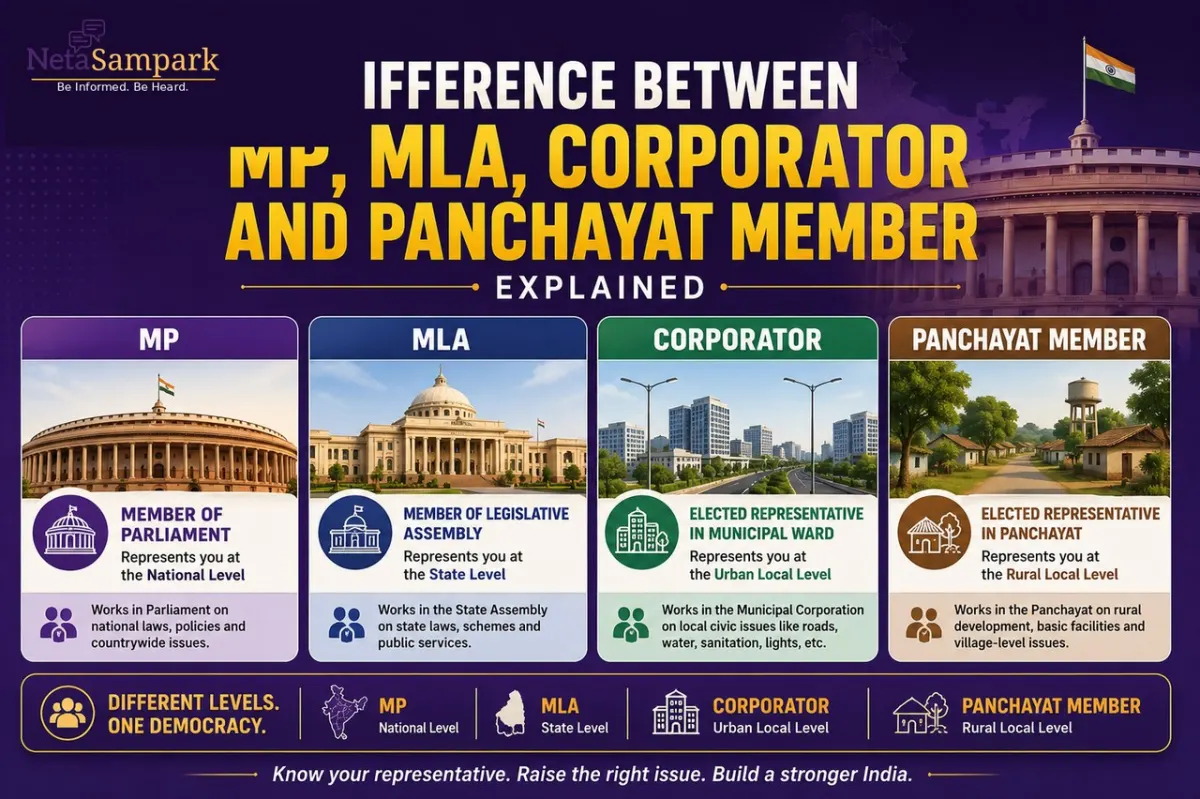
Quick take: Most civic frustration is not simply that “the government does nothing.” Often, the problem is that the right complaint never reaches the office responsible for it.
A broken streetlight may be a municipal issue. A police complaint generally belongs with the State police machinery. A school problem may need to go through the school, education department or local education authorities. A Central Government service failure may belong to a Union ministry or statutory body.
The first step is therefore not escalation.
It is identifying who actually owns the problem.
India's government is divided across Union, State and local institutions, with different responsibilities at each level. Municipalities, for example, are associated with functions such as roads, water supply, sanitation, solid-waste management and street lighting under the Twelfth Schedule framework, although the exact allocation depends on State municipal laws. (Ministry of Housing and Urban Affairs)
This guide gives you a practical way to identify the right desk, create a proper complaint and escalate it without simply forwarding the same message to every politician you know.
The Basic Rule: Complain to the Owner, Then EscalateThink about a civic issue in three layers:
1. The service provider
The department, municipality, panchayat, school, police station or agency actually responsible for the service.
2. The administrative authority
The officer or higher department that can review a complaint when the first level does not act.
3. Your elected representative
Your councillor, MLA or MP can follow up, raise the issue, seek explanations or bring political attention to a persistent problem—but they generally do not personally execute the work.
That distinction matters.
An MLA cannot personally repair a municipal road.
An MP cannot personally issue your caste certificate.
A councillor cannot register an FIR.
A politician can help move attention toward the right administrative desk, but the underlying file still has to be processed by the responsible authority.
The Five Desks Citizens Commonly Deal WithProblem / levelUsually start withRepresentative who may follow upWard-level civic servicesMunicipality / municipal corporationCouncillor / corporatorState servicesState department / district administrationMLAVillage-level servicesGram Panchayat / block / district administrationPanchayat representatives / MLACentral Government servicesRelevant Union ministry / department / statutory bodyMPPolice & public orderLocal police / State policeMLA / State authorities for escalation
This is a general map, not a universal rule. Responsibilities can differ between States, municipalities and specific schemes.
And there is one particularly important constitutional distinction:
Police and public order are State subjects. The Ministry of Home Affairs states that the primary responsibility for preventing, detecting, registering and investigating crime rests with State Governments. (Ministry of Home Affairs)
1. Streetlights That Never Come OnUsually responsible
For ordinary urban street lighting, the starting point is generally the municipality or municipal corporation, often through its electrical, engineering or street-lighting wing.
The Twelfth Schedule specifically includes public amenities including street lighting among municipal functions. (Ministry of Housing and Urban Affairs)
What to do
Start with:
Municipal complaint portal / ward office → relevant municipal department → councillor/corporator
Include:
- exact location
- nearby landmark
- pole number, if available
- photograph
- date and approximate time
- whether one light or an entire stretch is affected
- previous complaint number, if any
Example
“Streetlight pole near House No. 42, XYZ Road, Ward 18 has not been functioning since 2 September. The road remains unlit after 7 PM. Please inspect and restore the light. Previous complaint ID: XXXXX.”
That's actionable.
When the route changes
If the lighting is associated with a road or facility controlled by another authority—such as a highway or particular public agency—identify that agency first.
Don't assume every road inside a city is maintained by the municipal corporation.
2. Potholes and Neighbourhood RoadsRoad ownership is one of the easiest places to send a complaint to the wrong authority.
A road might be maintained by:
- a municipal corporation
- municipality
- panchayat
- State PWD
- development authority
- another statutory authority
- NHAI or another road agency, depending on the road
Municipal roads are among the functions associated with municipalities under the Twelfth Schedule, but the actual division of responsibility depends on State law and the particular road. (Ministry of Housing and Urban Affairs)
Before complaining, identify the road
Ask:
Who owns or maintains this road?
Then file the complaint with that authority.
Include
- photograph/video
- exact location
- nearest landmark
- road name
- direction of travel
- approximate size/severity
- safety impact
- previous complaint number
If possible, include a clearly identifiable landmark rather than simply writing:
“Pothole near my house.”3. Drinking Water and Irregular Supply
Water complaints can involve completely different problems.
For example:
- no water supply
- low pressure
- pipeline leakage
- contaminated water
- billing problem
- meter problem
- tanker shortage
- distribution failure
- source-level shortage
The responsible authority can therefore vary.
Urban areas
A typical starting path may be:
Water board / municipal water department → ward office → senior municipal/water officer
Rural areas
The relevant route may involve:
Gram Panchayat / local water-supply authority → block/district administration → State department
The exact structure varies by State.
Make the complaint specific
Instead of:
“Water is not coming.”
write:
“There has been no municipal water supply to Houses 10–40 on XYZ Street since 7 September. The neighbouring street received supply on 9 September. Please verify whether the issue is distribution, pipeline failure or scheduled supply disruption.”
That gives the department something to investigate.
4. Garbage, Drains and FloodingFor ordinary municipal sanitation and solid-waste issues, the municipality is generally the first place to start.
Municipal functions associated with the Twelfth Schedule include public health, sanitation, conservancy and solid-waste management. (Ministry of Housing and Urban Affairs)
Garbage
Start with:
Municipal sanitation complaint → ward office → councillor/corporator
Provide:
- location
- photograph
- collection point
- frequency of missed collection
- complaint number
Blocked drains
Start with the relevant municipal or local-government engineering/sanitation department.
Repeated flooding
This is where escalation becomes more important.
A recurring flooding problem may involve:
- storm-water drainage
- road design
- encroachment
- drainage capacity
- pumping infrastructure
- waterbody management
- PWD
- municipal engineering
- development authority
Instead of simply saying “the area floods every monsoon,” document the pattern.
Record:
location → date → rainfall/event → duration → depth/impact → previous complaints → photographs
A documented recurring problem is much harder to dismiss as a one-off incident.
5. Government Schools: Who Should You Approach?A school problem can have several different owners.
Examples include:
- broken toilet
- classroom damage
- drinking water
- teacher shortage
- mid-day meal issue
- scholarship issue
- admission problem
- infrastructure requirement
- examination issue
The appropriate authority depends on the school, State and particular issue.
The Ministry of Education operates the Department of School Education & Literacy at the Union level, but school administration and implementation involve State and local structures as well.
A practical escalation route
School → local/block/district education authority → State education department
For persistent local infrastructure problems, elected representatives can also be approached with the complaint number and evidence.
Don't start with a political accusation
Instead of:
“The government doesn't care about this school.”
write:
“The school has had two non-functional toilets since June. The issue was reported to the school on 12 August and again on 28 August. Complaint/letter references are attached. Please arrange inspection and provide the expected repair timeline.”
Evidence creates accountability.
6. Police, Law and Order and TrafficThis is one area where knowing the constitutional division of responsibility is especially important.
Police and public order are State subjects.
The Ministry of Home Affairs explicitly states that the primary responsibility for these matters rests with State Governments. (Ministry of Home Affairs)
For an immediate emergency
Use the appropriate emergency service.
In India, 112 is the national emergency response number.
A civic blog should never encourage someone to use a representative or grievance portal instead of contacting emergency services during an emergency.
For a police complaint
Start with the appropriate:
Police station → supervisory police officer → Commissioner/SP structure, depending on the jurisdiction
Keep:
- complaint/GD/DD/petition reference where provided
- FIR number if registered
- date and time
- police station
- names/designations where relevant
- copies of documents submitted
Where does the MLA fit?
An MLA can raise persistent local law-and-order concerns with the State authorities, but the MLA does not replace the police investigation process.
Where does the MP fit?
An MP is generally not the first administrative authority for an ordinary local police complaint.
The constitutional responsibility for police and public order remains primarily with the State.
7. Ration Cards, Welfare and CertificatesProblems involving:
- ration cards
- income certificates
- caste certificates
- domicile/residence certificates
- pensions
- state welfare schemes
- local government certificates
often belong to State Government departments, district administration, revenue authorities, food and civil supplies departments or social-welfare departments, depending on the service.
The first question should be:
Which department actually issues this service?
A councillor or MLA may follow up on a delayed application, but they generally do not personally issue the certificate.
What to keep
- application number
- date of application
- acknowledgement
- documents submitted
- current status
- rejection/return message, if any
Then ask for a specific action:
“Please confirm the reason the application has remained pending and the next required step.”8. Passport, Aadhaar, EPFO and Railways
These are good examples of why “government problem” does not automatically mean “go to MLA.”
Different Central Government departments and statutory bodies have their own official service and grievance mechanisms.
Examples include:
- Passport Seva
- UIDAI
- EPFO
- Indian Railways
Use the official service/grievance channel first.
If the matter remains unresolved, your MP may be an appropriate political follow-up point depending on the issue and circumstances.
But don't skip the underlying service process.
The rule
Service complaint first. Political escalation second.
Give the representative:
- application number
- complaint number
- dates
- department
- exact unresolved issue
A representative is far more likely to be useful when you provide a traceable file instead of a general complaint.
MP vs MLA vs Councillor: The 60-Second Mental ModelThink of the three roles like this:
Councillor / Corporator
Closest to local urban civic issues
Examples:
- local roads
- streetlights
- garbage
- drains
- local amenities
- ward-level infrastructure
But the precise responsibilities depend on the municipal law and local structure.
MLA
State-level political representation
Useful for issues involving:
- State Government departments
- State schemes
- State roads/PWD
- hospitals and State institutions
- education administration
- broader constituency-level problems
An MLA can follow up with the State administration but is not the officer who technically processes every departmental file.
MP
Union-level political representation
Useful for:
- Central Government departments
- Union schemes
- Central institutions
- national infrastructure
- issues requiring Parliament-level attention
An MP can also raise broader constituency issues, but an MP is not a substitute for the municipal or State authority that actually delivers the service.
The Most Important Question: Who Actually Owns the Asset?Before escalating, ask:
Who owns, funds, operates or maintains this thing?
Take a road.
It could be:
Municipal road → Municipality
or
State highway → State/PWD authority
or
National Highway → Relevant national highway authority
or
Village road → Panchayat/rural-road authority
The same complaint—“this road is broken”—can therefore belong to completely different offices.
This is why identifying the asset owner is often more important than identifying the politician.
How to Write a Complaint That Gets AnsweredA good civic complaint should answer five questions:
1. What happened?
State the problem in one sentence.
2. Where?
Give the precise location.
3. When?
Give the date or period.
4. What have you already done?
Include previous complaint numbers.
5. What exactly do you want?
Ask for a specific action.
A Simple Complaint TemplateSubject: Request for repair of [specific issue] at [location]
I am writing to report [specific problem] at [exact location].
The issue has been present since [date/period] and is affecting [specific impact].
I previously reported the matter under complaint/reference number [number], but the issue remains unresolved.
I request that the concerned department inspect the location and [specific action requested].
Please provide the complaint/reference number and, where possible, the expected timeline for resolution.
Photographs and previous complaint details are attached.
Simple.
Factual.
Trackable.
Don't Send the Same Complaint to Ten PeopleThis is one of the most common mistakes in civic escalation.
A citizen files a municipal complaint.
Then sends the same message to:
- councillor
- MLA
- MP
- Chief Minister
- Prime Minister
- Collector
- Commissioner
- social media
- WhatsApp groups
The result can be more noise without more accountability.
Instead:
Step 1
File with the responsible department.
Step 2
Save the complaint number.
Step 3
Wait for the applicable service timeline.
Step 4
Escalate to the appropriate administrative officer.
Step 5
If the problem persists, approach your elected representative with the complete paper trail.
This makes the escalation much stronger.
The Escalation LadderA practical escalation ladder looks like this:
Level 1 — Service provider
Municipality / panchayat / school / police station / department / agency
↓
Level 2 — Supervisory officer
Ward officer / engineer / BDO / senior police officer / departmental officer
↓
Level 3 — Administrative grievance mechanism
Municipal grievance system / State portal / departmental grievance system / appropriate Central grievance mechanism
↓
Level 4 — Elected representative
Councillor / MLA / MP, depending on the issue
↓
Level 5 — Formal legal or statutory remedy
RTI, appeal, ombudsman, regulator, tribunal or court where appropriate.
The correct endpoint depends on the problem.
When RTI Becomes UsefulSometimes the problem isn't simply that something wasn't fixed.
You want to know:
What happened to my complaint?
That's where the Right to Information Act, 2005 can become useful.
Instead of asking:
“Why are you so careless?”
you can ask for records such as:
- action-taken report
- inspection report
- file noting, where disclosable
- work order
- sanctioned estimate
- relevant correspondence
- recorded reasons for closure
RTI is an information mechanism, not a substitute for an emergency service or ordinary grievance redressal.
Use the grievance mechanism to seek action.
Use RTI when you need information held by a public authority.
Rural India Works DifferentlyDon't automatically apply an urban municipal model to a village.
In rural areas, the relevant institutions can include:
- Gram Sabha
- Gram Panchayat
- Panchayat Samiti / Block-level administration
- Zila Parishad
- district administration
- State departments
A village road, drinking-water problem or sanitation issue may therefore have a completely different administrative route from a similar-looking problem in a municipal corporation.
A useful rural sequence
Gram Panchayat → Block → District → State department
The exact path depends on the subject and the State's administrative structure.
And remember:
Gram Sabha is not simply a smaller municipal ward meeting.
It is part of the constitutional framework for rural local self-government.
Urban India Has Its Own ComplexityLiving inside a city does not automatically mean every public asset belongs to the municipal corporation.
You may encounter:
- municipal corporation
- municipality
- development authority
- State PWD
- water board
- electricity distribution company
- metro authority
- NHAI
- cantonment board
- housing authority
- other statutory bodies
So if a complaint gets rejected with:
“Not under our jurisdiction”
don't simply give up.
Ask:
Which authority has jurisdiction?
Then transfer the paper trail to the correct desk.
What NetaSampark Is ForNetaSampark is designed to help citizens understand who represents them and where they fit in the civic system.
That means helping answer questions such as:
- Who is my MP?
- Who is my MLA?
- Who represents my ward?
- Which constituency am I in?
- Who should I approach about a persistent local issue?
- How can I stay engaged between elections?
NetaSampark does not replace:
- police emergency services
- municipal complaint portals
- government service portals
- ECI voter services
- RTI processes
- courts or statutory authorities
It sits alongside those systems.
The idea is simple:
Use the official service channel to create the administrative record. Use your representative when political follow-up or constituency-level attention is useful.
Know Your Area Before You EscalateBefore contacting a representative, know:
Your ward
Your municipal body
Your Assembly constituency
Your Parliamentary constituency
The department responsible for the issue
That information can prevent your complaint from being bounced from one office to another.
You can use NetaSampark to explore your area and identify your representatives.
Explore your area on NetaSampark →
And find your representatives here:
Find your representatives →
A Better Way to Approach Your MP, MLA or CouncillorDon't send:
“Sir, please solve this urgently.”
Send:
Issue: Broken drainage on XYZ Road
Location: Ward 18, ABC Colony
First reported: 28 August 2026
Municipal complaint: #123456
Current status: Closed, but problem remains
Evidence: 3 dated photographs
Request: Please ask the concerned municipal department to inspect the location and provide an action-taken status.
Now the representative has something useful to work with.
The goal isn't to make the message longer.
It's to make it verifiable.
A Citizen's Pocket ChecklistBefore escalating a civic problem, ask:
- What exactly is the problem?
- Who owns the service/asset?
- Which department handles it?
- Have I filed the official complaint?
- Do I have the complaint number?
- Did I attach evidence?
- What is the applicable response timeline?
- Have I followed up once?
- Which administrative officer handles escalation?
- Is an MLA, MP or councillor actually relevant?
- What exactly am I asking the representative to do?
- Do I need RTI, an appeal, regulator or court instead?
The most effective citizen is not necessarily the person who sends the most complaints.
It is often the person who sends the right complaint to the right office, keeps the reference number, follows the process and escalates with evidence when the first level fails.
A pothole needs a road authority.
A streetlight needs the relevant local authority.
A police complaint belongs in the police system.
A Central Government service needs the responsible Union department or agency.
A State scheme belongs with its implementing State machinery.
And when those systems fail, your elected representative can become an important part of the escalation and accountability chain.
Know the problem. Know the department. Know your representative. Keep the paper trail.
That is how a civic complaint becomes more than a social-media post.
Official references
The allocation of municipal functions varies by State, but the Ministry of Housing and Urban Affairs' material on the Twelfth Schedule identifies areas including roads and bridges, water supply, sanitation, solid-waste management and street lighting among functions associated with municipalities. (Ministry of Housing and Urban Affairs)
The Ministry of Home Affairs confirms that police and public order are State subjects, with primary responsibility resting with State Governments. (Ministry of Home Affairs)
The Ministry of Education provides the Union Government's official framework and information for school education through the Department of School Education & Literacy.
Non-partisan civic explainer. Administrative responsibilities can differ by State, municipality, panchayat, road classification and individual government scheme. Before filing a complaint, verify the current official grievance channel for your area and the specific service involved.
Be Informed. Be Heard.
Official sources
Confirm fees, dates and eligibility on the official page before you act.