
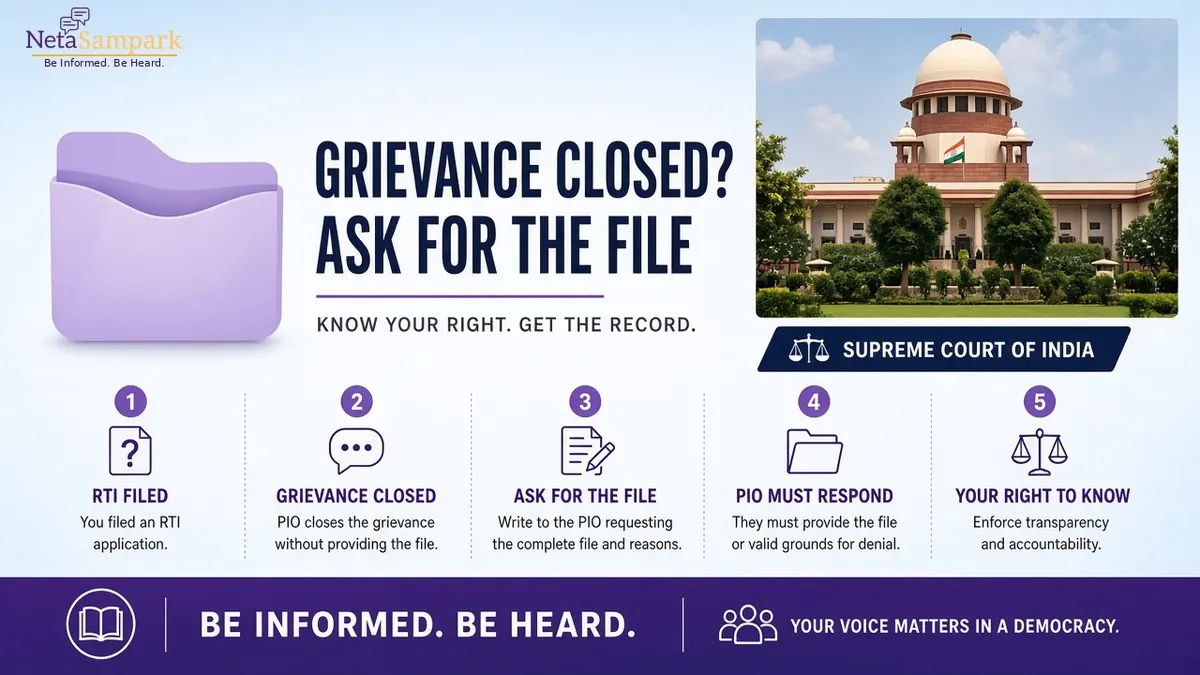
You filed a complaint about a pothole, broken streetlight, overflowing drain or another civic problem. You received a complaint number. You followed up. Perhaps you even escalated it through a government grievance portal.
Then the status changed to “Disposed” or “Closed.”
But the problem is still there.
At that point, the useful question is not always “Who should I complain to next?” Sometimes it is:
What records show what the government actually did about my complaint?
That is where the Right to Information Act, 2005 (RTI Act) can become useful.
RTI is not a replacement for a municipal complaint or grievance mechanism. It serves a different purpose: it gives citizens a legal route to seek information and records held by public authorities.
The distinction is important:
A grievance asks the government to fix a problem.
RTI asks for information about what the government has done, recorded or decided.
Grievance vs RTI: Don't Mix the Two
These mechanisms can work together, but they are not interchangeable.
ToolWhat it is mainly forMunicipal / State service complaintReporting a problem and asking for corrective actionCPGRAMSRaising a grievance relating to service delivery with the concerned public authorityRTISeeking information or records held by a public authorityFirst RTI AppealChallenging an inadequate, incomplete or refused RTI responseMP / MLA / Councillor or other representativePolitical and public follow-up or oversight
For example, if a road has a dangerous pothole, your first request should normally be to get the pothole repaired through the appropriate municipal or government service channel.
If the complaint is marked closed but you want to know what inspection was carried out, what action was recorded, or which work order was relied upon, RTI may be the more appropriate tool.
The RTI Act is about access to information; it is not itself a road-repair mechanism.
What If Your Government Complaint Is Marked “Closed”?Suppose you submitted a municipal complaint:
Complaint ID: 123456
Problem: Large pothole outside a school
Date: 1 September
The portal later says:
Status: Closed
You visit the location.
The pothole is still there.
There are several possible explanations. The authority may have inspected the location, transferred the matter, issued a work order, recorded that the work was completed, or closed the complaint for another reason.
Instead of guessing, you can create a paper trail.
Step 1: Preserve the original complaint
Save:
- complaint number
- date of complaint
- photographs
- location
- screenshots of the complaint status
- responses received
- names/designations shown on the portal
- dates of follow-ups
Don't rely on the portal remaining unchanged forever.
Step 2: Follow up through the appropriate grievance channel
If the municipal or state system provides a follow-up or escalation mechanism, use it.
For grievances filed through CPGRAMS, the official system allows citizens to track their grievance using the registration ID. CPGRAMS also provides an appeal mechanism for dissatisfied complainants. After disposal, a citizen can provide feedback; where the rating is “Poor,” the portal enables an appeal. The CPGRAMS FAQ says the appeal is to be filed within 30 days. (CPGRAMS)
This matters because RTI should not automatically be your first escalation for a service complaint.
Step 3: Use RTI when you need the records
If your objective has shifted from:
“Please fix this.”
to:
“Please tell me what records show what happened.”
then RTI can become useful.
The Most Important RTI Rule: Ask for Information, Not an ExplanationThis is where many RTI applications go wrong.
An RTI application should generally seek information or records held by the public authority, rather than asking the Public Information Officer (PIO/CPIO) to investigate your grievance, give an opinion or create a new explanation.
Instead of asking:
Why has the municipality failed to repair this road?
Ask for records such as:
- Certified copy of the action taken report relating to complaint number ______.
- Certified copy of the inspection report, if any, prepared in relation to the complaint.
- Copies of photographs or other records submitted in connection with the inspection, if available.
- Name and designation of the officer who recorded the action taken/closure, as reflected in the relevant record.
- Date on which the complaint was marked disposed/closed.
- Copy of the work order, estimate or other relevant record, if any, relied upon for the reported action.
- Relevant record showing the present status of the work, if such a record is maintained.
That changes the nature of the request.
You are not asking the PIO:
“Why are you incompetent?”
You are asking:
“What does the official record show?”A Practical Example: The Pothole That Was “Fixed”
Imagine you reported a pothole.
Your complaint was eventually marked:
Resolved
But nothing appears to have changed.
Instead of writing an emotional RTI, you could ask the concerned public authority for records such as:
Information requested
1. Certified copy of the action taken report relating to grievance/complaint number ______ dated ______.
2. Certified copy of any inspection report or site-visit record prepared in connection with the complaint.
3. Certified copies of relevant work orders, estimates or other records relating to repair work at the location identified in the complaint, if any.
4. The date on which the complaint was marked disposed/closed, as recorded in the relevant system or file.
5. Certified copy of the record showing the action taken that formed the basis for closure of the complaint.
This is much more useful than:
“Why did you close my complaint when the pothole is still there?”
The latter asks for an explanation. The former identifies specific records.
Ask for Five Useful Things Rather Than Twenty QuestionsA focused RTI is often easier to understand and process.
Depending on the issue, useful records can include:
1. Action Taken Report
What action was recorded against the complaint?
2. Inspection Record
Was an inspection conducted?
If an inspection report exists, request a copy.
3. Work Order
Was repair or maintenance work formally assigned?
If so, request the relevant work order.
4. File or Decision Record
Where appropriate, request the relevant file noting or recorded decision concerning the matter.
5. Closure Record
What record shows the basis on which the complaint was marked disposed or closed?
The exact records available will depend on the authority and the matter.
Do not assume that every authority maintains every type of record.
What You Should Not Ask in an RTIAvoid turning your RTI into a complaint letter.
Weak:
Why is the government so careless?
Better:
Certified copy of the inspection report relating to complaint number ______.
Weak:
Who is responsible for this negligence?
Better:
Name and designation of the officer recorded as having taken action on complaint number ______.
Weak:
Why has the road not been repaired?
Better:
Certified copy of the record indicating the action taken on the complaint and the basis on which it was marked closed.
Weak:
What should I do now?
Better:
Certified copy of the applicable Citizen's Charter/service standard for this category of complaint.
The principle is simple:
Ask for existing information and records rather than asking the PIO to provide an opinion.Choosing the Correct Public Authority
This is one of the most important parts of filing an RTI.
Your RTI needs to reach the public authority that holds the information.
For example:
Municipal road repair
→ concerned municipal corporation/public authority
State government scheme
→ concerned State department/public authority
Central government service
→ concerned Central ministry/department/public authority
Election Commission matter
→ Election Commission of India or the relevant public authority, depending on the information sought.
The Central Government's RTI Online portal specifically says that it is for Central Government public authorities and should not be used for State Government public authorities, including the Government of NCT of Delhi. Applications filed there for State authorities can be returned without refund.
So don't assume that one national RTI website works for every government body in India.
How to File an RTI OnlineFor Central Government public authorities, citizens can use the official RTI Online portal.
RTI Online — Government of India
The portal provides facilities to:
- submit an RTI request
- submit a first appeal
- check application status
- view application history
- make the applicable online payment
The portal also states that first appeals do not require a fee under the RTI Act.
For State Government authorities, check the relevant State's official RTI mechanism or follow the applicable procedure for submitting an RTI application to the concerned public authority.
What About Election Commission Information?The Election Commission of India has its own online RTI facility.
ECI says citizens can file RTI applications and first appeals through its RTI Online Portal and track applications there. (Election Commission of India)
Election Commission of India — RTI information
For ECI-related information, use the Commission's official RTI mechanism rather than assuming that every election-related question should be sent through the general Central RTI portal.
What Does an RTI Application Cost?The applicable RTI application fee depends on the rules governing the public authority.
For the Central Government RTI Online system, the applicable fee is prescribed under the relevant RTI rules. Applicants belonging to the BPL category can file without the application fee, subject to the required proof. (RTI Online)
Additional fees can sometimes arise for providing information in certain formats or circumstances.
Always check the official portal or rules applicable to the public authority before filing.
And use official payment channels.
Never share your UPI PIN, OTP or banking credentials with someone claiming to be an “RTI officer” over WhatsApp or social media.
What Happens After You File?Keep the registration number safely.
The Central RTI Online portal provides status tracking and allows citizens to access information about their applications and first appeals.
Your application may be:
- answered in full
- answered partially
- transferred where appropriate
- refused with a cited exemption
- returned or otherwise dealt with according to the applicable rules
If the information is held by another public authority, the RTI Act contains a mechanism for transfer in appropriate circumstances.
The important thing is to track the application rather than assuming silence means rejection.
The 30-Day ClockFor an ordinary RTI request, the RTI Act provides a statutory response framework, with 30 days being the standard period in many cases.
There are exceptions and special timelines under the Act, so don't treat 30 days as an absolute deadline applicable to every conceivable RTI situation.
For life or liberty matters, the Act provides a shorter statutory period subject to the applicable conditions.
Practical habit
The day you file your RTI:
Save the registration number.
Then put a reminder in your calendar for the applicable response deadline.
If the response does not arrive or is inadequate, don't simply abandon the matter.
What If the Reply Is Incomplete?Suppose you requested five records.
The authority provides only two.
Or perhaps the documents are illegible.
Or your request was denied and an exemption under Section 8 was cited.
Read the response carefully.
Ask:
- Which points were answered?
- Which documents were actually supplied?
- Was a specific exemption cited?
- Was the information transferred?
- Was the response signed/issued by the appropriate authority?
- Is there an identifiable First Appellate Authority?
You may have grounds to use the first appeal mechanism available under the RTI framework.
For Central RTI Online applications, the official portal provides a specific first-appeal facility.
First Appeal: Don't Treat It Like a Fresh ComplaintA first appeal should explain what went wrong with the RTI response.
For example:
“Point 3 of the application requested a certified copy of the inspection report. The reply does not provide the requested record or state whether such a record is held. The appellant therefore requests that the matter be reconsidered and the information supplied in accordance with the RTI Act.”
That is more useful than:
“The department is deliberately hiding everything.”
Keep the appeal focused on the information requested and the response received.
What If the Authority Says “Record Not Available”?That answer can itself become important.
Don't automatically assume that it proves wrongdoing.
A record may genuinely not exist, may not be maintained in the requested form, or may be held elsewhere.
Read exactly what the authority says.
If the response is inadequate, a first appeal can ask the First Appellate Authority to examine the response.
The point of RTI is not to force an authority to create a record that never existed.
It is to obtain information and records that fall within the scope of the law.
What If Your RTI Is Transferred?A transfer does not necessarily mean your application has disappeared.
If the information belongs with another public authority, the RTI framework provides for transfer in appropriate circumstances.
Keep track of:
- original registration number
- transfer information
- receiving authority
- new reference number, if provided
- response deadline
Treat every reference number as part of your paper trail.
What If CPGRAMS Says “Closed”?This is where the two systems can work together.
CPGRAMS is a grievance-redressal system. Its official portal says citizens can track grievances and provides an appeal mechanism for dissatisfied complainants. It also states that RTI matters themselves are not taken up as CPGRAMS grievances. (CPGRAMS)
So think of the distinction this way:
CPGRAMS
“Please address my grievance.”
RTI
“Please provide the information and records relating to what happened.”
One is about redressal.
The other is about information.
Using the correct tool for the correct objective makes your escalation much clearer.
Build a Paper Trail, Not a Social-Media FightFor a serious civic issue, maintain a simple record:
ItemRecordOriginal complaintID + dateFollow-upID/dateCPGRAMS complaintRegistration numberCPGRAMS responseDate + textCPGRAMS appealRegistration/dateRTIRegistration numberRTI responseDateFirst appealRegistration/dateSupporting evidencePhotos/documents
This turns a frustrating experience into a documented case.
And documentation becomes especially valuable when you later approach an elected representative, senior officer, grievance authority, regulator or—where appropriate—legal counsel.
When You Bring in Your MP, MLA or CouncillorAn elected representative can be useful for political and public follow-up, but they do not replace the statutory mechanisms available to you.
Give them a one-page brief.
Keep it simple:
Issue:
One sentence describing the problem.
Location:
Exact location.
Original complaint:
ID + date.
Escalation:
CPGRAMS/state grievance ID + date, if applicable.
RTI:
RTI registration number + date.
What the authority said:
One or two sentences.
What the records show:
One or two sentences.
Specific request:
For example: inspection, reopening, repair, written status, or time-bound action.
This is far more useful than sending ten screenshots and an angry paragraph.
Don't Publish Personal InformationAccountability does not require exposing individual employees.
If an official record contains:
- personal mobile numbers
- personal addresses
- private email addresses
- identification numbers
- other sensitive personal information
don't casually publish it online.
If you need to demonstrate an administrative failure, focus on:
the decision, the process, the record and the responsible institution.
Not the private life of a junior employee.
RTI Has LimitsRTI is powerful, but it is not a universal solution.
It does not mean:
- every document must be disclosed
- every question must receive the answer you want
- every record must exist
- every exemption can be ignored
- every government decision can be overturned through RTI
The RTI Act contains exemptions and procedural safeguards.
Some disputes also require other remedies, including departmental appeals, regulators, courts or other statutory mechanisms.
Use RTI for what it is designed to do:
Get information. Establish the record. Understand what happened.
Then decide what action makes sense.
A Simple Civic Escalation LadderFor an everyday service problem, a practical sequence can look like this:
1. Report
Use the appropriate local or government service channel.
Goal: Fix the problem.
↓
2. Follow up
Save the complaint ID and provide additional evidence where appropriate.
Goal: Get the service request acted upon.
↓
3. Escalate
Use the applicable state grievance mechanism or CPGRAMS where appropriate.
Goal: Obtain grievance redressal.
↓
4. Appeal
If the grievance mechanism provides an appeal and you are dissatisfied, use it.
For CPGRAMS, the official system provides an appeal facility for eligible dissatisfied grievances. (CPGRAMS)
↓
5. RTI
If you need to understand what records exist behind the action or closure:
Goal: Obtain information and records.
↓
6. First RTI Appeal
If the RTI response is inadequate or the information is refused in a manner you believe warrants appeal:
Goal: Challenge the RTI response through the prescribed appeal mechanism.
↓
7. Public/Political Follow-up
Use the documented record when approaching the appropriate elected representative or other oversight mechanism.
Goal: Apply informed public and institutional pressure.
A Ready-to-Adapt RTI StructureFor a civic complaint, a simple structure could look like this:
Subject: Request for information regarding complaint/ grievance number ______
Under the Right to Information Act, 2005, I request the following information relating to complaint/grievance number ______ dated ______ concerning ______ at ______:
- Certified copy of the action taken report relating to the complaint.
- Certified copy of any inspection report/site inspection record relating to the complaint.
- Certified copies of relevant work orders, estimates or other records relating to the work, if any.
- The date on which the complaint was marked disposed/closed, as recorded in the relevant system/file.
- Certified copy of the record indicating the action taken that formed the basis for closure of the complaint.
Kindly provide the information in the manner prescribed under the RTI Act and applicable rules.
Adapt the questions to your actual situation.
Do not copy this blindly. The correct public authority and the records you request depend on the issue.
The Citizen's Pocket ChecklistBefore filing:
- Original complaint ID saved
- Date and location recorded
- Photographs/screenshots saved
- Follow-up attempts documented
- CPGRAMS/state grievance ID saved, if applicable
- CPGRAMS appeal considered, if applicable
- Correct public authority identified
- RTI questions framed around records/information
- Applicable fee/BPL requirements checked
- Official filing route verified
- RTI registration number saved
- Response deadline noted
- First appeal route identified
A government portal saying “Closed” does not automatically answer every question a citizen may have about what happened.
But the answer is not necessarily another angry post.
There is a more methodical route:
Report the problem.
Follow up.
Use the grievance mechanism.
Appeal where available.
And when you need to understand the record behind the action:
Ask for the information.
That is where RTI can become powerful.
Not as a weapon.
Not as a substitute for a grievance complaint.
But as a way to move from:
“They said it was fixed.”
to:
“Show me the record of what was done.”
That distinction can turn a vague civic frustration into a documented, evidence-based issue.
Be informed. Be heard. Build the paper trail.
Official Sources
- RTI Online — Government of India
- CPGRAMS — Government of India
- Election Commission of India — RTI Online Portal
This is a non-partisan civic explainer, not legal advice. RTI procedures, fees and online filing arrangements can vary depending on the public authority and applicable rules. Check the relevant official government portal before filing.