
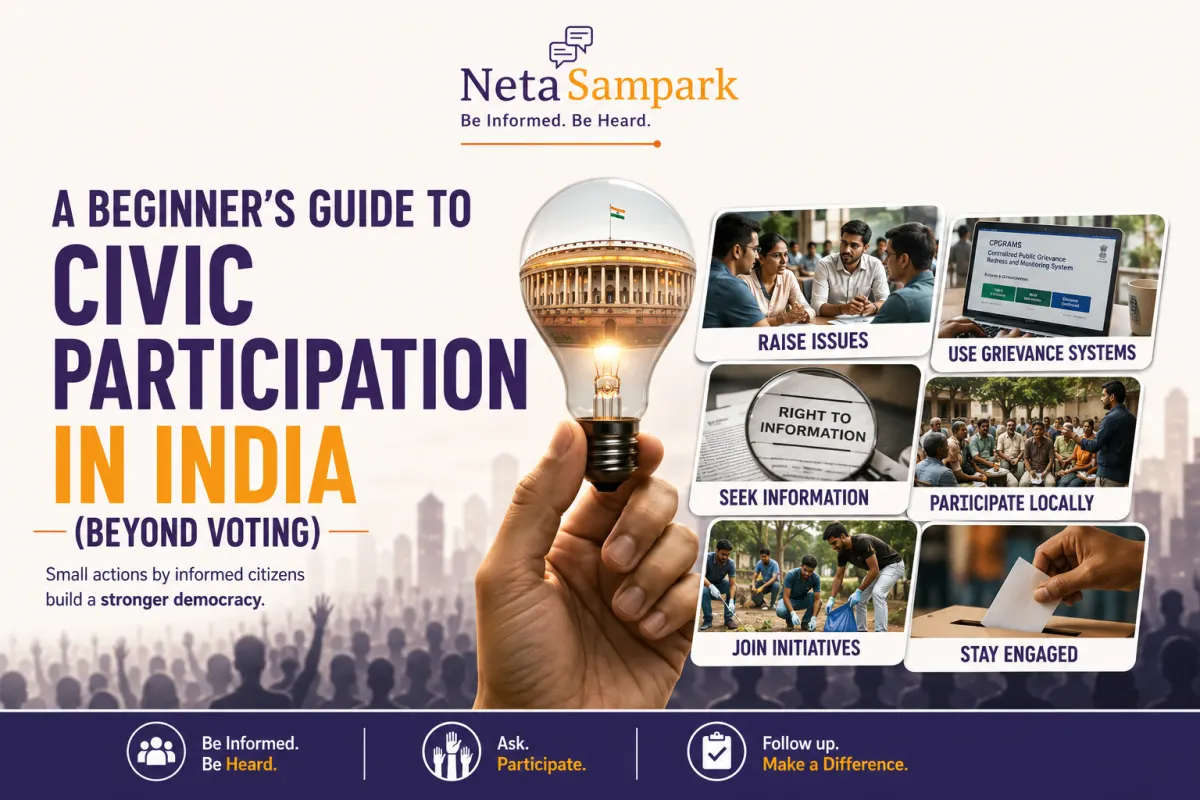
Democracy does not begin and end at the polling booth.
Voting is one of the most important ways citizens participate in democracy, but meaningful participation continues throughout the year. Citizens can raise concerns, question decisions, seek information, engage with elected representatives, participate in local governance and work with their communities to improve the places they live.
For someone new to civic participation, the process can seem complicated. Who should you contact? Where should you complain? Can you ask the government for information? Can one citizen actually make a difference?
The answer is yes.
Here is a practical beginner's guide to participating in India's democracy beyond voting.
What Is Civic Participation?
Civic participation means taking part in the processes and activities that affect your community and society.
It can be as simple as reporting a broken streetlight or as involved as participating in a local public consultation.
Civic participation can include:
- Voting in elections
- Contacting elected representatives
- Filing government complaints
- Participating in local meetings
- Using the Right to Information Act
- Responding to public consultations
- Joining community initiatives
- Monitoring public projects
- Raising issues through appropriate government channels
- Helping other citizens understand their rights and government services
You do not have to be a political activist or belong to a political party to participate.
Civic participation is for every citizen.
1 Start by Knowing Who Represents You
One of the simplest ways to become more civically engaged is to know your elected representatives.
Depending on where you live, you may have several representatives at different levels.
At the national level
Your Member of Parliament (MP) represents your parliamentary constituency in Parliament.
At the state level
Your Member of Legislative Assembly (MLA) represents your Assembly constituency in the State Legislative Assembly.
At the urban local level
If you live in a city, you may have an elected municipal councillor or corporator representing your ward.
At the rural local level
If you live in a rural area, you may have elected representatives within the Panchayati Raj system.
Knowing these representatives makes it easier to understand where to take an issue.
A problem involving a national policy may require the attention of an MP or Union government authority, while a local garbage or drainage issue may be better directed to the municipal authority.
2 Raise Civic Issues
You do not have to wait for an election to speak about problems in your neighbourhood.
If you see:
- A damaged road
- A broken streetlight
- Overflowing garbage
- Blocked drainage
- Water-supply problems
- Unsafe public infrastructure
- Illegal dumping
- Poor maintenance of a public facility
you can report the issue to the relevant local authority.
The important part is identifying who is responsible for the service.
An elected representative can help raise an issue, but many civic services are actually implemented by government departments or local bodies.
This distinction can make your complaint much more effective.
3 Use Government Grievance Systems
India has several official mechanisms through which citizens can submit grievances relating to government services.
For central-government matters, citizens can use the CPGRAMS public grievance system to lodge and track complaints concerning government departments and organisations.
CPGRAMS – Centralised Public Grievance Redress and Monitoring System
Many state governments and local authorities also have their own grievance portals, helplines and mobile applications.
Instead of only posting a complaint on social media, consider using the official grievance mechanism and keeping the complaint or reference number.
That creates a record that can be followed up.
4 Follow Up on Your Complaint
Submitting a complaint is only the first step.
Good civic participation also involves following up.
Keep:
- Complaint/reference number
- Date of submission
- Copies of documents
- Photographs or videos where relevant
- Names or details of officials contacted
- Responses received
If the issue remains unresolved, check whether the relevant department provides an escalation or appeal mechanism.
A well-documented complaint is generally more useful than repeatedly making the same informal request.
5 Use the Right to Information
The Right to Information Act, 2005 gives citizens an important tool for obtaining information from public authorities, subject to the exemptions and procedures provided under the law.
RTI can help citizens understand how a public decision was made or obtain records held by a public authority.
For example, depending on the circumstances, a citizen might seek information about:
- The status of a government project
- Amount sanctioned for a project
- Expenditure recorded
- Copies of relevant government orders
- Rules or procedures followed
- Status of a particular application
- Records relating to a public work
The purpose of RTI is not simply to ask, “Why haven't you done this?”
A more effective approach is often to ask for specific records or information that the public authority holds.
6 Participate in Local Government
Some of the decisions that affect your daily life are made very close to where you live.
Local governments deal with matters such as:
- Roads
- Sanitation
- Waste management
- Water supply
- Local infrastructure
- Public spaces
- Street lighting
- Community facilities
In rural areas, the Gram Sabha is an important forum for local participation.
The Constitution's Panchayati Raj framework recognises the Gram Sabha, and state laws provide for its functioning.
Participating in local meetings or understanding decisions taken by local bodies can give citizens a much stronger voice in community affairs.
7 Pay Attention to Public Spending
Citizens do not need to be financial experts to take an interest in public spending.
If a road, park, drainage project or community facility is being constructed in your area, you can pay attention to:
- What project is being undertaken?
- Which authority is responsible?
- What is the stated scope of work?
- How long is the project expected to take?
- Has the work actually been completed?
- Does the finished work appear to match the stated project?
This does not mean assuming wrongdoing whenever something looks unusual.
It means being an informed citizen and asking legitimate questions.
8 Participate in Public Consultations
Government policies and regulations can sometimes be opened for public comments or consultation.
When a consultation is relevant to your work, community or interests, you can read the proposal and submit feedback through the official mechanism provided.
Public consultation allows citizens, organisations, experts and other stakeholders to contribute before certain decisions are finalised.
You do not need to agree with every proposal.
Constructive participation can include:
- Supporting a proposal
- Raising concerns
- Suggesting alternatives
- Providing evidence
- Explaining how a proposal could affect your community
9 Join Community Initiatives
Civic participation is not limited to government websites and elected representatives.
Your community itself can be a powerful place to begin.
Citizens can work together on issues such as:
- Cleanliness
- Waste segregation
- Road safety
- Tree protection
- Public-space maintenance
- Blood donation
- Community education
- Accessibility
- Neighbourhood safety
A group of residents documenting the same problem and approaching the appropriate authority together can sometimes bring greater attention to an issue than isolated complaints.
10 Use Social Media Responsibly
Social media has changed how citizens communicate with government and elected representatives.
Citizens can use platforms such as X, Instagram, Facebook and other channels to:
- Highlight public issues
- Share official information
- Tag relevant authorities
- Follow representatives
- Participate in public discussions
- Bring attention to unresolved issues
But civic participation also requires responsibility.
Before sharing a claim, check:
Is it true?
Is the source reliable?
Is the information current?
Could sharing it mislead people?
Being an active citizen does not mean sharing every political claim that appears on your feed.
An informed voice is more powerful than a viral rumour.
11 Talk to Your Elected Representatives
You do not have to wait until election season to communicate with your representative.
Depending on the issue, citizens can contact the relevant representative's office, attend public meetings where available, submit written requests or communicate through official channels.
When approaching a representative, make your communication clear.
Instead of:
"Nothing works in our area."
Try:
"The streetlight outside the community centre on this road has not been working for three weeks. We reported it on [date]. The complaint number is [number]. Could you help us follow up with the relevant authority?"
Specific information makes it easier to understand and follow up on the issue.
12 Track What Your Representatives Do
Civic participation should not stop after you elect someone.
Citizens can follow:
- Parliamentary and Assembly proceedings
- Questions raised by representatives
- Legislative debates
- Government announcements
- Local development activities
- Public commitments
- Responses to citizen concerns
The objective is not to support or oppose a representative automatically.
It is to understand what your representative is doing and what your government is doing.
This allows citizens to make better-informed decisions at the next election.
13 Learn the Difference Between an Issue and a Political Argument
Not every civic problem needs to become a political fight.
A broken road is a problem.
A water shortage is a problem.
A delayed government service is a problem.
The useful question is:
Who is responsible, what is the official process, and what can citizens do next?
Keeping the focus on facts, responsibility and solutions can make civic engagement much more productive.
14 Help Others Participate
Civic participation becomes stronger when more people understand how government works.
You can help family members, friends and neighbours:
- Find their voter registration
- Understand government services
- Identify their representatives
- Submit legitimate complaints
- Understand official announcements
- Avoid misinformation
- Participate in local initiatives
You don't need to be an expert.
Sometimes simply helping another person understand where to start can make a meaningful difference.
A Simple Civic Participation Checklist
If you're new to civic participation, start with these five steps:
1. Know
Know your MP, MLA and local representatives.
2. Observe
Pay attention to issues affecting your community.
3. Report
Use the appropriate government grievance channel.
4. Follow Up
Keep records and track the response.
5. Participate
Stay informed and contribute to public discussions and community initiatives.
You don't need to do everything at once.
Start with one issue in your own neighbourhood.
Civic Participation Is More Than Politics
Civic participation is sometimes misunderstood as political activity.
It is much broader.
You can participate in democracy without joining a political party, attending rallies or debating politics online.
You can participate by:
asking a question,
filing a complaint,
attending a Gram Sabha,
using RTI,
checking public information,
speaking to your representative,
helping your community,
or simply staying informed about decisions that affect your life.
Democracy Works Better When Citizens Participate
Elections give citizens the power to choose their representatives.
But between elections, governments continue to make decisions, public money continues to be spent and communities continue to face problems that need solutions.
That is why civic participation matters.
A democracy becomes stronger when citizens don't simply ask “Who won?” but also ask:
“What is happening?”
“Who is responsible?”
“What can I do?”
“Has the problem been resolved?”
Being a citizen is not a once-in-five-years responsibility.
It is an ongoing relationship between people, their communities and the institutions that govern them.
The simple rule: Vote. Ask. Participate. Follow up.
Be informed. Be heard.