
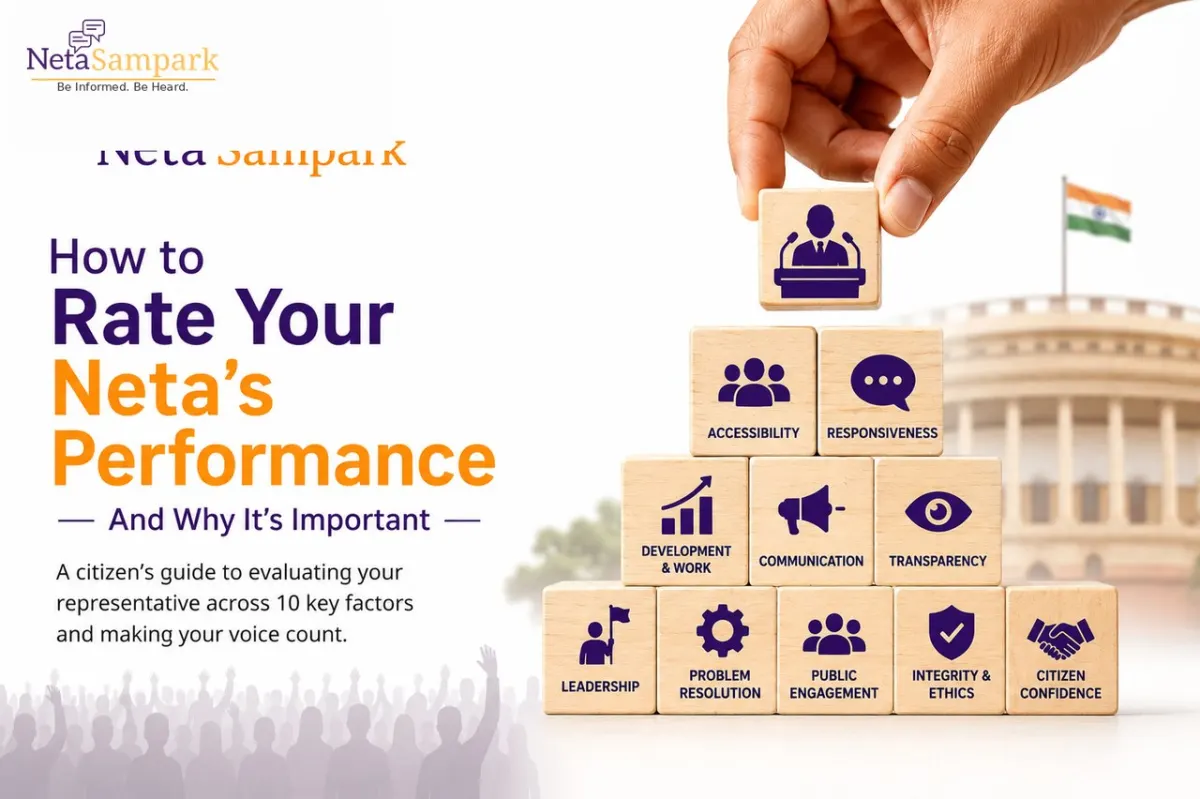
Quick take: You should not need a political science degree—or a neighbour’s rumour—to know who represents you. In under two minutes you can identify your Lok Sabha MP, MLA, and municipal corporator / councillor (or panchayat representatives in rural areas). Then comes the harder, more useful part: what to ask so the conversation produces a file number, not only a photo-op.
This guide is deliberately non-partisan. Names change with elections; mandates do not.
Minute 1–2: Find your representatives
Option A — Fastest path (recommended)
- Open https://netasampark.com/representatives.
- Enter your locality, PIN, or follow the on-screen location steps.
- Note three lines on your result card:
- - Member of Parliament (Lok Sabha)
- - Member of Legislative Assembly
- - Ward corporator / councillor (where mapped)
- Save the page or screenshot for your records.
That is the two-minute version. You now have names and seats without scrolling through PDFs of delimitation orders.
Option B — Official / parallel checks (useful for verification)
What you needOfficial-leaning routeParliamentary & Assembly constituencyECI / CEO maps, electoral search via electoralsearch.eci.gov.in using EPICPolling station partVoter Helpline / ECINET / voters.eci.gov.inMunicipal wardYour municipal corporation website / GIS ward mapSitting MP / MLA directoryLok Sabha / state legislature sites; cross-check after by-elections
Use Option B when boundaries recently changed, you shifted house, or you want a second source. Use Option A when you need to act today.
Rural readers
If you are outside a municipal corporation, your third local face is usually the sarpanch / ward panch / panchayat member, not a corporator. The same logic applies: identify the seat, then the person currently notified for that seat.
Why three names matter (not one viral handle)
Indian federalism spreads power on purpose:
- Corporator — closest to street-level civic works.
- MLA — state laws, state schemes, state police oversight channels.
- MP — Union Parliament, central schemes, national infrastructure interfaces.
Messaging only the most famous name on social media often means messaging the person least able to sign the work order you need. Finding all three is civic hygiene.
Be Informed. Be Heard.
Look up your MP, MLA and local representative in one flow.
Open NetaSampark Representatives →
Democracy doesn’t end on election day.
Then what to ask them (scripts you can paste)
Good asks are specific, time-bound, and attached to a ticket. Bad asks are vague (“do something for our area”) or purely partisan.
Asks that fit a corporator / councillor
- Status of ward works: streetlight stretch __, drain desilt schedule, park maintenance roster.
- Copy of the latest ward committee / works list if publicly shareable.
- Help obtaining a written reply from the municipal engineer on ticket __.
- Site visit request with date—not a promise of miracles.
Sample
I am a resident of Ward , address . Municipal ticket __ (dated ) concerns . Kindly help obtain a written status and expected completion window from the department.
Asks that fit an MLA
- State scheme delivery bottlenecks (health camp stock-outs, school teacher vacancy replies from DEO).
- State road / PWD inspection for a marked stretch.
- Follow-up on delayed certificates stuck in tehsil/department—after you filed online.
- Question in the Assembly if the issue is systemic across the constituency.
Sample
Constituents in __ have open PWD/municipal references . Local offices last replied on . Requesting your office’s intervention for a dated inspection note.
Asks that fit an MP
- Central scheme last-mile issues with documented ticket IDs.
- Rail / NH / telecom / passport-type Union service failures past SLA.
- MPLADS recommendation process as notified—transparent, not personal favours.
- Parliament questions on recurring constituency-wide Union subject problems.
Sample
Residents face repeated failures on __ (portal ticket __). Kindly advise the constituency office channel for escalation to the Ministry/PSU grievance cell and share any public status.
What not to ask
- Anything illegal, communal, or seeking preferential violation of rules.
- “Get my FIR cancelled” as a first message—go through due process.
- Partisan loyalty tests. You are a citizen, not a cadre worksheet.
A simple monthly habit (15 minutes)
- Find / refresh your three representatives on NetaSampark Representatives.
- Pick one civic issue your household actually faces.
- File the official ticket first.
- Send one factual follow-up to the matching representative.
- Log the reply date in a notes app.
Fifteen minutes a month beats one furious thread a year.
Rate Your Neta / Neta Trust Score — use lightly, use fairly
NetaSampark also offers citizen-facing signals such as Rate Your Neta and Neta Trust Score. Treat them as conversation starters and accountability cues, not as courtroom verdicts.
Healthy use
- Read what the score claims to measure.
- Pair ratings with your own documented experience (tickets, replies, visits).
- Update your view when representatives respond well—accountability is a two-way street.
Unhealthy use
- Sharing scores as campaign ammunition without context.
- Ignoring official data, affidavits, and parliamentary records.
- Mistaking a crowd rating for a legal finding.
Non-partisan civic tech works when citizens stay curious and fair. Rate when you have signal; ask better questions either way.
After you find them: channel etiquette
ChannelBest forAvoidOfficial email / web formPaper trailAttachments that are huge video dumps without a summaryConstituency office visitComplex casesArriving without ticket IDsPhone / SMSAppointment & status nudgesAbuse; recording without consent where restrictedSocial media public tagSpotlight after private follow-up failedFirst and only step for emergencies
Always keep a short timeline: issue noticed → ticket filed → representative informed → reply received.
Special cases
- You just moved cities: Re-check Assembly and ward boundaries; EPIC address and civic ward can lag each other. Update electoral roll via Forms on voters.eci.gov.in when needed.
- By-election / vacancy: The seat may show as vacant; follow Speaker/CEO notifications. Still use municipal channels for street issues.
- Multiple homes (hostel + hometown): Your voting constituency and your daily civic corporator may differ. Ask the office that owns the problem’s geography.
Closing: two minutes to find, a lifetime to engage
Locating your MP, MLA and corporator is the easy part—and it should stay easy. The meaningful work is the calm, repeated practice of informed asks. That is how representation becomes a relationship with receipts, not a rumour mill.
Democracy doesn’t end on election day. It continues every time a citizen finds the right desk and asks a fair question.
Start here
Find your representatives → · Explore your area →
Be Informed. Be Heard. Democracy doesn’t end on election day.