
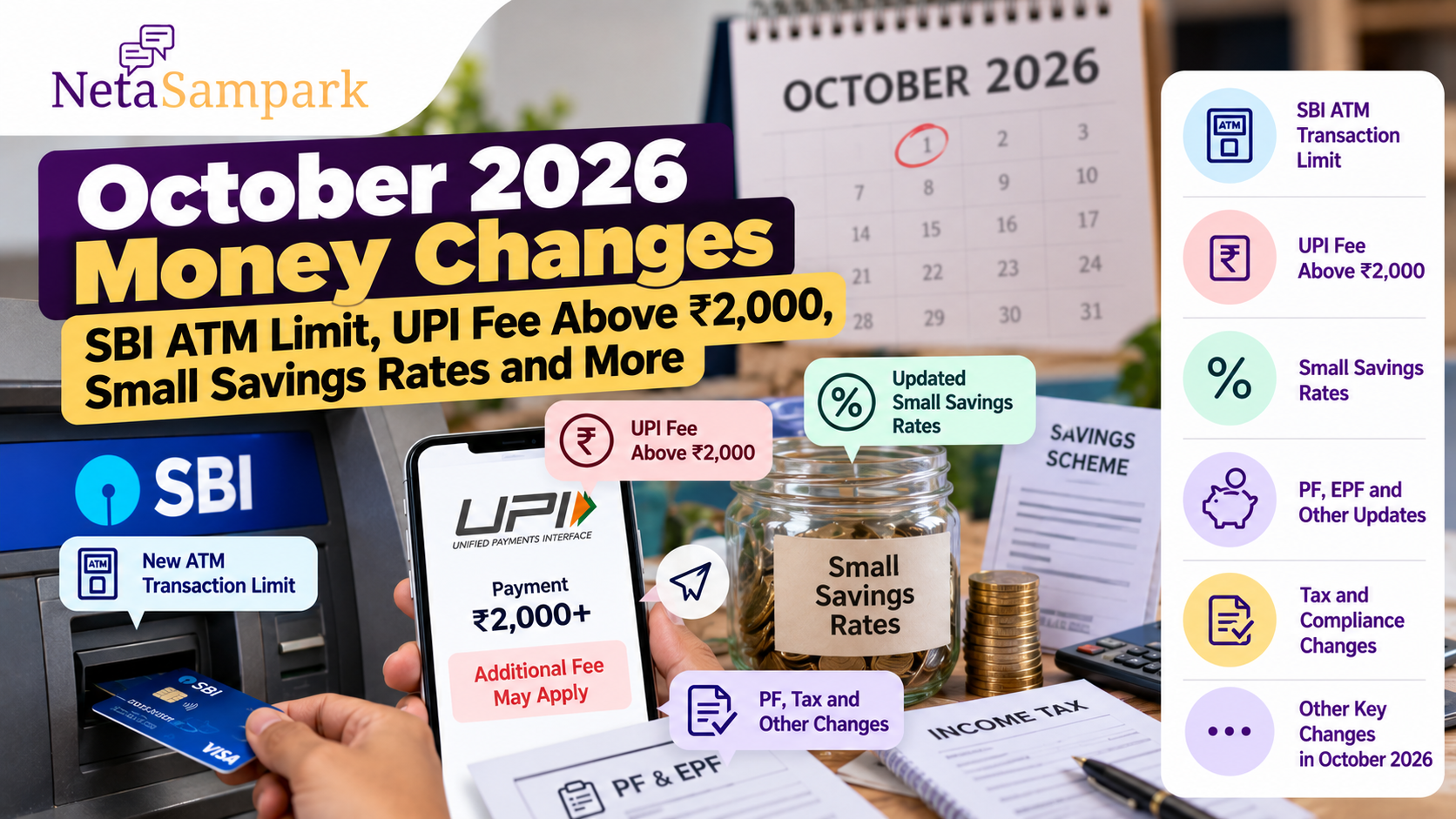
October 2026 brings several changes that affect everyday banking, digital payments, savings, LPG subsidies and tax compliance.
One important clarification is needed at the outset: UPI itself is not becoming a paid service for ordinary users. From 15 October, a Merchant Discount Rate (MDR) will apply to specified high-value person-to-merchant UPI transactions above ₹2,000. Person-to-person payments remain free. Press Information Bureau
Here are the key October changes households, savers and taxpayers should know.
1 SBI ATM rules change from 1 October
State Bank of India is reducing the number of free monthly transactions at other banks' ATMs and ADWMs for salary package account holders.
From 1 October 2026:
- The free limit at other banks' ATMs falls from 10 to 5 transactions per month.
- Both financial and non-financial transactions count toward the limit.
- SBI's own ATM rules depend on the account/card category.
- The change primarily affects SBI salary package account holders using other-bank ATMs.
For example, checking a balance or requesting a mini statement at another bank's ATM can count as a transaction, not just cash withdrawal. Moneycontrol
What SBI customers should do
If you have an SBI salary account, check how many ATM transactions you have already used during the month.
Where practical, use SBI ATMs or digital banking for routine services instead of repeatedly using another bank's ATM.
Also check your specific account variant, because SBI's free-transaction rules differ across account types.
2 SBI Basic Savings Bank Deposit accounts: four free cash withdrawals
A separate change applies to SBI's Basic Savings Bank Deposit (BSBD) accounts.
From 1 October, four cash withdrawals per month remain free. Withdrawals beyond the free limit attract the applicable charge of ₹15 plus GST per transaction. Digital fund transfers such as UPI, IMPS, NEFT and RTGS remain free under the cited SBI rule change. The Financial Express
This is different from the salary-account ATM change, so customers should first identify which SBI account type they hold.
3 UPI above ₹2,000: the important distinction
This is likely to be the most misunderstood October change.
From 15 October 2026, an MDR of 0.4% will apply to specified person-to-merchant UPI transactions above ₹2,000. The charge is imposed within the payment ecosystem on eligible merchants; it is not a transaction fee charged directly to ordinary consumers. Business Standard
For transactions of ₹75,000 or more, the MDR is capped at ₹300 per transaction. The Times of India
What remains free?
Person-to-person UPI payments remain free regardless of amount.
Payments to merchants up to ₹2,000 also remain outside the new MDR band, while the government has said that consumers will not face a UPI transaction charge. Press Information Bureau
So:
UPI paymentOctober 2026 position₹1,000 to a shopNo MDR₹2,000 to a shopNo MDR₹5,000 to an eligible merchant0.4% MDR applies to merchant₹50,000 to an eligible merchant0.4% MDR₹75,000+MDR capped at ₹300₹10,000 to a friendNo charge₹50,000 to a family memberNo charge
The key takeaway: don't interpret the change as "UPI now costs customers 0.4%."
4 Small savings rates stay unchanged for October–December
The Finance Ministry reviewed small-savings rates for the third quarter of FY 2026–27 and kept them unchanged from the July–September quarter. The applicable period is 1 October to 31 December 2026. DEA
The rates include:
Small Savings SchemeOct–Dec 2026 ratePost Office Savings Account4.0%1-Year Time Deposit6.9%2-Year Time Deposit7.0%3-Year Time Deposit7.1%5-Year Time Deposit7.5%5-Year Recurring Deposit6.7%Senior Citizens' Savings Scheme8.2%Monthly Income Account7.4%National Savings Certificate7.7%Public Provident Fund7.1%Kisan Vikas Patra7.5%Sukanya Samriddhi Account8.2%
What does this mean for existing investors?
There is no October rate reset simply because the calendar quarter changed.
For schemes such as PPF and Sukanya Samriddhi, the notified rate continues for the current quarter. For fixed-rate products such as NSC and certain deposits, the applicable rate is generally determined according to the scheme rules and the terms when the investment is made.
5 New bulk FD disclosure rules for deposits of ₹3 crore and above
The Reserve Bank of India has introduced revised rules for bulk deposits, with the changes taking effect from 1 October 2026.
A single term deposit of ₹3 crore or more falls within the bulk-deposit framework for the relevant banks. Banks must disclose applicable bulk-deposit rates and update them daily on working days, with rates published in advance for the applicable deposits. The Economic Times
The rules are mainly relevant to:
- High-value individual depositors
- Companies
- Trusts
- Institutions
- Other customers placing ₹3 crore or more in a qualifying deposit
What about a normal ₹1 lakh or ₹5 lakh FD?
For ordinary retail FDs below the bulk-deposit threshold, this particular October change does not create a new daily-rate requirement.
Existing FDs also do not automatically have their interest rates changed merely because the new rules begin on 1 October. Business Today
6 LPG subsidy: Aadhaar biometric authentication
Another important household change begins on 1 October.
The Ministry of Petroleum and Natural Gas has said that domestic LPG consumers seeking refills at the regulated retail selling price with applicable subsidy need to have completed Biometric Aadhaar Authentication (BAA). Press Information Bureau
Authentication can be completed:
- During LPG delivery
- At the distributor's showroom
- Through the relevant oil company's mobile app
The official release lists:
- IndianOil ONE for Indane
- HelloBPCL for Bharatgas
- HP PAY for HP Gas
Consumers who have already completed the authentication do not need to repeat it. Press Information Bureau
The government has also said that consumers who do not complete BAA can still receive LPG, but the applicable market-price arrangement would apply without subsidy, subject to the stated conditions. Press Information Bureau
7 Income-tax deadlines: check whether the extension applies to you
Taxpayers should also check the revised AY 2026–27 deadlines.
The Income Tax Department announced on 29 September that, for the specified taxpayers covered by the extension:
- The ITR deadline moves from 31 October 2026 to 21 November 2026.
- The audit-report deadline moves from 30 September 2026 to 21 October 2026. Income Tax Department
This is not a blanket extension for every taxpayer. Whether the revised deadline applies depends on the category of taxpayer covered by the CBDT circular.
If you use a tax professional, confirm your applicable deadline rather than relying on the general October calendar.
8 NPS subscribers should check their applicable charges
The Pension Fund Regulatory and Development Authority has issued a revised Point of Presence (PoP) charge structure for NPS and NPS Lite. The framework was issued in August 2026, so subscribers should check whether their particular NPS account and mode of contribution fall under the applicable PoP charges. PFRDA PROD
Not every NPS subscriber is affected in the same way, particularly where contributions are made through channels such as e-NPS.
October 2026 money-change checklist
Before the month gets busy, check these items:
If you use SBI
- Check your account type.
- Check how many other-bank ATM transactions you use each month.
- Keep track of free withdrawal limits.
- Use digital banking where appropriate.
If you use UPI
- Don't confuse merchant MDR with a consumer transaction fee.
- P2P UPI remains free.
- The new MDR framework starts on 15 October, not 1 October.
- Check your bill if a merchant attempts to add a separate "UPI charge."
If you have savings schemes
- PPF: 7.1%
- NSC: 7.7%
- SCSS: 8.2%
- Sukanya Samriddhi: 8.2%
- KVP: 7.5%
- Post Office Savings Account: 4%
These rates apply for October–December 2026. TaxGuru
If you have an LPG connection
- Check whether Aadhaar biometric authentication is complete.
- If not, use your OMC's official app, distributor or delivery channel.
- Don't share OTPs or Aadhaar details with unverified callers.
If you have a large FD
- If you're placing or renewing a deposit of ₹3 crore or more, check the bank's published bulk-deposit rate.
- Don't assume the rate offered previously will automatically apply to a new deposit.
If you're filing an income-tax return
- Check whether the CBDT extension applies to your taxpayer category.
- Keep the audit-report and ITR deadlines separate.
- Use the Income Tax Department portal for the latest filing status. Income Tax Department
The October takeaway
October 2026 is not about one single "new money rule." Several different changes begin at different dates and affect different groups.
1 October: SBI ATM and BSBD changes, LPG Aadhaar authentication, bulk-deposit disclosure rules and the new small-savings quarter.
15 October: the new MDR framework for specified UPI merchant transactions above ₹2,000.
Throughout October: taxpayers, FD investors and NPS subscribers should check the rules applicable to their specific category rather than assuming that a change applies to everyone.
The safest approach is simple: check your bank's account-specific terms, use official government portals for tax and subsidy matters, and distinguish a merchant-side charge from a fee charged directly to you.