
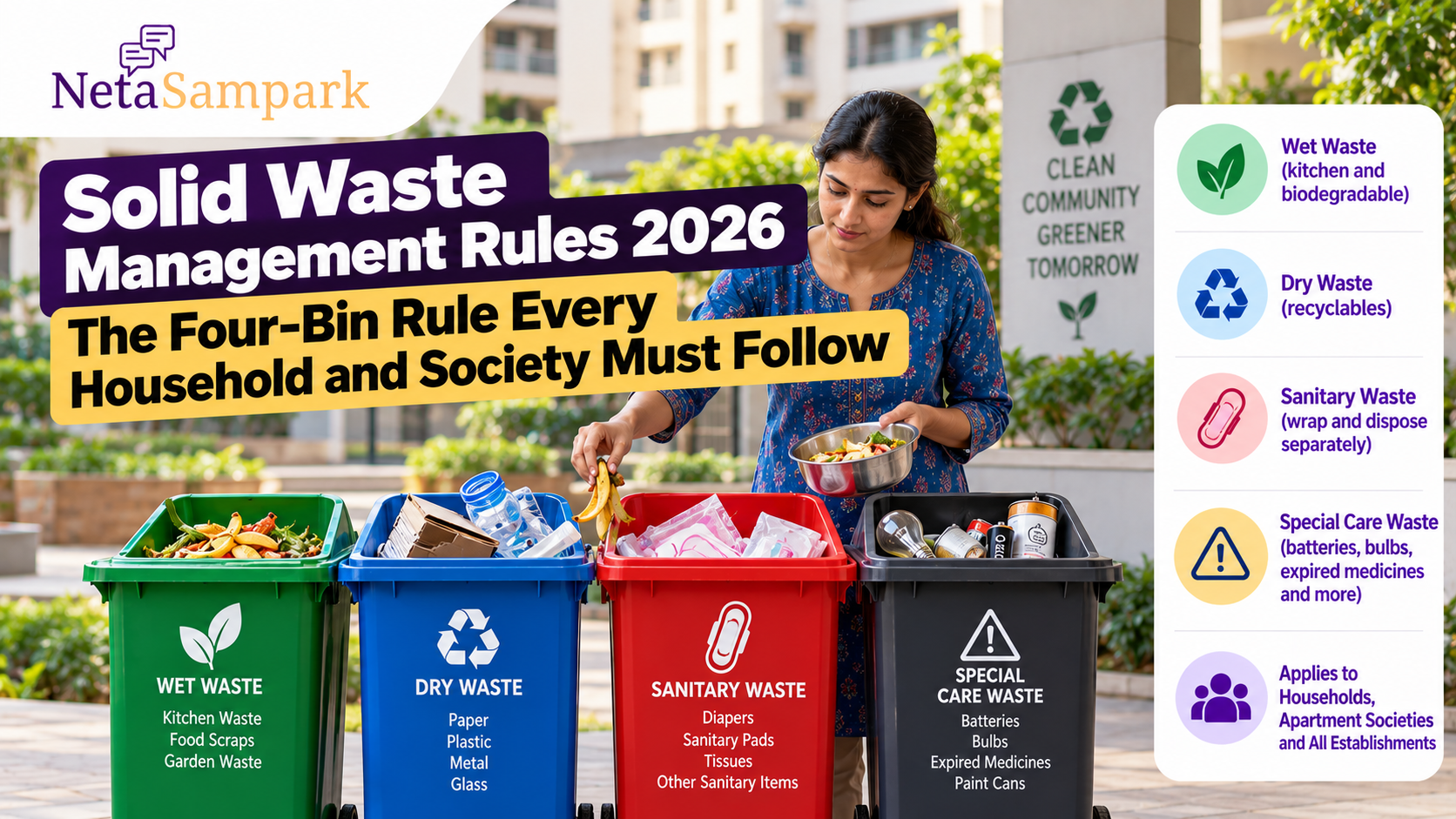
India's waste-management rules changed significantly in 2026.
The Solid Waste Management Rules, 2026, notified by the Ministry of Environment, Forest and Climate Change, replaced the 2016 rules and came into force on 1 April 2026. One of the most important changes for ordinary citizens is mandatory four-stream segregation at source. E-Gazette
That means waste should be separated before it leaves your home, apartment or establishment — not after everything has been thrown into one garbage bag.
The four streams are:
- Wet waste
- Dry waste
- Sanitary waste
- Special care waste
The rules apply across urban and rural areas and cover households, institutions, commercial establishments and other waste generators. Department of Science and Technology
What is the four-bin rule?
The basic principle is simple:
Separate waste where it is generated, store each stream separately and hand it over to an authorised waste collector or agency.
The rules do not make a particular colour scheme such as "green, blue, red and black" a universal national requirement. Local bodies can prescribe the containers, colours and collection arrangements in their jurisdictions.
What is mandatory nationally is the four separate waste streams.
1 Wet waste: kitchen and biodegradable waste
Wet waste is the organic material that can generally decompose.
Examples include:
- Vegetable and fruit peels
- Leftover food
- Kitchen waste
- Flowers
- Meat and other food waste
- Other biodegradable organic material
The government says wet waste should be processed through appropriate methods such as composting or bio-methanation. Press Information Bureau
At home
Keep a separate container for daily kitchen waste.
Do not put plastic packets, batteries, sanitary products or medicine strips into the wet-waste container.
In an apartment society
If the society qualifies as a Bulk Waste Generator, it has additional responsibilities for processing wet and horticultural waste.
2 Dry waste: recyclables and other dry material
Dry waste includes material such as:
- Paper
- Cardboard
- Plastic
- Glass
- Metal
- Wood
- Rubber
- Other non-wet waste
Dry waste can include both recyclable and non-recyclable material. Gazette Tracker
Keep it separate and reasonably clean and dry where possible.
Examples:
Put in dry waste:
- Newspapers
- Cardboard boxes
- Plastic containers
- Metal cans
- Glass bottles
- Packaging material
Don't put in dry waste:
- Used sanitary pads
- Diapers
- Batteries
- Expired medicines
- Paint cans
- Used needles
Those belong to other streams.
3 Sanitary waste: wrap it and keep it separate
Sanitary waste includes items such as:
- Used diapers
- Sanitary pads
- Tampons
- Condoms
- Incontinence sheets
- Similar sanitary products
The rules require used sanitary waste to be securely wrapped in the pouch supplied by the manufacturer or brand owner, or in suitable wrapping material as instructed by the local authority. It must then be kept separately from wet, dry and special-care waste. Gazette Tracker
Why this matters
Sanitary waste should not be opened or mixed with recyclable material.
A simple household practice is:
Use → wrap securely → place in the separate sanitary-waste container → hand over through the authorised collection system.
4 Special care waste: don't put it in the normal garbage
The fourth category covers household waste that requires special handling.
Examples include:
- Paint cans
- Pesticide containers
- CFL bulbs
- Tube lights
- Expired medicines
- Mercury thermometers
- Batteries
- Used needles and syringes
- Certain cleaning agents and insecticides
The rules provide for collection through authorised agencies or designated collection centres. Press Information Bureau
A common mistake
A dead battery may look like ordinary dry waste.
It isn't something you should simply throw into the household dry-waste bag.
Keep batteries and similar special-care items separately until your local body or authorised collection centre provides the appropriate disposal route.
What about garden waste?Garden and horticultural waste has separate handling requirements.
The rules require waste generators to store horticultural or garden waste separately on their premises and dispose of it according to directions of the local authority. Gazette Tracker
So a society should not simply mix large quantities of:
- Fallen leaves
- Grass
- Tree trimmings
- Garden pruning waste
with household wet waste.
For larger residential communities, local arrangements may provide for composting or other decentralised processing.
What about construction waste?Renovating your house?
Don't put construction debris into the regular four household waste streams.
The rules require construction and demolition waste to be stored separately and managed under the applicable Construction and Demolition Waste Management Rules. Gazette Tracker
This includes materials such as:
- Broken tiles
- Concrete
- Bricks
- Cement debris
- Plaster
- Demolition material
Check your local body's designated C&D waste collection or disposal system.
What every household must doUnder Rule 5, every waste generator has specific responsibilities.
A household must:
- Segregate waste into the four streams at source.
- Store the streams separately.
- Hand over segregated waste to authorised waste pickers or waste collectors as directed by the local authority.
- Securely wrap sanitary waste.
- Keep C&D waste separately.
- Keep horticultural waste separately.
- Not throw, burn or bury waste in streets or open public spaces.
- Not put waste into drains or water bodies.
- Pay applicable waste-management user fees specified under local bye-laws. Gazette Tracker
In other words, putting everything into one bag and expecting the collection worker to sort it later is not the system contemplated by the 2026 rules.
What changes for apartment societies and RWAs?This is where the 2026 rules become particularly important.
The rules specifically include residential societies within the Bulk Waste Generator framework when they meet at least one of the prescribed thresholds.
An entity can qualify as a Bulk Waste Generator if it has:
- 20,000 sq. metres or more of floor area, or
- Water consumption of 40,000 litres per day or more, or
- Solid-waste generation of 100 kg per day or more. Solid Waste Management Portal
So an apartment complex should not assume that "we are a residential society, therefore BWG rules don't apply."
The actual criteria matter.
What a Bulk Waste Generator must doBulk Waste Generators have additional responsibilities.
These include:
1. Register through the centralised portal
BWGs are required to register with the concerned local body through the centralised online portal. Gazette Tracker
The CPCB's Solid Waste Management portal provides a registration facility for Bulk Waste Generators. Solid Waste Management Portal
2. Collect the streams separately
The society must make arrangements for collecting and handing over:
- Dry waste
- Sanitary waste
- Special-care waste
to the local body or an authorised agency. Gazette Tracker
3. Process wet waste
Bulk Waste Generators have responsibilities for decentralised processing of wet and horticultural waste through methods such as:
- Composting
- Bio-methanation
- Other approved technologies
New BWGs are specifically required to establish and operate adequate wet-waste processing facilities. Existing BWGs unable to do so can follow the exemption and Extended Bulk Waste Generator Responsibility provisions specified in the rules. Gazette Tracker
Your apartment society should ask these 7 questionsIf you live in a gated community or apartment complex, ask the RWA or facility manager:
1. Are we classified as a Bulk Waste Generator?
Check the 20,000 sq. metre, 40,000-litre-per-day and 100-kg-per-day criteria.
2. Are residents actually segregating into four streams?
Separate bins in the garbage room are not enough if residents are mixing everything inside their flats.
3. Where does wet waste go?
Ask whether it is composted, bio-methanated or sent elsewhere under an authorised arrangement.
4. Where does dry waste go?
Ask whether it is handed to authorised waste pickers, recyclers or an authorised agency.
5. How is sanitary waste collected?
There should be a separate system rather than mixing it with recyclable dry waste.
6. Where should residents take batteries, bulbs and expired medicines?
The society should communicate the designated collection mechanism.
7. Who is responsible for compliance?
The association or facility-management team should know whether the property has BWG registration and what obligations apply.
Can the garbage collector mix all four streams?The purpose of source segregation is to prevent that from happening.
The rules place responsibility on waste generators to segregate and hand over waste separately. Local authorities and authorised collection agencies then have responsibilities for collection, transportation and processing.
The new framework is designed around the principle that segregated waste should remain suitable for its respective processing route. Press Information Bureau
If your household is properly segregating but the collection system routinely mixes everything together, record the issue and raise it with the local body or authorised collection agency.
The rules also provide for local-body bye-laws and user fees, so the exact complaint channel and collection arrangements can vary by city.
What happens if people don't follow the rules?The 2026 framework uses a polluter-pays approach.
The government has provided for environmental compensation for specified non-compliance, while local bodies can also impose user fees and fines under applicable bye-laws. Press Information Bureau
The exact amount of a fine or fee is therefore not necessarily identical across every city.
Don't assume that a national article quoting one city's fine automatically applies to your municipality.
The four-bin setup you can start at homeA practical household arrangement is:
StreamExamplesHousehold actionWetFood scraps, vegetable peels, flowersSeparate containerDryPaper, plastic, metal, glassKeep clean and dry where practicalSanitaryDiapers, pads, tampons, condomsWrap securely and separateSpecial careBatteries, bulbs, medicines, paint containersStore separately until authorised collection
The colour of the bins should follow your local body's instructions. The national rule is about keeping the four streams separate.
Don't put these things in the wrong binDon't put a battery in dry waste.
Keep it with special-care waste.
Don't put a sanitary pad in wet waste.
Wrap it and keep it in the sanitary stream.
Don't put food scraps in dry waste.
Food belongs in wet waste.
Don't put paint cans with ordinary plastic.
Follow the special-care collection arrangement.
Don't put construction debris in household garbage.
Keep C&D waste separate.
Don't burn household waste.
The rules prohibit waste generators from throwing, burning or burying solid waste in streets or open public spaces and from disposing of it in drains or water bodies. Gazette Tracker
What the new rules mean for citizensThe biggest change is not simply the number of bins.
It is the shift in responsibility.
Under the 2026 framework, waste segregation begins where waste is created — inside the home, apartment, office, shop, institution or other establishment.
For households, the immediate action is straightforward:
Separate wet, dry, sanitary and special-care waste.
For apartment societies and larger establishments, there is an additional question:
Do we qualify as a Bulk Waste Generator, and are we meeting the additional processing, registration and responsibility requirements?
The Solid Waste Management Rules, 2026 have been in force since 1 April 2026. Solid Waste Management Portal
So if your society still has one garbage room where everything ultimately ends up mixed together, this is a good time to ask the management committee for its four-stream segregation and collection plan — and, if applicable, its Bulk Waste Generator compliance status.