
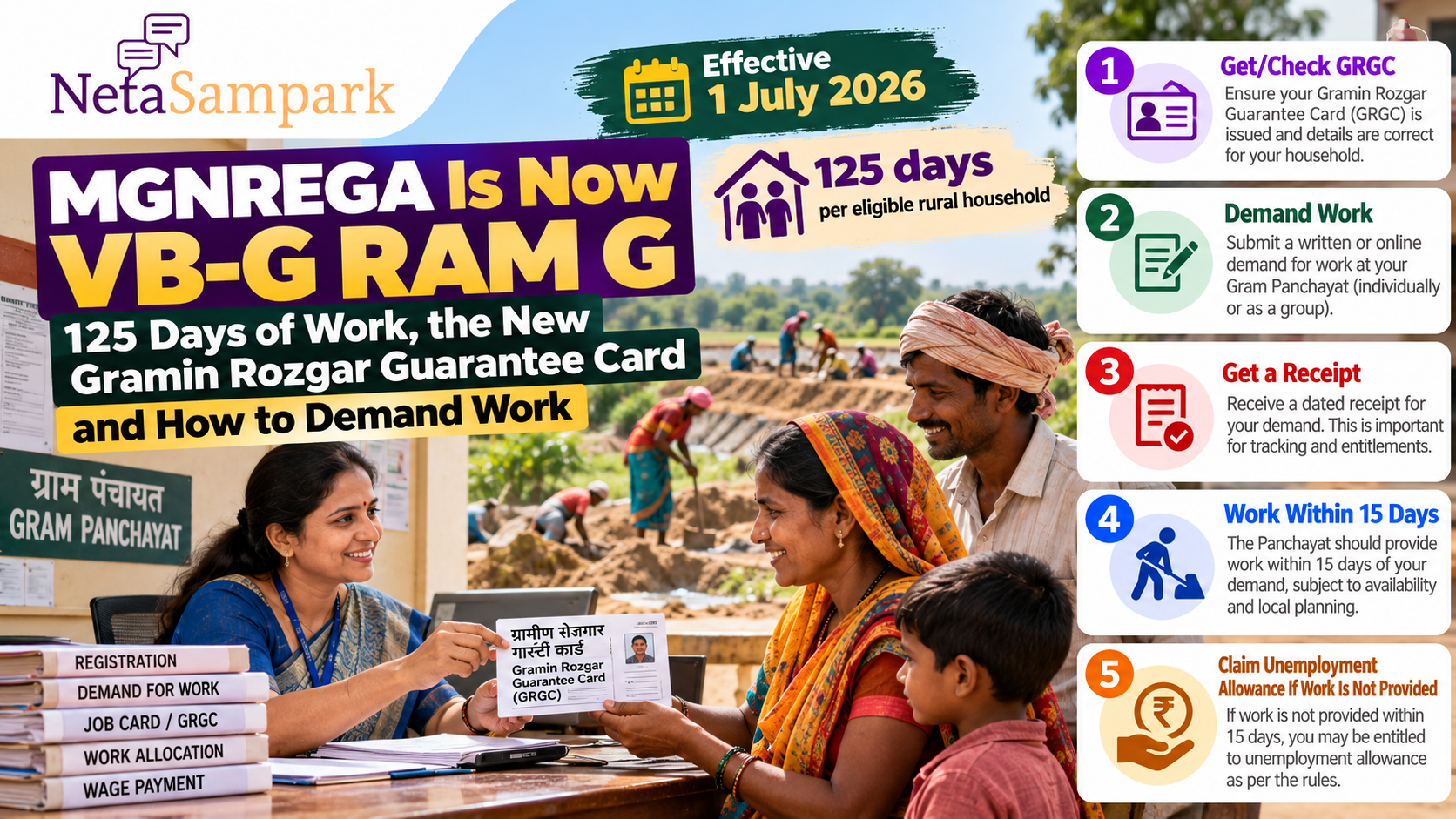
MGNREGA Is Now VB-G RAM G: 125 Days of Work, the New Gramin Rozgar Guarantee Card and How to Demand Work
India's rural employment guarantee system has moved to a new legal framework.
From 1 July 2026, the Viksit Bharat–Guarantee for Rozgar and Ajeevika Mission (Gramin), or VB-G RAM G Act, 2025, replaced the Mahatma Gandhi National Rural Employment Guarantee Act (MGNREGA). The new law raises the statutory employment guarantee from 100 days to 125 days per financial year for an eligible rural household whose adult members volunteer to undertake unskilled manual work. Press Information Bureau
For workers, however, the most important question is not the name of the law. It is: How do I get my card, demand work and prove that I asked for it?
The answer remains largely demand-driven. A worker can ask for employment through the Gram Panchayat and other authorised channels, and the application must be registered with a dated receipt. If employment is not provided within the prescribed 15-day period, the worker can become entitled to unemployment allowance under the Act. PRS Legislative Research
What Changed From MGNREGA to VB-G RAM G?
| Earlier MGNREGA | VB-G RAM G |
|---|---|
| 100 days' guaranteed employment | 125 days per financial year |
| MGNREGA Job Card | Gramin Rozgar Guarantee Card (GRGC) |
| MGNREGA Act, 2005 | VB-G RAM G Act, 2025 |
| Came into force under old framework | Effective from 1 July 2026 |
| Demand for unskilled manual work | Demand-driven employment continues |
| Employment within 15 days | 15-day employment guarantee continues |
| Unemployment allowance where applicable | Unemployment allowance continues |
The government has specifically stated that the new law retains the statutory, demand-driven character of rural employment rather than converting it into a purely discretionary government scheme. Press Information Bureau
Is Your Old MGNREGA Job Card Still Valid?
This is important during the transition.
The government's FAQ says that existing MGNREGA Job Cards of workers whose e-KYC has been completed remain valid until new Gramin Rozgar Guarantee Cards are issued under the new law. Press Information Bureau
So an eligible worker should not assume that an old card became useless on 1 July 2026.
At the same time, households are expected to receive the new Gramin Rozgar Guarantee Card (GRGC) under the VB-G RAM G framework.
If your household already has a verified MGNREGA record, check with the Gram Panchayat about the transition and issuance of the new card rather than applying repeatedly.
What Is the New Gramin Rozgar Guarantee Card?
The GRGC is the household's identification and entitlement record under the new employment guarantee framework.
Under the Act, a rural household willing to undertake unskilled manual work can submit the names, ages and address details of its members to the Gram Panchayat for registration.
The Gram Panchayat is required to issue the card after the prescribed verification process. The Act provides for issuance within 15 days of receiving the registration application. S3WaaS
The card records important employment information, including:
- Registered adult household members
- Photograph/details of members
- Bank or post-office account information
- Aadhaar details, where applicable
- Days for which work was demanded
- Days of work actually allocated
- Work and muster-roll details
- Unemployment allowance, if any
- Date-wise wage payments
- Delay compensation, if any
- Assets provided through the programme
The GRGC is prescribed to remain valid for three years, after which it can be renewed following verification. S3WaaS
Special GRGCs for Vulnerable Groups
The Act also provides for a special Gramin Rozgar Guarantee Card for certain groups, including:
- Single women
- Persons with disabilities
- Persons above 60
- Released bonded labourers
- Members of Particularly Vulnerable Tribal Groups
- Transgender persons
The special card is intended to provide additional protection concerning work allocation, work evaluation and worksite facilities, as applicable. S3WaaS
Who Is Eligible for the 125-Day Guarantee?
The basic eligibility is a rural household whose adult members volunteer to undertake unskilled manual work.
The guarantee is therefore calculated at the household level, not as 125 days for every individual adult member.
For example, if three adults from one household request work, the statutory household entitlement is not automatically 125 days for each of the three people. The guarantee is for 125 days of wage employment for the household in a financial year, subject to the Act and applicable scheme provisions. Press Information Bureau
How to Demand Work Under VB-G RAM G
Having a GRGC does not mean you should simply wait for the Panchayat to assign work.
The system remains demand-driven.
An adult member can request unskilled manual employment through the prescribed channels.
The Act allows applications to be made:
- Orally
- In writing
- Through the Gram Panchayat
- Through the Programme Officer
- Through an authorised person
- Through a digital platform or other authorised method
Applications can also be made individually or as a group. PRS Legislative Research
Step 1: Keep Your Card and Details Ready
Before demanding work, check that your household's GRGC or transitional employment record contains the correct:
- Name
- Age
- Address
- Household members
- Bank/post-office account details
- Aadhaar/e-KYC information, where applicable
If something is wrong, ask the Gram Panchayat or relevant programme official to correct it.
Step 2: Clearly Demand Work
Tell the Gram Panchayat or authorised official that you are demanding employment under VB-G RAM G.
You can request work individually or with other household members/work seekers, subject to the applicable procedure.
The government's FAQ also states that workers can continue to use the familiar Form 6 route for written demands, alongside digital channels where available. Press Information Bureau
Step 3: Insist on a Receipt
This is one of the most important protections for a worker.
The Act requires the work demand to be registered and a dated receipt to be issued. The demand and its date are critical because the 15-day employment period runs from the relevant application date or the date from which employment was sought in the case of an advance application. PRS Legislative Research
Do not rely only on:
"Come back later; we will see."
Keep the receipt safely.
If the demand was made digitally, save the application/reference number and screenshot.
What Happens After You Demand Work?
The Gram Panchayat and Programme Officer are required to ensure that employment is provided within 15 days of the application, or from the requested start date where an advance application is involved, whichever is later. PRS Legislative Research
As far as possible, employment should be provided within five kilometres of the applicant's village. Where work is provided outside the prescribed radius, the Act provides for additional compensation towards transportation and living expenses under the applicable provisions. PRS Legislative Research
Workers should therefore record:
Date of demand → receipt/reference number → requested start date → work allocated → date work actually begins.
That simple timeline can become important if there is a dispute.
What If No Work Is Given Within 15 Days?
This is where the employment guarantee becomes particularly important.
If employment is not provided within the prescribed period, the worker may become entitled to unemployment allowance payable by the State Government. Press Information Bureau
The Act provides that the unemployment allowance should be:
- At least one-fourth of the notified wage rate for the first 30 days during the financial year; and
- At least one-half of the notified wage rate for the remaining period,
subject to the conditions and rules under the Act. Press Information Bureau
So if you demanded work and did not receive it, do not simply treat the application as closed.
Keep your demand receipt and ask the appropriate Panchayat/Programme Officer about the status of the employment demand and your unemployment-allowance entitlement.
What If the Panchayat Says There Is No Work?
"No work available" should not automatically mean that the demand disappears.
The government has said that where ongoing works are insufficient to meet employment demand, new works from the approved shelf of works can be taken up, subject to the VB-G RAM G framework and applicable planning requirements. Press Information Bureau
The new programme also places emphasis on works connected with:
- Water security
- Core rural infrastructure
- Livelihood-related infrastructure
- Climate resilience
- Extreme-weather mitigation
- Durable and productive rural assets Press Information Bureau
Therefore, a worker who is refused work should ask for the demand to be formally registered rather than accepting an informal verbal refusal.
Can You Apply for Work as a Group?
Yes.
The Act specifically permits applications to be made individually or jointly by a group of workers. PRS Legislative Research
This can be useful when several households in a village want employment around the same time.
The important point is still the same: make sure the demand is properly registered and obtain the dated receipt.
What About Wage Payments?
VB-G RAM G continues to provide for wage employment and timely wage payments.
The government has also stated that revised wage rates have been notified under the new framework and that no notified daily wage rate is below ₹300, with the national average wage increasing by more than 10% at the launch of the new framework. Press Information Bureau
The actual notified wage rate is State/UT-specific, so workers should check the applicable rate for their State rather than assuming that ₹300 is the wage everyone will receive.
The GRGC is intended to record date-wise wage payments and any applicable delay compensation. S3WaaS
What Work Can Be Taken Up?
VB-G RAM G is designed around employment as well as creation of durable rural assets.
The government identifies four broad priority areas:
- Water-related works
- Core rural infrastructure
- Livelihood-related infrastructure
- Works for mitigation of extreme weather events Press Information Bureau
This means the programme is not simply a wage-payment mechanism. Work undertaken under it is also intended to create or improve useful community and household-level rural assets.
What About the 60-Day Agricultural Season Provision?
One change workers should watch for is the provision allowing States to notify a peak agricultural season of up to 60 days in a financial year.
The purpose is to align public employment works with periods of peak sowing and harvesting activity. The details, including the dates notified by the State, matter in practice.
For workers, this means that the availability and scheduling of VB-G RAM G work can vary according to the State's notified agricultural-season arrangements.
What Should You Do If Your Name or Household Details Are Wrong?
Do not wait until you need employment to discover that your records contain an error.
Check:
- Household name
- Adult members
- Aadhaar/e-KYC status
- Bank account
- Address
- Mobile number
- Work-demand history
- Wage-payment history
Take the issue to the Gram Panchayat or the appropriate programme official and keep evidence of the correction request.
What If the Panchayat Refuses to Register Your Demand?
A verbal refusal is difficult to prove.
Instead:
- Submit your employment demand through the prescribed channel.
- Ask for registration of the demand.
- Obtain the dated receipt/reference number.
- Keep a copy or photograph.
- If refused, approach the Programme Officer or other grievance mechanism prescribed by the State.
- Escalate through the applicable grievance system if the issue remains unresolved.
The VB-G RAM G framework includes dedicated grievance-redressal rules, so workers should use the formal route rather than relying on repeated informal visits. PRS Legislative Research
Keep These Documents and Records
A rural worker should maintain a small employment file containing:
- GRGC/MGNREGA Job Card or transitional record
- Aadhaar/e-KYC details
- Bank or post-office account details
- Employment-demand receipts
- Digital application/reference numbers
- Work-allocation information
- Muster-roll details where available
- Wage-payment records
- Unemployment-allowance records
- Copies of complaints and acknowledgements
A dated receipt can be much more useful than a verbal assurance.
Don't Pay Anyone to "Activate" Your Job Card
There is no reason to pay an intermediary simply to submit a legitimate employment demand.
Be particularly careful if someone asks for:
- OTP
- UPI PIN
- ATM PIN
- Bank password
- Aadhaar OTP
- Money for "guaranteed work"
- Money to add your name to a work list
Use the Gram Panchayat, Programme Officer and officially notified digital systems.
The 5-Minute VB-G RAM G Checklist
Before demanding work, check:
- 1. Card: Do you have a valid GRGC or verified transitional job-card record?
- 2. e-KYC: Are your household records correctly updated?
- 3. Demand: Have you formally asked for work?
- 4. Receipt: Do you have the dated acknowledgement/reference number?
- 5. 15 days: If work was not provided within the applicable period, have you asked about unemployment allowance?
The Most Important Thing to Remember
The change from MGNREGA to VB-G RAM G is not simply a change of name.
The old 100-day guarantee has become a 125-day statutory employment guarantee, the new framework provides for Gramin Rozgar Guarantee Cards, and the government says the demand-driven right to seek work and the 15-day employment rule continue. Press Information Bureau
For a rural worker, the practical rule is simple:
Have your household record in order → demand work formally → get a dated receipt → track the 15-day deadline → claim the applicable unemployment allowance if work is not provided.
And if you already have an e-KYC-verified MGNREGA Job Card, do not assume it was cancelled overnight. The government has expressly provided for its validity during the transition until the new GRGC is issued. Press Information Bureau