
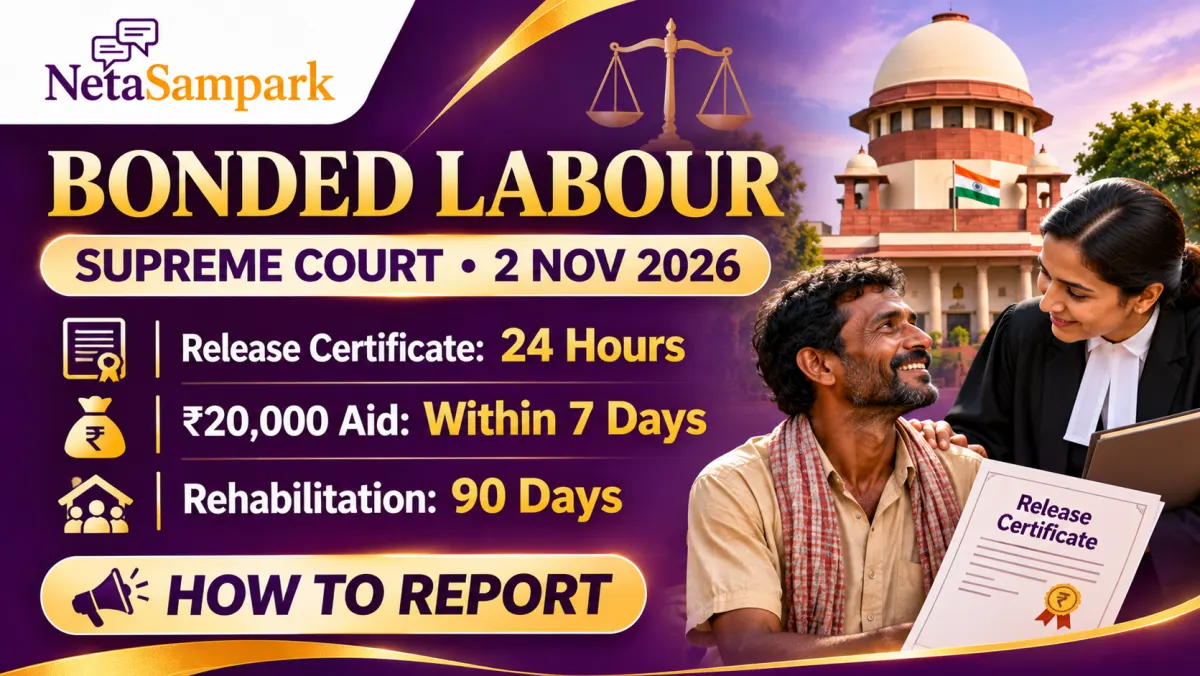
On 2 November 2026 the Supreme Court told every state that a rescued bonded labourer must get a release certificate, ordinarily within 24 hours of the facts being verified, ₹20,000 in immediate help within seven days, and rehabilitation within 90 days. States have six months to put these systems in place.
Updated 4 November 2026
Bonded labour was abolished in India in 1976. But it still happens, at brick kilns, stone quarries, farms, and in workers taken from one state to another with an "advance" they can never pay back. The big problem has always been what happens after a rescue. Workers wait months for a release certificate and longer still for the money they're owed. This judgment tries to fix that delay. Here's what it says, and how you can report a case.
Quick facts
| Item | Details |
|---|---|
| Official portal | Supreme Court judgment, 2 November 2026 (PDF) |
| Helpline | Police 112; Childline 1098 for children; the local SDM or District Magistrate |
| Fee | Free. Reporting and rehabilitation cost the worker nothing |
| Deadline | Release certificate ordinarily within 24 hours of verification; ₹20,000 within 7 days; rehab within 90 days; states to comply within 6 months (by around May 2027) |
| Documents | None needed to report. Any details of the place, employer and workers help |
| Case | Writ Petition (Civil) No. 511 of 2022, judgment dated 2 November 2026 |
| Law | Bonded Labour System (Abolition) Act, 1976 |
The timeline the court has set
| Step | Who does it | Time limit |
|---|---|---|
| Complaint verified | District administration (SDM or DM) | Promptly |
| Release certificate issued | District Magistrate or authorised officer | Ordinarily within 24 hours of verification |
| Immediate financial assistance | District administration | ₹20,000 within 7 days of the release certificate |
| Rehabilitation package | State and district | Within 90 days |
| States set up systems and file compliance | State governments | Within 6 months |
What the court said, in simple words
• Speed matters. A release certificate shouldn't wait for weeks. Once facts are verified, it should ordinarily be issued within a day.
• No waiting for conviction. The immediate ₹20,000 help is not linked to the employer being convicted in court. Criminal cases can take years, and the worker can't wait that long to eat.
• Rehabilitation on a clock. The full rehabilitation, including money and other support, should be done within 90 days.
• Nodal officers and coordination. States need clear nodal officers, and when workers are taken from one state to another, both states must coordinate.
• Vigilance committees must work. District Vigilance Committees under the 1976 Act are supposed to identify and rescue bonded labourers. Many exist only on paper.
• Tracking. The court referred to using the NAVJIVAN portal to track cases and rehabilitation.
Read the full judgment on the Supreme Court website for the exact wording.
Who brought this case
The petition was filed by Surendra Manjhi, himself a survivor of bonded labour, who was rescued along with other workers and then faced long delays in getting his release certificate and rehabilitation. The judgment is reported as 2026 INSC 1185. His experience is exactly the gap the court is trying to close: rescue on paper, but months or years of waiting before any real help arrives.
Who counts as a bonded labourer?
Under the Bonded Labour System (Abolition) Act, 1976, it's bonded labour when someone has to work for an employer because of a loan, advance or debt, and they lose freedoms like:
• the freedom to leave and work somewhere else,
• the freedom to move around freely,
• the right to sell their labour or products at market value,
• or they're paid little or nothing.
Common signs: workers can't leave the brick kiln, the employer keeps their ID cards, the "advance" never reduces, or whole families are made to work.
How to report bonded labour, step by step
1. Call 112 if someone is in immediate danger. For a child, call 1098.
2. Inform the SDM or District Magistrate. They're the main authority under the 1976 Act. A written complaint, even a simple letter or WhatsApp message to their office, creates a record.
3. Give details: location, employer's name if known, number of workers, where they're from, and how long they've been there.
4. Contact the National Human Rights Commission at nhrc.nic.in if local officials don't act. NHRC takes bonded labour complaints seriously.
5. Reach out to NGOs working on bonded labour. They often help with rescues and follow-up.
6. Ask for the release certificate after rescue. It's the key paper for getting rehabilitation money.
You can also file an FIR. Our guide on Zero FIR and e-FIR under BNSS explains how to report at any police station.
Why the release certificate matters so much
The release certificate is the official proof that a person was a bonded labourer and has been freed. Without it:
• the worker can't get rehabilitation money,
• the "debt" isn't officially cancelled,
• and the case can drag on.
Under the 1976 Act, once someone is freed, any bonded debt is wiped out. The employer can't legally recover it.
Money a rescued worker is entitled to
There are two parts:
• Immediate assistance: ₹20,000, which the court says must be paid within seven days of the release certificate.
• Rehabilitation: under the Central Sector Scheme for Rehabilitation of Bonded Labourer, 2021, the total assistance generally ranges from ₹1 lakh to ₹3 lakh depending on the category. Women, children, and people rescued from extreme exploitation like trafficking get higher amounts. Check the latest scheme details on the Ministry of Labour and Employment website.
Rehabilitation can also include land, housing, skill training and linking to other schemes like ration cards and job cards.
What states must do by around May 2027
The court gave states six months from 2 November 2026. In that time they're expected to:
• appoint nodal officers,
• make sure District Vigilance Committees are active,
• set up inter-state coordination,
• use the tracking portal for cases,
• and file compliance affidavits in court.
If your state's response looks slow, ask your MLA or MP about it. You can find them on NetaSampark.
If you're a worker, or a family member of one
You don't need any paper to ask for help. Just tell the officer where you were made to work, who the employer was, how much "advance" was given and how long you worked. If you have a phone, save photos of any slips, registers or messages about the debt. Once you're rescued, keep your release certificate safe and make photocopies, because every benefit after that depends on it. If the ₹20,000 doesn't come within seven days, go back to the SDM's office with a copy of the certificate and ask in writing why. Local NGOs and the district legal services authority can help you write that letter for free.
Frequently asked questions
What is a release certificate?
It's an official document issued by the District Magistrate or an authorised officer confirming that a person was a bonded labourer and is now free. It's needed to get rehabilitation money and other benefits.
Who do I complain to about bonded labour?
Go to the SDM or District Magistrate, call the police on 112, or call 1098 if a child is involved. If local officials don't act, you can approach the National Human Rights Commission.
Do I need a conviction to get rehab money?
No. The Supreme Court made it clear on 2 November 2026 that immediate assistance of ₹20,000 shouldn't wait for the employer's conviction. It should come within seven days of the release certificate.
How much rehabilitation money is given?
Under the 2021 central scheme, generally ₹1 lakh to ₹3 lakh depending on the category, plus the immediate ₹20,000. Check the Labour Ministry website for the current amounts.
What is the NAVJIVAN portal?
It's an online system referred to in the judgment for tracking bonded labour cases, release certificates and rehabilitation. It's meant to make delays visible.
Sources
• Supreme Court of India: judgment dated 2 November 2026, WP(C) 511 of 2022
• Ministry of Labour and Employment
• India Code: Bonded Labour System (Abolition) Act, 1976