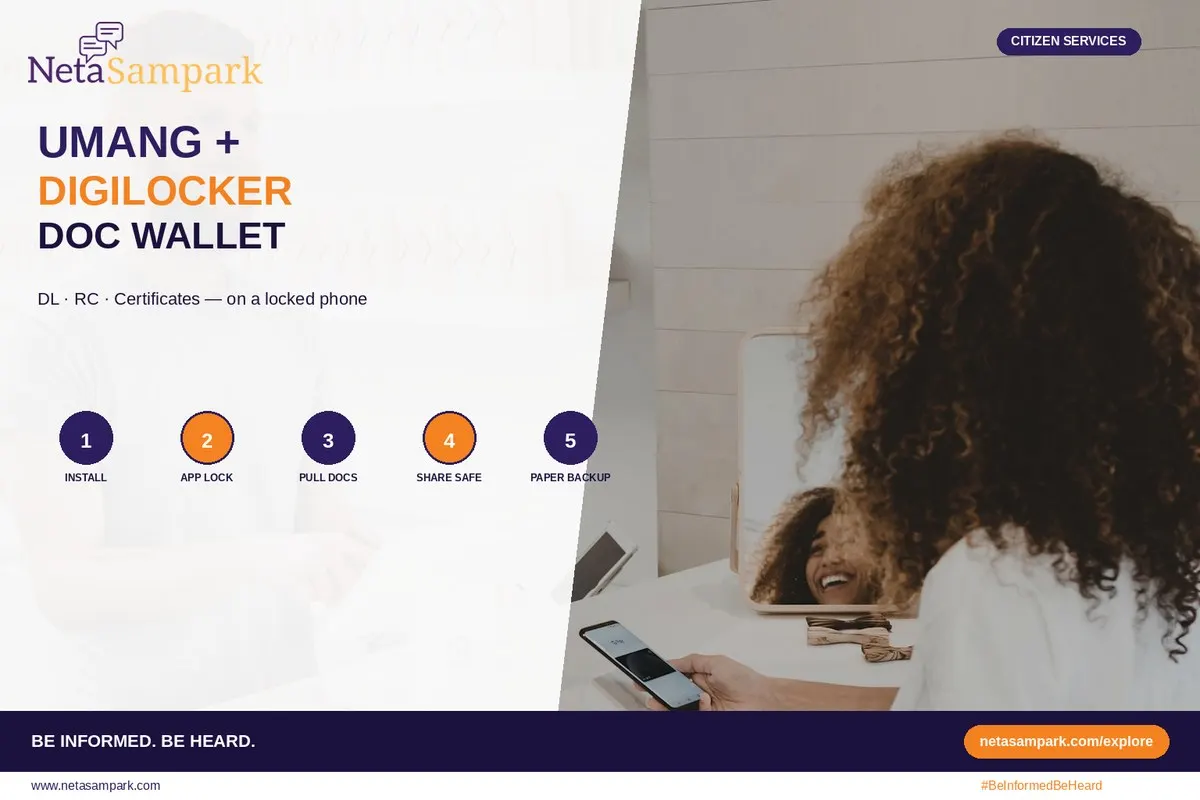
Quick take: Most counter visits still start with, “Documents lao.” Then comes the frantic search for the old marksheet, licence, certificate or registration paper sitting somewhere in a cupboard.
You can avoid a lot of that.
DigiLocker gives you access to authentic documents issued by participating government departments and institutions. UMANG brings many government services into one place. They won't replace every physical document or every government counter—but setting them up properly can save you a surprising number of trips.
This isn't a tech tutorial. It's a practical family setup guide: what to keep digitally, what not to trust, and how to avoid handing your OTP to the wrong person.
DigiLocker and UMANG are not the same thing
Think of them this way:
DigiLocker = your document wallet.
It lets you access authentic digital documents issued through participating departments and institutions. DigiLocker says its issued documents are at par with physical originals under the applicable IT rules. (DigiLocker)
UMANG = your government-services front door.
It provides access to many central and state government services through one platform. The exact services available depend on the department and state. (UMANG)
You don't need to choose one over the other.
For most families, the useful combination is:
DigiLocker for documents + UMANG for services.
Official starting points:
- DigiLocker
- UMANG
Don't download APKs sent through WhatsApp, Telegram or a "helper" website.
The 30-minute family setup
Don't wait until you're standing at a government counter.
Pick one evening and set this up for the adults and students who actually need it.
1. Start with your own phone
Use your own device and your own mobile number.
Set a proper screen lock first. If your phone has biometric authentication, enable it.
Then create or access your DigiLocker account through the official service.
DigiLocker uses authentication and consent mechanisms to protect access to documents. (DigiLocker)
Never give your OTP to someone who says, "I'll just set it up for you."
If a CSC operator or family helper is assisting, let them guide you—but keep control of the OTP and final approval.
2. Pull your important issued documents
Once inside DigiLocker, look under Issued Documents and search for documents from departments and institutions that are available to you.
Depending on your profile and participating issuers, this can include things such as:
- Driving licence
- Vehicle registration
- School certificates
- University documents
- Identity-related documents
- Government certificates
Availability varies by issuer and state. If something isn't there, that doesn't automatically mean there's a problem with your record. The relevant department or institution may simply not have that document available through DigiLocker.
DigiLocker distinguishes between Issued Documents and files you personally upload. Issued documents come from participating issuers and can be verified; uploaded files are essentially your own digital copies. (DigiLocker)
That distinction matters.
Issued document vs scanned PDF: don't confuse them
This is one of the most important things to understand.
Suppose you scan your old degree certificate and upload the PDF.
That's useful.
But it isn't the same as a degree certificate that appears under Issued Documents from your university.
One is your copy.
The other is an electronically issued document from the participating issuer.
For official work, prefer the issued version whenever available. DigiLocker itself recommends using issued documents for official purposes. (DigiLocker)
So don't tell an officer, "It's in DigiLocker," until you've checked where it appears.
The documents worth setting up first
Don't spend Saturday uploading 300 random files.
Start with the documents that can save you a trip.
For drivers
Check whether your driving licence and vehicle registration are available.
For students
Look for marksheets, certificates and academic records supported by the relevant institution or board.
For job seekers
Keep educational certificates and other frequently requested documents accessible.
For parents and elders
Set up the documents they repeatedly need for government, banking, travel or service applications.
And keep a physical emergency file.
Digital-first does not mean throwing away every original.
What if your document isn't available?
Don't panic.
There are three very different situations:
"I can't find it."
Search again using the issuer/document details.
"The issuer isn't listed."
The department or institution may not currently provide that document through DigiLocker.
"The document details are wrong."
That's an issuer-side correction issue. DigiLocker can't magically rewrite the underlying government record.
In the third case, contact the department that issued the document and follow its correction process.
Don't create a second account and hope the mistake disappears.
Now set up UMANGUMANG is useful when you don't know which government department's website you are supposed to visit.
Instead of remembering twenty different portals, you can search for a service inside UMANG and see whether that department has made it available there.
The catalogue changes, and state services vary.
So don't assume:
"If it is a government service, it must be on UMANG."
It may not be.
If your state's service isn't available there, go directly to the official state department portal.
Pin only the services you actually use
Don't turn UMANG into another app graveyard.
Choose a few services relevant to your household.
For example:
- One pension-related service
- One utility service
- One employment or education service
- One certificate/service you regularly use
The goal isn't to have every government department on your home screen.
The goal is to find the right service without wasting an hour searching Google.
The security rules that matterYour documents are valuable.
Treat your DigiLocker account accordingly.
Never share your OTP
Not with a "DigiLocker executive."
Not with a bank caller.
Not with a CSC operator over the phone.
Not with someone claiming your certificate will expire in two hours.
Don't use random links
If someone sends:
"Click here to update your DigiLocker immediately."
Stop.
Open the official website or app yourself.
Don't post document QR codes publicly
A document you need to show to an authority is different from putting its QR code or full document online.
Share only what is necessary.
Check consent screens
DigiLocker operates on a consent-based model for accessing and sharing documents, and access/sharing activity is logged. (DigiLocker)
Don't blindly press Allow because you're standing in a queue.
Read what you're being asked to share.
Your family's "digital document emergency kit"Create a simple folder on your phone or secure cloud storage.
For each person, keep:
Identity
- Aadhaar-related copy where genuinely needed
- Voter information
- Other frequently used ID
Education
- Marksheets
- Certificates
- Degree documents
Vehicle
- Driving licence
- RC
- Insurance
Government services
- Income certificate
- Caste certificate, where applicable
- Domicile/residence certificate
- Pension-related documents
Important personal records
- Birth certificate
- Marriage certificate
- Property-related records
But remember:
A scan is a backup, not automatically an officially issued digital document.
Keep originals safely stored.
Teach one elder properlyThis may be the most useful 10 minutes you spend.
Don't just set everything up for your parents and walk away.
Sit with them.
Let them unlock the phone.
Show them:
Open app → find document → show document → close app.
Do it twice.
Write the important steps in their notebook.
And tell them one thing clearly:
"Nobody from the government needs your OTP over a phone call."
That sentence can prevent a lot of trouble.
When the physical paper still mattersThere will still be situations where paper is useful.
For example:
- A local office specifically asks for a photocopy
- An elderly person is more comfortable with paper
- Internet connectivity is poor
- A court or authority has specific filing requirements
- You need an original physical document for a process
- A department hasn't integrated its records digitally
Don't waste 40 minutes arguing with a counter officer because you saw a post saying everything is supposed to be paperless.
Ask:
"What is the required document, and under which process?"
Then follow the official route.
Digital governance is improving, but implementation is not identical everywhere.
A simple family checklistTaskDone?DigiLocker account created☐Phone/app properly locked☐Driving licence checked☐RC checked☐Education certificates checked☐Important government certificates checked☐UMANG installed / accessed officially☐3–5 useful services identified☐Important physical originals stored safely☐One elder taught how to access documents☐Family told never to share OTPs☐Three mistakes to stop making"I uploaded the PDF, so it's officially verified."
Not necessarily.
Check whether it is an Issued Document or simply something you uploaded yourself. (DigiLocker)
"Everything is available on UMANG."
No.
Service availability depends on the department and state. (UMANG)
"I'll set this up when I need it."
That's exactly when you shouldn't.
The first time you need your certificate is usually when you're already under a deadline.
Set it up beforehand.
One more habit that pays offEvery time you successfully complete an important government process, ask yourself:
"What document did they ask me for?"
If it is something you'll probably need again, add it to your digital document checklist.
After a year, your family won't have a random pile of PDFs.
You'll have a small, organised civic file.
Where NetaSampark fits
DigiLocker helps you prove who you are and what documents you have.
UMANG helps you reach certain government services.
Neither tells you what to do when the underlying government system fails.
That's where knowing the right department, grievance route and elected representative still matters.
For civic services and representative discovery, explore NetaSampark at NetaSampark Explore.
Soft close
The best time to find your marksheet isn't when the officer is waiting for it.
The best time to discover that your old certificate isn't digitally available isn't when an application closes tonight.
Spend half an hour setting up DigiLocker and UMANG now.
Keep the originals. Keep the digital copies. Keep control of your OTP.
The next time someone says, "Documents lao," you might already have them in your pocket.
Be informed. Be heard.
Non-partisan civic explainer. DigiLocker and UMANG services, participating issuers, and department requirements can change. Always use the official government app or website and verify the requirement with the relevant department before relying on a digital document for a specific process.