
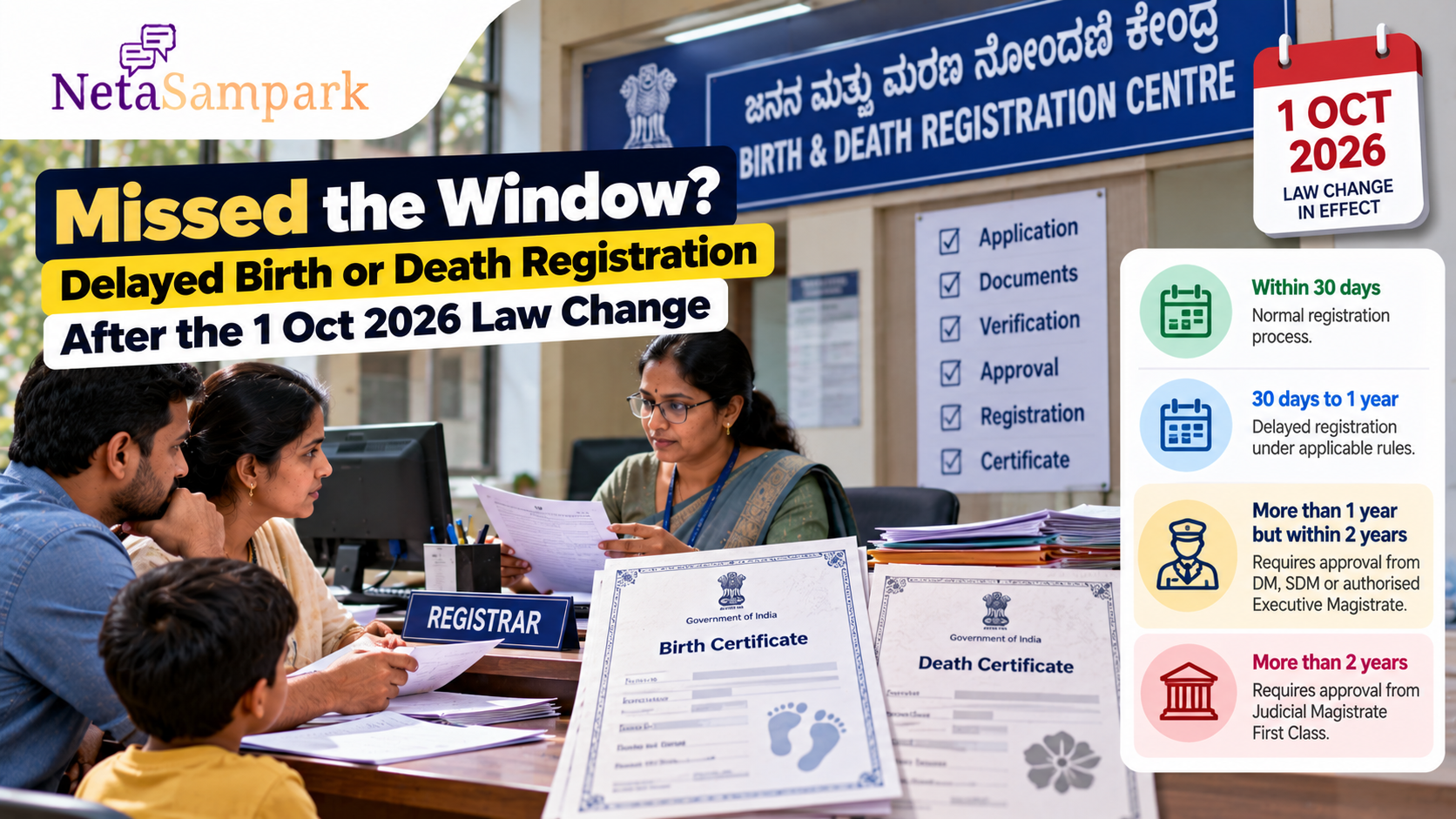
Missed the Window? Delayed Birth or Death Registration After the 1 Oct 2026 Law Change
If a birth or death in your family was never registered, the process has become more formal from 1 October 2026.
The Registration of Births and Deaths (Amendment) Act, 2026 is now in force. It changes the approval required when information about a birth or death is submitted more than one year after the event. The stricter requirement becomes especially important when the delay crosses two years. Rashtrapati Bhavan
The good news is that a missed registration is not automatically impossible. The law still provides a route for delayed registration. But the authority you need to approach now depends on how long the registration has been delayed.
What Changed From 1 October 2026?
The main change is in Section 13 of the Registration of Births and Deaths Act, 1969.
The new framework divides very late registrations into two categories:
| When you report the birth/death | Approval required |
|---|---|
| Within the normal reporting period | Normal registration process |
| More than 30 days but within 1 year | Delayed-registration procedure under the applicable rules |
| After 1 year but within 2 years | DM, SDM or authorised Executive Magistrate |
| After 2 years | Judicial Magistrate First Class |
The 2026 amendment specifically changes the procedure for cases reported after one year. Gazette Tracker
First, Don't Confuse Registration With Getting a Duplicate Certificate
There are two very different situations.
Situation 1: The birth or death was never registered
You need delayed registration.
Situation 2: It was registered, but you lost the certificate
You generally need a copy/extract of the existing registration, not a fresh delayed registration.
Before starting a delayed-registration application, check whether a record already exists with the local Registrar of Births and Deaths.
This can save you from going through a much more complicated process unnecessarily.
The Normal Registration Window
The Civil Registration System (CRS) provides a normal reporting period of 21 days from the date of occurrence. The official CRS FAQ states that registration within this period does not attract a registration fee. Civil Registration System
The 2023 amendment subsequently created a delayed-reporting framework for events reported after the normal period.
For an event that is already several years old, however, the new 2026 provisions become particularly important.
If the Delay Is More Than One Year but Within Two Years
Suppose a child was born on 15 November 2024, but the birth was never registered and the family now applies after the one-year mark but before two years have elapsed.
Under the amended Section 13(3), registration requires an order from one of the following:
- District Magistrate (DM)
- Sub-Divisional Magistrate (SDM)
- Executive Magistrate authorised by the District Magistrate
The authority must verify the correctness of the reported birth or death before issuing the order.
The prescribed fee also has to be paid. Gazette Tracker
What Does “Verification” Mean?
The law requires the authority to verify that the reported birth or death actually occurred.
That means you should be prepared to produce whatever documentary evidence the local registration authority or magistrate requires to establish:
- Date of birth/death
- Place of occurrence
- Identity of the person
- Relationship of the applicant
- Circumstances of the event
- Any existing medical or institutional record
The exact document list can vary according to the circumstances and the state/local registration system.
What If the Delay Is More Than Two Years?
This is the biggest change.
If information about a birth or death is given after two years, the amended law requires an order from a:
Judicial Magistrate of the First Class
The Judicial Magistrate must have jurisdiction over the area where the birth or death took place.
The reported event must also be verified before registration can proceed, and the prescribed fee applies. Gazette Tracker
So if someone is trying to register a birth from 10 years ago, they should not expect the ordinary municipal birth-registration counter to simply issue the certificate.
There is now a judicial approval stage.
Example: A Birth From 2018
Suppose a person born in 2018 never had a birth registered.
In 2026, the person cannot simply treat the application as a normal new birth-registration request.
Because the delay is more than two years, the amended Section 13(3A) requires an order from the Judicial Magistrate First Class having jurisdiction over the place where the birth occurred, followed by registration through the competent Registrar. Gazette Tracker
The same basic rule applies to a death that was never registered and is being reported more than two years after it occurred.
What Documents Should You Start Collecting?
There is no single universal document list that will fit every delayed-registration case.
Your local Registrar or competent authority may require additional evidence.
But start gathering documents that establish the event and the identity of the person involved.
For a delayed birth registration
Potentially relevant records may include:
- Hospital birth/discharge record
- Hospital or nursing-home records
- Mother and child's medical records
- Immunisation records
- School admission records
- Aadhaar or other identity documents
- Parents' identity/address documents
- Proof of place of birth
- Family records
- Affidavit/declaration where required
- Records from the local authority
- Any earlier correspondence regarding registration
For a delayed death registration
Potentially relevant records may include:
- Hospital death records
- Medical certificate of cause of death
- Cremation/burial records
- Cemetery records
- Deceased person's identity documents
- Applicant's identity documents
- Proof of relationship
- Police records, where applicable
- Records from the local authority
- Any existing institutional record of the death
Do not create documents or declarations to fill a gap in the record. Submit genuine records and explain any missing documentation to the competent authority.
Where Do You Start?
The first practical step should normally be the Registrar of Births and Deaths for the area where the event occurred.
The CRS explains that registration is carried out by local Registrars appointed by the state government and that the registration authority is generally connected to the place where the birth or death occurred. Civil Registration System
Depending on your state, this may be through:
- Municipal corporation
- Municipality
- Nagar Panchayat
- Gram Panchayat
- Health department
- Revenue/local administration
- Other designated registration authority
Do not assume that the authority where you currently live is automatically the authority responsible for the original registration.
Can You Apply Online?
In many parts of India, birth and death registration services have been digitised.
The Ministry of Home Affairs says the revamped Civil Registration System (CRS) includes features such as online fee payment, delayed reporting, SMS/e-mail notifications, e-sign and electronic delivery of certificates. However, implementation is not identical across every State/UT. Ministry of Home Affairs
The MHA reported in its 2024–25 Annual Report that the revamped CRS portal had been launched in 24 States/UTs, with the list including Karnataka, Maharashtra, Andhra Pradesh, Telangana and several other jurisdictions. Ministry of Home Affairs
So check your state/local registration authority's current process before assuming that a delayed-registration application can be completed entirely online.
A case requiring magistrate approval may also require an offline or separate approval process.
What If the Birth Happened at Home?
A home birth does not mean the birth cannot be registered.
The important issue is establishing the occurrence and place of birth through the prescribed registration process.
For an old unregistered home birth, gather as much contemporaneous evidence as possible and ask the local Registrar what evidence is required for the delayed-registration route.
Don't wait until the person needs a certificate urgently for:
- School admission
- Passport
- Aadhaar-related documentation
- Government benefits
- Employment
- Immigration
- Marriage documentation
- Other legal or administrative purposes
What If the Death Happened at Home?
Similarly, a death outside a hospital still has a registration procedure.
Depending on the circumstances, medical certification, local records and other prescribed documentation may be relevant.
If the death was never registered and several years have passed, the more-than-two-year Judicial Magistrate route can become applicable under the amended law.
What Happens After the Magistrate's Order?
The magistrate's order is not itself the birth or death certificate.
It provides the required legal authorisation for the delayed registration.
The applicant then has to complete the registration process with the competent Registrar in accordance with the applicable procedure.
Think of it as:
Old unregistered event
↓
Evidence collected
↓
Competent authority/magistrate verification
↓
Required order
↓
Registrar completes registration
↓
Birth/death certificate issued
Does the New Law Mean Old Births Cannot Be Registered?
No.
The amendment does not create a blanket prohibition on registering old events.
Instead, it introduces different approval levels depending on how long the reporting has been delayed.
For delays exceeding two years, the law requires judicial involvement through a Judicial Magistrate First Class. Gazette Tracker
That distinction is important.
A person who missed registration years ago should not simply give up because the event is old.
They should identify the applicable delayed-registration route.
What About a Certificate That Was Already Issued?
If a birth or death was already registered and the certificate has been lost, damaged or misplaced, do not file a fresh delayed-registration application merely because you no longer have the paper certificate.
First search for the existing registration record.
The CRS framework provides for certificates/extracts from registered records.
Your local authority can tell you how to obtain another copy.
Birth Certificates Have Become More Important
The 2023 amendment to the Registration of Births and Deaths Act introduced a major change: for persons born on or after 1 October 2023, the birth certificate is intended to serve as a single document for establishing date and place of birth for specified purposes under the amended law. Ministry of Home Affairs
That makes it even more important for parents to ensure that a child's birth is registered correctly.
It is much easier to correct a documentation problem early than to reconstruct evidence years later.
Don't Wait Until a Passport or School Deadline
A common mistake is to discover the missing registration only when another service demands a birth certificate.
For example:
“The school needs the birth certificate next week.”
or:
“The passport application is asking for proof of date of birth.”
If the underlying birth was never registered, you may suddenly have to deal with a delayed-registration process.
If you already know that a birth or death was never registered, start the process now.
What If the Details in the Old Records Don't Match?
This is a different problem from delayed registration.
Suppose:
- Hospital record says 12 March
- School record says 13 March
- Aadhaar has another date
Do not simply choose whichever date is convenient.
Tell the Registrar about the discrepancy and provide the underlying records.
The authority handling the delayed registration may need to establish the correct particulars before the registration can be completed.
The 2026 amendment specifically requires verification of the correctness of the reported event for the newly covered delayed-registration categories. Gazette Tracker
What If Someone Asks for a Large “Processing Fee”?
Be careful.
The amended Act says registration is subject to payment of the prescribed fee. Gazette Tracker
That does not mean an applicant should pay an unofficial amount simply because an intermediary demands it.
Ask for:
- Official fee amount
- Receipt
- Application/reference number
- Name of the authority processing the case
If judicial proceedings are required, use the appropriate court/legal process rather than relying on an unofficial agent who promises to “get the certificate done.”
A Practical Checklist for Families
If a birth or death was never registered, collect these details first:
☐ Date of birth/death
☐ Exact place where it occurred
☐ Name of hospital/institution, if applicable
☐ Existing medical records
☐ Applicant's identity documents
☐ Parent/spouse/relative records where relevant
☐ Proof establishing the event
☐ Existing government records
☐ Details of the local Registrar
☐ Approximate length of delay
Then determine which category applies:
Less than one year
Follow the applicable delayed-reporting process.
More than one year but within two years
Prepare for the DM/SDM/authorised Executive Magistrate approval route. Verification is required. Gazette Tracker
More than two years
Prepare for the Judicial Magistrate First Class route, followed by registration with the competent Registrar. Gazette Tracker
What Changed on 1 October 2026 — In One Table
| Question | Before the 2026 change | From 1 October 2026 |
|---|---|---|
| Delay beyond one year | One delayed-registration approval route under the earlier framework | Split into 1–2 years and more than 2 years |
| 1–2 years late | Earlier Section 13 framework | DM/SDM/authorised Executive Magistrate |
| More than 2 years late | Earlier approval framework | Judicial Magistrate First Class |
| Verification | Applicable under the existing framework | Explicit verification of correctness in the amended Section 13(3)/(3A) |
| Fee | Prescribed fee | Prescribed fee continues to apply |
The 2026 amendment was enacted as Act No. 12 of 2026 and received Presidential assent on 6 August 2026. The Central Government subsequently notified 1 October 2026 as its commencement date. Rashtrapati Bhavan
The Bottom Line
If your family missed registering a birth or death, the window has not closed.
But from 1 October 2026, very old cases require a more formal approval process:
More than 1 year but within 2 years → DM / SDM / authorised Executive Magistrate
More than 2 years → Judicial Magistrate First Class
In both cases, the reported event must be verified and the prescribed fee paid before registration can proceed. Gazette Tracker
If you have an old unregistered birth or death in your family, the practical first step is to contact the Registrar of Births and Deaths for the place where the event occurred, establish whether a record already exists, and then follow the correct delayed-registration route based on the age of the case.