
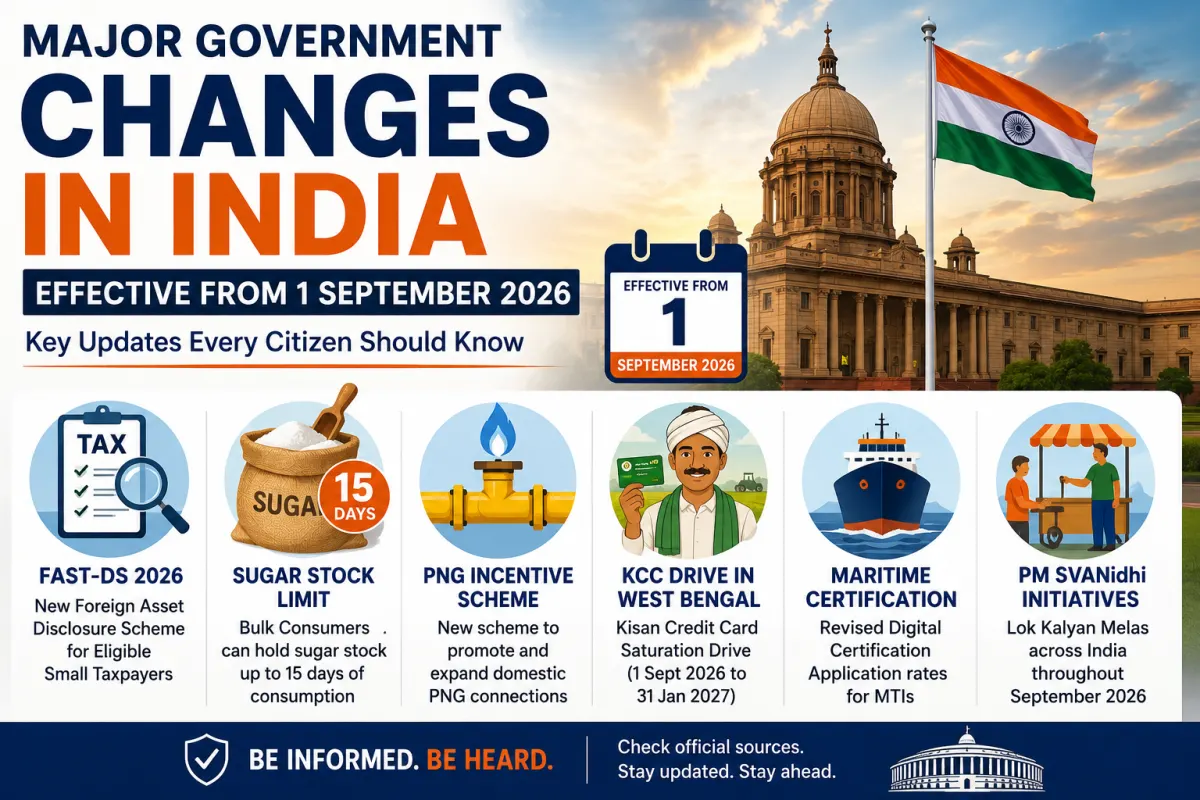
Major Government Changes and Updates Taking Effect in India From 1 September 2026
1 September 2026 brings several important government updates in India. But not all of them are new rules for every household.
Some affect taxpayers, some businesses, some farmers in specific states, and some are sector-specific. This distinction matters because many “September 1 rule change” lists circulating online combine genuine government notifications with outdated or unrelated information.
This guide focuses on updates that can be verified through official Government of India sources.
What Is Actually Changing From 1 September 2026?
The most notable confirmed updates include:
- Foreign Assets of Small Taxpayers Disclosure Scheme (FAST-DS)
- New restrictions on sugar stocks held by bulk consumers
- New incentive scheme for domestic PNG connections
- Kisan Credit Card saturation drive in West Bengal
- Revision of Digital Certification Application rates for Maritime Training Institutes
- PM SVANidhi Lok Kalyan Melas during September
Not every item affects ordinary consumers directly. Understanding who is affected is just as important as knowing the date.
1 New Foreign Asset Disclosure Scheme for Small Taxpayers
One of the most significant developments beginning in September concerns taxpayers who have certain foreign assets or foreign income that were not previously disclosed.
The Government introduced the Foreign Assets of Small Taxpayers Disclosure Scheme, 2026 (FAST-DS 2026) as a one-time compliance opportunity for eligible taxpayers.
The Income Tax Department describes the scheme as an opportunity for eligible taxpayers to voluntarily disclose specified foreign assets and foreign income that were not previously reported, subject to the conditions of the scheme. (Income Tax Department)
Who could potentially benefit?
The Income Tax Department gives examples including:
- Employees receiving foreign ESOPs or RSUs
- Former students with dormant or low-balance foreign bank accounts
- Returning non-residents with certain foreign savings or insurance policies
- Individuals who held certain foreign assets while working abroad
Eligibility depends on the specific conditions of the scheme. (Income Tax Department)
Important September 1 development
On 1 September 2026, the CBDT notified the rules and prescribed forms for FAST-DS 2026. The Income Tax Department's portal also confirms that Form 1 is available for filing online. (Income Tax Department)
The filing route is:
e-File → Income Tax Forms → File Income Tax Forms → Other Acts → Foreign Assets of Small Taxpayers Disclosure Scheme, 2026
Don't misunderstand this
This is not a general amnesty for all undisclosed foreign assets.
The scheme has specific eligibility requirements, exclusions, valuation rules and payment requirements.
If you think it applies to you, check the official Income Tax Department guidance rather than relying on social-media summaries.
2 New Sugar Stock Limit for Bulk Consumers
A second September 1 measure concerns the sugar market.
From 1 September 2026, bulk consumers will not be permitted to hold sugar stocks exceeding 15 days of their consumption.
The Government announced this measure as part of its response to recent sugar-price increases and concerns about speculation and hoarding. (Press Information Bureau)
Who does this affect?
The important word is:
Bulk consumers.
This is not a 15-day sugar limit for ordinary households.
Consumers buying sugar for normal household use should not interpret the measure as meaning they can legally possess only 15 days' worth of sugar.
The measure is directed at bulk consumption and market-level stock management.
The Government has simultaneously imposed a 400-tonne stock limit on sugar dealers from 1 August to 30 November 2026. (Press Information Bureau)
Why Is the Government Doing This?
The Government says sugar prices rose from ₹48.18 per kg on 20 July 2026 to ₹55.70 per kg on 20 August 2026, an increase of around 15.6% in one month. (Press Information Bureau)
It attributes the recent price movement to several factors, including:
- Lower-than-expected domestic production
- Increased festive-season demand
- Weather-related crop damage
- Global sugar-supply conditions
- Speculation and hoarding
The Government has also announced permission for duty-free import of 10 lakh metric tonnes of raw sugar to augment domestic availability. (Press Information Bureau)
What does this mean for households?
The Government says adequate stocks are available to meet domestic demand until the new crushing season begins.
So the September 1 measure should not be interpreted as a nationwide household sugar shortage or household stock restriction. (Press Information Bureau)
3 New Incentive Scheme for Domestic PNG Connections
A new government initiative concerning Piped Natural Gas (PNG) also becomes effective from 1 September 2026.
The Ministry of Petroleum & Natural Gas has introduced the Incentive Scheme for Promotion of Domestic PNG Connections.
The Government says the scheme is designed to accelerate the expansion of active domestic PNG connections and encourage the conversion of unbilled connections into working connections. (Press Information Bureau)
India currently has around 1.74 crore domestic PNG connections, according to the Ministry. (Press Information Bureau)
What Does the PNG Scheme Do?
The scheme provides incentives to City Gas Distribution (CGD) companies.
The objective is to encourage companies to:
- Activate existing unbilled PNG connections
- Expand PNG networks
- Connect more households
- Increase the number of households actually using PNG
The Government says the scheme is intended to bring clean, safe and convenient piped cooking gas to more households. (Press Information Bureau)
Does every household get a new PNG connection on September 1?
No.
The scheme does not mean that every Indian household automatically receives a PNG connection or a direct cash benefit.
Its impact depends on whether PNG infrastructure is available in your area and on the actions of the relevant City Gas Distribution company.
4 Kisan Credit Card Drive Begins in West Bengal
This is an important example of why citizens should be careful with headlines saying “new rule across India.”
From 1 September 2026 to 31 January 2027, the Government is conducting a Kisan Credit Card (KCC) Saturation Drive in West Bengal. (Press Information Bureau)
The campaign will involve around 6,000 rural and semi-urban bank branches across the state. (Press Information Bureau)
Who is the campaign aimed at?
The Government has specifically highlighted:
- Small farmers
- Marginal farmers
- Tenant farmers
- Sharecroppers
- Dairy farmers
- Fisheries
- Animal husbandry
- Other eligible agricultural and allied activities
The objective is to identify eligible farmers without KCCs and facilitate new applications, renewals or enhancement of existing limits where required. (Press Information Bureau)
Important
This is not a nationwide KCC rule beginning on September 1.
It is a West Bengal-specific saturation campaign.
5 Maritime Certification Charges Change
There is also a sector-specific change affecting India's maritime training ecosystem.
The Directorate General of Shipping has published an addendum revising the rate for the Digital Certification Application (DCA) by Maritime Training Institutes.
The revised rate is effective from:
1 September 2026
The order is listed by the Directorate General of Shipping as an official DGS Order and is specifically applicable to Maritime Training Institutes. (Directorate General of Shipping)
Who needs to care?
This is primarily relevant to:
- Maritime Training Institutes
- Training providers
- Institutions involved in seafarer certification processes
For the average household, this does not represent a new consumer rule.
6 PM SVANidhi Outreach Activities Continue Through September
September also brings another important government initiative for street vendors.
Under PM SVANidhi, the Government is organising Lok Kalyan Melas from 1 September to 30 September 2026 to strengthen last-mile access to credit, welfare schemes and capacity-building programmes. (Press Information Bureau)
The Government says these melas bring together:
- Street vendors
- Banks
- Urban Local Bodies
- Government agencies
The objective is to help eligible vendors access credit and other government support.
The PM SVANidhi programme has already facilitated loans to millions of street vendors, according to the Ministry of Housing & Urban Affairs. (Press Information Bureau)
If you are a street vendor
This is worth checking with your local Urban Local Body or the relevant PM SVANidhi support channel.
What Is NOT a September 1 Rule?
This is just as important as knowing what is changing.
A number of “September 1 changes” circulating online are actually:
- Older rules
- Sector-specific regulations
- Previously announced measures
- Changes that have a different effective date
- Proposals that have not yet come into force
Example: Indian Standard Time Rules
The Government notified the Legal Metrology (Indian Standard Time) Rules, 2026 on 27 August 2026.
But these rules do not take effect on 1 September 2026.
The Government states that they will come into force 180 days after publication in the Official Gazette.
So they should not be described as a September 1 change.
This is an excellent example of why citizens should check the effective date, not just the notification date.
What About the Machinery Safety Rules?
Another claim that has appeared in online lists concerns the Machinery and Electrical Equipment Safety (Omnibus Technical Regulation).
The regulation had previously been scheduled for implementation from 1 September 2026.
However, the Ministry of Heavy Industries subsequently rescinded the order in January 2026.
Therefore, it would be misleading to tell readers that this regulation is simply “coming into force on September 1.”
The lesson:
A previously announced effective date can change.
Always check the latest government notification.
What Should Ordinary Citizens Actually Do?
For most households, there is no need to panic about a giant list of new rules.
Instead, understand which updates actually apply to you.
If you're a taxpayer
If you have previously undisclosed foreign assets or foreign income, check whether FAST-DS 2026 applies to you.
Use the official Income Tax Department portal.
If you're a household consumer
The sugar stock restriction is not a 15-day household limit.
There is no reason to stockpile sugar because of the announcement.
If your area has PNG
Watch for information from your local City Gas Distribution company about PNG connections and activation.
If you're a farmer in West Bengal
The KCC Saturation Drive may provide an opportunity to check your eligibility and apply or update your KCC.
If you're a street vendor
Check whether your local PM SVANidhi/Lok Kalyan Mela can help you access credit or other eligible government schemes.
September 2026 Changes: Quick Summary
UpdateEffective / StartsWho is affected?FAST-DS 2026 rules & forms1 Sept 2026Eligible taxpayers with specified foreign assets/incomeSugar stock restriction1 Sept 2026Bulk consumersDomestic PNG incentive scheme1 Sept 2026CGD companies / households in PNG-served areasKCC Saturation Drive1 Sept 2026–31 Jan 2027Eligible farmers in West BengalMaritime DCA rate revision1 Sept 2026Maritime Training InstitutesPM SVANidhi Lok Kalyan Melas1–30 Sept 2026Eligible street vendors and participating local bodiesDon't Believe Every “New Rule From September 1” List
This is perhaps the most important takeaway.
Every month, social media produces lists claiming that:
“These 10 new rules will change your life from September 1.”
Some may be accurate.
Some may be outdated.
Some may apply only to businesses.
Some may be government schemes rather than rules.
And some may have been announced but postponed, amended or withdrawn.
For citizens, the safest approach is simple:
Check three things:
1. Who issued the notification?
2. What exactly does it say?
3. What is the actual effective date?
A headline is not a legal notification.
Where Should Citizens Verify Government Changes?
When a change affects your money, documents, benefits or legal obligations, start with the relevant official government authority.
Income Tax
Use the official Income Tax Department e-Filing portal for FAST-DS and taxpayer-related information. (Income Tax Department)
Consumer and food-related measures
Check announcements from the Ministry of Consumer Affairs, Food & Public Distribution and PIB. (Press Information Bureau)
PNG
Check the Ministry of Petroleum & Natural Gas and your local City Gas Distribution company. (Press Information Bureau)
Agriculture and KCC
Check official Ministry of Finance/PIB announcements and your participating bank. (Press Information Bureau)
Maritime matters
Check the Directorate General of Shipping for applicable orders and circulars. (Directorate General of Shipping)
The Bigger Picture
September 1 does not represent one giant nationwide overhaul.
Instead, several different government measures begin or become operational around the same date, each affecting a different group.
For the average citizen, the most relevant questions are:
Do I have an issue involving undisclosed foreign assets?
Do I operate as a bulk sugar consumer?
Is PNG becoming available in my area?
Am I an eligible farmer in West Bengal who could benefit from the KCC drive?
Am I a street vendor who could benefit from PM SVANidhi outreach?
If the answer is no, many of these changes may have little or no direct effect on your daily life.
Final Takeaway
The biggest mistake is to treat every September 1 announcement as a rule that applies to every Indian citizen.
The official record shows a much more nuanced picture.
FAST-DS 2026 creates a compliance opportunity for eligible taxpayers with specified foreign assets or income.
Sugar stock restrictions target bulk consumers and market participants—not ordinary household shoppers.
The PNG incentive scheme is designed to accelerate domestic PNG connections.
The KCC drive is specifically focused on eligible farmers in West Bengal.
The maritime DCA revision is relevant to Maritime Training Institutes.
And PM SVANidhi Lok Kalyan Melas are providing additional outreach to street vendors during September. (Income Tax Department)
Don't follow the headline. Check the rule.
Before acting on any “new rule from September 1” message, verify the official notification, effective date and who it actually applies to.
Be Informed. Be Heard.