Government services in India have moved rapidly online.
Today, you can check your voter registration, store official documents, submit grievances, access government services, participate in consultations and even seek information from public authorities without necessarily visiting a government office.
But there is one problem:
There are so many government websites that citizens often don't know which one to use.
Instead of searching Google every time you need a government service, it is worth keeping a small collection of official portals bookmarked.
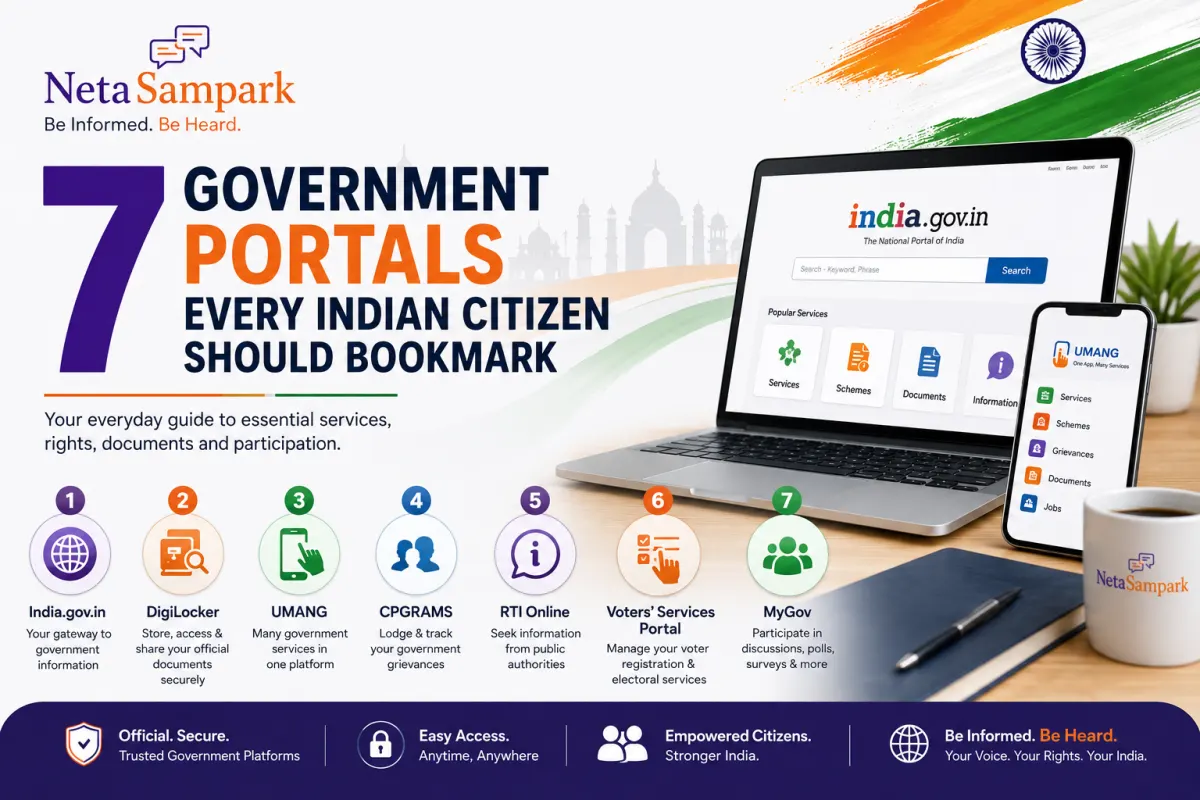
Here are seven that every Indian citizen should know.
1 India.gov.in — Your Gateway to Government Information
National Portal of India — India.gov.in
If you don't know where to start, India.gov.in is one of the best places to begin.
The National Portal of India is developed under the Digital India programme by the National Informatics Centre and brings together government information and links to services from different ministries and departments. (National Portal of India)
What can you find?
The portal provides access to information and links covering areas such as:
- Government services
- Schemes
- Education
- Health
- Employment
- Documents
- Agriculture
- Citizen services
- Ministries and departments
It can be particularly useful when you know what you want to do but don't know which government department handles it.
Bookmark it if:
You frequently search for government schemes, services or official information.
2 DigiLocker — Keep Your Important Documents Digitally
How many documents do you carry around or keep stored in multiple places?
Driving licence.
Educational certificates.
Government-issued documents.
Certificates and records.
DigiLocker provides a digital document wallet for accessing, sharing and verifying authentic digital documents issued by participating organisations. It is a flagship initiative of the Ministry of Electronics & Information Technology under Digital India. (DigiLocker)
DigiLocker distinguishes between issued documents, which are fetched from integrated issuers, and documents that users upload themselves. (DigiLocker)
The platform also states that issued DigiLocker documents are treated at par with original physical documents under the applicable legal framework. (DigiLocker)
Why it is useful
Instead of searching through files every time you need a document, you can access eligible digital records from one place.
You can also share documents electronically when supported by the receiving organisation.
Bookmark it if:
You frequently need certificates, licences or other official documents.
3 UMANG — Many Government Services in One Place
UMANG stands for Unified Mobile Application for New-age Governance.
It was developed by the Ministry of Electronics & Information Technology and the National e-Governance Division to provide a unified platform for accessing government services. (UMANG)
The platform brings together services from different levels of government, including Central and State services where available. (UMANG)
What makes UMANG useful?
Instead of installing or remembering multiple government applications, you can first check whether the service you need is available through UMANG.
The platform includes categories covering areas such as:
- Students
- Employment
- Pensioners
- Farmers
- Health
- Women and children
- Transport
- Finance
- Public grievances
- Citizen engagement
(UMANG)
UMANG also has a dedicated section for discovering government schemes. (UMANG)
Bookmark it if:
You regularly use government services and want a single starting point.
4 CPGRAMS — When You Have a Government Grievance
CPGRAMS — Public Grievance Portal
Sometimes the problem isn't finding information.
The problem is:
“I have already approached the government, but my issue hasn't been resolved.”
That's where the Centralised Public Grievance Redress and Monitoring System (CPGRAMS) can be useful.
CPGRAMS is a government grievance platform for citizens to lodge grievances relating to Central and State Government organisations. It also provides facilities for tracking grievances. (PG Portal)
The portal also provides an appeal mechanism where a citizen is dissatisfied with the redressal of a grievance. (PG Portal)
Use it for things such as:
- Problems with government service delivery
- Unresolved departmental grievances
- Delays
- Issues with government organisations
- Follow-up on previously submitted grievances
Important distinction
CPGRAMS is not the same as RTI.
If you want a government authority to address a grievance, a grievance mechanism may be appropriate.
If you want information or records held by a public authority, RTI may be the appropriate route.
Bookmark it if:
You regularly interact with government departments or may need to escalate an unresolved service issue.
5 RTI Online — When You Need Government Information
The Right to Information can be one of the most powerful tools available to citizens who want to understand how government works.
The RTI Online portal allows Indian citizens to submit RTI applications and first appeals online for covered Central Government public authorities.
You can also track applications and appeals through the portal.
What can RTI be useful for?
For example, you may want information about:
- Government expenditure
- Official records
- Project approvals
- Administrative decisions
- Action taken on a matter
- Rules or procedures
- Records held by a public authority
But there is an important limitation:
RTI Online is not for every government authority.
The official portal specifically says that applications for State Government public authorities, including the Government of NCT Delhi, should not be filed through this Central Government portal. Such applications can be returned without refund.
So always identify the correct public authority before submitting an RTI.
Bookmark it if:
You want to use your Right to Information to seek information from Central Government public authorities.
6 Voters' Services Portal — Manage Your Electoral Information
Election Commission of India — Voters' Services Portal
If you're an eligible voter, this is one portal you should definitely know.
The Election Commission of India's Voters' Services Portal provides a range of voter-related services. (Election Commission of India)
You can use it for services such as:
- New voter registration
- Correction of electoral-roll details
- Deletion requests
- Replacement of EPIC
- Downloading e-EPIC
- Finding your polling station
- Finding BLO details
- Tracking applications
- Registering complaints or suggestions
- Searching your name in the voter list
The current portal also provides access to electoral-roll downloads and application tracking. (Voter Services)
For new registration, eligible citizens use Form 6; Form 8 is used for correction/shifting and certain EPIC-related services, according to the ECI's current guidance. (Election Commission of India)
Bookmark it if:
You want to make sure your voter information is correct before election day.
7 MyGov — Participate, Don't Just Observe
Government websites aren't only about submitting applications.
Citizens can also participate in governance.
MyGov is the Government of India's citizen-engagement platform. It provides opportunities for citizens to participate through activities such as discussions, polls, surveys, quizzes, campaigns, tasks and other engagement programmes. (MyGov)
This makes it different from portals such as DigiLocker or CPGRAMS.
The purpose isn't simply:
“Get a government service.”
It can also be:
“Participate in the conversation.”
You may find:
- Public consultations
- Polls and surveys
- Discussions
- Campaigns
- Quizzes
- Citizen tasks
- Government information
- Opportunities to submit ideas
Bookmark it if:
You want to participate in public initiatives rather than only consume government services.
The 7 Portals at a Glance
PortalBest Used ForIndia.gov.inFinding government information and servicesDigiLockerAccessing and sharing digital documentsUMANGAccessing multiple government servicesCPGRAMSGovernment grievancesRTI OnlineSeeking information from Central Government public authoritiesVoters' Services PortalVoter registration and electoral servicesMyGovCitizen participation and engagementDon't Use the Wrong Portal
Knowing the portals is useful.
Knowing which one to use is even more useful.
Need a government document?
Try DigiLocker.
Don't know which government service you need?
Start with India.gov.in or UMANG.
Have an unresolved government-service grievance?
Look at CPGRAMS or the appropriate departmental/state grievance system.
Want official information or records?
Consider RTI.
Need to check your voter registration?
Use the Voters' Services Portal.
Want to participate in government consultations and activities?
Check MyGov.
One More Important Rule: Verify the Website
Government services are frequently targeted by phishing and impersonation scams.
Don't assume that a website is genuine simply because:
- It has the Government of India logo
- It looks official
- Someone sent you the link on WhatsApp
- The URL contains words like "government" or "India"
When possible, start from the official domain or reach the service through a known government portal.
For example:
.gov.in and official government domains can help identify government websites, but you should still check the exact domain and page.
Never share sensitive information merely because someone claims that a government benefit requires it.
Bookmark These Before You Need Them
The best time to discover a government portal is before you urgently need it.
You don't want to start searching for your voter details on election day.
You don't want to discover DigiLocker when you're standing at a counter looking for a certificate.
You don't want to search for a grievance portal after months of an unresolved issue.
And you don't want to learn about RTI only after you've spent weeks trying to obtain information.
A few minutes spent bookmarking trusted government portals can save considerably more time later.
Government Digital Services Are Part of Modern Citizenship
Being a citizen today isn't only about voting once every few years.
It can also mean:
Knowing your rights.
Accessing government services.
Keeping your documents organised.
Checking your electoral information.
Raising legitimate grievances.
Seeking information.
Participating in public discussions.
The internet has made many of these activities easier—but only if citizens know where to go.
So save these seven portals.
You may not need all of them today.
But one day, one of them could save you a trip to a government office.
Know your portals. Know your rights. Stay engaged.
Be Informed. Be Heard.