You have a problem.
A road is damaged.
A streetlight isn't working.
Your government service application is stuck.
A public office isn't responding.
You want to know why a project was delayed.
The next question is usually:
Where should I complain?
India has several ways for citizens to approach government authorities, including RTI, Public Grievance Redressal Systems (PGRS) and civic/municipal apps.
But these systems serve different purposes.
Choosing the wrong one can waste time.
The most important distinction is this:
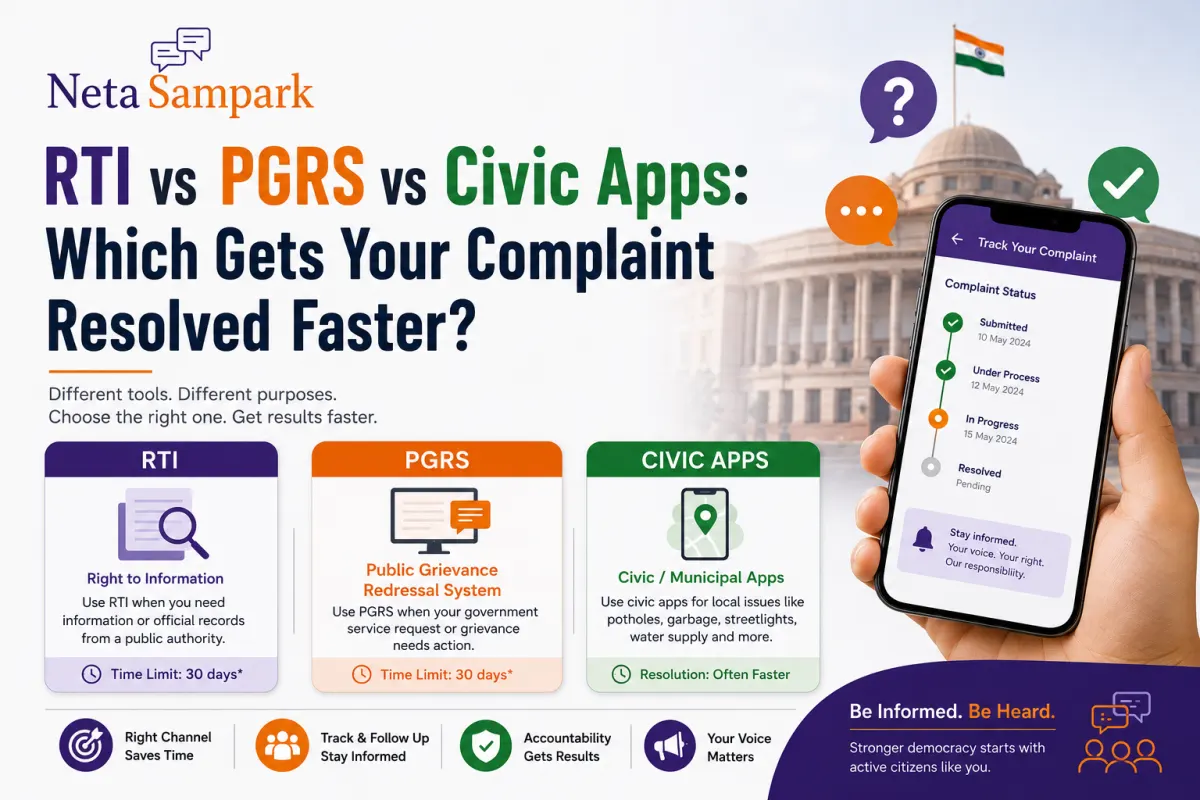
RTI is primarily for obtaining information. PGRS and civic grievance systems are primarily for getting a public-service problem addressed.
So which one is faster?
There is no universal winner. The right platform depends on what you want the government to do.
The Quick Answer
Your problemBest first optionPothole, garbage, streetlight, drainageCivic app / local grievance systemWater, sanitation or municipal service complaintCivic app / municipal PGRSGovernment service not being deliveredPGRSGovernment department has not respondedPGRSYou want documents or official informationRTIYou want to know how a decision was madeRTIYou want copies of recordsRTIYou want an existing public problem fixedPGRS / Civic appYou want information that can help establish what happenedRTIComplaint already made but no actionEscalate through the relevant grievance mechanism
The biggest mistake is using RTI as a substitute for a complaint.
1 What Is RTI?
RTI stands for Right to Information.
Under the Right to Information framework, citizens can seek information held by public authorities, subject to the applicable provisions and exemptions.
The central government's RTI Online portal allows Indian citizens to submit RTI applications and first appeals to covered Central Government public authorities. It specifically warns that applications for State Government public authorities should not be filed through that central portal.
RTI is therefore fundamentally an information-access mechanism.
For example:
Instead of asking:
“Please repair the road outside my house.”
an RTI could ask something like:
“Please provide the details of the authority responsible for maintenance of this road, the relevant work order and records relating to its maintenance.”
Those are two very different requests.
2 What Is PGRS?
PGRS generally refers to a Public Grievance Redressal System.
These systems are designed to help citizens submit complaints about government services and track their resolution.
At the national level, the Government of India's CPGRAMS allows citizens to lodge grievances relating to service delivery with government authorities. The system provides a registration ID for tracking and also provides an appeal facility where the citizen is dissatisfied with the grievance resolution. (PG Portal)
CPGRAMS is connected with Ministries/Departments and State Government organisations, allowing grievances to be routed to the relevant authority. (PG Portal)
State governments also operate their own grievance systems.
For example, Karnataka operates Janaspandana / Integrated Public Grievance Redressal System (iPGRS) for public grievances. (PGRS GOK)
3 What Are Civic Apps?
Civic apps are usually designed around local government services.
Depending on the city, municipality or state, they can allow citizens to report issues such as:
- Potholes
- Garbage
- Streetlights
- Drainage
- Water-related problems
- Roads
- Public sanitation
- Illegal dumping
- Other local civic problems
The advantage is that the complaint can potentially go directly into the workflow of the authority responsible for that service.
Example
If a streetlight in your neighbourhood isn't working, an appropriate municipal complaint channel may be much more useful than filing an RTI.
You don't need information about the streetlight.
You need someone to fix it.
RTI vs PGRS vs Civic Apps
Here's the simplest way to understand the difference:
RTI asks:
“Give me information.”
PGRS asks:
“Please address my grievance.”
Civic app asks:
“Please fix this local civic problem.”
That distinction can save citizens considerable time.
RTI: Best When You Need Information
Suppose you want to know:
- How much money was allocated for a project?
- Which department approved it?
- Who was responsible for a particular decision?
- What action was recorded on a complaint?
- Whether a particular document exists?
- What rules apply to a government service?
- What records are available concerning a public project?
RTI may be appropriate.
The RTI Online system itself describes the process as one for citizens seeking information under the RTI Act.
RTI is particularly powerful when you need a paper trail.
It can help citizens move from:
“I think something happened.”
to:
“I want to know what the official records show.”
PGRS: Best When You Need Action
Suppose your government service isn't being delivered.
For example:
“I submitted my application but haven't received the service.”
or:
“My government department has not responded to my request.”
A grievance mechanism is generally more appropriate than RTI.
CPGRAMS is specifically designed for public grievances relating to service delivery and provides tracking and appeal functionality. (PG Portal)
The Government's CPGRAMS framework currently states that grievances should be resolved promptly and within a maximum period of 30 days, with an interim or appropriate reply where resolution isn't possible within that timeframe due to circumstances such as policy or sub-judice matters. (PG Portal)
That does not mean every complaint will necessarily be solved within 30 days.
It means the grievance system has a prescribed handling framework.
Civic Apps: Best for Local Problems
Imagine you see:
A large pothole outside your neighbourhood school.
You want it repaired.
The logical first step is usually the local civic authority's grievance channel.
Why?
Because the problem is:
specific + local + actionable.
A civic complaint can contain:
- Location
- Photograph
- Description
- Landmark
- Category of issue
That information can help the relevant local authority identify the problem.
So Which Is Faster?
This is where the answer gets interesting.
For a simple civic problem:
Civic app is often the best first choice.
Example:
“Streetlight not working.”
Use the relevant municipal/civic complaint system.
For a government-service grievance:
PGRS is usually the more appropriate route.
Example:
“My application has been pending and the department hasn't responded.”
Use the appropriate grievance system.
For information:
RTI is the appropriate tool.
Example:
“Provide copies of records showing how this project was approved.”
That isn't really a grievance.
It's an information request.
What If Your Complaint Is Being Ignored?
This is where citizens can use the systems strategically.
Suppose you report a problem through the appropriate grievance system.
You receive a complaint number.
But nothing happens.
Instead of immediately filing an RTI saying:
“Why haven't you fixed my complaint?”
you may first use the available reminder, escalation or appeal mechanism.
CPGRAMS, for example, provides status tracking and an appeal facility where the citizen is dissatisfied with the resolution. (PG Portal)
The exact escalation mechanism will depend on the department and grievance platform.
Where RTI Becomes Powerful
Now imagine the complaint remains unresolved.
You might want to understand what happened.
For example:
“I complained about a road repair on January 10. The complaint was marked closed, but the road remains damaged.”
Now you may have two separate objectives.
Objective 1: Get the road fixed
Use the appropriate grievance mechanism.
Objective 2: Understand what happened to your complaint
An RTI may potentially be useful for seeking relevant records, subject to the RTI Act and applicable exemptions.
You could seek information such as records concerning the processing of the complaint, rather than simply asking:
“Why are you not doing your job?”
The quality of an RTI application matters.
The Power of Combining the Tools
The systems don't necessarily have to compete.
In some situations, they can work together.
Step 1 — Report the problem
Use the civic app or PGRS.
Step 2 — Save the complaint number
Keep screenshots and acknowledgement details.
Step 3 — Follow up
Use the available reminder or escalation mechanism.
Step 4 — Check the response
Was the issue actually resolved?
Step 5 — If necessary, seek information
If you need to understand the official record or action taken, consider whether an RTI request is appropriate.
This creates a documented trail.
A Simple Example
Imagine a road in your area has been damaged for months.
You want it repaired.
Wrong first approach:
RTI
“Why is the road damaged?”
This may generate information, but it isn't necessarily the most direct way to get the road repaired.
Better first approach:
Civic grievance
“Road damaged at [location]. Please inspect and repair.”
Attach photographs and location details.
If nothing happens:
Follow up or escalate through the applicable grievance system.
If you later want information:
An RTI could potentially be used to seek relevant records, such as information about the authority responsible, work orders or action recorded, depending on what records exist and what information is legally disclosable.
Another Example: Government Certificate Delayed
Suppose you applied for a government certificate.
Your application has been pending much longer than expected.
First step:
Use the department's grievance mechanism or applicable PGRS.
Don't start with RTI simply because you're frustrated.
Your immediate objective is:
Get the service processed.
If the issue remains unresolved, escalate through the prescribed mechanism.
If you later need documentary information about the processing of the application, RTI may become relevant.
Another Example: You Suspect Public Money Was Spent Improperly
Now the situation changes.
You aren't simply asking someone to repair something.
You want information.
You may want to know:
- What was sanctioned?
- What was spent?
- Who was responsible?
- What records exist?
- What work order was issued?
- When was the work completed?
This is where RTI can be much more useful.
The objective is not:
“Fix this.”
It is:
“Show me the official information and records.”
The Biggest Mistake: Asking the Wrong Question
The effectiveness of a citizen complaint often depends on how clearly the problem is framed.
Compare:
Weak
“Nothing is happening in my area.”
Better
“The streetlight at [specific location] has not been functioning since [approximate date]. Please inspect and repair it.”
And compare:
Weak RTI
“Why is the municipality not working properly?”
Better RTI
“Please provide the records relating to the maintenance work order for [specific location/project] for [specified period].”
The second versions are easier for the relevant system or authority to understand and process.
Don't Confuse a Complaint With an RTI Application
This distinction is worth remembering.
Complaint
Something needs to be done.
RTI
I want information held by a public authority.
Civic complaint
A local public-service problem needs attention.
Once you understand this, choosing the right channel becomes much easier.
A Citizen's Decision Tree
Ask yourself one question:
What do I actually want?
“I want this problem fixed.”
➡️ Civic app / PGRS
“I want my government service delivered.”
➡️ PGRS / departmental grievance mechanism
“I want to know what happened to my complaint.”
➡️ PGRS tracking/escalation, and potentially RTI for appropriate records
“I want government records or information.”
➡️ RTI
“I want to know how public money was spent.”
➡️ RTI
“I want a pothole repaired.”
➡️ Civic complaint
“I want a department to act on my pending application.”
➡️ Grievance system
What About NetaSampark?
There is another important layer to citizen participation.
Government grievance systems are designed to route complaints to government authorities.
But citizens may also want to make their elected representatives aware of issues affecting their constituency.
These are different functions.
A citizen can potentially:
Report the issue → Track the official complaint → Follow up with the authority → Keep the elected representative informed → Evaluate the response
This is where structured citizen engagement can complement formal government grievance mechanisms.
A complaint platform should not replace government systems.
It can help citizens understand, organise and follow their civic concerns more effectively.
Don't Expect Every Platform to Solve Every Problem
No grievance platform can guarantee that a problem will be solved immediately.
The actual resolution can depend on:
- Which department is responsible
- Whether the complaint is within that authority's jurisdiction
- Available resources
- Technical feasibility
- Legal restrictions
- Required approvals
- The complexity of the issue
- Whether the complaint contains enough information
A good platform can improve routing, tracking and accountability.
It cannot magically eliminate administrative constraints.
The Golden Rule
Before filing anything, ask:
Do I want information, action, or a local service correction?
Then choose accordingly.
Information → RTI
Government grievance → PGRS
Local civic problem → Civic app
This simple distinction can save citizens from filing the wrong type of request.
Final Takeaway
RTI, PGRS and civic apps are not three versions of the same system.
They solve different problems.
RTI gives citizens a legal mechanism to seek information.
PGRS gives citizens a structured route to raise grievances about public services and government functioning.
Civic apps provide a convenient channel for reporting many local municipal and civic problems.
The fastest route isn't necessarily the platform with the fastest interface.
It is the platform that sends the right request to the right authority for the right purpose.
So the next time something goes wrong, don't just ask:
“Where can I complain?”
Ask:
“What outcome do I need?”
Because getting the right answer—or the right action—often begins with choosing the right channel.