
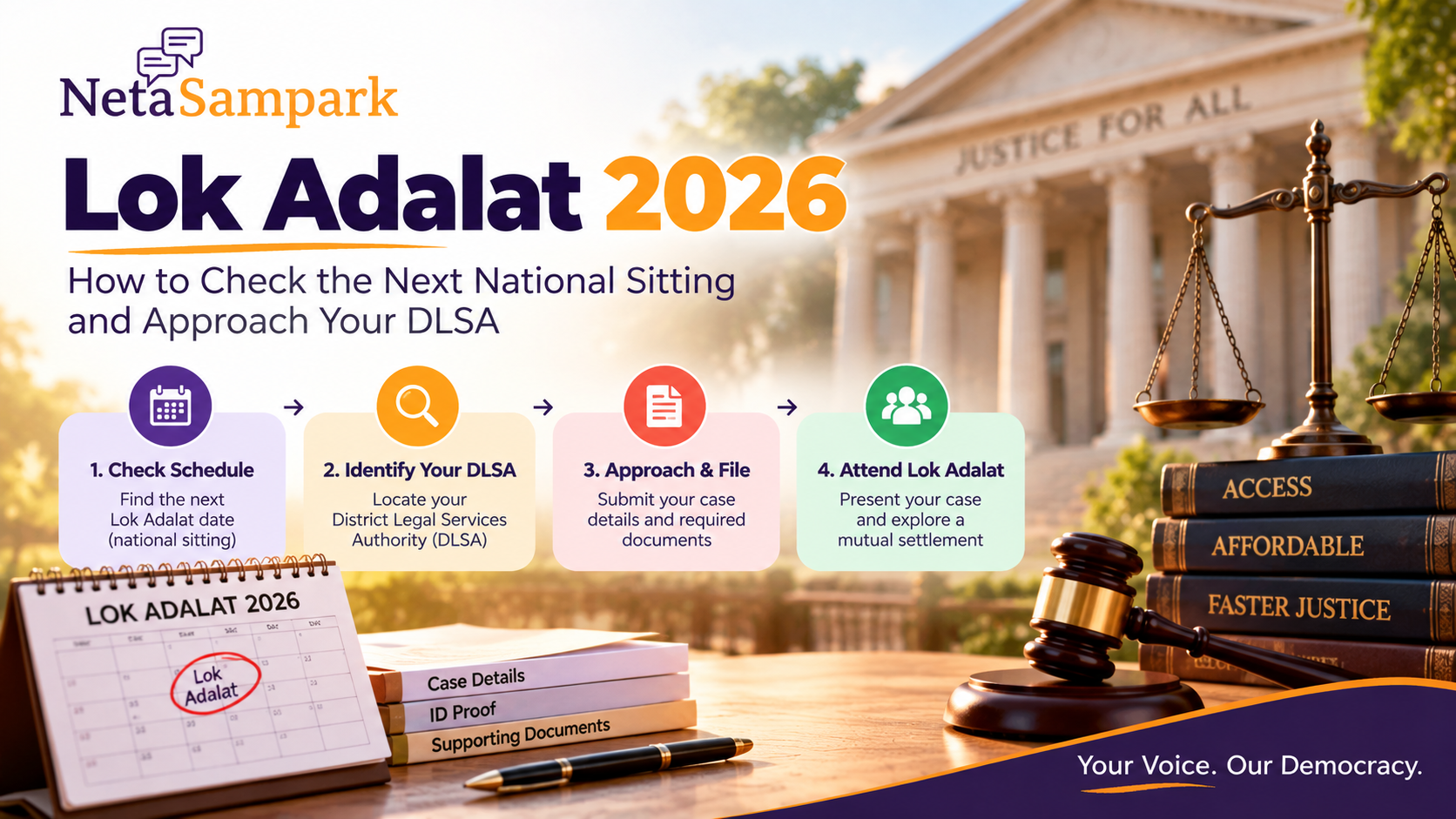
Quick take: If you have a pending court matter or a dispute that may be settled before litigation, Lok Adalat can provide a structured route for an amicable settlement. The next scheduled National Lok Adalat in the 2026 national calendar is 12 December 2026. However, states and districts can announce special, state-level, or rescheduled sittings, so check your State Legal Services Authority (SLSA) and District Legal Services Authority (DLSA) before assuming the national date is the only option. (National Legal Services Authority)
What Lok Adalat actually does
Lok Adalat is an alternative dispute-resolution forum conducted through the legal-services authorities.
It can deal with:
- Cases already pending before courts
- Certain pre-litigation disputes
- Matters that are legally capable of being settled or compromised
- Categories notified for a particular Lok Adalat sitting
The key word is settlement.
A Lok Adalat bench does not simply impose its preferred outcome. The parties must reach a compromise; the members act as conciliators to help the parties arrive at an acceptable settlement. (National Legal Services Authority)
2026 National Lok Adalat calendar
The national schedule published by Legal Services Authorities lists:
SittingDate1st National Lok Adalat14 March 20262nd National Lok Adalat9 May 20263rd National Lok Adalat12 September 20264th National Lok Adalat12 December 2026
(AP State Legal Services)
Important: Local schedules can differ. For example, Delhi has separately published a notification for a National Lok Adalat on 10 October 2026, while Karnataka's 2026 notices include a postponement of its third Lok Adalat sitting. That is why the state/district notice matters more than blindly following a generic calendar. (Delhi State Legal Services Authority)
Step 1 — Check the next sitting
Start with:
NALSA → your State Legal Services Authority → your DLSA
Look for sections such as:
- Lok Adalat
- National Lok Adalat
- Notifications
- Events
- Upcoming sittings
- DLSA contacts
The official NALSA site maintains information about Lok Adalats and a directory of Legal Services Authorities. (National Legal Services Authority)
Don't rely on an old WhatsApp poster. A sitting can be postponed, rescheduled or organised as a special Lok Adalat.
Step 2 — Find your DLSA
Your District Legal Services Authority is generally the practical first contact for a district-level citizen.
Tell the DLSA:
“I have a pending / proposed dispute and want to know whether it can be placed before the upcoming Lok Adalat.”
Keep your:
- District
- Court name, if already filed
- Case number / CNR, if available
- Names of parties
- Nature of dispute
- Contact number
ready.
NALSA and State Legal Services Authority websites publish DLSA directories. For example, Karnataka's official directory provides district-wise DLSA contacts. (Karnataka State Legal Services Authority)
Step 3 — Check whether your matter can be settled
Don't assume every dispute automatically goes to Lok Adalat.
Ask the DLSA or your lawyer:
- Is this category eligible?
- Is the matter already pending in court?
- Can it be taken up as a pre-litigation matter?
- Does the upcoming sitting cover this category?
- What documents or application are required?
- Does the other party need to participate or consent?
This is particularly important for cases where settlement has specific legal requirements.
Step 4 — Prepare your document folder
Keep one physical folder and one digital folder.
Include:
- Case number / CNR, if applicable
- Court notice or previous orders
- Complaint / petition / plaint
- Relevant agreements
- Bills, invoices or receipts
- Bank/payment records
- Identity document
- Previous correspondence
- Relevant photographs or records
- Any settlement proposal already exchanged
Don't dump 200 unrelated pages on the bench.
Arrange documents chronologically and mark the pages that actually prove your position.
Step 5 — If the case is already in court
Ask your advocate or the court's legal-services desk about referral to Lok Adalat.
A pending case can be referred for settlement where the matter is appropriate for Lok Adalat proceedings. If the parties reach a settlement, the Lok Adalat records the award according to the applicable legal framework. (National Legal Services Authority)
You don't necessarily have to wait for a particular National Lok Adalat date to ask about settlement mechanisms. Regular and other forms of Lok Adalat also operate through Legal Services Authorities. (National Legal Services Authority)
Step 6 — If your dispute has not reached court
Ask your DLSA about the pre-litigation route.
This can be useful where both sides are willing to discuss settlement but the dispute has not yet become a full court case.
Bring:
- Your written complaint / dispute summary
- The other party's details
- Supporting documents
- Your contact details
- A clear statement of what settlement you are seeking
Don't exaggerate the claim. A one-page factual chronology is often more useful than an emotional ten-page narrative.
What happens at Lok Adalat?
A simplified flow is:
Case identified → parties contacted → matter placed before bench → settlement discussion → agreement if reached → award recorded
If the parties do not reach a settlement, the matter is not simply decided against one side because they attended Lok Adalat. NALSA explains that the forum works through amicable settlement/compromise. (National Legal Services Authority)
What happens if you settle?
This part deserves attention.
NALSA states that a Lok Adalat award is treated as a decree of a civil court, and the award is final and binding on the parties. NALSA also states that no court fee is payable for filing a matter in Lok Adalat and that court fees already paid in a pending matter can be refunded when the matter is settled there. (National Legal Services Authority)
So:
Don't sign a settlement casually.
Before agreeing, check:
- Exact amount
- Payment date
- Instalments, if any
- Who pays what
- Withdrawal/closure of related proceedings
- Return of documents or property
- Default consequences
- Any conditions that survive settlement
If you don't understand a clause, ask for clarification before signing.
Lok Adalat is not a “discount court”
A common misunderstanding is:
“Go to Lok Adalat and the other side has to accept whatever you ask.”
That's not how the mechanism works.
The purpose is to facilitate a mutually acceptable settlement. Legal Services Authority members are conciliators and should not pressure parties into compromising. Karnataka's official guidance, for example, expressly states that parties should not be coerced or pressured to settle. (Karnataka State Legal Services Authority)
Court fee and cost
NALSA states that no court fee is payable when a matter is filed in Lok Adalat. For an existing court case that is subsequently settled through Lok Adalat, the court fee already paid can be refunded as provided by the applicable rules. (National Legal Services Authority)
That does not mean every associated expense disappears. You may still have costs relating to documents, travel, legal representation or other case-specific requirements.
Don't confuse these three
National Lok Adalat
A coordinated Lok Adalat sitting held across Legal Services Institutions according to a national schedule.
Regular Lok Adalat
Other Lok Adalat formats organised by Legal Services Authorities, including continuous, daily, mobile or state-level arrangements. (National Legal Services Authority)
Permanent Lok Adalat
A separate statutory mechanism dealing with specified public utility services under the Legal Services Authorities Act framework. (National Legal Services Authority)
If someone says “Lok Adalat,” ask which type and which sitting.
Citizen mistakes that waste time
Mistake 1: Waiting for the national date.
Your DLSA may have another relevant sitting or process.
Mistake 2: Going to the court without checking the cause list / notice.
Confirm where and when your matter is listed.
Mistake 3: Carrying no case number.
Find your CNR or case number before contacting the DLSA if the matter is already filed.
Mistake 4: Signing because “everyone else is signing.”
Read the settlement terms.
Mistake 5: Assuming the other party will automatically appear.
Ask the DLSA/lawyer how the other side is being notified.
Mistake 6: Paying an unofficial “Lok Adalat agent.”
Use the official Legal Services Authority channels.
Free legal assistance is a separate question
If you cannot afford legal assistance, ask your DLSA/SLSA whether you qualify for legal services under the applicable eligibility rules.
NALSA's mandate includes providing legal services so that access to justice is not denied because of economic or other disabilities. (Karnataka State Legal Services Authority)
NALSA's official portal also provides Legal Services Authority directories and contact information. (National Legal Services Authority)
Your 20-minute Lok Adalat preparation
5 minutes: Find the latest official SLSA/DLSA notification.
5 minutes: Write your dispute in five sentences.
5 minutes: Collect case number + key documents.
5 minutes: Call/email the DLSA and ask:
“Can this matter be taken up in the upcoming Lok Adalat, and what do I need to submit?”
Save the response.
How NetaSampark helps
Legal settlement is handled through the Legal Services Authorities and courts. NetaSampark can help citizens find and understand the relevant local civic/legal-service channels so a dispute doesn't remain an anonymous complaint.
Be Informed. Be Heard.