
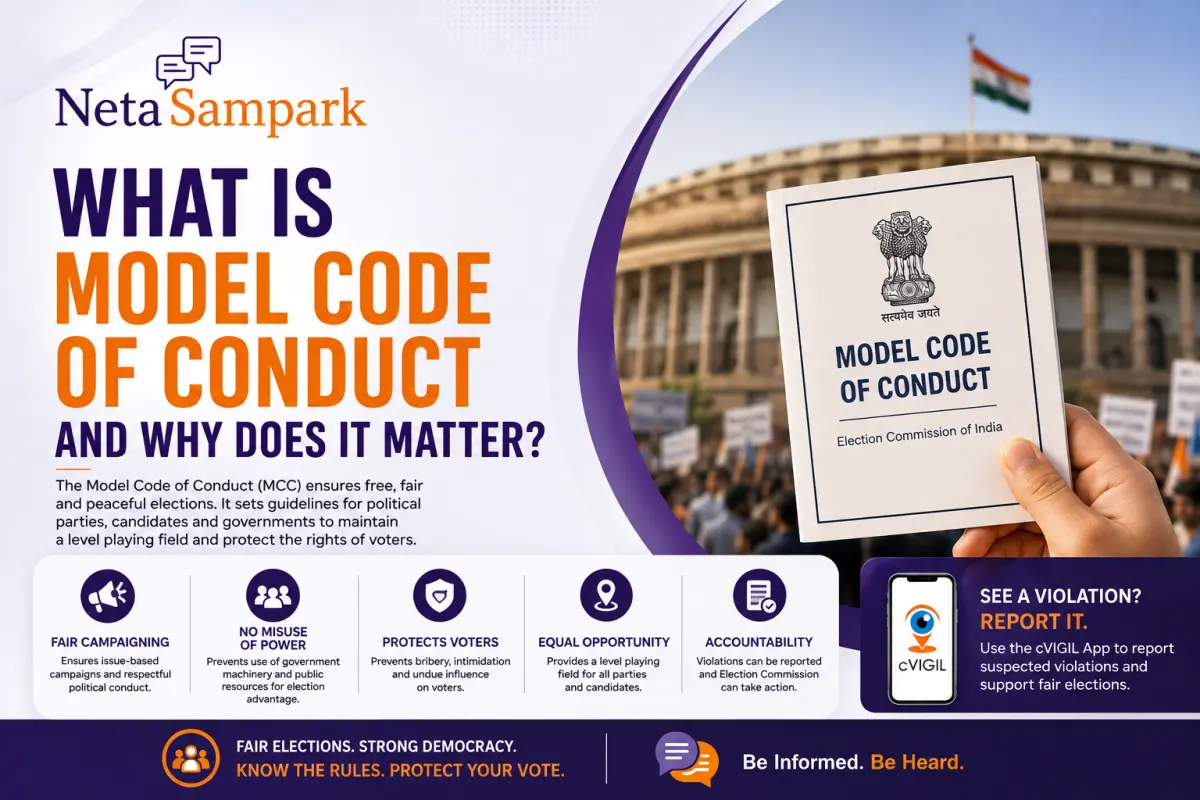
What Is the Model Code of Conduct and Why Does It Matter?
Elections are one of the most important parts of a democracy. They give citizens the opportunity to choose their representatives and hold governments accountable.
But an election is not simply about voting on polling day.
During an election period, political parties and candidates campaign, make promises, address voters and compete for support. With millions of citizens watching, it is important that this competition takes place within a framework of fairness and responsible conduct.
This is where the Model Code of Conduct (MCC) comes in.
The Model Code of Conduct is a set of guidelines issued by the Election Commission of India (ECI) for political parties, candidates and other stakeholders during elections.
Its purpose is to help maintain a level playing field, peaceful campaigning and electoral integrity.
What Is the Model Code of Conduct?
The Model Code of Conduct is a framework of guidelines that governs the behaviour of political parties and candidates during elections.
It covers areas such as:
- Campaign conduct
- Public meetings
- Election speeches
- Criticism of opponents
- Use of government machinery
- Election promises and manifestos
- Polling-day conduct
- Campaigning near polling stations
- Political advertisements
- Conduct of ministers and ruling parties
The MCC comes into effect when the Election Commission announces the election schedule and remains applicable for the relevant election period.
It applies to political parties and candidates, and certain provisions and directions also affect governments and public officials during the election period.
Why Was the Model Code of Conduct Needed?
Elections involve competition.
Candidates want attention.
Parties want votes.
Campaigns can become highly aggressive.
Without commonly understood rules for campaign conduct, there can be concerns about:
- Misuse of official machinery
- Intimidation
- Communal or inflammatory appeals
- Personal attacks
- Unfair use of government resources
- Campaigning too close to polling stations
- Misleading statements
- Abuse of public office
The MCC provides a framework intended to keep electoral competition fair.
It is essentially about ensuring that political competition does not undermine the fairness of the election itself.
When Does the Model Code of Conduct Come Into Effect?
The MCC generally comes into force from the announcement of the election schedule by the Election Commission.
This is an important distinction.
It is not simply a set of rules that applies only on voting day.
It governs conduct during the election period.
Depending on the election, this can cover weeks or months of campaigning before polling.
The MCC ends after the relevant election process reaches the point specified by the Election Commission and applicable instructions.
What Does the MCC Cover?
The Model Code contains several important areas of conduct.
Let's look at some of them from a citizen's perspective.
1 Respectful Campaigning
Political parties and candidates are expected to conduct their campaigns responsibly.
Criticism of opponents should generally focus on:
- Policies
- Programmes
- Past record
- Work
- Public conduct
Campaigns should not descend into personal attacks or unverified allegations.
The idea is to encourage citizens to compare political performance and ideas, rather than turning elections into purely personal conflicts.
2 No Appeal to Caste or Religion in Certain Contexts
Election campaigns can have a powerful influence on society.
The MCC places restrictions and provides guidance concerning appeals to caste or communal feelings for securing votes.
Political parties and candidates are expected to avoid activities that aggravate differences between communities or create tension.
This is particularly important in a country as diverse as India.
An election should allow citizens to make political choices without creating unnecessary social conflict.
3 No Bribing or Intimidating Voters
Citizens should be able to vote freely.
The MCC addresses conduct involving:
- Bribery
- Intimidation
- Undue influence
- Creating hostility between communities
- Interfering with voters' freedom
Some of these actions may also constitute offences under election and criminal laws, not merely violations of the MCC.
That distinction is important.
The Model Code is not the only legal framework governing elections.
4 Government Machinery Should Not Be Misused
One of the most important concerns during elections is the potential advantage enjoyed by a party that is already in government.
Government resources are public resources.
The MCC therefore contains provisions intended to prevent the ruling party from using official machinery unfairly for electoral advantage.
This can involve matters such as:
- Official vehicles
- Government buildings
- Public employees
- Government advertising
- Official events
- Public resources
The basic principle is:
Government machinery belongs to the public, not to a political party.
5 New Announcements and Projects During Elections
Once the MCC is in force, governments are subject to restrictions concerning announcements, inaugurations and certain activities that could influence voters.
This does not mean that all government work stops.
Essential government functions continue.
But the election period creates additional restrictions designed to prevent government programmes or public resources from being used to influence electoral choices.
The Election Commission may issue directions depending on the circumstances.
6 Political Meetings and Processions
Political parties conduct rallies, meetings and processions during campaigns.
The MCC provides guidelines concerning how such activities should be conducted.
Parties and candidates are expected to:
- Follow applicable laws
- Obtain required permissions
- Avoid disruption
- Respect competing parties' meetings
- Avoid conflict
- Follow restrictions imposed by authorities
The objective is to allow political participation while maintaining public order.
7 Campaigning Near Polling Stations
Polling stations need to remain free from campaign pressure.
Campaigning restrictions apply around polling areas, with specific requirements under election law and Election Commission instructions.
This helps protect voters from undue influence when they are exercising their franchise.
The exact restrictions and permitted distance or activities should be checked against the rules applicable to the particular election.
8 Political Advertisements
Political parties and candidates use newspapers, television, outdoor advertising and increasingly digital platforms to communicate with voters.
Election authorities regulate political advertising through applicable laws, regulations and Election Commission directions.
Certain political advertisements may require pre-certification through the appropriate mechanism, particularly under the rules governing electronic and social-media campaigning.
This is one reason political advertising during elections should not be treated like ordinary commercial advertising.
9 Election Manifestos
Political parties use manifestos to communicate their plans and priorities.
The MCC also contains principles concerning election manifestos.
Manifestos should not undermine constitutional principles or involve promises that conflict with legal and regulatory requirements.
The Election Commission has also emphasised transparency around the rationale and means of implementing promises.
For citizens, this is useful because a manifesto should ideally help voters understand:
What does this party propose to do?
How does it propose to do it?
What could it cost?
What are the likely implications?
This allows voters to evaluate promises more thoughtfully.
What Does the MCC Mean for Ordinary Citizens?
The Model Code is mainly directed at political parties, candidates and relevant government actors.
But citizens are affected by it too.
It helps create an environment where voters can:
- Hear competing political arguments
- Attend campaign events
- Compare candidates
- Follow manifestos
- Raise questions
- Vote without intimidation
- Participate in elections peacefully
In other words:
The MCC helps protect the conditions in which citizens exercise their democratic choice.
Can Citizens Report Violations?
Yes.
Citizens who observe suspected violations can report them through the mechanisms provided by the Election Commission.
During elections, the Election Commission has also used the cVIGIL application to allow citizens to report certain suspected violations of the Model Code of Conduct and related election rules.
The availability and scope of reporting mechanisms can vary by election, so citizens should follow the official instructions issued for the election taking place in their area.
When reporting an issue, useful information can include:
- What happened
- Where it happened
- When it happened
- Who was involved, if known
- Photographs or video where appropriate
- Other relevant evidence
The goal should be to report facts and suspected violations, rather than use the reporting mechanism to make unsupported political accusations.
What Happens After a Complaint?
A complaint does not automatically mean that a candidate or party has violated the MCC.
Election authorities may examine the information and determine whether further action is appropriate.
Depending on the nature of the matter, authorities may:
- Seek an explanation
- Verify facts
- Issue directions
- Require corrective action
- Take action under applicable election law
- Refer the matter to another authority
The exact response depends on the facts and the applicable rules.
This is why citizens should distinguish between:
“I reported a suspected violation”
and
“The candidate was found guilty of violating the rules.”
They are not the same thing.
Is the Model Code of Conduct a Law?
This is one of the most commonly misunderstood aspects of the MCC.
The Model Code of Conduct itself is generally described as a set of guidelines rather than a standalone statute enacted by Parliament.
However, many activities covered by the MCC may also be governed by existing laws.
For example, certain conduct involving:
- Bribery
- Intimidation
- Hate speech
- Defamation
- Public order
- Electoral offences
may have consequences under other laws.
The Election Commission can also issue directions and take steps within its constitutional and statutory powers in response to violations.
Therefore, saying “the MCC is not a standalone law” does not mean that violations of election-related rules are consequence-free.
Why the MCC Matters in a Democracy
Imagine two candidates competing for the same constituency.
One candidate has access to government resources.
The other does not.
If public machinery could freely be used for campaigning, the contest could become unfair.
Or imagine a campaign where voters are intimidated or communities are deliberately set against one another.
The election might still technically take place, but the democratic environment would be weakened.
The MCC helps establish standards intended to prevent such situations.
Its larger objective is:
Fair competition + peaceful campaigning + informed voters
The MCC Is About More Than Politicians
It is easy to think:
“The Model Code is only for politicians.”
But elections involve an entire ecosystem.
That includes:
- Political parties
- Candidates
- Government officials
- Election officials
- Media organisations
- Digital platforms
- Campaign workers
- Citizens
Everyone has a role in maintaining a healthy electoral environment.
Citizens, in particular, can contribute by:
- Checking information before sharing it
- Avoiding inflammatory rumours
- Reporting genuine concerns
- Respecting other voters
- Comparing policies and performance
- Understanding election rules
- Voting freely
Social Media Has Made the MCC Even More Important
Election campaigning has changed dramatically.
A political message can now reach thousands of people within minutes.
A short video can spread across multiple platforms.
A misleading claim can go viral before anyone has checked it.
This makes responsible digital political communication extremely important.
Citizens should be cautious about:
- Edited videos
- Fake screenshots
- Misleading captions
- Old content presented as new
- False polling information
- Fake election announcements
- Impersonation accounts
- Unverified allegations
The speed of social media makes verification more important—not less.
What Should a Responsible Voter Do?
You don't need to be an election-law expert to participate responsibly.
A few simple habits can help.
Check the source
Where did the information originate?
Check the date
Is the information current?
Check the evidence
Is there reliable evidence supporting the claim?
Check the context
Has a video, quote or photograph been presented accurately?
Check the official information
For election-related information, use official Election Commission and government sources where possible.
Report genuine violations
If you see something that appears to violate election rules, use the appropriate official reporting mechanism.
The Model Code and the Spirit of Democracy
The MCC is ultimately about more than individual campaign rules.
It reflects an important democratic principle:
Elections should be contests for public support—not contests to undermine the electoral process itself.
Candidates should be able to campaign.
Citizens should be able to listen and question.
Political parties should be able to compete.
And voters should be able to make their choices freely.
The Model Code of Conduct helps establish the framework within which that competition takes place.
What Citizens Should Remember
When you hear that the Model Code of Conduct has come into force, remember:
It doesn't mean elections have stopped.
It means the election has entered a period where additional standards and restrictions apply to campaign and government conduct.
As a citizen, this is a good time to become more informed, not less engaged.
Follow the campaign.
Compare the candidates.
Read the manifestos.
Check claims.
Question respectfully.
Report genuine violations.
And most importantly, make your own decision.
Democracy Works Best When Citizens Know the Rules
A healthy election requires more than candidates following rules.
It requires citizens who understand what those rules are designed to protect.
The Model Code of Conduct helps create a framework for fairer political competition, responsible campaigning and a peaceful electoral environment.
For citizens, understanding the MCC means understanding something larger:
Your vote is yours.
No candidate, party, campaign or social-media trend should take away your ability to make an informed and independent choice.
Know the rules. Check the facts. Make your voice count.
Be Informed. Be Heard.
Official sources
Confirm fees, dates and eligibility on the official page before you act.