
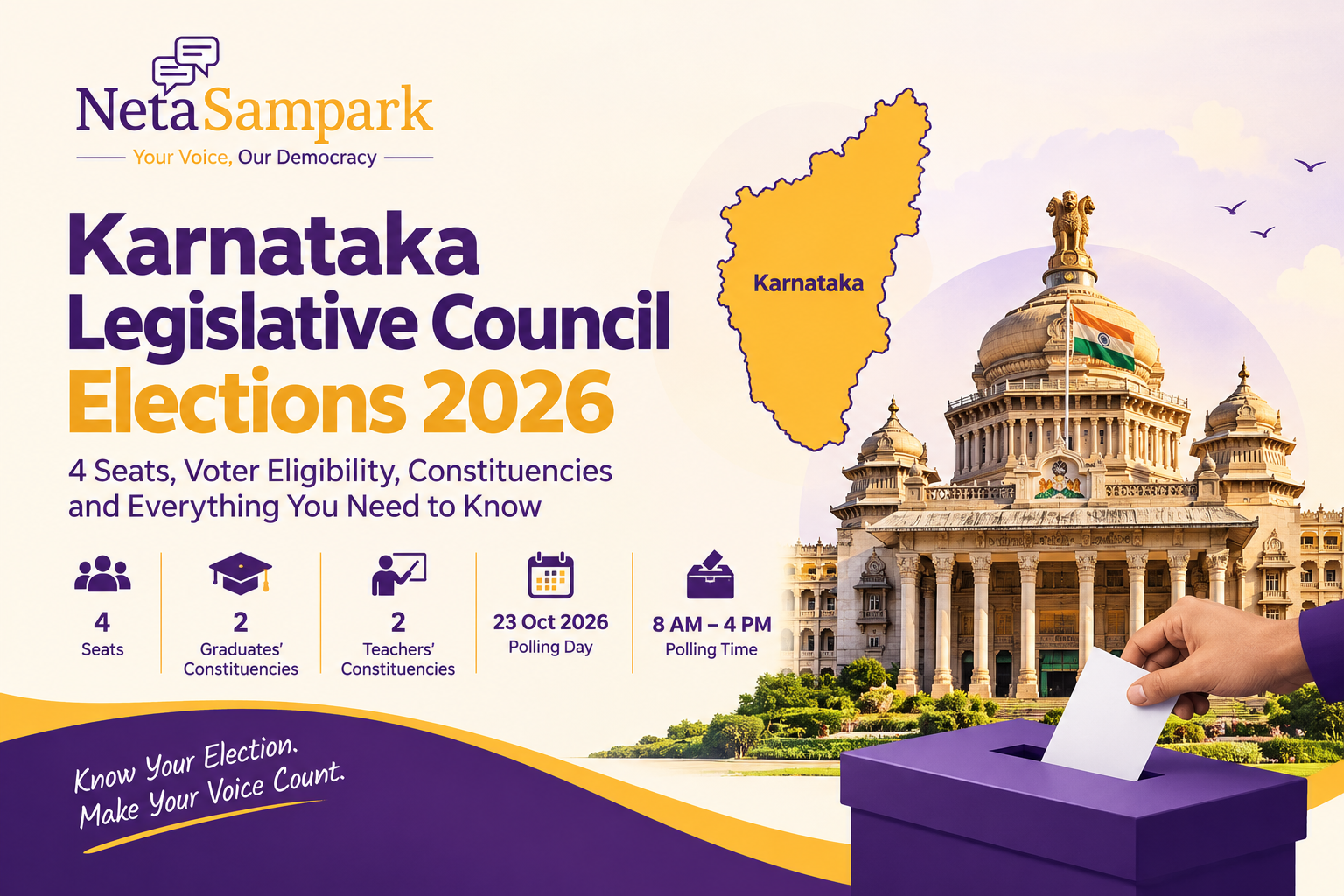
On 23 October 2026, eligible graduates and teachers across parts of Karnataka will vote to elect four Members of the Karnataka Legislative Council (MLCs).
Unlike Assembly or Lok Sabha elections, these are special elections where only registered graduates and teachers in specific constituencies can vote.
For many citizens, these elections receive less attention than general elections. Yet they play an important role in Karnataka’s democracy because they give professionals, educators and graduates a direct voice in the state legislature.
If you are a graduate, teacher, educational institution, candidate or politically aware citizen, here is everything you need to know about the Karnataka Legislative Council Elections 2026.
What is the Karnataka Legislative Council?
Karnataka has a bicameral legislature, which means it has:
- Legislative Assembly (Vidhan Sabha) – the lower house
- Legislative Council (Vidhan Parishad) – the upper house
The Karnataka Legislative Council has 75 members, making it one of the largest Legislative Councils in India. These members are elected through different methods:
| Category | Number of Members |
|---|---|
| Local Authorities | 25 |
| MLAs | 25 |
| Graduates' Constituencies | 7 |
| Teachers' Constituencies | 7 |
| Nominated by Governor | 11 |
Members of the Legislative Council serve a six-year term, and one-third retire every two years, making it a permanent body.
Which Karnataka seats are going to polls in 2026?
This year, elections will be held for four seats:
Graduates' Constituencies
- Karnataka South-East Graduates
- Karnataka West Graduates
Teachers' Constituencies
- Karnataka North-East Teachers
- Bangalore Teachers
The terms of the current members from these constituencies end in November 2026.
Election Schedule: Important Dates
| Event | Date |
|---|---|
| Notification | 29 September 2026 |
| Last date for nominations | 6 October 2026 |
| Scrutiny of nominations | 7 October 2026 |
| Last date for withdrawal | 9 October 2026 |
| Polling day | 23 October 2026 |
| Polling time | 8:00 AM – 4:00 PM |
| Counting of votes | 27 October 2026 |
| Election process completion | 31 October 2026 |
The Election Commission has also stated that the Model Code of Conduct (MCC) came into force immediately in the concerned constituencies.
Which districts are covered?
Many voters are unaware that Graduates' and Teachers' constituencies cover multiple districts.
Karnataka South-East Graduates Constituency
Includes:
- Kolar
- Chikkaballapura
- Tumakuru
- Chitradurga
- Davanagere (except Channagiri and Honnali taluks)
Karnataka West Graduates Constituency
Includes:
- Uttara Kannada
- Dharwad
- Gadag
- Haveri
Karnataka North-East Teachers Constituency
Includes:
- Bidar
- Kalaburagi
- Yadgir
- Ballari
- Vijayanagara
- Raichur
- Koppal
Bangalore Teachers Constituency
Includes:
- Bengaluru Urban
- Bengaluru Rural
- Ramanagara
These are separate electoral constituencies and are not the same as Assembly constituencies.
Who can vote?
This is one of the most important questions.
Not every voter in Karnataka can vote in these elections.
You must be registered separately in the relevant electoral roll.
Who can vote in a Graduates' Constituency?
A person generally must:
✔ Be an Indian citizen
✔ Be an ordinary resident of the constituency
✔ Have held a graduate degree (or equivalent qualification) for at least three years before the qualifying date
✔ Be registered in the Graduates' electoral roll
Registration is done through Form 18.
Who can vote in a Teachers' Constituency?
A person generally must:
✔ Be an Indian citizen
✔ Be an ordinary resident of the constituency
✔ Have taught for at least three years within the preceding six years
✔ Be employed in eligible educational institutions
✔ Be registered in the Teachers' electoral roll
Registration is done through Form 19.
Important: Your Voter ID Alone Is Not Enough
This is where many citizens get confused.
Having:
✔ A Voter ID card
✔ Your name in Assembly voter lists
✔ Participation in Lok Sabha elections
does not automatically make you eligible for Graduates' or Teachers' Constituency elections.
You must be registered separately in the corresponding electoral roll.
How are these elections different?
Legislative Council elections use a system called:
Proportional Representation by Single Transferable Vote (STV)
This means:
- Voters rank candidates in order of preference
- You may mark:
- 1
- 2
- 3
- and so on
This system ensures that votes are transferred based on voter preferences during counting.
Unlike Assembly elections, where the candidate with the most votes wins directly, Legislative Council elections use a preference-based counting system.
Why do these elections matter?
Graduates and teachers often have direct experience with:
- Education policy
- Employment
- Skill development
- Public services
- Infrastructure
- Government administration
These constituencies were created to ensure that educated professionals and teachers have representation in the legislative process.
In Karnataka, graduates and teachers elect 14 out of 75 members of the Legislative Council. That is nearly 19% of the Council’s strength.
Karnataka in the National Context
The Election Commission has announced elections for 28 Legislative Council seats across four states:
| State | Seats |
|---|---|
| Uttar Pradesh | 11 |
| Bihar | 8 |
| Maharashtra | 5 |
| Karnataka | 4 |
Karnataka’s elections are part of a larger electoral exercise involving 14 Graduates' seats and 14 Teachers' seats across India.
What should eligible voters do now?
If you are a graduate or teacher in one of these constituencies:
☐ Confirm which constituency you belong to
☐ Verify your registration in the correct electoral roll
☐ Understand candidate backgrounds
☐ Learn how preference voting works
☐ Vote on 23 October 2026
Democracy Is More Than Just Major Elections
Most citizens know about Lok Sabha and Assembly elections.
But democracy also works through institutions like the Legislative Council, where teachers, graduates and local bodies participate in choosing representatives.
The upcoming Karnataka Legislative Council elections may involve only four seats, but they represent an important democratic principle:
Different sections of society should have a voice in governance.
For eligible graduates and teachers, 23 October 2026 is not just another election date—it is an opportunity to shape representation in Karnataka’s Legislative Council.
Quick Facts
📌 Karnataka seats going to polls: 4
📌 Graduates' seats: 2
📌 Teachers' seats: 2
📌 Polling date: 23 October 2026
📌 Polling time: 8 AM – 4 PM
📌 Counting: 27 October 2026
📌 Karnataka Legislative Council strength: 75 members