
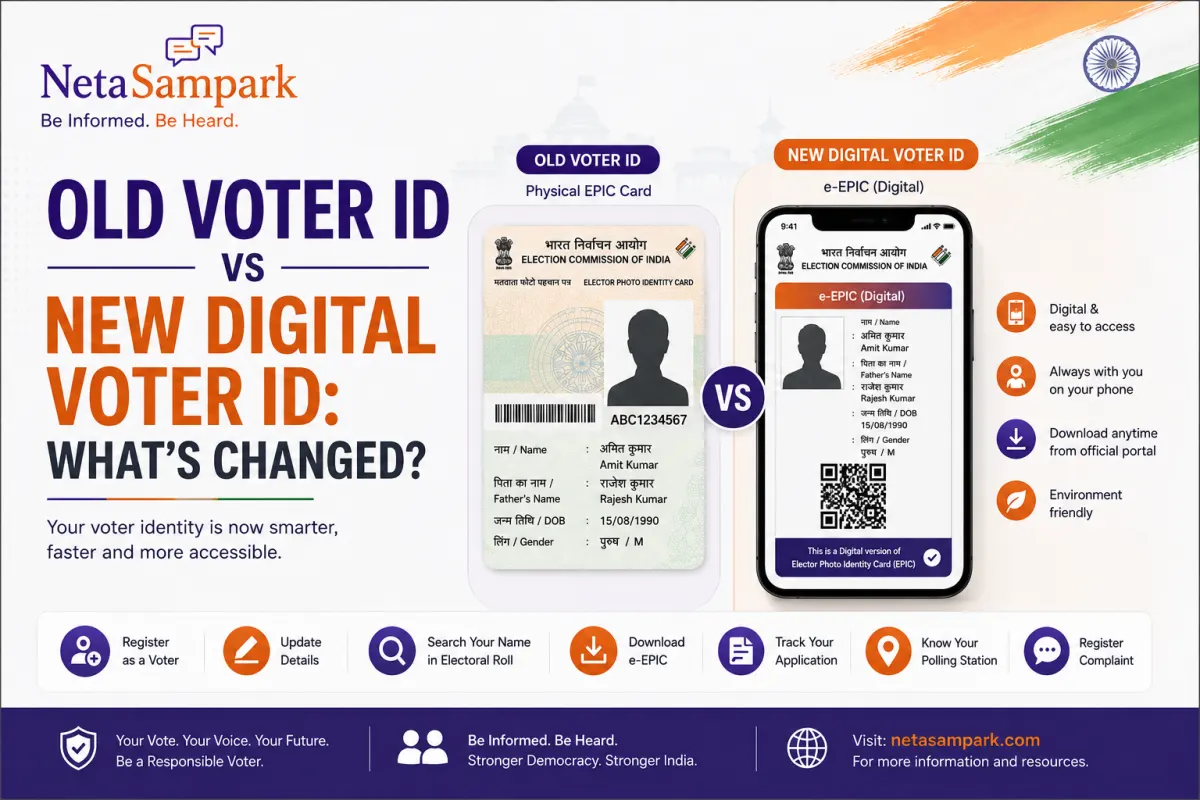
For years, the Voter ID card, officially known as the Elector Photo Identity Card (EPIC), has been one of the most recognisable documents associated with voting in India.
Today, voters also have access to an electronic version called e-EPIC.
So what exactly has changed?
Is the digital voter ID replacing the physical card?
Can you vote using your phone?
Do you need both?
And most importantly, does having a Voter ID automatically mean your name is on the electoral roll?
The short answer is: the format has become more digital, but your electoral-roll registration remains the fundamental requirement for voting.
The Election Commission's current Voter Service Portal provides facilities for registering as a voter, updating electoral-roll details, tracking applications, searching your name in the voter list and downloading the digital version of your EPIC. (Voter Services)
First: What Is a Voter ID?
The Voter ID card is commonly called the Voter ID, but its official name is Elector Photo Identity Card (EPIC).
It is issued to registered electors and serves as an identity document for electoral purposes.
The physical EPIC has traditionally been provided as a card containing information associated with the elector.
The Election Commission's current electoral-roll guidance continues to recognise EPIC as an important voter identification document. (Election Commission of India)
But there is an important distinction:
Having an EPIC is not the same thing as simply having the right to vote. Your name must be included in the relevant electoral roll.
What Is e-EPIC?
e-EPIC is the electronic version of the Elector Photo Identity Card.
The Election Commission's Voter Service Portal currently provides an “E-EPIC Download” service for getting the digital version of the Electoral Photo Identity Card. (Voter Services)
The electronic card can be accessed through the Election Commission's digital voter services.
This means your voter identity information doesn't have to exist only as a physical card.
Old Voter ID vs Digital Voter ID
FeaturePhysical EPICe-EPICFormatPhysical cardDigital/electronicIssued byElection authoritiesElection authoritiesContains voter identity informationYesYesCan be accessed digitallyNoYesConvenient for online storageLimitedYesCan be downloadedNoYesRequires physical cardYesNoElectoral-roll registration requiredYesYes
The biggest difference is therefore format and accessibility, rather than the basic concept of voter registration.
Why Was e-EPIC Introduced?
Digital services can make it easier for citizens to access official documents.
Imagine you:
- Lost your physical voter card
- Moved to another city
- Need access to your EPIC details
- Don't want to carry the physical card everywhere
- Want a digital copy available when needed
A digital version can make access more convenient.
The Election Commission provides online facilities for downloading e-EPIC through its Voter Service Portal. (Voter Services)
Does the Digital Voter ID Replace the Physical Card?
Not in the sense that citizens should assume the physical EPIC has suddenly become irrelevant.
The important point is that both physical and electronic forms relate to the same electoral identity.
The digital version gives voters an additional way to access their EPIC.
The Election Commission's current voter services explicitly provide both voter-related application services and e-EPIC download facilities. (Voter Services)
So you don't need to think of it as:
Old card → cancelled
Instead, think:
Physical EPIC + digital e-EPIC → more flexible access
Can You Vote Using Only Your Digital Voter ID?
This is where voters should be careful.
Do not assume that having an e-EPIC on your phone is, by itself, what determines whether you can vote.
The fundamental requirement is that you are an eligible elector whose name appears on the electoral roll for the relevant constituency.
The Election Commission's voter portal provides a specific service to search your name in the voter list and check polling details. (Voter Services)
At elections, the Commission also specifies accepted identification documents and procedures for that particular election.
For example, ECI election material has stated that EPIC is a principal identification document while also permitting specified alternative documents under applicable instructions. (Elections 24)
So remember:
Voter registration comes first. Identification is a separate part of the polling process.
Your Voter ID Is Not the Same as Your Voter Registration
This is one of the most important things every voter should understand.
Imagine you have a physical Voter ID card.
You move to another city.
You assume:
“I have my Voter ID, so I can vote from my new address.”
Not necessarily.
Your electoral-roll entry needs to reflect your eligible registration at the appropriate place.
The Election Commission's current Voter Service Portal provides Form 8 for correction of entries, shifting of residence and replacement/updating of EPIC in applicable cases. (Voter Services)
The card alone doesn't determine your polling location.
What If You Lose Your Physical Voter ID?
This is one area where digital access can be particularly useful.
The Election Commission provides an e-EPIC download facility through the Voter Service Portal. (Voter Services)
For replacement or updating of an EPIC, the current Voter Service Portal directs electors to Form 8. (Voter Services)
So losing your physical card doesn't necessarily mean you have lost your electoral identity.
But you should still verify your electoral-roll details.
What If Your Name Is Missing From the Voter List?
This is much more important than whether you have a physical or digital card.
Suppose you have an old Voter ID.
You search for your name before an election.
Your name isn't appearing in the relevant electoral roll.
Don't simply assume:
“I have a Voter ID, therefore I can vote.”
Instead, check the issue with the Election Commission's voter services and follow the appropriate registration or correction process.
For new registration, the current portal uses Form 6.
For correction, shifting of residence or replacement/updating of EPIC, Form 8 is used in applicable cases. (Voter Services)
What Has Actually Improved?
The biggest change is accessibility.
Earlier, your voter identity was strongly associated with a physical card.
Now, citizens can interact with voter services online.
The current ECI portal provides facilities including:
- New voter registration
- Correction of electoral-roll entries
- EPIC replacement
- e-EPIC download
- Application tracking
- Voter-list search
- Polling-station information
- Complaints and suggestions
- BLO-related services (Voter Services)
That means the voter-service experience is becoming increasingly digital.
Digital Does Not Mean Everything Is Automatic
One misconception is that once voter services become digital, every change happens instantly.
That's not necessarily the case.
Electoral-roll applications can involve verification and processing by election authorities.
The Election Commission's voter service information explains that applications can be tracked and that processes may involve the Booth Level Officer (BLO) and Electoral Registration Officer (ERO). (Voter Services)
So:
Online application ≠ instant approval.
Always track your application.
Can Your Voter Details Be Corrected Online?
Yes, the Election Commission's current Voter Service Portal provides online services for correcting electoral-roll entries.
Form 8 is used for correction and certain related services, including shifting of residence and replacement/updating of EPIC. (Voter Services)
This is particularly useful if:
- Your name is misspelled
- Your address has changed
- Other electoral-roll details need correction
- Your EPIC needs replacement
Always check the current form requirements before submitting an application.
What About Your Address?
Address changes are particularly important.
Suppose you move:
Bengaluru → Mysuru
or:
Delhi → Pune
Your old physical Voter ID doesn't automatically mean your electoral-roll entry has been transferred to your new location.
The Election Commission's current guidance provides for shifting of electoral-roll entries through the applicable Form 8 process. (Voter Services)
After moving, check:
Is my name correctly registered at my new address?
Don't wait until election day to find out.
Digital Voter ID Is About Convenience—Not a New Voting System
The phrase “digital voter ID” can sometimes make it sound as though the voting process itself has become digital.
That's not what e-EPIC means.
e-EPIC is essentially the electronic version of your EPIC.
It doesn't mean:
- Voting happens through your phone
- Your vote is cast through the app
- Electoral rolls no longer matter
- Physical polling stations have disappeared
It is a digital document and service-access improvement.
What Should You Check Before an Election?
Don't wait until polling day.
A few weeks before an election, check:
1. Is my name on the electoral roll?
Use the official voter-search service. (Voter Services)
2. Is my address correct?
If you've moved, check whether your electoral-roll entry has been updated.
3. Is my polling station correct?
The Voter Service Portal provides polling-related information. (Voter Services)
4. Do I have access to my EPIC?
If useful, download your e-EPIC through the official portal. (Voter Services)
5. Is any correction required?
If something is wrong, use the appropriate voter-service form.
Don't Buy a New Voter ID From a Random Website
This is increasingly important in the digital era.
You may see websites or social-media posts offering:
“Download your digital Voter ID instantly.”
or:
“Update your Voter ID for ₹99.”
Don't assume such websites are legitimate.
Use the official Election Commission voter services.
The official portal is:
Election Commission Voter Service Portal
The Election Commission currently provides e-EPIC download, registration, correction, application tracking and voter-list search through its official voter services. (Voter Services)
The Most Important Difference Isn't Physical vs Digital
It is easy to focus on the card.
But the more important question is:
Is your electoral-roll information correct and active?
Think of it this way:
EPIC = your voter identity document
Electoral Roll = the official list of electors
e-EPIC = digital access to your EPIC
These are related, but they are not identical concepts.
Old Voter ID vs New Digital Voter ID: The Bottom Line
The transition from physical voter cards to digital services is primarily about convenience, accessibility and easier interaction with election authorities.
You can now access your e-EPIC digitally and use the Election Commission's online services for registration, corrections, tracking and voter-list searches. (Voter Services)
But the fundamentals remain:
You must be eligible.
Your name must be on the electoral roll.
Your electoral details should be accurate.
You should follow the identification requirements applicable to your election.
The digital card makes accessing your voter identity easier.
It does not replace the importance of being correctly registered.
Before Election Day, Check Your Name—not Just Your Card
Your Voter ID may sit safely in your wallet.
Your e-EPIC may be stored on your phone.
But neither should give you false confidence.
The most important question is:
“Is my name correctly present in the electoral roll, and do I know where I need to vote?”
Check before election day.
If something is wrong, use the official voter-service system and resolve it as early as possible.
Because the smartest voter isn't the one who simply carries a Voter ID.
It's the one who knows their electoral details, understands their rights and is ready before polling day.
Check your name. Check your details. Know your polling station.
Be Informed. Be Heard. (Voter Services)