
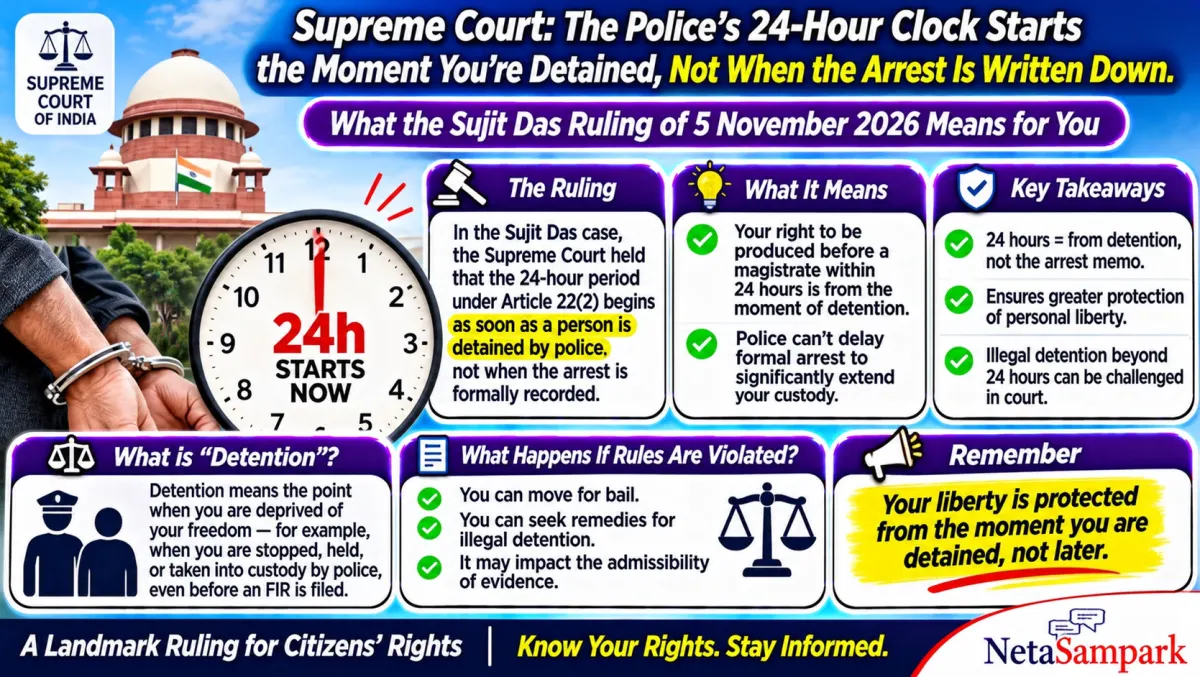
On 5 November 2026, the Supreme Court held in Sujit Das v. Union of India that the 24-hour limit for producing a person before a magistrate starts from the moment police detain them, not from the time a formal arrest is recorded. Anyone kept beyond 24 hours must be released at once.
Updated 21 November 2026
Here's a situation many families know too well. Police pick someone up in the evening "for questioning". He sits in the station all night and the next day. Then, around 6 PM the next evening, the arrest memo is finally written. The 24 hours were being counted from that memo. So in practice, he was held for over 40 hours before seeing a judge.
The Supreme Court has now said that's not allowed. The clock starts the moment the police restrain you. This post explains the ruling in plain words, what you can do if a family member is picked up, and how it connects to your existing rights under the Bharatiya Nagarik Suraksha Sanhita, 2023 (BNSS).
Quick facts
| Item | Details |
|---|---|
| Official portal | Supreme Court of India (sci.gov.in) for judgments; Article 22 in the Constitution of India |
| Helpline | 15100 (NALSA free legal aid) and 112 (police emergency) |
| Fee | None. Free legal aid is available to many people under the Legal Services Authorities Act |
| Deadline | Production before a magistrate within 24 hours of detention, excluding only travel time to the court |
| Documents | Note the exact time and place of pickup, names of officers, and any arrest memo given |
| Case | Sri Sujit Das and Ors. v. Union of India, 2026 INSC 1195, decided 5 November 2026 |
| Bench | Justice Ujjal Bhuyan and Justice Atul S. Chandurkar |
| Laws involved | Article 22(2) of the Constitution; Section 58 BNSS (old Section 57 CrPC) |
What did the Supreme Court actually decide?
The case came from Tripura. In a narcotics case, the four appellants were detained but their formal arrest was shown about 18 hours later, as reported by The Hindu. The Tripura High Court had refused them bail. The Supreme Court allowed their appeals.
In paragraph 69 of the judgment, the court summed up its conclusions. In simple words:
1. The 24 hours start at detention. The clock under Article 22(2) runs from the date and time a person is detained and their liberty is curtailed, not from the formal arrest.
2. Over 24 hours means release. If a detained person isn't produced before a magistrate within 24 hours, they must be released from custody at once.
3. Only travel time is excluded. Nothing else can be cut from the 24 hours, except the time needed to travel from the place of arrest to the magistrate's court.
4. Earlier High Court views overruled. Decisions of the Orissa, Madras and Kerala High Courts that took a different view don't lay down the correct law.
5. Reasonable time, not just 24 hours. Police must not hold someone longer than is reasonable even inside the 24 hours, as Section 58 BNSS already says.
6. Magistrates must record the real time. At production, the magistrate has to write down the actual date and time of detention.
7. Magistrates can refuse remand. If the magistrate feels the detention was longer than reasonable, even within 24 hours, they may decline to send the person to custody.
The court also said a copy of the judgment must go to all state Directors General of Police, High Court Registrars General and state judicial academies. So police and courts across India have been told.
Why does "touching the body" matter?
The court pointed out that "arrest" isn't defined in the IPC, the old CrPC or the BNSS. That gap let investigators hold people informally, sometimes for days, before showing an arrest on paper. The court said that even touching a person with a view to detaining them can amount to arrest. In The Hindu's words, the 24-hour countdown begins from "the very second" of that physical restraint.
The court also said this right can't be diluted even under special laws like the NDPS Act, UAPA or PMLA. So it applies to all kinds of cases, not just ordinary crimes.
What are your rights the moment police detain you?
The ruling sits on top of rights you already have. Our detailed guide on the rights of an arrested person under the BNSS covers them in full. In short:
• Grounds of arrest. You must be told why you're being arrested.
• A lawyer. You can meet a lawyer of your choice during interrogation, though not throughout.
• Family to be told. Police must inform a relative or friend you name about the arrest and where you're held.
• Arrest memo. It should carry the date and time, be signed by a witness, and be countersigned by you.
• Medical examination. You can ask for one.
• 24 hours to a magistrate. Now counted from the moment of detention.
If the detention is "preventive" rather than for a specific offence, different rules apply. See our post on preventive detention under the BNSS.
What should you do if a family member is picked up?
Act fast and write everything down. Here's a simple plan.
1. Note the exact time. Write down when and where the person was picked up, who was there, and the police vehicle or officer names if you can. This time is now the start of the 24 hours.
2. Go to the police station. Ask the duty officer whether the person has been arrested and on what grounds. Ask for the arrest memo.
3. Call a lawyer or legal aid. If you can't afford a lawyer, call 15100 or reach your District Legal Services Authority. Our guide on free legal aid through NALSA and DLSA explains who qualifies.
4. Watch the clock. If 24 hours pass from detention and the person hasn't been produced before a magistrate, tell your lawyer right away. Under this ruling, the person must be released.
5. At production, speak up. Your lawyer can point out the real time of detention to the magistrate. The magistrate is now bound to record it.
6. Keep proof. CCTV near the spot, call records, or witnesses who saw the pickup can all help show the real time.
Things to keep in a note on your phone:
☐ Time and place of pickup
☐ Police station name
☐ Officers' names or badge numbers
☐ Arrest memo time, if given
☐ Time of production before the magistrate
What if the police still hold someone beyond 24 hours?
You have options, and the lawyer will pick the best one.
• Bail or release application before the magistrate, relying on Sujit Das.
• Habeas corpus petition before the High Court, which asks the court to produce the person and test whether the detention is legal.
• Complaint to senior police officers, such as the Superintendent of Police, and to the State Human Rights Commission for illegal detention.
Don't try to handle it alone if you can avoid it. A lawyer or a legal aid counsel knows how to move the court quickly.
Does this mean every accused will walk free?
No. Please don't read it that way. The ruling doesn't cancel cases or stop investigations. It says that if police take away someone's liberty, the person must be shown to a magistrate within 24 hours from that moment. Police can still arrest, investigate and ask for remand. They just can't hide the real time of detention anymore.
For honest police work, the change is small. For the kind of "unofficial custody" the court called a "reprehensible practice", it's a big change.
How is this different from an FIR?
An FIR is about registering a crime. Detention and arrest are about holding a person. You can have one without the other. If you need to report a crime, our guide on Zero FIR and e-FIR under the BNSS explains how to file.
Frequently asked questions
When does the 24-hour period start after police pick someone up?
From the moment of detention, when the person's liberty is curtailed. That's what the Supreme Court held on 5 November 2026 in Sujit Das v. Union of India.
What happens if a person isn't produced within 24 hours?
The court said they must be released from custody at once. Only travel time from the place of arrest to the magistrate's court can be left out of the 24 hours.
Does this apply to NDPS, UAPA or PMLA cases?
Yes. The court said Article 21 and Article 22 rights can't be cut down even under special laws like these.
Can the magistrate refuse police custody even within 24 hours?
Yes. If the magistrate thinks the detention was longer than reasonable in the circumstances, they may decline remand, as per the judgment.
Where can I read the judgment?
Search for Sujit Das v. Union of India (2026 INSC 1195) on the Supreme Court's website, sci.gov.in. LiveLaw has also posted the full judgment PDF.
Final reminder
Save 15100 and your local lawyer's number in your phone today (21 November 2026). If someone in your family is ever picked up, note the time first and call for legal help second. And if you think police excess is a problem in your area, raise it with your MLA. Find your MLA and MP on NetaSampark and write to them.
Sources
• Constitution of India, Legislative Department
• Bharatiya Nagarik Suraksha Sanhita, 2023 on India Code
• National Legal Services Authority (NALSA)
• Judgment PDF: Sri Sujit Das and Ors. v. Union of India, 5 November 2026 (via LiveLaw)
• The Hindu: 24-hour rule starts from detention, 5 November 2026 (news report)