
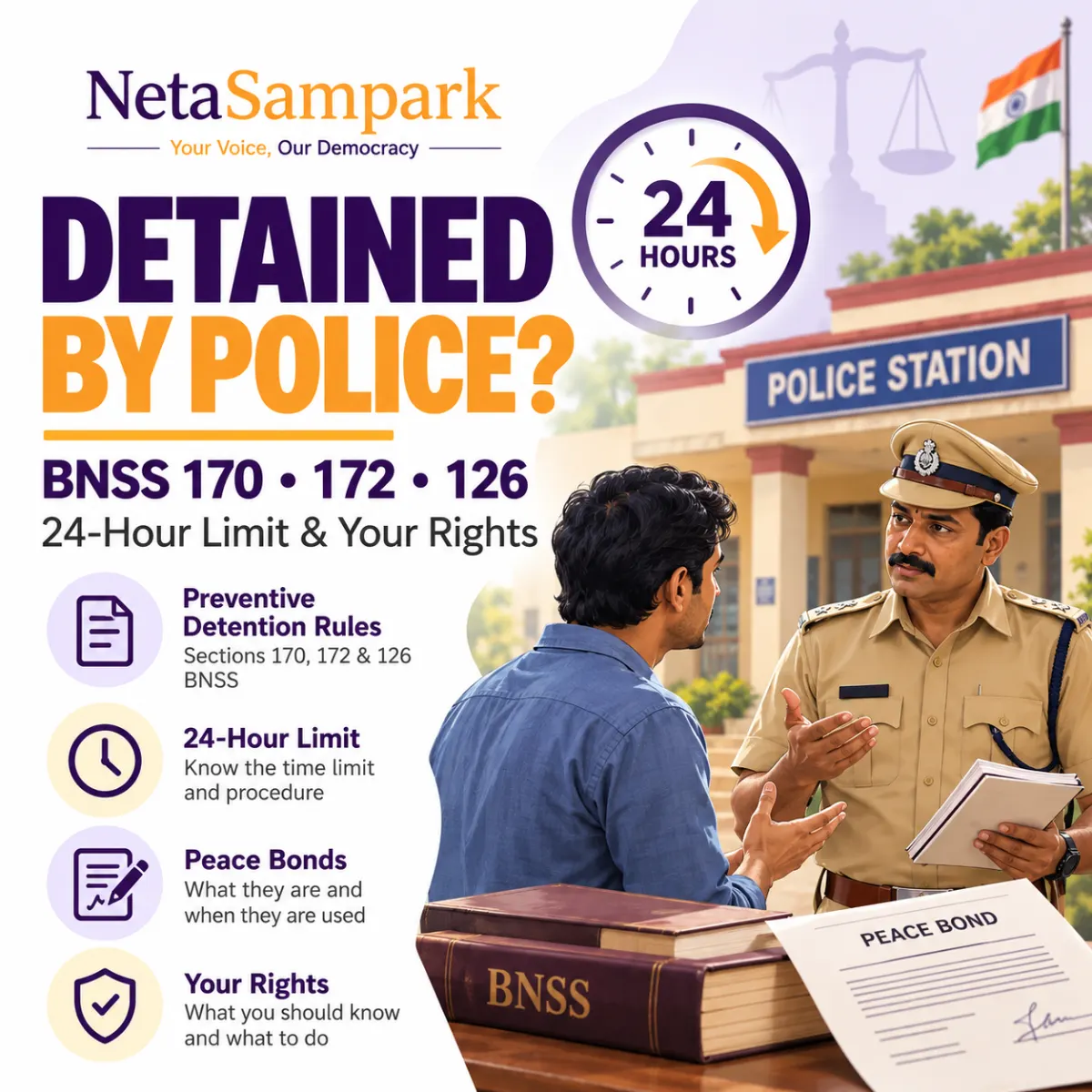
Can the police detain you even if you have not committed an offence? Can they hold you before a protest or public gathering? And can they make you sign a bond promising to maintain peace?
Under India’s Bharatiya Nagarik Suraksha Sanhita (BNSS), 2023, the police have certain powers to prevent anticipated offences and respond to people who disobey lawful police directions. But these powers are governed by legal conditions and safeguards.
Three provisions are especially important:
- Section 170: Arrest to prevent the commission of a cognizable offence.
- Section 172: The duty to comply with lawful police directions under the relevant chapter.
- Section 126: Proceedings before an Executive Magistrate to require security for keeping the peace.
Understanding the differences can help citizens, students, protesters, organisers and families understand what the law permits—and what steps may be available if someone is detained.
This guide is for general legal awareness, not a substitute for advice from a lawyer who can examine the facts of an individual case.
1 What is preventive police action under the BNSS?
Preventive police action aims to stop a potential offence or disturbance before it occurs. It is different from investigating an offence that has already taken place, although the two situations can overlap.
For example, police may receive specific information suggesting that a confrontation is likely at a public gathering. Depending on the circumstances, they may take lawful steps to prevent violence or another cognizable offence.
However, the mere possibility that someone might create a disturbance should not automatically be treated as sufficient justification for every restriction or detention. The relevant legal provision, the facts, and the necessity of the action matter.
The BNSS came into force on 1 July 2024, replacing the Code of Criminal Procedure (CrPC) for matters governed by the new law. Sections 170 and 172 appear in Chapter XII, which deals with preventive action by the police.
2 Section 170 BNSS: When can police arrest someone to prevent an offence?
Section 170 authorises a police officer to arrest a person without a warrant or a Magistrate’s order in a specific preventive situation.
The provision applies when:
- The police officer knows of a design or plan to commit a cognizable offence.
- The officer considers that the offence cannot otherwise be prevented.
- The arrest is made under the authority of this provision.
A cognizable offence is one for which the police have statutory authority to arrest without a warrant and investigate according to law, subject to the applicable conditions.
Does the police need a warrant?
No. Section 170 expressly permits an arrest without a warrant or prior order from a Magistrate when its conditions are satisfied.
But the absence of a warrant does not mean the police can arrest anyone simply because that person is present at a protest, gathering or politically sensitive location. The statutory requirements still matter.
What is the 24-hour limit under Section 170?
Section 170(2) says that a person arrested under Section 170 cannot be detained in custody for more than 24 hours from the time of arrest, unless further detention is required or authorised under another provision of the BNSS or another law in force.
This is an important qualification. The provision does not create an absolute rule that every person must be released after 24 hours regardless of the legal circumstances. If a separate legal basis for continued detention applies, the relevant safeguards and procedures must also be followed.
Equally, the police cannot assume that the possibility of future trouble, by itself, authorises indefinite custody under Section 170.
Official text: Section 170 BNSS.
3 Section 172 BNSS: What if you do not follow a police direction?
Section 172 concerns compliance with lawful directions issued by police officers while performing duties under Chapter XII of the BNSS.
It contains two important parts.
Section 172(1): People must comply with lawful directions given by a police officer in the discharge of duties under this chapter.
Section 172(2): A police officer may detain or remove a person who resists, refuses, ignores or disregards a direction given under subsection (1). The officer may take the person before a Magistrate or, in petty cases, release the person as soon as possible within 24 hours.
Does Section 172 mean every police instruction must be obeyed?
The section refers to lawful directions given in the performance of duties under the relevant chapter. It should not be read as a blanket power to issue any instruction whatsoever.
If an officer directs people to move away from an area to prevent an imminent confrontation, for instance, the circumstances and legal authority behind that direction are relevant.
If a person believes an instruction is unlawful, they should prioritise physical safety, avoid escalating the confrontation, document what happened where possible and challenge the action through appropriate legal channels.
Is the 24-hour rule under Section 172 identical to Section 170?
No. The wording differs.
Section 170(2) expressly prohibits custody beyond 24 hours unless further detention is authorised or required under another law.
Section 172(2), by contrast, says that in petty cases a person may be released as soon as possible within 24 hours; otherwise, the person may be taken before a Magistrate. It should not be summarised as a universal rule that every detention under Section 172 must end within 24 hours in every circumstance.
Official text: Section 172 BNSS.
4 Section 126 BNSS: What is a peace bond?
Section 126 allows an Executive Magistrate to initiate proceedings when information indicates that a person is likely to breach the peace, disturb public tranquillity or commit a wrongful act likely to cause such a disturbance, and the Magistrate considers that there are sufficient grounds to proceed.
The Magistrate may require the person to show cause why they should not be ordered to execute a bond or bail bond for keeping the peace.
The period specified under Section 126 cannot exceed one year.
A peace bond is essentially a legal undertaking to maintain peace, subject to the terms of the order. It is not, by itself, a criminal conviction.
Does a peace bond mean you have been found guilty?
No. Section 126 provides for preventive proceedings, not an automatic finding of guilt for a separate criminal offence.
The subsequent procedure matters. Under Section 130, the Magistrate must make a written order setting out the substance of the information received, the proposed bond amount, its duration and the number of sureties, where applicable.
Under Section 135, the Magistrate conducts an inquiry into the truth of the information. If the necessary grounds are not established, Section 137 provides for discharge and release where the person is in custody solely for that inquiry.
The law therefore provides a process through which the allegations and need for security are examined. A peace bond should not be understood as an automatic consequence of merely attending a protest or gathering.
Can someone be kept in custody during peace-bond proceedings?
Section 135(3) permits the Magistrate, in specified circumstances, to direct a person to execute an interim bond while the inquiry is pending and to detain the person until the bond is executed or, if it is not executed, until the inquiry concludes. The Magistrate must consider immediate preventive necessity and record reasons in writing.
This is a distinct legal situation from simply continuing a police detention under Section 170. The applicable procedural requirements must be examined carefully.
Official references:
5 Section 170 vs Section 172 vs Section 126: What is the difference?
| Provision | What it deals with | Key point |
|---|---|---|
| Section 170 | Arrest to prevent a cognizable offence | Requires knowledge of a design to commit such an offence and that it cannot otherwise be prevented. |
| Section 172 | Compliance with lawful police directions | Allows detention or removal in the circumstances specified by the section. |
| Section 126 | Security for keeping the peace | An Executive Magistrate may initiate proceedings requiring a person to show cause why a peace bond should not be ordered. |
These provisions are connected in some situations, but they are not interchangeable. A police officer’s preventive power, a direction to comply with police instructions, and a Magistrate’s peace-bond proceeding each have their own legal requirements.
6 What rights should you know if the police detain you?
The exact safeguards depend on whether you are being arrested, detained under a preventive provision, taken before a Magistrate or proceeded against under another law. The following are practical steps to consider.
Ask for the legal basis
Calmly ask which provision is being invoked and whether you are under arrest or being detained under a preventive power. Ask where you are being taken.
Do not physically resist or escalate a confrontation in an attempt to obtain an answer.
Contact a lawyer and inform family
Article 22(1) of the Constitution protects the right of an arrested person to be informed of the grounds of arrest and to consult and be defended by a legal practitioner of their choice, subject to the constitutional framework and applicable law.
Ask to contact a lawyer and have a trusted person informed of your whereabouts. Additional statutory procedures may apply to the particular type of arrest or detention.
Know the ordinary 24-hour safeguard for arrests
Article 22(2) generally requires an arrested person to be produced before the nearest Magistrate within 24 hours of arrest, excluding the time necessary for the journey from the place of arrest to the Magistrate’s court. Detention beyond that period requires the authority of a Magistrate.
This constitutional safeguard is related to, but not identical to, the specific limit in Section 170(2). A separate law or a valid judicial order may affect what happens next.
Keep a record of the incident
Where it is safe and lawful to do so, record:
- The time and place where you were stopped or taken into custody.
- The police station or other location where you were taken.
- The provision mentioned by the police, if any.
- The names or identification details of officers, where available.
- Any documents, notices, orders or bond papers you receive.
- The names and contact details of witnesses.
Do not put yourself or others at risk to obtain photographs or recordings. Preserve messages, videos and other material already available to you.
Seek legal aid if you cannot afford a lawyer
The National Legal Services Authority (NALSA) states that people in custody are among the categories eligible for legal services under Section 12 of the Legal Services Authorities Act, 1987. NALSA also provides information on early access to legal assistance for people called for questioning or arrested.
Visit NALSA or contact the relevant District Legal Services Authority for assistance.
7 What should you do if you are asked to sign a peace bond?
Do not treat the document as a meaningless formality. Its conditions can have legal consequences.
Before signing, where circumstances permit:
- Ask for the written order and the legal provision under which the proceedings are being conducted.
- Read the bond carefully and ask for an explanation of any term you do not understand.
- Check the amount, duration, surety requirements and any other conditions.
- Ask a lawyer to review the document if possible.
- Obtain a copy of the order and bond, and retain any receipts or acknowledgements.
If you disagree with the allegations, tell your lawyer and raise your objections through the prescribed proceedings. Do not sign a document you do not understand simply because someone says it is routine.
If the person is being produced before a Magistrate, explain any concern about the legality of the detention, the factual basis for the proceeding or the proposed bond conditions.
8 Can preventive detention be challenged?
Potentially, yes. The appropriate remedy depends on the facts, the legal provision used and the stage of the proceeding.
A lawyer may examine whether the statutory conditions were met, whether required procedures were followed, whether the detention has a lawful basis and whether the relevant time limits have been observed.
Depending on the circumstances, remedies may include making submissions before the Magistrate, pursuing appropriate proceedings before a higher court or seeking a writ of habeas corpus where legally available.
Do not assume that every preventive detention is unlawful—or that every police action is valid simply because the police describe it as preventive. The legality of a particular action depends on the applicable law and evidence.
9 Frequently asked questions
Can police detain me before a protest even if I have not committed a crime?
Section 170 may permit an arrest to prevent a cognizable offence where its conditions are satisfied, including the requirement that the offence cannot otherwise be prevented. Section 172 may also apply to non-compliance with lawful directions under the relevant chapter. Whether a particular detention is lawful depends on the circumstances and legal authority relied upon.
Does the 24-hour limit mean I must always be released after 24 hours?
No. Section 170 sets a 24-hour custody limit unless further detention is required or authorised under another provision of the BNSS or another law. Section 172 has different wording, including a specific reference to release within 24 hours in petty cases. Article 22 also contains a general safeguard concerning production before a Magistrate after arrest.
Can the police force me to sign a peace bond?
Section 126 provides for proceedings before an Executive Magistrate, who may require a person to show cause why a peace bond should not be ordered. The subsequent procedure and any interim directions must follow the BNSS. Seek legal advice before signing a document you do not understand.
Does signing a peace bond amount to admitting guilt?
A peace bond is a preventive legal undertaking and is not, by itself, a criminal conviction. Read the document carefully and obtain legal advice about its specific wording and consequences.
What if I am kept in custody beyond the applicable time limit?
Contact a lawyer or legal aid authority promptly. The lawyer can examine the legal basis for the continued custody and whether an application before the Magistrate or an appropriate court is warranted.
Where can I read the law myself?
Start with the official BNSS text available through India Code. Read Sections 126, 130–137, 170 and 172, along with the relevant constitutional provisions.
Conclusion: Know the difference between preventive powers and unlimited detention
Sections 170, 172 and 126 BNSS serve different purposes. Section 170 concerns arrest to prevent a cognizable offence; Section 172 addresses compliance with lawful police directions; and Section 126 provides for peace-bond proceedings before an Executive Magistrate.
The 24-hour safeguard is important, but the precise rule depends on the provision being used and whether another lawful basis for continued custody applies. Peace-bond proceedings also have their own process, including a written order and inquiry.
Knowing the difference can help you ask the right questions, preserve relevant evidence and seek timely legal assistance when necessary.
Stay informed. Understand your rights. Verify the law.
About NetaSampark
NetaSampark helps citizens understand public institutions, government processes and civic rights through accessible guides and resources.
Explore more citizen guides at NetaSampark.com.
Editorial note: This article provides general legal information and should be reviewed by a qualified Indian criminal-law practitioner before publication. The law and court interpretations may evolve, and the facts of a particular incident can materially change the legal position.