
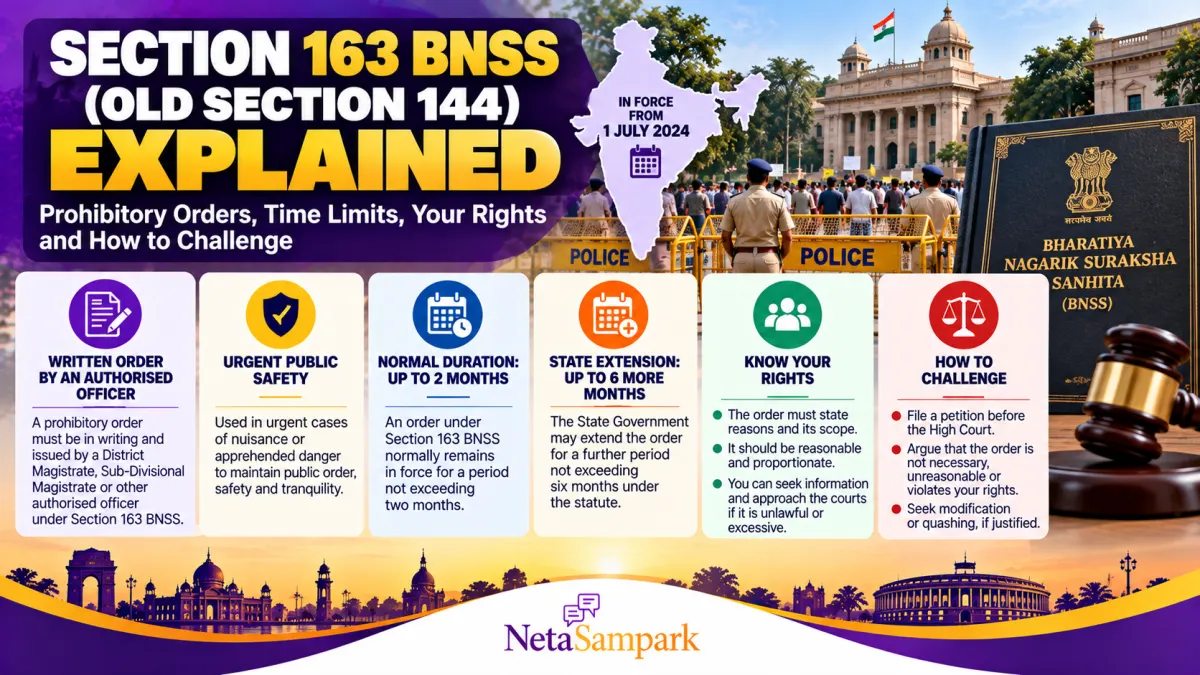
Have you seen a police announcement banning gatherings, rallies, processions or public meetings in your city? Such restrictions are often associated with Section 163 of the Bharatiya Nagarik Suraksha Sanhita (BNSS), 2023, which replaced Section 144 of the Code of Criminal Procedure (CrPC) from 1 July 2024.
Section 163 allows an empowered Executive Magistrate to issue urgent written orders when immediate action is considered necessary to prevent danger to life, health or safety, a riot, an affray or a disturbance of public tranquillity.
But the provision does not automatically ban every gathering or make every public protest illegal. The restrictions depend on the actual order, the area it covers, its duration and the circumstances in which it was issued.
This guide explains what Section 163 means, what authorities can prohibit, how long an order can remain in force, what citizens should know about their rights and how an affected person can challenge an order.
What Is Section 163 BNSS?
Section 163 of the Bharatiya Nagarik Suraksha Sanhita, 2023, is titled “Power to issue order in urgent cases of nuisance or apprehended danger.”
It authorises a District Magistrate, Sub-Divisional Magistrate or another Executive Magistrate specially empowered by the State Government to issue a written order where sufficient grounds exist and immediate prevention or a speedy remedy is necessary.
The order may direct a person to stop a particular act or take specified action concerning property under their possession or management.
The provision is intended to prevent situations such as:
- A credible risk of violence or a riot.
- Conduct endangering human life, health or safety.
- A serious disturbance of public tranquillity.
- Obstruction, annoyance or injury to a person lawfully carrying out their duties.
- An affray or other situation requiring urgent preventive action.
The order must state the material facts supporting it. In an emergency, or where there is insufficient time to serve notice beforehand, the Magistrate may issue an order without first hearing the affected person.
Official legal text: Section 163 BNSS — India Code
Section 144 CrPC vs Section 163 BNSS: What Changed?
Section 144 CrPC was the familiar provision used for urgent prohibitory orders under the previous criminal procedure law.
The BNSS replaced the CrPC framework from 1 July 2024. Section 163 carries forward the core power to issue urgent preventive orders.
| Feature | Former Section 144 CrPC | Current Section 163 BNSS |
|---|---|---|
| Law | Code of Criminal Procedure, 1973 | Bharatiya Nagarik Suraksha Sanhita, 2023 |
| Purpose | Prevent urgent danger or disturbance of public order | Substantially the same preventive purpose |
| Authority | Specified Executive Magistrates | District Magistrate, SDM or another specially empowered Executive Magistrate |
| Order | Written order stating material facts | Written order stating material facts |
| Ordinary maximum duration | Two months | Two months |
| Extension | State Government could extend under the former provision | State Government may extend under the conditions in Section 163(4) |
The key point for citizens is that the familiar term “Section 144” is now commonly used to describe orders issued under Section 163 BNSS. When checking a current notification, look for the actual statutory provision cited in the order.
What Can a Section 163 Order Ban?
The exact restrictions depend on the wording of the order issued for a particular location and situation.
Depending on the circumstances, an order may prohibit or restrict:
1. Public Gatherings
An order may restrict gatherings where authorities consider them likely to create a risk of violence, a riot or a serious disturbance of public tranquillity.
The order should be checked carefully to determine which gatherings are covered, where the restriction applies and whether any exceptions have been specified.
2. Rallies, Processions and Public Meetings
A prohibitory order may restrict processions, demonstrations, public meetings or other specified activities in the affected area.
However, Section 163 does not mean that every peaceful meeting or protest is automatically prohibited throughout a district or state. The applicable order and the legal justification for the restrictions matter.
3. Conduct That Creates an Immediate Public-Safety Risk
An order may direct people to refrain from particular conduct or take specified action concerning property where this is necessary to prevent danger, injury or a disturbance of public order.
For example, authorities may impose restrictions around a location where credible information indicates a risk of clashes.
4. Activities in a Specified Area
Section 163 allows orders to be directed at a particular individual, people residing in a particular place, or the public generally when visiting or frequenting a particular place or area.
This means that a restriction may be localised rather than automatically applying to an entire city or district.
Important: Do not assume that Section 163 always means a curfew. A curfew, an assembly restriction and other public-order measures may have different terms and legal bases. Read the actual notification to understand what is prohibited.
How Long Does a Section 163 Order Last?
Section 163(4) sets a specific time limit.
- Ordinary duration: An order cannot remain in force for more than two months from the date it is made.
- State Government extension: Where the statutory conditions are met, the State Government may extend the order for a further period not exceeding six months from the date the original order would otherwise have expired.
- Not an automatic extension: An extension requires the action specified by the law; an order does not continue indefinitely just because authorities still consider the situation sensitive.
For example, if a Magistrate makes an order on 1 October, its ordinary maximum duration would run for two months from that date. Any extension must be checked against the applicable government notification and the statutory conditions.
Always read the order and any extension notification to determine the actual dates and scope.
Legal source: Section 163(4), BNSS.
Can Authorities Issue an Order Without Giving Notice First?
Yes. Section 163(2) permits an order to be issued ex parte in an emergency or when circumstances do not allow sufficient time to serve notice on the affected person.
This means a person may receive the order without having had an opportunity to present their side beforehand.
However, the law provides a mechanism to seek rescission or alteration of an order. Under Section 163(7), the authority considering such an application must provide an early opportunity for the applicant to appear, personally or through an advocate, and explain why the order should be changed or withdrawn. If the application is rejected wholly or partly, written reasons must be recorded.
What Are Your Rights Under Section 163?
A prohibitory order can restrict certain activities, but citizens retain legal rights. The order must be considered alongside the Constitution and applicable judicial decisions.
1. You Can Read and Verify the Order
Check the written notification for:
- The authority that issued it.
- The reasons and material facts stated.
- The geographical area covered.
- The activities prohibited or restricted.
- The start date and period of operation.
- Any exemptions or special permissions.
Section 163(1) requires a written order stating the material facts. If you cannot obtain a copy, ask the issuing authority or relevant district administration for the notification.
2. Peaceful Assembly Is a Constitutional Right
Article 19(1)(b) of the Constitution protects the right to assemble peaceably and without arms, subject to reasonable restrictions in the interests of the sovereignty and integrity of India and public order.
Article 19(1)(a) protects freedom of speech and expression, also subject to constitutional restrictions.
A restriction under Section 163 must be assessed in light of the circumstances, the legal authority invoked and the rights affected. The existence of a prohibitory order does not, by itself, establish that every peaceful gathering is unlawful.
3. Restrictions Must Have a Legal Basis
The Supreme Court has addressed the relationship between public-order restrictions and fundamental rights in several decisions.
In Anuradha Bhasin v. Union of India (2020), the Court emphasised that restrictions affecting fundamental rights must satisfy legal requirements and be subject to appropriate scrutiny.
In Mazdoor Kisan Shakti Sangathan v. Union of India (2018), the Court considered the balance between peaceful protest and the rights of other members of the public.
These decisions are relevant to understanding proportionality and the need to balance competing rights. Whether a particular Section 163 order is lawful depends on its facts, terms and legal justification.
How to Challenge a Section 163 Order
If an order affects you or your organisation, there are legal routes to seek its modification or cancellation.
Option 1: Apply to the Magistrate Under Section 163(5)
Section 163(5) expressly allows a Magistrate to rescind or alter an order made by that Magistrate, a subordinate Magistrate or a predecessor.
An affected person can make an application explaining why the order should be withdrawn or modified.
Your application can address matters such as:
- Whether the circumstances justify the restriction.
- Whether the order covers a wider area or activity than necessary.
- Whether the stated reasons adequately support the restrictions.
- Whether circumstances have changed since the order was issued.
- Whether a narrower restriction could address the identified risk.
Attach a copy of the order and any relevant supporting material. Keep proof that the application was submitted.
Under Section 163(7), the authority must provide an early opportunity to present your case, personally or through an advocate. If the application is rejected wholly or partly, written reasons must be recorded.
Option 2: Apply to the State Government if It Extended the Order
Section 163(6) allows the State Government to rescind or alter an extension order made under Section 163(4).
If your grievance concerns the State Government's extension rather than the original Magistrate's order, identify the relevant notification and consider applying to the State Government under the applicable provision.
Option 3: Seek Judicial Review
Depending on the facts, an affected person may approach the jurisdictional High Court, including through a petition under Article 226 of the Constitution.
Possible grounds may include lack of legal authority, failure to meet statutory requirements, inadequate justification, disproportionate restrictions or infringement of fundamental rights.
The appropriate remedy depends on the facts, the nature of the order and the available legal procedures. Obtain legal advice before filing a court petition, particularly if the order is already in force and the proposed activity is imminent.
What Should You Include in a Challenge Application?
A clear application should identify the order and explain the precise relief requested.
Include:
- A copy of the Section 163 order and any extension notification.
- Your name, address and connection to the affected activity or area.
- The specific restrictions you are challenging.
- The factual and legal reasons for requesting modification or cancellation.
- Supporting documents, such as permissions, correspondence or evidence of changed circumstances.
- The relief requested, such as withdrawing the order or narrowing its scope.
Keep the application factual and respectful. Do not assume that filing a challenge automatically suspends the order. Unless it is withdrawn, modified, stayed or otherwise ceases to operate, comply with its applicable terms.
What Happens If Someone Violates a Prohibitory Order?
Ignoring a valid order can lead to legal consequences. The precise offence and penalty depend on the applicable law, the wording of the order and the circumstances of the alleged violation.
Section 163 itself is the preventive power; criminal liability for disobedience may arise under other applicable provisions, including Section 223 of the Bharatiya Nyaya Sanhita, 2023, where its requirements are met.
If you are served with a notice or accused of violating an order, preserve the documents and seek legal advice promptly. Do not assume that an order is invalid simply because you disagree with it.
How to Check Whether a Section 163 Order Is in Force in Your Area
When a restriction is announced, take these steps:
- Visit your district administration or police department's official website.
- Look for the latest prohibitory-order notification.
- Verify the date, area, duration and activities covered.
- Check whether a subsequent order has modified, withdrawn or extended the restriction.
- If details are unclear, contact the issuing authority or district administration.
- Keep a copy of the applicable notification for reference.
News reports and social media posts can help you learn that an order exists, but the official notification should be used to establish its actual terms.
Frequently Asked Questions
Is Section 163 the same as the old Section 144?
Section 163 BNSS replaced the former Section 144 CrPC when the new criminal procedure law came into force on 1 July 2024. It carries forward the core power to issue urgent preventive orders.
Does Section 163 automatically ban gatherings of five or more people?
No. Do not assume that every Section 163 order imposes the same numerical restriction. Check the actual order and the legal provisions that apply to the gathering or activity.
Can Section 163 be imposed across an entire city?
An order may apply to individuals, people in a particular place or the public visiting a specified area. The geographical scope depends on the order issued and its legal basis.
Can a Magistrate issue an order without hearing me first?
Yes, in an emergency or where there is insufficient time to serve notice, Section 163(2) permits an ex parte order. You can seek rescission or alteration under Section 163(5), subject to the applicable procedure.
Can a Section 163 order last longer than two months?
The ordinary maximum is two months. The State Government may extend it for a further period not exceeding six months under the conditions and procedure in Section 163(4).
How can I challenge an order?
You can apply to the Magistrate under Section 163(5), approach the State Government regarding an extension under Section 163(6), or consider judicial review where appropriate.
Does filing a challenge allow me to ignore the order?
No. Filing an application does not automatically suspend the order. Obtain a modification, withdrawal or appropriate stay before acting contrary to a restriction that remains in force.
Conclusion
Section 163 BNSS is the current legal provision corresponding to the familiar Section 144 CrPC. It gives empowered Executive Magistrates the ability to issue urgent preventive orders to address risks to life, safety and public tranquillity.
The law also sets limits: an order must state material facts, normally cannot remain in force for more than two months, and may be extended by the State Government only under the statutory conditions. Affected people can seek modification or cancellation and may pursue judicial remedies where appropriate.
If a prohibitory order is announced in your area, read the official notification carefully, understand exactly what it restricts, comply with any restrictions that remain in force, and seek legal advice if you believe the order is unlawful or disproportionate.
Official and legal resources
- India Code — Bharatiya Nagarik Suraksha Sanhita, 2023
- NCRB — BNSS chapter and statutory text
- Supreme Court judgment: Anuradha Bhasin v. Union of India
- Supreme Court judgment: Mazdoor Kisan Shakti Sangathan v. Union of India
This article is for general legal information, not individual legal advice. The legality and effect of a specific prohibitory order depend on its wording, the circumstances and applicable judicial decisions.