
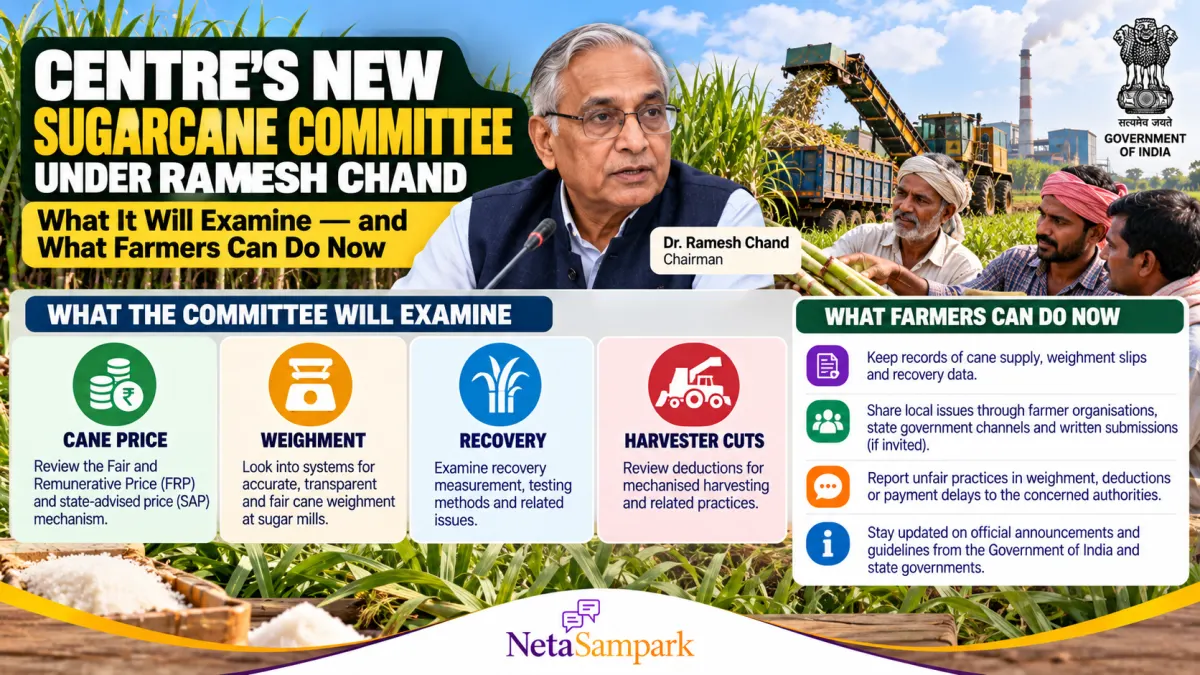
Centre’s New Sugarcane Committee Under Ramesh Chand: What It Will Examine and What Farmers Can Do Now
The Centre has constituted a committee chaired by former NITI Aayog member Professor Ramesh Chand to examine sugarcane farmers’ concerns, including cane prices, sugar recovery testing, weighment at sugar mills and deductions for mechanically harvested cane. Announced on 14 October 2026, the committee follows discussions between farmer representatives from Karnataka and Maharashtra and Union ministers.
For sugarcane growers, the key question is whether the review will lead to better returns, more transparent weighing and fairer deductions. Here is what the committee will examine, what the current pricing framework means, and what farmers can do while awaiting its recommendations.
What Is the Centre’s New Sugarcane Committee?
The Government of India has established the committee to examine issues raised by sugarcane farmers and recommend measures to address their concerns.
According to the Press Information Bureau (PIB) announcement, the committee is chaired by Professor Ramesh Chand, a former Member of NITI Aayog.
The other members are:
- Agriculture Commissioner, Ministry of Agriculture and Farmers Welfare
- Joint Secretary (Sugar), Department of Food and Public Distribution
- Joint Secretary (Legal Metrology), Department of Consumer Affairs
The committee will consult farmers’ representatives, sugar mill associations, state governments and other experts or organisations as necessary. It will submit its findings and specific recommendations for consideration by the competent authority.
Important: The committee has been formed to examine concerns and recommend measures. Its constitution does not, by itself, change the existing sugarcane price, sugar MSP or mill payment rules.
1 Higher Sugarcane Prices: Will Farmers Get Better Returns?
One of the committee’s main responsibilities is to examine the demand for higher remunerative returns from sugarcane cultivation.
Farmers’ returns depend on several factors, including cultivation costs, labour, fertiliser, irrigation, harvesting, transportation and the price payable for the cane delivered to a mill. The committee will consider cultivation costs and other relevant factors while examining the demand for better returns.
What is the difference between FRP and SAP?
Two pricing terms are important for sugarcane farmers:
- Fair and Remunerative Price (FRP): The price determined by the Central Government for sugarcane, subject to the applicable framework.
- State Advised Price (SAP): A price announced by certain state governments under their respective policies. Its application and relationship with FRP depend on the relevant state’s framework.
For the 2026–27 sugar season, the Centre has approved an FRP of ₹365 per quintal at a basic sugar recovery rate of 10.25%. The approved framework provides a premium of ₹3.56 per quintal for every 0.1 percentage-point increase in recovery above 10.25%, and a corresponding reduction for a decrease below that rate. Mills with recovery below 9.5% are subject to a special protection under which the FRP is not reduced further; the announced payable rate for that category is ₹338.30 per quintal.
Farmers should check the applicable rules and payment calculations for their state and mill.
Official reference: PIB — FRP of ₹365 per quintal for the 2026–27 season.
What farmers should understand
The committee is examining the demand for higher returns. It has not yet announced a new FRP or guaranteed an increase in the price farmers will receive.
Farmers should continue checking official Central and state government announcements rather than relying on unverified messages claiming that a revised price has already been approved.
2 Sugar MSP: Why Is the Price of Sugar Also Being Examined?
The committee will also examine the demand for revision of the ex-mill Minimum Selling Price (MSP) of sugar.
This is different from the FRP paid for sugarcane.
| Term | What it means |
|---|---|
| Sugarcane FRP | The minimum remunerative price framework for sugarcane payable to farmers |
| State Advised Price (SAP) | A state-announced cane price where applicable |
| Ex-mill sugar MSP | The minimum selling price framework for sugar sold by mills |
The committee will consider sugar production costs, market realisations and the financial viability of sugar mills while examining the demand for a revision of sugar MSP.
Why does this matter to farmers? The economics of sugar mills affect the wider sugarcane supply chain. However, a change in sugar MSP does not automatically translate into an identical increase in the cane price payable to every farmer. Any policy change would depend on the government's decision and the applicable pricing arrangements.
Farmers should therefore follow announcements on both sugarcane FRP and sugar MSP, while keeping the two separate.
3 Sugar Recovery: How Will the Committee Examine Testing?
Sugar recovery refers broadly to the quantity of sugar obtained from the sugarcane processed. Recovery figures are relevant to sugar production economics and, under the applicable FRP framework, the price calculation.
Farmers may have concerns about how recovery is tested, recorded and reported by mills. The committee will examine existing testing and reporting mechanisms and consider measures for more transparent verification.
Why recovery figures matter
Recovery testing can influence the calculation of cane prices under the applicable framework. A dispute over how recovery is measured or reported can therefore become a concern for farmers and mills alike.
The committee's review will cover the processes used to test and report recovery and the mechanisms available to verify the results.
What farmers can do now
- Keep copies of cane supply records and weighment slips.
- Retain payment statements that show the rate and any recovery-related calculation.
- Record the relevant date, supply centre or mill and details of the disputed transaction.
- If figures appear inconsistent, submit a written complaint to the mill's management or the relevant state sugarcane authority.
- Request a written explanation of the calculation and preserve the response.
Farmers should avoid assuming that a difference in payment necessarily proves incorrect testing. A complaint supported by records is more useful than an allegation without transaction details.
4 Sugarcane Weighment: Will the Committee Review Mill Weighing Practices?
The committee will examine sugarcane weighment practices at sugar mills, including whether calibration, inspection and verification mechanisms are adequate.
Accurate weighing is essential because the payable amount depends in part on the quantity of cane recorded as supplied.
If the recorded weight is lower than the quantity actually delivered, the farmer could receive less than expected. The review will consider how weighing systems operate and whether the existing verification arrangements are sufficient.
What should farmers check?
Before and after delivering cane, farmers should retain the records available to them and compare the quantities recorded across relevant documents.
A practical checklist includes:
- Weighment slip: Check the recorded weight, date and identifying details.
- Supply record: Compare the weight with the farmer's cane delivery or supply statement.
- Deductions: Check whether the slip or payment statement shows a deduction and how it has been calculated.
- Payment record: Compare the payable quantity and rate with the final payment.
- Complaint evidence: Preserve copies or photographs of the relevant documents.
If a farmer suspects a weighing-machine problem, the complaint should identify the mill or weighbridge, date, transaction and discrepancy. The farmer can approach the mill's grievance channel and the relevant state sugarcane authority. Where the issue concerns weighing equipment or measurement compliance, the state Legal Metrology department may also be an appropriate authority.
Do not rely only on verbal assurances. Request an acknowledgement or complaint reference wherever possible.
5 Mechanised Harvesting: What About Deductions From Cane Weight?
Another important issue is the deduction made from the weight of mechanically harvested sugarcane.
Mechanised harvesting can change the condition of cane delivered to a mill, including the amount of extraneous material or other harvesting-related losses. But the committee will examine the actual losses, if any, arising from mechanised harvesting and evaluate the financial impact of existing deduction practices on the cane price payable to farmers.
The objective of the review is to examine whether current practices and deductions are supported by the actual losses involved.
What farmers using harvesters should record
Farmers who use mechanical harvesting can take practical steps to document the transaction:
- Keep the harvesting contractor's receipt or agreement, if available.
- Record the name of the harvesting service provider and the date of harvesting.
- Retain the mill's weighment slip and payment statement.
- Ask for the reason and calculation behind any deduction.
- Photograph or document relevant conditions when a deduction is disputed, where it is safe and permitted to do so.
- Submit a written complaint through the mill's grievance process or the relevant state authority if the deduction appears unexplained or inconsistent with applicable rules.
Farmers should distinguish between harvesting charges paid to a contractor and deductions made by a mill from the recorded cane weight. These are not necessarily the same transaction and should be documented separately.
The committee has not yet announced a uniform new deduction rule. Farmers should not assume that all existing deductions have been cancelled or that a particular deduction has already been declared unlawful.
6 What Can Sugarcane Farmers Do Right Now?
Farmers do not need to wait for the committee's final report to organise their records or raise a specific grievance.
Step 1: Prepare a complete record of each disputed supply
Collect the available documents:
- Farmer registration or cane supply identification details
- Cane supply slips and weighment records
- Harvesting contractor receipts, where applicable
- Payment statements and bank credit records
- Details of any disputed deduction
- Copies of complaints and replies received
Keep the originals safe and submit copies unless the authority specifically requires otherwise.
Step 2: Write down the exact problem
Instead of making a general complaint that payment is unfair, specify the issue. For example:
- The weighment slip records a quantity that appears inconsistent with the supply record.
- A deduction appears on the payment statement, but the calculation has not been explained.
- The recovery figure used in a calculation appears inconsistent with the record supplied by the mill.
- The payment due for a particular delivery has not been credited.
Include dates, amounts, transaction details and supporting documents wherever available.
Step 3: Approach the appropriate authority
The correct channel depends on the nature of the complaint and the state in which the cane was supplied.
| Issue | Possible first point of contact |
|---|---|
| Cane price or payment calculation | Sugar mill management and the relevant state sugarcane department |
| Delayed or disputed payment | Mill grievance channel and the state authority responsible for sugarcane payments |
| Weighment discrepancy | Mill management and the relevant state sugarcane authority |
| Weighing equipment or measurement compliance | State Legal Metrology department, where applicable |
| Harvesting-related deduction | Mill management, relevant state sugarcane authority and the applicable grievance mechanism |
Keep the complaint acknowledgement, reference number and any written response. If the issue remains unresolved, use the applicable state escalation or grievance procedure.
Step 4: Share evidence through farmer organisations
The committee has stated that it will consult stakeholders, including farmers' representatives. Farmer organisations and cooperatives can help consolidate recurring concerns and present them with supporting evidence.
A useful submission should explain:
- The location and mill involved
- The number of farmers reporting the issue, if known
- The type of discrepancy or deduction
- The financial impact, with calculations where possible
- Supporting slips, statements or other documents
- The specific change or clarification being requested
Farmers should not assume that an individual complaint will automatically reach the committee. Follow official announcements to learn whether a formal consultation, submission process or meeting has been announced.
Step 5: Follow official updates
Use the following government sources to check announcements and policy changes:
- Press Information Bureau — official Central Government releases
- Department of Food and Public Distribution — sugar-sector policy and notifications
- Department of Consumer Affairs — consumer affairs and Legal Metrology information
- Ministry of Agriculture and Farmers Welfare — agriculture-related announcements
Farmers in Karnataka and Maharashtra should also check their respective state sugarcane department and government announcements for state-specific procedures.
7 What Happens Next?
The committee is expected to consult relevant stakeholders and submit a report containing findings and specific recommendations as early as possible. The report will then be considered by the competent authority.
The process may cover several distinct questions:
- Whether cane returns should be revised, taking cultivation costs into account
- Whether the ex-mill sugar MSP should be revised
- Whether sugar recovery testing and reporting need stronger verification
- Whether weighment calibration, inspection and verification are adequate
- Whether deductions for mechanically harvested cane reflect actual losses and how they affect farmers' payments
The announcement does not set a public deadline for the committee's final report. Nor does it specify that every recommendation will be accepted or implemented.
Farmers should watch for the committee's findings and any subsequent official orders before treating a proposed change as a new rule.
Frequently Asked Questions
Has the Centre increased the sugarcane FRP because of this committee?
No new FRP has been announced as a result of the committee's formation. The approved FRP for the 2026–27 season is ₹365 per quintal at a basic recovery rate of 10.25%, subject to the announced recovery-linked framework.
Is sugar MSP the same as sugarcane FRP?
No. FRP concerns the price payable for sugarcane under the applicable framework. Ex-mill sugar MSP concerns the minimum selling price framework for sugar sold by mills. The committee will examine both issues separately.
Will the committee stop deductions for mechanically harvested cane?
No such change has been announced yet. The committee will examine existing practices, actual losses, if any, and the financial impact of deductions on farmers.
Can farmers submit their complaints now?
Farmers can raise individual grievances through the relevant mill and state authority channels. Whether the committee will accept direct public submissions or conduct specific consultations should be confirmed through official announcements.
Does the committee's formation guarantee higher payments?
No. The committee will examine concerns and recommend measures. Any change in pricing or payment practices will depend on subsequent decisions and applicable official rules.
Conclusion
The Centre's new committee under Professor Ramesh Chand puts several long-standing sugar-sector concerns under review: remunerative cane prices, the ex-mill sugar MSP, recovery testing, weighment transparency and deductions linked to mechanical harvesting.
For farmers, the immediate practical step is to keep accurate supply and payment records, request explanations for disputed calculations, and use the appropriate grievance channels. Farmer organisations can also prepare evidence-based submissions if official consultations are announced.
The key distinction is between an issue being reviewed and a rule actually changing. Until the government announces specific decisions, farmers should rely on existing official pricing notifications and verified updates rather than unconfirmed claims about new rates or cancelled deductions.
Official source: Government of India — Committee to Examine Issues Relating to Sugarcane Farmers and the Sugar Sector, 14 October 2026.