
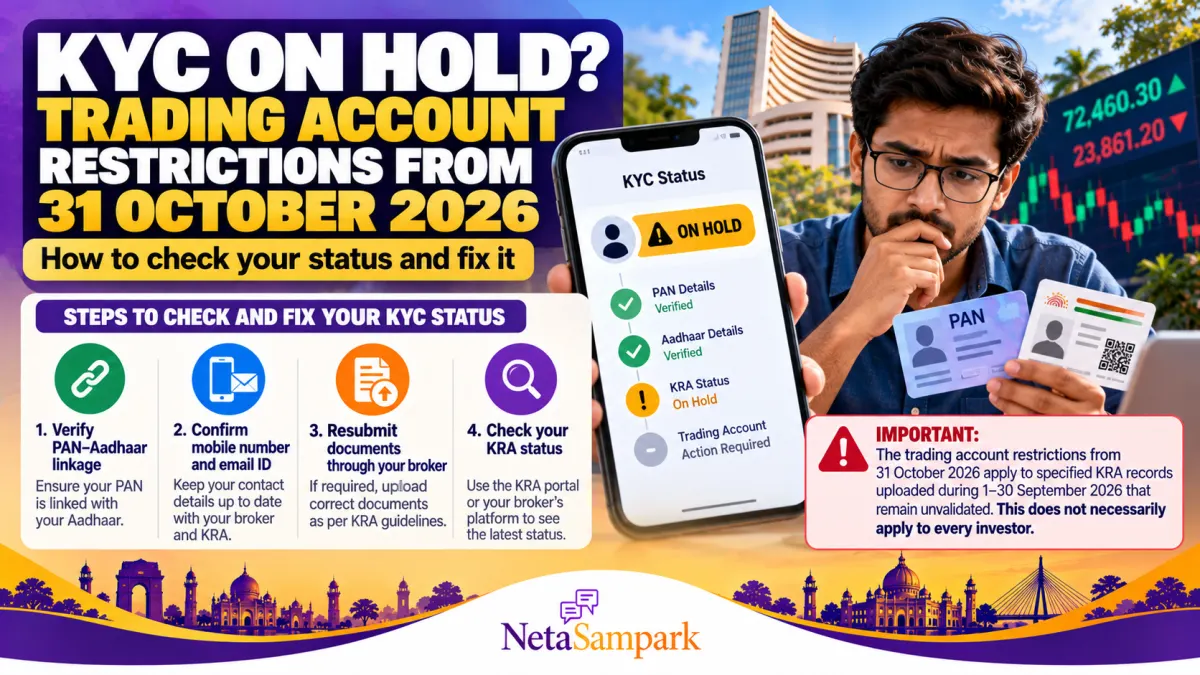
If your stock market KYC status shows “On Hold” at a KYC Registration Agency (KRA), you should check it before 31 October 2026. An exchange circular issued in October 2026 specifies trading restrictions from that date for certain KYC records uploaded between 1 and 30 September 2026 that remain unvalidated.
Affected investors may be prohibited from placing trades and even squaring off existing open positions until their KYC validation requirements are met. This makes it important to check your status, correct any discrepancies and confirm that the update has reached your broker and the relevant KRA.
However, the 31 October deadline does not automatically apply to every investor whose KYC shows “On Hold.” The restrictions described in the circular apply to a specified group of records. Your broker can confirm whether your PAN is affected.
This guide explains how to check your KRA status, what each status means, how to correct common problems and what to do if your account remains restricted.
What Is a KRA and Why Does Its KYC Status Matter?
A KYC Registration Agency (KRA) is a SEBI-registered agency that maintains and processes KYC records for India's securities market. These records help brokers and other registered intermediaries verify an investor's identity and details.
Your broker may have completed its initial account-opening process, but your KYC record can still require verification or correction at the KRA level.
The KRA validation framework covers details such as:
- PAN
- Name
- Address
- Mobile number
- Email address
If the KRA cannot verify required information, your KYC may remain on hold or be rejected. Under SEBI's KYC framework, investors whose required KYC attributes remain unverified may not be allowed to transact further in the securities market until the issues are resolved.
Official reference: SEBI — Review of validation of KYC records by KRAs under the Risk Management Framework.
Why Is 31 October 2026 Important?
An exchange circular dated 14 October 2026 specifies that certain KYC records uploaded to a KRA between 1 September and 30 September 2026 will face trading restrictions from 31 October 2026 if they remain unvalidated.
The specified restrictions include:
- Not being permitted to trade on the exchange.
- Not being permitted to square off existing open positions while the restriction remains in force.
- Having the affected PAN flagged as not permitted to trade until the KYC requirements are satisfied.
The circular also states that investors whose PANs subsequently become KRA-compliant can be permitted to trade on T+1, based on information received from the KRA by the exchange on T Day.
This is particularly important for investors with open derivatives positions. Do not assume you will be able to exit a position normally after the restriction takes effect.
What should you do? Contact your broker now and ask whether your PAN appears on the list of affected clients. A general KYC status check is useful, but your broker should confirm whether the specific exchange restriction applies to your account.
For background on the exchange's KYC compliance requirements, see the National Stock Exchange's KRA information page.
Step 1: Check Your KRA KYC Status Online
You can check your status through a KRA's official website. You will generally need your PAN and may be asked to complete a captcha or other verification.
Option A: CVL KRA
- Visit the official CVL KRA website.
- Look for the KYC Inquiry or KYC status option.
- Enter your PAN and the requested verification details.
- Submit the inquiry.
- Note the KRA name and status displayed.
Option B: NDML KRA
- Visit NDML KRA.
- Open the KYC inquiry or status-check facility.
- Enter your PAN and complete the requested verification.
- Check the displayed status and any available details about your record.
NDML KRA lists its investor helpdesk at 022-4914-2600/01/02/04/05/06, available Monday to Friday, 9:30 AM to 6:00 PM. You can also check its official website for current contact details.
What if you do not know which KRA holds your record?
Start with your broker's KYC or account profile section. You can also use an official KRA inquiry facility to identify the agency associated with your PAN.
Use only official websites and your broker's verified support channels. Do not share your trading password, OTP or account PIN with anyone claiming to resolve your KRA status.
Step 2: Understand What Your KYC Status Means
Your status determines what action you may need to take.
| KYC status | What it generally means | What you should do |
|---|---|---|
| KYC Validated | Required verification has been completed and the record is validated. | Confirm with your broker if you still see a restriction. |
| KYC Registered | The record is registered, but may not have the fully validated status needed for portability across intermediaries. | Ask your broker whether any additional validation is required for your account. |
| Under Process | The record is being processed or verification is pending. | Ask your broker whether documents or corrections are outstanding and when to check again. |
| On Hold | A discrepancy or verification issue needs attention. | Contact your broker and correct the specific issue. |
| Rejected | The record has been rejected during the applicable verification process. | Ask the broker or KRA for the rejection reason and the required corrective action. |
| Not Available | The KRA inquiry did not find a record. | Check your PAN entry and ask your broker to verify whether your KYC was uploaded correctly. |
The precise meaning can vary with the KRA's status labels and applicable rules. A “Registered” status is not the same as “Validated,” so do not assume that registration alone resolves every validation requirement.
You can also consult the NDML KRA status descriptions.
Step 3: How to Fix a KYC Status Showing “On Hold”
The correct fix depends on the discrepancy recorded against your KYC. Do not upload random documents or repeat the entire account-opening process without first finding out what is wrong.
1. Check your PAN–Aadhaar linkage
Where applicable, verify that your PAN is linked to Aadhaar and that the details are consistent.
You can check PAN–Aadhaar linkage through the official Income Tax e-Filing portal.
If a linkage or identity mismatch is causing the problem, follow the official instructions to correct it. If your case falls under an exemption or special category, ask your broker what alternative verification applies.
2. Verify your mobile number and email address
A mobile number or email address that cannot be verified can prevent KYC validation.
Check the contact details recorded with your broker and KRA. If they are outdated or incorrect:
- Request an update through your broker's official process.
- Complete any OTP or verification steps using your own device.
- Confirm that the corrected details have been submitted to the KRA.
- Check the KRA status again after processing.
Updating contact details in your broker's app does not necessarily mean that the KRA record has already been corrected.
3. Correct your name, address or PAN details
If your name, address or other identifying details do not match the relevant records, ask your broker which field is causing the discrepancy.
Depending on the issue, you may need to submit an updated KYC form or supporting documents, such as an officially accepted identity or address document.
Ensure that the documents are valid, legible and consistent with the details being verified. If a document has expired or does not meet the applicable requirements, ask which replacement is accepted.
4. Resubmit the required documents through your broker
Your broker or KRA should tell you which information or documents are missing.
Follow these steps:
- Contact your broker through its official support channel.
- Ask for the exact reason for the “On Hold” status.
- Submit the requested correction or documents through the authorised process.
- Save the acknowledgement, ticket number or submission reference.
- Ask when the updated information will be sent to the KRA.
- Recheck the KRA status and confirm the outcome with your broker.
Keep a copy of the documents and submission confirmation. This will help if you need to escalate a delayed correction.
Step 4: Contact Your Broker Before the Deadline
If your KYC shows “On Hold,” do not rely only on the status displayed in your trading app. Contact your broker and ask three specific questions:
- What is the exact reason for my KYC being on hold?
- Is my PAN included in the group affected by the 31 October 2026 trading restrictions?
- What correction is required, and has my updated KYC been received and validated by the KRA?
You can send a message like this:
Subject: Urgent — KRA KYC On Hold and 31 October 2026 Trading Restriction
Dear Support Team,
My KRA KYC status is showing as “On Hold.” Please confirm the exact reason for this status and whether my PAN is affected by the trading restrictions scheduled to apply from 31 October 2026.
Kindly specify the documents or corrections required, confirm the process for submitting them, and let me know how I can verify that my KYC has been successfully validated by the KRA and the exchange.
Please register this request and share a reference number for follow-up.
Regards,
[Your Name]
Do not include your full PAN or sensitive identity documents in a public post. Share such information only through the broker's verified, secure process.
Step 5: What If You Have Open Positions?
This is one of the most important points for active traders.
The specified exchange restrictions state that affected clients may not be allowed to trade or square off open positions while the restriction remains in force.
If you trade futures and options or hold other positions that may need active management:
- Contact your broker immediately to confirm whether you are affected.
- Ask about the status of any existing open positions.
- Complete the required KYC correction as early as possible.
- Confirm that the exchange restriction has been lifted before relying on your ability to place or close orders.
Do not assume that an order will be accepted simply because your trading app allows you to log in. Account access and permission to trade are different things.
Also, do not wait until the deadline to discover whether you can close a position. If your KYC is unresolved, the restriction may affect your ability to manage it.
Step 6: How Long Does It Take to Restore Trading Access?
There is no single guaranteed timeline for every case. The time depends on the nature of the discrepancy, how quickly the correct documents are submitted, the KRA's processing and validation, and the exchange's receipt of the compliance update.
The October 2026 exchange circular states that PANs becoming compliant subsequently can be permitted to trade on T+1, based on the information received from the KRA by the exchange on T Day.
In practical terms, you should:
- Submit the correction promptly.
- Keep the acknowledgement.
- Check that the KRA status has changed.
- Ask your broker to confirm that the updated status has reached the exchange.
- Verify that trading restrictions have been removed before placing orders.
If your status appears corrected but your account remains restricted, ask the broker to investigate the exchange-level status rather than repeatedly submitting the same documents.
Common Mistakes to Avoid
Waiting until 31 October: Start checking now if your KYC is on hold.
Assuming “Registered” means “Validated”: These are distinct statuses and can have different implications.
Uploading documents without knowing the problem: Ask for the exact discrepancy first.
Assuming a broker-app update is enough: Confirm that the KRA has processed the correction and that the exchange restriction has been removed.
Ignoring open positions: Restrictions can affect the ability to manage existing positions, not just open new trades.
Trusting unsolicited KYC links: Never share OTPs, passwords or PINs with callers or links sent through unverified messages. Open the official KRA or broker website yourself.
Frequently Asked Questions
Will every investor with “KYC On Hold” lose trading access on 31 October 2026?
No. The cited October circular specifies restrictions for certain KYC records uploaded between 1 and 30 September 2026 that remain unvalidated. Contact your broker to confirm whether your PAN is included.
Is “KYC Registered” enough to continue trading?
The implications depend on the applicable rules and your account's circumstances. SEBI distinguishes “Registered” from “Validated.” Ask your broker whether your record meets the current requirements and whether any account-level restriction remains.
Can I fix KYC online?
Often, yes. Many corrections can be initiated through your broker's official online process, although the documents and steps required depend on the specific discrepancy.
What if my KRA status changes but my trading account remains blocked?
Contact your broker and request confirmation that the updated KYC status has been received by the KRA and communicated to the exchange. Keep your submission reference and status screenshots for follow-up.
Where can I complain if the broker does not resolve the issue?
First raise a complaint through the broker's official grievance process and preserve the reference number. If the matter remains unresolved, you can review the applicable complaint mechanism through SEBI's SCORES platform.
Final Checklist: Complete These Steps Before 31 October
- Check your KRA status using an official website.
- Contact your broker to confirm whether your PAN is affected by the deadline.
- Find out the exact reason for any “On Hold” or “Rejected” status.
- Verify PAN–Aadhaar linkage where applicable.
- Update and verify your mobile number and email address if needed.
- Submit the required corrections or documents through an authorised channel.
- Save the acknowledgement and follow up until the KRA status is corrected.
- Confirm with your broker that any exchange-level trading restriction has been removed.
The key takeaway: An “On Hold” status should not be ignored, but the 31 October 2026 restriction is not a blanket freeze on every investor. Check your own KRA record, confirm whether your PAN is affected, and complete the specific correction required. Do not assume your trading access has been restored until your broker confirms it.
Sources: SEBI's KYC validation FAQ, NSE's KRA information, and NDML KRA.