
5 What If the Cyber Fraud Involves Social Media, WhatsApp or a Fake Website?
Not every cybercrime involves a direct bank transfer. You can also report incidents such as:
- Fake customer-care numbers and impersonation accounts.
- Social media account hacking.
- Online shopping scams and fake sellers.
- Phishing messages and fraudulent links.
- Fake job offers and work-from-home scams.
- Investment and cryptocurrency scams.
- Threats, blackmail or online harassment.
- Suspicious websites, phone numbers and messaging accounts used to facilitate fraud.
Use the National Cyber Crime Reporting Portal and choose the relevant complaint category.
The portal also has a separate facility to report suspected cybercrime identifiers, including suspicious website URLs, phone numbers, email addresses, messaging handles and social media URLs. This reporting facility helps authorities analyse suspicious identifiers; it is not a substitute for filing a victim complaint when a crime has already occurred. Report a Suspect.
If the incident involves a child or an offence against a woman, use the relevant reporting option on the portal. For immediate danger, contact local police or call 112.
6 What Evidence Should You Preserve Before Contacting the Police?
Evidence can help investigators understand how the fraud occurred, identify the accounts or devices involved and coordinate with the relevant financial institutions.
Use this checklist before submitting your complaint.
- Bank statement or transaction receipt.
- UPI transaction ID or bank reference number.
- Date, time and amount of each suspicious transaction.
- Screenshots of SMS messages, WhatsApp chats, emails or social media conversations.
- Fraudulent website URL, phone number, email address or social media profile.
- Details of the bank, wallet or payment app involved.
- Complaint acknowledgement from 1930 or the online portal.
- Details of any communication with the bank or payment provider.
Preserve original messages and files wherever possible. Do not delete the conversation with the suspected fraudster simply because you have taken screenshots.
If your phone or account may have been compromised, secure your email, banking and social media accounts from a trusted device. Contact your bank using its official app, website or verified customer-care number to block affected payment instruments where appropriate.
7 What to Do If You Have Already Filed a Complaint but Received No Update
If you have already registered a complaint, retain the acknowledgement number and follow up through the available official channels.
Follow-up options
Option 1: Check the online complaint status
Visit cybercrime.gov.in and use the available complaint tracking facility, where applicable.
Option 2: Contact the relevant district cyber police station
Use the contact details listed on the UP Police Cyber Crime page. Share your complaint reference number and ask which unit is handling the case.
Option 3: Contact the state cybercrime headquarters
UP Police lists the following email address for its Cyber Crime Headquarters:
Email: sp-cyber.lu@up.gov.in
Use this channel for relevant cybercrime correspondence. Include your complaint reference, the date of filing and a concise explanation of the unresolved issue. Do not send unnecessary sensitive information or passwords.
Option 4: Contact the appropriate nodal or grievance officer
The national portal publishes state and Union Territory cybercrime nodal officer and grievance officer details. If you filed a complaint using the portal's “Report & Track” facility and the response was not appropriate, consult the official directory for the relevant escalation contact.
Official nodal and grievance officer directory.
An acknowledgement number is useful for follow-up, but it does not guarantee a particular investigation timeline or recovery outcome.
8 Common Mistakes to Avoid After Cyber Fraud
Waiting to collect every document before calling 1930
Do not delay the initial report while gathering paperwork. Call 1930 promptly and provide the available details. You can organise additional evidence for the subsequent complaint and investigation.
Reporting only to your bank
Contacting your bank or payment provider is important, but it should not replace reporting the cybercrime through the appropriate official channel.
Assuming an online complaint guarantees a refund
Recovery depends on the circumstances, the movement of funds, the evidence available and action by the relevant authorities and financial institutions. Report promptly, but do not believe anyone promising guaranteed recovery.
Paying a recovery agent
Fraudsters sometimes target previous victims with offers to recover lost money in exchange for an advance fee. Be cautious of unsolicited calls, social media messages and unofficial websites claiming to be police officers or government recovery agents.
Sharing OTPs, PINs or passwords
Police, banks and legitimate payment providers do not need your ATM PIN or banking password to register a cybercrime complaint. Never disclose OTPs or install remote-access applications at the request of an unknown caller.
Using unverified contact numbers
Find local cyber police contacts through the official UP Police website. Fraudsters may impersonate police officers, cyber experts or customer-care staff.
Frequently Asked Questions (FAQs)
1. What number should I call for cyber fraud in Uttar Pradesh?
Call 1930 immediately for online financial fraud. You should also complete the relevant complaint process at cybercrime.gov.in and follow the helpline's instructions.
2. Is the 1930 cybercrime helpline available 24 hours?
The National Cyber Crime Reporting Portal lists 1930 as a 24-hour helpline. UP Police also directs victims of online financial fraud to call this number promptly.
3. Can I report cybercrime online without visiting a police station?
Yes. You can report cybercrime through the National Cyber Crime Reporting Portal. Depending on the case and the investigation, police may subsequently contact you or require additional information.
4. How do I find the cyber police station for my district?
Visit the UP Police Cyber Crime page and look for the official directory of cyber police station phone numbers and email addresses. Verify the entry for your district or commissionerate.
5. Can I visit a regular police station for an online scam?
Yes. You can approach your nearest police station for assistance with reporting the incident and identifying the appropriate police unit. For financial fraud, call 1930 immediately as well.
6. What if money was transferred through UPI?
Call 1930, contact your bank or payment provider through its official channel, and file the complaint at the national portal. Keep the UPI transaction ID, amount, date, time and screenshots ready.
7. Can I report a fake WhatsApp number or fraudulent website?
Yes. You can report a cybercrime through the national portal and use its Report a Suspect facility for suspicious phone numbers, website URLs, email addresses and messaging or social media identifiers.
8. Does filing a cybercrime complaint guarantee recovery of my money?
No. Prompt reporting can help authorities and financial institutions take appropriate action, but recovery is not guaranteed. Avoid anyone demanding an advance fee in exchange for a promised refund.
9. What is the emergency police number in Uttar Pradesh?
Call 112 for an immediate police emergency or urgent danger. For online financial fraud, use 1930 as the dedicated national cybercrime helpline.
Official Links for Cybercrime Victims in Uttar Pradesh
- Report cybercrime online: National Cyber Crime Reporting Portal
- Financial cyber fraud helpline: 1930
- UP Police Cyber Crime Headquarters and resources: uppolice.gov.in/article/en/cyber-crime
- UP Police contact directory: UP Police — Contact Us
- Cybercrime nodal and grievance officers: National Cyber Crime Reporting Portal directory
- Report suspicious websites and phone numbers: Report a Suspect
- Emergency police helpline: 112
Final Word
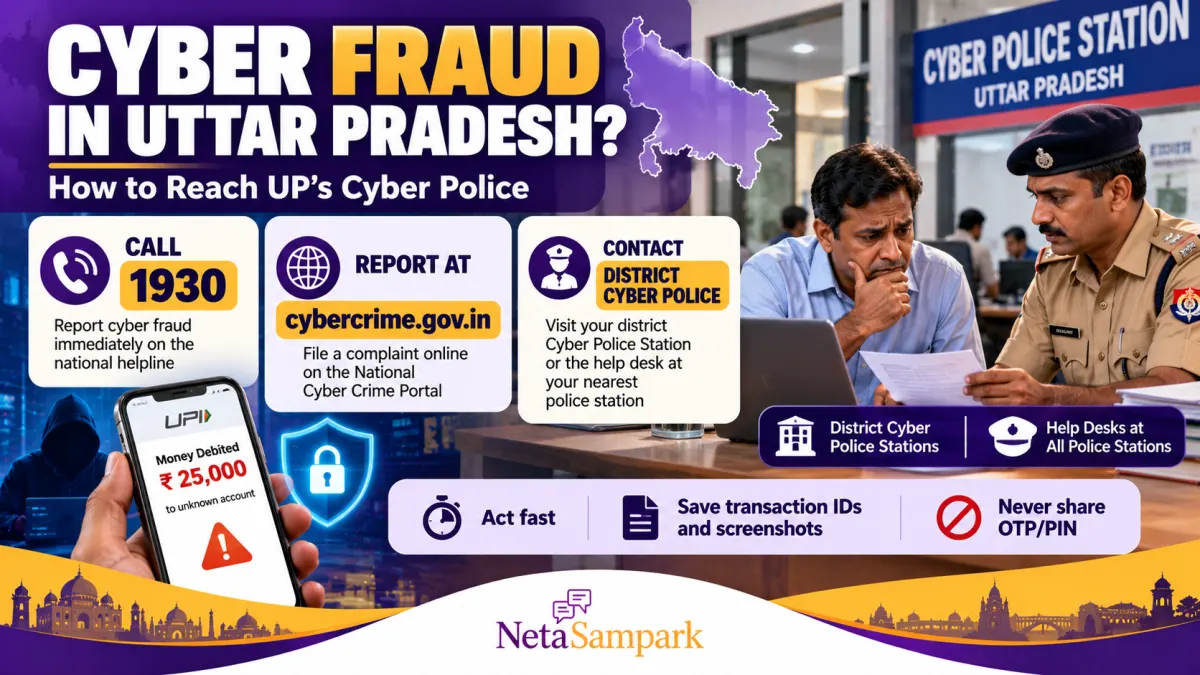
If you are a victim of cyber fraud in Uttar Pradesh, act quickly: call 1930, report the incident through cybercrime.gov.in and preserve all transaction evidence. You can then contact your district cyber police station or approach your nearest police station for assistance.
Keep your complaint acknowledgement, use verified government contact details and be cautious of anyone promising guaranteed recovery. Prompt reporting and accurate evidence give the authorities the information they need to assess the case and take appropriate action.