
How to File an RTI Online in Madhya Pradesh: ₹10 Application Fee, ₹50 First Appeal and Free Filing for BPL Families
Want to know how much money was spent on a road in your village, why your pension application is pending, how a government contract was awarded or what action was taken on a public complaint? The Right to Information (RTI) Act, 2005 allows Indian citizens to request information held by public authorities.
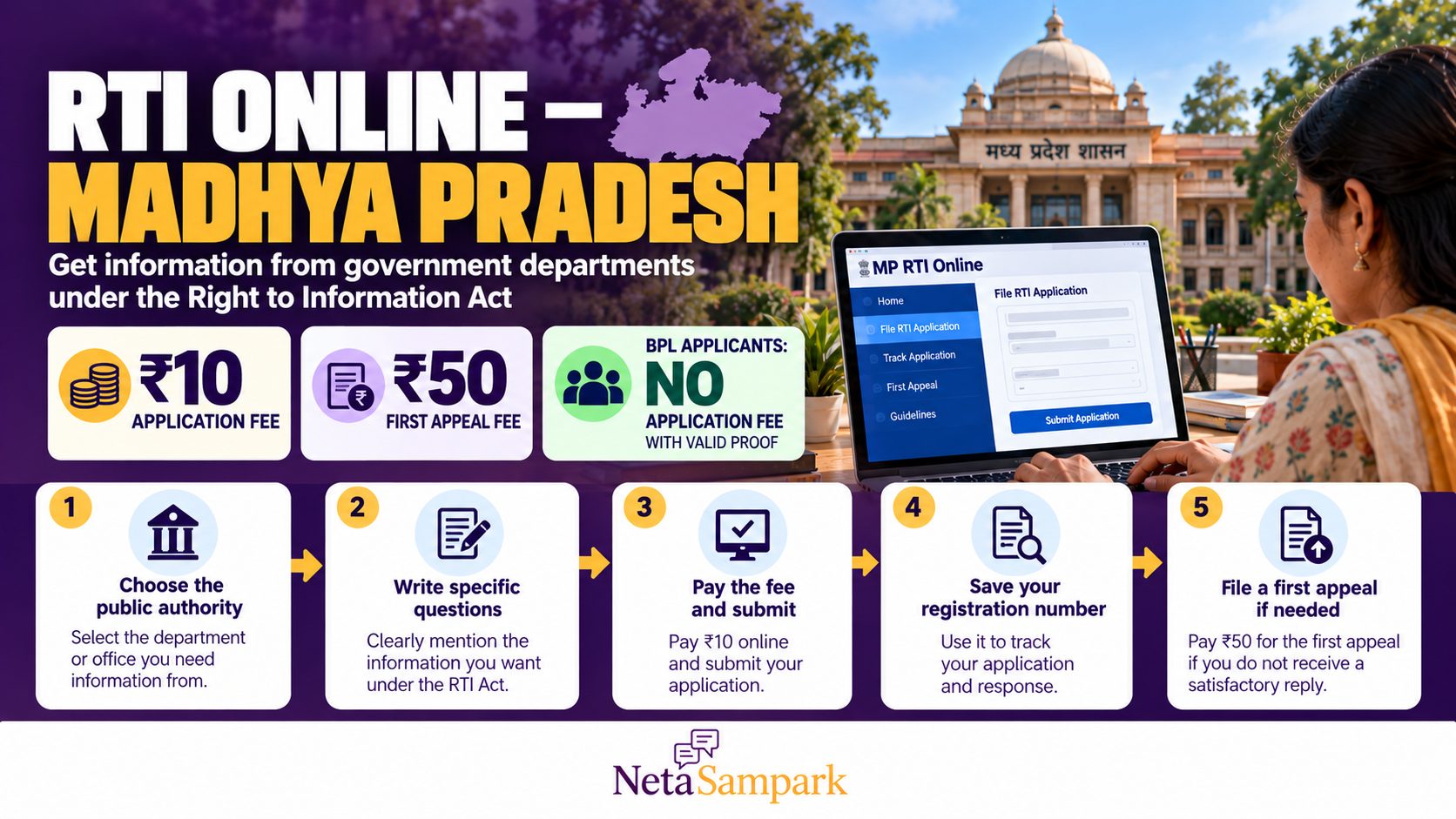
In Madhya Pradesh, the state’s Right to Information (Fees and Appeal) Rules, 2005 prescribe a ₹10 application fee and a ₹50 fee for a first appeal. Eligible applicants classified as Below Poverty Line (BPL) are exempt from the prescribed RTI fees, subject to the applicable requirements and proof.
This guide explains how to prepare an RTI application, where to submit it, what to ask for, how the fees work and what to do if the department does not respond.
1 Madhya Pradesh RTI: Important Details
| Particular | Details |
|---|---|
| Law | Right to Information Act, 2005 |
| State rules | Madhya Pradesh Right to Information (Fees and Appeal) Rules, 2005 |
| Application fee | ₹10 |
| First appeal fee | ₹50 under the Madhya Pradesh state rules |
| BPL applicants | Exempt from prescribed RTI fees, subject to applicable requirements |
| Normal response period | 30 days from receipt of the application by the relevant public authority |
| First appeal deadline | Generally 30 days from the relevant decision or expiry of the response period |
| Official state portal | Check the availability and instructions at rti.mp.gov.in |
The Madhya Pradesh rules specify the ₹10 application fee and ₹50 first appeal fee. Before making an online payment, confirm that the portal is an official, functioning Madhya Pradesh government service and that the selected department is covered by it.
You can read the Madhya Pradesh Right to Information (Fees and Appeal) Rules, 2005.
2 What Can You Ask for Under the RTI Act?
The RTI Act allows citizens to seek existing information held by, or under the control of, a public authority. This may include records, documents, orders, reports, circulars, contracts and other information covered by the Act.
For example, you can ask for:
- Copies of work orders and expenditure records for a government road.
- The current status of a pension or benefit application.
- Copies of official orders concerning a pending application.
- Details of funds allocated and expenditure recorded for a public project.
- Inspection reports or action-taken reports held by a department.
- Copies of eligibility criteria and selection lists, subject to applicable exemptions.
- Records showing action taken on a complaint submitted to a government office.
The Act also provides for inspection of certain records and taking notes or certified copies, subject to the applicable rules.
What should you avoid asking?
An RTI application is generally more effective when it asks for specific records or information rather than an explanation of someone's motives.
Instead of asking:
“Why has the officer deliberately delayed my pension?”
Ask:
“Please provide a copy of the action-taken report, the dates on which my pension application was processed at each stage, and copies of any deficiency notices issued against application number [number].”
The second request identifies information that may already exist in official records.
3 How to File an RTI Online in Madhya Pradesh
Start by checking the state portal at rti.mp.gov.in. Confirm that it provides a working application facility for the public authority you want to approach.
If the online facility is available for that authority, follow the instructions shown on the official portal.
Step 1: Identify the correct department
Decide which public authority holds the information.
Examples include:
- Gram Panchayat or district administration records.
- Municipal corporation or municipal council records.
- Revenue department records.
- Public works department records.
- Social welfare and pension records.
- State government department orders and expenditure records.
Choose the department or office most likely to hold the information. Selecting the wrong authority can delay the process.
Step 2: Prepare your RTI questions
Write a concise request identifying the information, period and relevant subject.
For example:
“Please provide certified copies of the work order, sanctioned estimate, expenditure statement and completion report for the road improvement work carried out in [locality] during financial year [year].”
Use numbered questions if you are seeking several related records. Include an application number, project name, location or date where available.
Step 3: Enter the applicant details
Fill in the details requested by the official application facility. Provide accurate contact information so that the authority can communicate its response or request any prescribed additional fee.
Only Indian citizens can exercise the right to information under the RTI Act.
Step 4: Pay the prescribed fee, if applicable
For a non-BPL applicant, the Madhya Pradesh rules prescribe an application fee of ₹10.
If the official online portal supports electronic payment, follow its payment instructions and save the transaction receipt.
If the online facility is unavailable for the relevant authority, check the department’s official instructions for an accepted alternative method of submitting the application and paying the fee.
Step 5: Submit the application and save the acknowledgement
After submission, save the application or registration number, payment receipt and a copy of the questions you submitted.
These records will help you follow up with the department or file a first appeal if necessary.
Important: Do not assume that a portal for the Central Government or another State automatically accepts RTI requests for Madhya Pradesh departments. Use the correct public authority and submission procedure.
4 What If the Online RTI Portal Does Not Work?
If the portal is unavailable or does not list the department you need, you can still explore the applicable offline procedure.
Under the Madhya Pradesh RTI rules, an application may be submitted to the relevant State Public Information Officer or State Assistant Public Information Officer using an accepted fee-payment method.
Before sending an application by post or visiting an office:
- Identify the public authority holding the information.
- Find the designated Public Information Officer (PIO) or Assistant Public Information Officer (APIO).
- Confirm the current fee-payment method accepted by that authority.
- Attach or provide the prescribed fee, unless you qualify for an exemption.
- Keep a copy of the application and proof of submission.
You can also consult the Madhya Pradesh Right to Information rules for the applicable state fee and appeal provisions.
5 RTI Fees in Madhya Pradesh: Application, Copies and Appeals
The initial application fee is not necessarily the only amount payable. Depending on the information requested, additional charges may apply under the relevant rules.
| Type of charge | General provision |
|---|---|
| RTI application | ₹10 |
| First appeal | ₹50 under the Madhya Pradesh state rules |
| Photocopies on A4/A3 paper | Generally ₹2 per page under the state rules |
| Inspection of records | The applicable rules prescribe charges for inspection beyond the first hour |
| BPL applicant | Exempt from prescribed RTI fees, subject to applicable requirements |
The authority should communicate any additional fee required to provide the information. Check the payment instructions and the applicable rules before paying.
Is the first appeal really ₹50?
Yes. Rule 7 of the Madhya Pradesh Right to Information (Fees and Appeal) Rules, 2005 prescribes a ₹50 fee for a first appeal.
This differs from the Central Government's RTI fee rules, under which a first appeal does not carry a fee. For an application to a Madhya Pradesh State public authority, check the Madhya Pradesh rules rather than assuming the central fee arrangement applies.
6 How Can BPL Families File an RTI Without Paying the Fee?
Citizens recognised as Below Poverty Line under the applicable Madhya Pradesh provisions are exempt from the prescribed RTI fees.
The state rules define BPL status by reference to recognition by the Government of Madhya Pradesh. Applicants should follow the authority’s instructions on the proof required.
What should a BPL applicant do?
- Prepare the RTI application with the same care as any other applicant.
- Identify yourself as eligible for the BPL fee exemption.
- Attach or present the prescribed proof of BPL status, as required by the submission method.
- Keep a copy of the proof and application.
- Save the acknowledgement or postal receipt.
Do not pay the standard application fee if you qualify for the exemption and have provided the required proof in accordance with the rules.
The exemption concerns prescribed RTI fees. If you receive a notice about an additional charge, check the applicable rules and the reason for the charge before making a payment.
7 How Long Does a Government Department Have to Reply?
Under Section 7(1) of the RTI Act, a public authority generally has 30 days from receipt of the application to provide a decision.
Different deadlines can apply in particular circumstances. For example, an application concerning a matter involving the life or liberty of a person is subject to a 48-hour response requirement under the Act.
If an application is submitted to an Assistant Public Information Officer, the statutory response period can include an additional five days under Section 5(2).
If the authority requires an additional fee for providing the information, it should notify the applicant. The period between sending the fee intimation and payment is treated in accordance with Section 7(3).
If the information is not provided within the applicable statutory period, or the authority does not respond, the applicant may have grounds to file a first appeal.
8 How to File a First Appeal if You Receive No Reply
A first appeal is available if you do not receive a decision within the prescribed period or are dissatisfied with the decision of the Public Information Officer.
Under the Madhya Pradesh rules, the first appeal fee is ₹50, subject to applicable exemptions.
Step-by-step process
- Keep a copy of your original RTI application.
- Note the date on which the authority received it.
- Save any response, rejection notice or fee communication.
- Identify the First Appellate Authority (FAA), which is senior in rank to the relevant PIO within the public authority.
- Prepare a memorandum of appeal explaining the delay, refusal or incomplete response.
- Submit the appeal within the applicable deadline and pay the prescribed fee, unless exempt.
- Keep the appeal acknowledgement and supporting documents.
The usual first-appeal deadline is 30 days from the expiry of the response period or from receipt of the relevant decision. The appellate authority may admit a delayed appeal if it is satisfied that there was sufficient cause.
Under the Madhya Pradesh rules, a first appeal is generally to be decided within 30 days, with an extension permitted up to a total of 45 days where the required reasons are recorded in writing.
9 What If the First Appeal Also Fails?
If you remain dissatisfied with the first appellate decision, or the First Appellate Authority does not decide the appeal within the applicable period, you may consider a second appeal to the Madhya Pradesh State Information Commission.
Section 19(3) of the RTI Act generally provides a 90-day period for filing a second appeal, calculated from the date the decision should have been made or was actually received, as applicable. The Commission may admit a delayed appeal if sufficient cause is shown.
A second appeal should explain the original request, the response or lack of response, the grounds of disagreement and the relief sought.
Keep these documents ready:
- Original RTI application.
- Proof of application submission and fee payment, if applicable.
- Reply from the PIO, if any.
- First appeal and acknowledgement.
- First appellate order, if any.
- Relevant supporting documents.
For the current procedure and contact details, consult the official Madhya Pradesh government and State Information Commission resources.
10 Sample RTI Application for a Madhya Pradesh Government Department
You can adapt this template to request records from a department, municipality or other public authority.
To: The State Public Information Officer
[Name of Department or Public Authority]
[District, Madhya Pradesh]
Subject: Application under the Right to Information Act, 2005
Sir/Madam,
Please provide the following information under the Right to Information Act, 2005, concerning [clearly identify the project, application, scheme or subject] for the period [start date] to [end date]:
- Please provide a copy of the relevant sanction order or administrative approval.
- Please provide copies of the applicable work order, estimate or official instruction.
- Please provide the expenditure recorded for the specified work or activity.
- Please provide copies of inspection reports and completion certificates, if available.
- Please provide the dates on which the relevant application or file was processed and copies of any recorded action-taken reports.
I request that the information be provided in the form permitted under the RTI Act. If any part of the request concerns information held by another public authority, please take the appropriate action under the Act.
I am enclosing or paying the prescribed application fee, unless exempt under the applicable BPL provisions.
Yours faithfully,
[Applicant's name]
[Postal address]
[Contact details, if provided]
[Date]
Tip: Keep the request focused on existing records. A clear request is easier for the PIO to identify, process and answer.
Frequently Asked Questions
What is the RTI application fee in Madhya Pradesh?
The prescribed application fee under the Madhya Pradesh Right to Information (Fees and Appeal) Rules, 2005 is ₹10 for applicants who are not exempt.
What is the first appeal fee in Madhya Pradesh?
The Madhya Pradesh state rules prescribe ₹50 for a first appeal. Check whether you qualify for an applicable fee exemption.
Can BPL families file an RTI for free?
Eligible BPL applicants are exempt from prescribed RTI fees under the applicable provisions. They should provide the required proof of BPL status.
How long does the department have to reply?
The usual statutory period is 30 days from receipt of the application, subject to the exceptions and other provisions in the RTI Act.
Can I ask for the status of my pension application?
Yes. You can request existing records relating to your application, including its processing dates, recorded status, deficiency notices and action taken.
Can I file an RTI if the online portal is unavailable?
Check the department’s official instructions and use an accepted alternative submission method, such as applying to the designated PIO or APIO.
What should I do if the department ignores my RTI?
If the applicable response period expires without a decision, you may file a first appeal with the designated First Appellate Authority. If the matter remains unresolved, a second appeal to the State Information Commission may be available.
Final Checklist Before Filing
- Identified the public authority holding the information.
- Written specific questions about existing records.
- Checked the official online facility or offline submission procedure.
- Paid the prescribed fee or supplied proof of BPL exemption.
- Saved the application and acknowledgement.
- Recorded the date for calculating the response deadline.
- Kept the documents needed for a possible first appeal.
Useful links
- Madhya Pradesh RTI portal
- Madhya Pradesh RTI (Fees and Appeal) Rules, 2005
- Right to Information Act, 2005 — official government reference
The RTI Act gives citizens a way to seek government-held information and scrutinise public decisions. Identify the correct department, ask for specific records, keep proof of submission and follow the statutory appeal process if the information is not provided.