
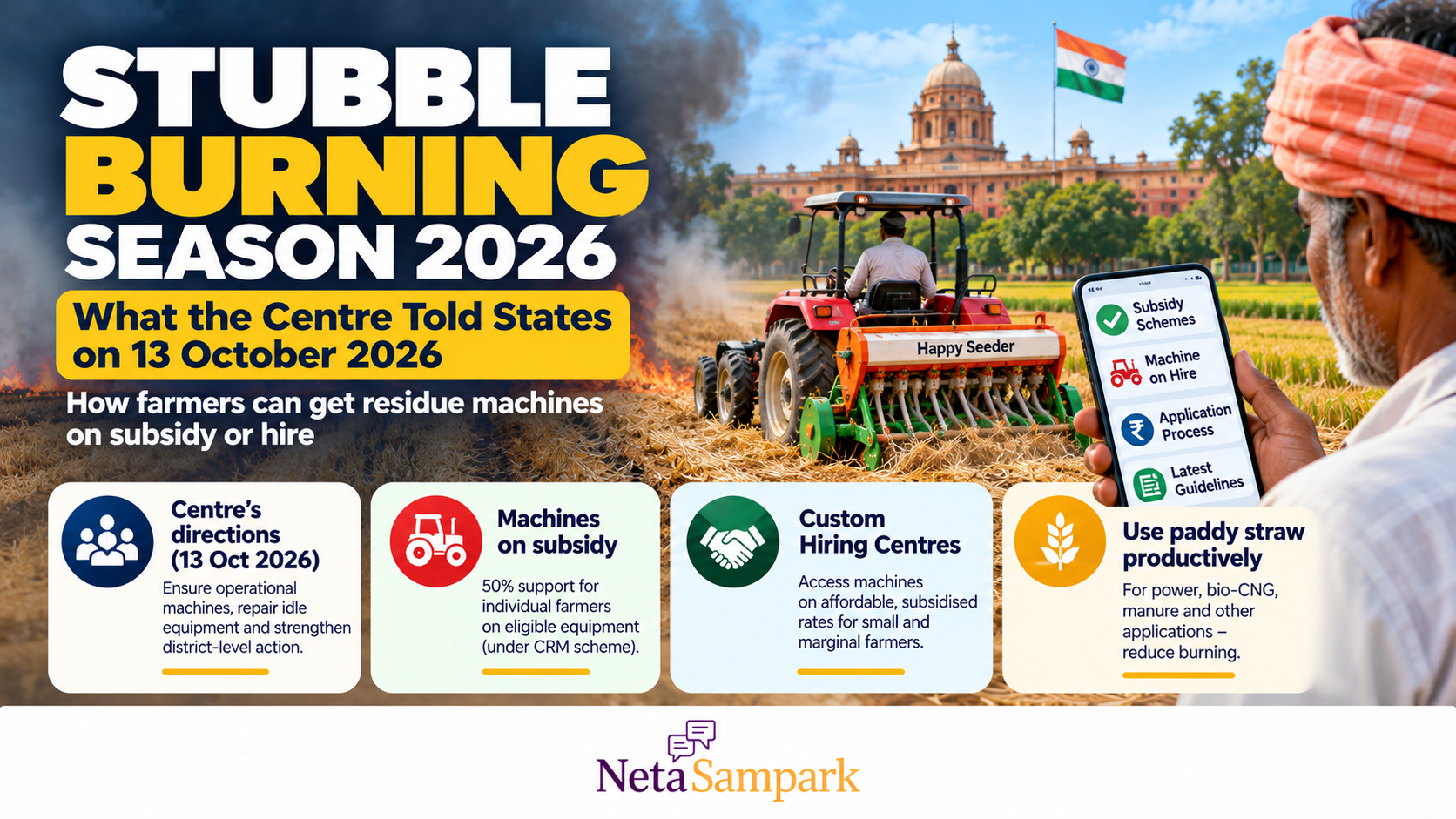
Stubble Burning Season 2026: What the Centre Told States on 13 October — and How Farmers Can Get Residue Machines on Subsidy or Hire
As paddy harvesting continues across northern India, the Centre has told States to intensify efforts to prevent stubble burning and make crop-residue management machinery available to farmers when they need it. In a review meeting on 13 October 2026, the Union Agriculture and Environment Ministers called for urgent field-level action, repairs to non-functional machines and better access to subsidised machinery through Custom Hiring Centres (CHCs).
For farmers, the message is practical: you may not need to purchase an expensive machine to manage paddy straw. Depending on your State, district, scheme eligibility and local availability, you may be able to obtain financial assistance to purchase equipment or hire machinery at an affordable rate.
Here is what changed in the Centre’s latest review, which machines can help, how the subsidy works and where to ask for assistance before the next crop is sown.
1 What Did the Centre Say on 13 October 2026?
The Ministry of Agriculture and Farmers Welfare reported that Union Agriculture Minister Shivraj Singh Chouhan and Union Environment Minister Bhupender Yadav co-chaired an inter-ministerial review meeting at Krishi Bhawan, New Delhi.
The meeting focused on implementing crop-residue management measures urgently during the ongoing paddy harvesting season.
According to the official Press Information Bureau release dated 13 October 2026, the key directions included:
Make existing machinery operational
The Centre emphasised that machines already distributed to farmers must be used effectively rather than left idle or out of order.
The Agriculture Minister said that more than 3.54 lakh crop-residue management machines had been provided to States, including 26,109 new machines during 2026–27 as reported at the meeting.
Authorities were asked to repair non-functional older equipment promptly and make it available for the harvesting season.
Activate Custom Hiring Centres
Custom Hiring Centres provide access to agricultural machinery for farmers who do not own the equipment themselves.
The Centre stressed that these centres should be operational and that small and marginal farmers should be able to access suitable machinery at affordable, subsidised rates.
Intensify district-level action
District collectors were asked to convene meetings, strengthen monitoring and implement practical solutions on the ground.
The emphasis was on coordinating agriculture departments, local administration and other stakeholders during the short period between paddy harvesting and the sowing of rabi crops.
Turn paddy straw into a resource
The meeting also called for plans to use crop residue for productive purposes, including electricity generation, bio-CNG, manure and other biomass applications.
The objective is to create alternatives to burning while supporting soil health and potential income opportunities for farmers.
What does this mean for farmers?
The Centre’s announcement is a push to improve the availability and use of machinery and existing support systems. It does not mean every farmer automatically qualifies for a new machine or that every district has an open subsidy application window.
Farmers should check the scheme and equipment availability in their own district.
2 Crop Residue Management Scheme 2026–27: How Much Support Is Available?
The Centre’s Crop Residue Management (CRM) scheme has supported machinery for managing paddy straw since 2018–19.
At a review meeting in June 2026, the Agriculture Ministry reported a provision of ₹544.15 crore for 2026–27 under the CRM scheme. The States’ plans included distributing more than 46,000 machines, establishing 910 Custom Hiring Centres and developing 141 stubble supply-chain projects.
These were announced targets for the year, not a guarantee that every district would receive the same number of machines or that applications would remain open throughout the season.
The general assistance structure reported by the government is:
| Type of support | Assistance reported under the scheme |
|---|---|
| Individual farmers purchasing eligible crop-residue machinery | 50% of the machine cost |
| Eligible organisations establishing Custom Hiring Centres | 80% of eligible project cost for projects costing up to ₹30 lakh, subject to scheme conditions |
| Eligible paddy-straw supply-chain projects | Separate assistance provisions apply under the relevant guidelines |
For Custom Hiring Centres, the 80% assistance provision is subject to a maximum permissible subsidy of ₹24 lakh per project for projects costing up to ₹30 lakh under the applicable CRM operational guidelines.
The final eligible amount, approved machinery, application process and availability depend on the current guidelines and the implementing State.
Official references:
Important: The CRM scheme’s implementation and eligibility differ by State. Farmers should confirm whether the particular machine and subsidy component are available in their jurisdiction before buying equipment or making a financial commitment.
3 Which Machines Can Help You Manage Paddy Straw?
The right machine depends on your soil, crop residue, tractor availability, sowing schedule and whether you intend to incorporate straw into the field or remove it for another use.
<PRIVATE_PERSON>Below are common crop-residue management options supported or referenced in government scheme materials.</PRIVATE_PERSON>
Happy Seeder
<PRIVATE_PERSON>The Happy Seeder allows wheat to be sown into fields containing paddy residue, reducing the need to burn or completely remove the straw first.</PRIVATE_PERSON>
It can be useful where farmers want to retain residue in the field while preparing for the next crop.
Super Seeder
A Super Seeder cuts and incorporates crop residue while sowing the next crop. It can help combine residue management and sowing operations, subject to suitable field conditions and machine specifications.
Smart Seeder and related seeders
Other residue-management seeders can help farmers establish the next crop in fields containing paddy straw. The appropriate machine depends on the crop, residue load and local agronomic recommendations.
Straw baler and rake
A baler collects straw into bales, while a rake helps gather residue for collection. This approach is useful when the straw is to be transported for biomass use, fodder where suitable, or other productive applications.
Straw Management System
A Super Straw Management System, commonly called a Super SMS, can help spread chopped straw more evenly behind a combine harvester, supporting subsequent field operations.
Not every machine is suitable for every field. Ask your local agriculture officer or Krishi Vigyan Kendra (KVK) which equipment is recommended for your conditions.
4 How to Get a Crop-Residue Machine on Subsidy
If you want to purchase your own machine, begin with your State Agriculture Department. Do not buy equipment first and assume that the subsidy will be reimbursed later.
Step 1: Contact your district agriculture office
Ask the district or block agriculture office whether crop-residue machinery subsidies are available under the current CRM or other applicable agricultural mechanisation programme.
Confirm:
- Whether your State and district are covered.
- Which machines are eligible.
- Whether applications are currently open.
- Whether applications are selected through a lottery or another approval process.
- What documents and farmer registration details are required.
- Whether there is an approved dealer or manufacturer list.
Step 2: Check the official machinery portal
The Department of Agriculture and Farmers Welfare operates the Direct Benefit Transfer in Agriculture Mechanization portal.
Visit:
The portal publishes scheme information, guidelines and application-related notices. However, a live application window or target allocation for one State does not mean the same facility is open in every State.
For example, the portal has published a specific September–October 2026 application window for a second SMAM lottery in Kerala. That is a Kerala-specific notice, not a nationwide deadline for CRM machinery.
Step 3: Complete the prescribed registration
If your State’s application facility is open, follow its instructions to register or log in, select the eligible machine and submit the requested details.
Depending on the scheme, you may need farmer registration details, identity information, land or cultivation records, bank details and other supporting documents.
Provide only the information required through the official channel.
Step 4: Wait for approval before purchasing
Follow the applicable selection and approval process. Some programmes use online lotteries, while others follow different allocation and verification procedures.
Check whether the scheme requires approval before purchase, whether the machine must come from an approved dealer and how the subsidy is calculated.
Step 5: Keep the purchase and verification records
Retain the invoice, payment proof, machine details and any inspection or verification documents required by the scheme.
Check the application status through the relevant portal or district agriculture office. Do not assume that an application submission alone guarantees subsidy approval.
5 How Small and Marginal Farmers Can Hire a Machine Instead
Buying a machine may not be economical for a farmer who needs it for only a few acres. Hiring equipment can avoid the purchase price and maintenance responsibilities.
The Centre specifically emphasised activating Custom Hiring Centres and making machinery accessible to small and marginal farmers at affordable, subsidised rates.
Where can you find a Custom Hiring Centre?
Start with these local sources:
- Block Agriculture Office: Ask for the nearest operational crop-residue machinery centre.
- District Agriculture Department: Request the current list of centres and equipment available in your district.
- Farmer Producer Organisation (FPO): Ask whether it operates a machinery bank or can arrange a shared service.
- Cooperative society or Panchayat: Check whether a local institution manages eligible agricultural equipment.
- Krishi Vigyan Kendra: Ask for advice on suitable machines and local service providers.
You can also consult the ICAR website for agricultural extension information and local initiatives.
What should you ask before booking?
Ask the centre:
- Which machine is available for your crop and field?
- What is the rental charge per acre, hour or other billing unit?
- Does the price include the tractor, operator, fuel and transport?
- When can the machine reach your field?
- Is the machine compatible with your field conditions?
- Will the operator help with setup and operation?
- What happens if the machine breaks down during the booked period?
Get the rental terms in writing or retain a message confirming the agreed charges and service.
Do not assume all Custom Hiring Centres provide machinery free of cost. Rental rates, subsidies and special arrangements for small or marginal farmers vary by State and centre.
6 Who Can Apply for Machinery Subsidies?
Eligibility depends on the particular scheme component.
Under the CRM framework, individual farmers may qualify for assistance to purchase approved crop-residue machinery. Eligible organisations and groups may qualify for support to establish Custom Hiring Centres.
The categories listed in the government’s CRM materials include:
- Individual farmers, for eligible machinery purchases.
- Rural entrepreneurs and eligible farmer entrepreneurs.
- Cooperative societies.
- Registered farmers’ societies.
- Farmer Producer Organisations (FPOs).
- Panchayats.
- Other eligible groups or institutions specified in the applicable guidelines.
The subsidy percentages and project limits are not interchangeable across these categories.
Before applying, confirm the current eligibility conditions, required ownership or registration documents, machine specifications and district allocation with the implementing authority.
7 What If Your Village Has Machines but None Are Working?
This is one of the issues highlighted in the Centre’s 13 October review.
If a machine is recorded as available but is not operational, ask the relevant agriculture officer or machinery centre to clarify whether it can be repaired or replaced and whether another centre can provide equipment in time.
You can:
- Contact the local Custom Hiring Centre or equipment owner.
- Ask the block agriculture office to identify another operational machine nearby.
- Report non-functional government-supported equipment to the district agriculture authority.
- Provide the location, machine type and details of the unavailability.
- Ask for an alternative before your sowing deadline.
Keep a record of your request and any response. The Centre’s directions emphasise repairing older machines and improving their actual use, but the announcement does not establish an automatic individual entitlement to a replacement machine.
8 Can Paddy Straw Be Sold Instead of Burned?
Yes, in suitable locations, paddy straw can be collected and supplied for productive uses rather than burned.
Potential uses include:
- Biomass-based electricity generation.
- Bio-CNG and other bioenergy applications.
- Pellet production.
- Industrial biomass applications.
- Other locally suitable agricultural or biomass uses.
Whether a farmer can sell straw depends on the local supply chain, buyer demand, straw quality, collection costs, storage and transport arrangements.
Before harvesting, ask local FPOs, biomass aggregators or the district agriculture office whether a buyer or collection programme operates in your area.
Check the price, quantity accepted, moisture requirements, loading arrangements and who pays transport costs. A collection arrangement that is viable in one district may not be available in another.
9 Why Is the Centre Urging Farmers to Avoid Stubble Burning?
Open burning of crop residue releases smoke and particulate pollution and can worsen air quality. It also exposes people nearby to smoke and can affect soil organisms and the soil environment.
Residue management can provide alternatives, but farmers need practical support: machinery that arrives on time, workable rental costs, suitable equipment and reliable arrangements for straw collection.
That is why the Centre’s latest directions focus not only on distributing new machines but also on repairing existing equipment and ensuring that machinery is actually accessible during the short window between harvesting and sowing.
The goal is to reduce burning without leaving farmers to solve a time-sensitive field-management problem on their own.
10 What Farmers Should Do Now: A Quick Checklist
- Contact the block or district agriculture office about operational residue-management machines.
- Ask for the nearest Custom Hiring Centre and its current rental charges.
- Check whether a machinery subsidy application is open in your State.
- Confirm the eligible machine and approval requirements before purchase.
- Ask about machine availability and booking dates before harvesting is complete.
- Check whether local FPOs or buyers collect straw for productive use.
- Report non-functional machinery to the relevant local authority.
- Keep application acknowledgements, invoices and booking confirmations.
Frequently Asked Questions
Has the Centre announced a new nationwide subsidy on 13 October 2026?
The 13 October announcement focused on urgent implementation, repair and use of existing machines, access through Custom Hiring Centres, and district-level action. It should not be interpreted as a new universal subsidy application window for every farmer across India.
How much subsidy can an individual farmer receive?
The CRM scheme has provided financial assistance at 50% of the cost of eligible machinery for individual farmers under the applicable scheme framework. The eligible amount and availability depend on the relevant State implementation, machine and current guidelines.
Can I hire a machine instead of buying one?
Yes. Custom Hiring Centres and other local machinery services may offer crop-residue equipment for hire. Availability and charges vary, so contact your block agriculture office or local centre before booking.
Are Custom Hiring Centres free for small farmers?
Not necessarily. The Centre has directed authorities to ensure affordable, subsidised access for small and marginal farmers. Actual rental charges and any special local provisions must be confirmed with the implementing authority.
Which States are covered by the crop-residue machinery programme?
The Centre’s CRM programme has historically focused on Punjab, Haryana, Uttar Pradesh and the National Capital Territory of Delhi, while government reporting also includes assistance and machinery initiatives involving Madhya Pradesh. Other agricultural mechanisation programmes may operate separately. Check the current rules for your State and district.
What should I do if a machine is broken or unavailable?
Contact the machinery centre and block agriculture office, explain the problem and ask for an alternative machine or service. The Centre’s 13 October directions specifically emphasised repairing non-functional older machinery and ensuring operational availability.
Official Sources and Useful Links
- PIB: Centre’s stubble-management review, 13 October 2026
- PIB: Crop-residue management targets and funding for 2026–27
- Agriculture Mechanization DBT portal
- Agriculture Mechanization application tracking
- Crop Residue Management operational guidelines
- Indian Council of Agricultural Research
The Bottom Line
The Centre’s 13 October 2026 message is that crop-residue machinery must be operational, accessible and used when farmers need it—not merely counted on paper.
If you are preparing to sow the next crop, contact your local agriculture office now. Ask whether you can hire a suitable machine, whether a subsidy application is open and whether straw collection services operate in your area.
Check availability before buying, confirm subsidy approval before spending and arrange machinery early enough to meet your sowing schedule.