
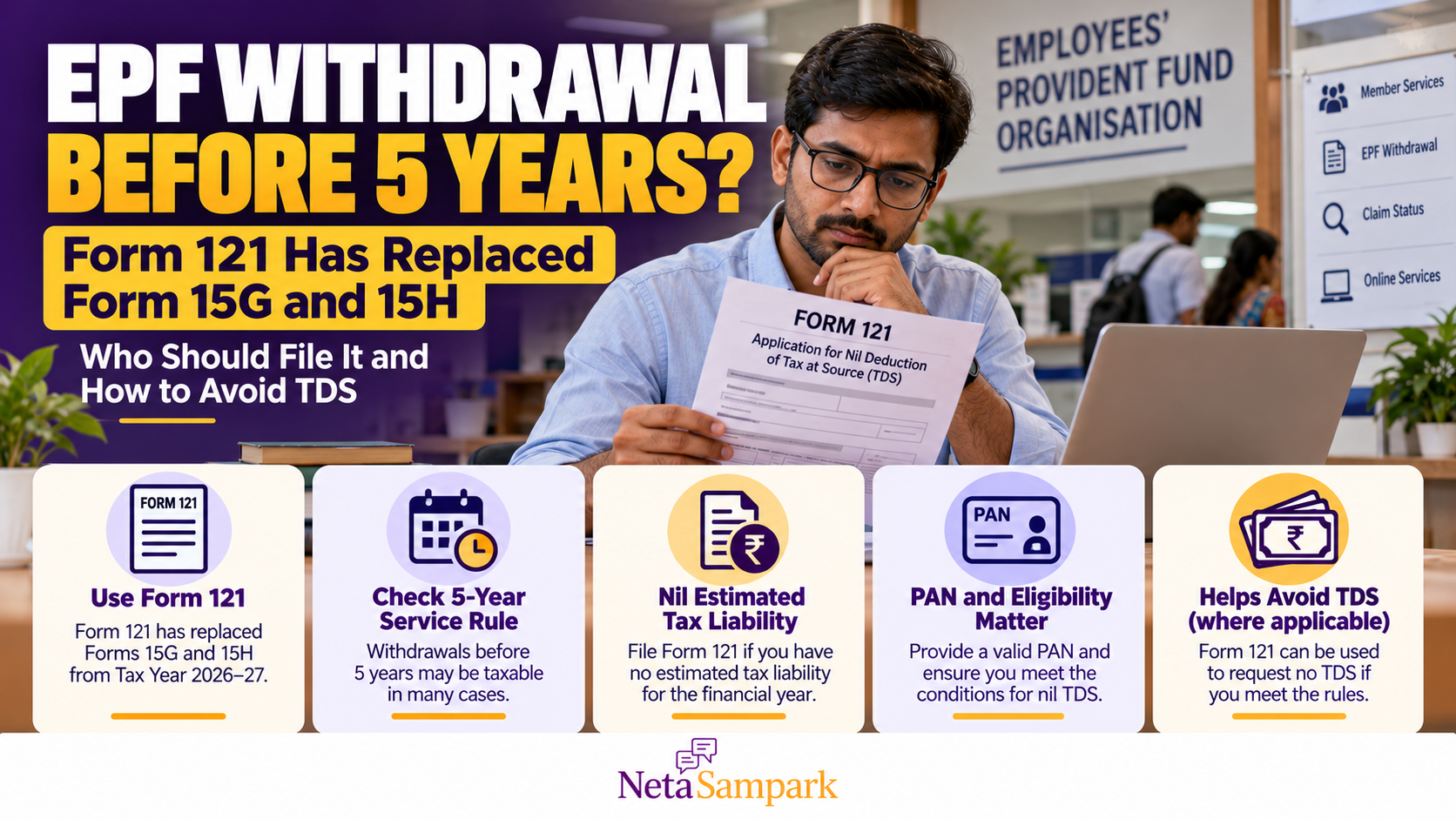
EPF Withdrawal Before 5 Years? Form 121 Replaces Form 15G and 15H — Who Should File It and How to Avoid TDS
Planning to withdraw your Employees’ Provident Fund (EPF) balance before completing five years of service? There is an important tax-form change to know about. From Tax Year 2026–27, Form 121 has replaced the earlier Forms 15G and 15H for eligible taxpayers seeking to receive specified payments without tax deducted at source (TDS).
The change matters to employees making an early PF withdrawal, particularly those whose estimated tax liability for the year is nil. However, Form 121 does not automatically make every PF withdrawal tax-free. You must meet the eligibility conditions, and the tax treatment of the withdrawal depends on your circumstances.
This guide explains who should file Form 121, when TDS may apply to an EPF withdrawal before five years, what happens if you do not submit the form and how to avoid common mistakes.
1 What Has Changed? Form 121 Replaces Forms 15G and 15H
Under the new Income-tax Act, 2025 and Income-tax Rules, 2026, Form 121 is the unified declaration used for specified payments where an eligible taxpayer seeks non-deduction of TDS because the tax on their estimated total income for the tax year is expected to be nil.
Previously, eligible taxpayers used Form 15G or Form 15H, depending on their circumstances.
The Income Tax Department has confirmed that Form 121 replaces both forms for tax years beginning on or after 1 April 2026.
| Particular | Earlier system | New system from Tax Year 2026–27 |
|---|---|---|
| Declaration form | Form 15G or Form 15H | Form 121 |
| Governing legislation | Income-tax Act, 1961 | Income-tax Act, 2025 |
| Relevant provision | Section 197A | Section 393(6) |
| Relevant rules | Income-tax Rules, 1962 | Income-tax Rules, 2026 |
| Age-based form distinction | Separate Forms 15G and 15H | One unified Form 121 |
Form 121 covers several specified types of income, including payments of accumulated balances from recognised provident funds, subject to the applicable conditions.
Official confirmation: Income Tax Department — Form 121.
2 When Can TDS Apply to an EPF Withdrawal Before Five Years?
The five-year rule is important, but it does not mean that every early withdrawal automatically attracts TDS.
Under the established EPF tax framework, TDS can apply when an employee withdraws an eligible taxable accumulated PF balance before completing five years of continuous service and the withdrawal meets the applicable threshold.
The established threshold for TDS on an early EPF withdrawal is ₹50,000. Withdrawals below this threshold are generally not subject to TDS under the relevant provision, although the underlying income-tax treatment must still be considered.
The general framework is:
| Situation | General TDS treatment |
|---|---|
| Withdrawal after five years of continuous service | Generally no TDS on the EPF withdrawal |
| Eligible early withdrawal below ₹50,000 | Generally no TDS under the withdrawal threshold |
| Early withdrawal of ₹50,000 or more, with PAN and no valid nil-deduction declaration | TDS may apply at the prescribed rate |
| Eligible early withdrawal with PAN and a valid Form 121 | TDS may be avoided if all declaration conditions are met |
| Withdrawal without PAN where TDS applies | A higher rate may apply under the applicable provisions |
| Qualifying exceptional circumstances under the EPF tax rules | TDS may not apply, depending on the facts |
The threshold concerns TDS; it is not a blanket exemption from income tax.
For current filing decisions, confirm the applicable provisions under the Income-tax Act, 2025 and Income-tax Rules, 2026 rather than relying solely on older EPFO guidance referring to Forms 15G and 15H.
3 Who Should File Form 121?
Form 121 is intended for eligible taxpayers whose estimated tax liability on their total income for the relevant tax year is nil.
For EPF withdrawal purposes, the declaration is not simply a statement that you have no salary or that you have left your job. You must consider your estimated total income for the entire tax year and the applicable tax rules.
You may consider Form 121 if:
- You are an eligible resident taxpayer.
- You are making a payment covered by Form 121, such as an eligible recognised provident fund withdrawal.
- Your estimated tax liability for the relevant tax year is nil.
- You satisfy the conditions prescribed for submitting the declaration.
- You provide the required PAN and other information accurately.
The Income Tax Department's guidance states that eligible resident individuals, Hindu Undivided Families (HUFs) and certain other specified persons may use the form, subject to the prescribed conditions. Companies and firms are not eligible, and non-residents cannot use Form 121.
What if you are below 60 years of age?
You no longer need to choose between Form 15G and Form 15H. Form 121 is the unified form for eligible taxpayers of different ages.
However, being below 60 years does not by itself make you eligible. Your estimated tax liability and the other prescribed conditions determine whether you can submit the declaration.
What if you are 60 years or older?
The same unified Form 121 applies to eligible taxpayers aged 60 and above. The previous age-based distinction between Form 15G and Form 15H has been removed for the new tax-year framework.
Official guidance: Income Tax Department — Form 121 FAQs and user manual.
4 How to File Form 121 for an EPF Withdrawal
The Income Tax Department's published online manual primarily explains how the payer or deductor files the declaration received from the taxpayer. This is an important distinction: Form 121 is a declaration furnished by the recipient to the payer, and the payer has its own reporting obligations.
For an EPF withdrawal, confirm the submission method accepted by EPFO or the relevant authorised payer before filing your withdrawal claim.
Step 1: Check your estimated tax liability
Estimate your total income for the relevant tax year, including salary, interest, other income and the proposed PF withdrawal where applicable.
Do not assess eligibility using only your monthly salary or the amount of tax deducted by your employer. If you are unsure how the withdrawal affects your taxable income, consult a qualified tax professional.
Step 2: Keep your PAN and EPF details ready
Check that your PAN details are correct and consistent with your EPF records.
Keep your Universal Account Number (UAN), member details and withdrawal-related documents ready for the relevant claim process.
Step 3: Confirm how EPFO accepts Form 121
Check the latest instructions on the official EPFO website or the relevant member portal.
Do not assume that submitting a form through the Income Tax Department's portal automatically attaches it to your EPF withdrawal claim. The taxpayer's declaration and the payer's reporting process are separate steps.
Step 4: Submit the declaration through the prescribed route
Provide the declaration to the relevant payer in the manner it accepts. Make sure the tax year, PAN and other particulars are correct.
A declaration should be submitted in time, ideally before the payment is made or credited, so that the payer can consider it before deducting tax.
Step 5: Retain proof of submission
Save the acknowledgement, declaration details and any reference number provided.
If TDS is deducted despite your submission, these records can help you establish what was submitted and when.
Step 6: Check the status of your EPF claim
Use the official EPFO member services to check your claim status. If the withdrawal is processed with TDS, review the relevant tax records and determine whether the deduction is correct.
Official resources:
5 What Happens If You Do Not Submit Form 121?
If TDS is applicable and you do not submit a valid declaration, the payer may deduct tax at the prescribed rate.
For an eligible early EPF withdrawal under the established framework, the commonly applicable TDS rate is 10% where the required PAN is furnished. A higher rate may apply where PAN requirements are not met.
For example, suppose an eligible taxable early withdrawal is ₹2,00,000 and TDS is deducted at 10%. The deduction would be ₹20,000, leaving ₹1,80,000 paid to you before any other applicable adjustments.
This is an illustration, not a prediction of the tax treatment of every withdrawal. The actual deduction depends on the applicable rules, the payment and your circumstances.
Does Form 121 guarantee that no tax will be payable?
No. Form 121 is a declaration for non-deduction of TDS where the eligibility conditions are met. It is not a general tax exemption.
If your estimated tax liability is not nil, you should not submit the declaration merely to avoid an immediate deduction. Tax that is due may still need to be paid through the applicable tax-return or payment process.
6 How the Five-Year Rule Works
The five-year test generally concerns continuous service, not simply the time you have spent at your most recent employer.
If you change jobs and transfer your accumulated EPF balance to your new employer's PF account, eligible previous service can count towards the continuous-service period.
This is why employees should check their complete EPF service history before deciding whether a withdrawal is an early withdrawal.
Example 1: You have worked for three years
You leave your job after three years and want to withdraw your accumulated PF balance. If the withdrawal meets the relevant TDS threshold and no exception applies, TDS may be deducted.
If your estimated tax liability is nil and you satisfy all the conditions, Form 121 may be relevant.
Example 2: You changed jobs after two years
You transferred your PF balance to your new employer and have completed another three years of qualifying service. Your total continuous service may reach five years.
Check the transfer and service records before treating the withdrawal as an early withdrawal.
Example 3: You have completed more than five years
If you have completed the required period of continuous service, the accumulated PF withdrawal is generally not subject to TDS under the early-withdrawal provision.
You should still verify that the withdrawal qualifies under the applicable rules.
7 When Can an Early EPF Withdrawal Be Exempt from TDS?
The applicable EPF tax framework recognises circumstances in which TDS may not apply even though the employee has not completed five years of continuous service.
These include certain cases involving:
- Transfer of the accumulated PF balance to another recognised provident fund.
- Termination of service because of ill health.
- Discontinuation or closure of the employer's business.
- Other circumstances beyond the employee's control covered by the applicable rules.
Whether an exception applies depends on the specific facts and legal conditions.
Do not assume that resignation, unemployment or a financial emergency automatically qualifies as an exception. Check the applicable EPF and income-tax provisions before submitting a claim.
8 What If TDS Has Already Been Deducted?
If TDS has already been deducted, first check whether the deduction was correct.
Review:
- Your period of continuous service.
- Whether the withdrawal met the relevant TDS threshold.
- Whether PAN details were provided correctly.
- Whether a valid Form 121 declaration was submitted in time.
- Whether an exception to TDS applies.
- The TDS information reported against your PAN.
If excess tax was deducted, you may be able to claim a refund through the applicable income-tax return process, subject to the law and your actual tax liability.
A refund is not automatic merely because TDS was deducted. It depends on the tax ultimately payable and the relevant filing requirements.
9 Common Mistakes to Avoid
Filing an old Form 15G or Form 15H
For Tax Year 2026–27 onwards, Form 121 is the prescribed replacement for eligible declarations under the new tax framework. Confirm the applicable form for the tax year in question.
Assuming every PF withdrawal is taxable
The five-year rule, withdrawal threshold, transfer history and applicable exceptions all matter. Check the specific facts before assuming TDS will be deducted.
Filing Form 121 when tax is payable
The form is intended for eligible taxpayers whose estimated tax liability is nil. Submitting an incorrect declaration can create compliance problems.
Ignoring previous employment
Eligible transferred service can count towards continuous service. Check your EPF records before deciding whether you have completed five years.
Assuming TDS is the final tax
TDS is a collection mechanism. The final tax treatment of the withdrawal may differ, and excess deductions may be recoverable through the prescribed process.
Frequently Asked Questions
Has Form 121 replaced Form 15G and Form 15H?
Yes. For tax years beginning on or after 1 April 2026, Form 121 replaces Forms 15G and 15H for eligible declarations under the new Income-tax Act and Rules.
Can I use Form 121 if I withdraw my PF after three years?
Potentially, if the payment is covered by the form and your estimated tax liability is nil, and you meet all other eligibility conditions. Your service period and the applicable TDS rules must also be considered.
Is Form 121 compulsory for every EPF withdrawal?
No. It is not mandatory for every withdrawal. It is relevant to eligible taxpayers seeking non-deduction of TDS on specified payments.
Can a senior citizen use Form 121?
Yes. Eligible resident individuals aged 60 or older can use the unified form, subject to the prescribed conditions.
Can a non-resident file Form 121?
No. The Income Tax Department's guidance states that non-residents are not eligible to furnish Form 121.
Will Form 121 make my PF withdrawal tax-free?
No. It concerns TDS and is available only when the prescribed conditions are satisfied. It does not automatically exempt the underlying income from tax.
Where can I check the official form instructions?
Use the Income Tax Department's Form 121 page and the Form 121 user manual. For the EPF claim process, check the official EPFO website.
Final Checklist Before Withdrawing Your EPF
- Check your total qualifying service, including eligible transferred service.
- Confirm whether the withdrawal is covered by the early-withdrawal TDS provisions.
- Check the relevant withdrawal threshold and any applicable exception.
- Estimate your total tax liability for the tax year.
- Confirm whether you qualify to submit Form 121.
- Verify your PAN and EPF details.
- Follow the submission process accepted by the relevant payer.
- Keep the declaration and withdrawal acknowledgement.
- Check the tax deduction and claim a refund if excess tax was deducted, where eligible.
The bottom line: Form 121 replaces Forms 15G and 15H for eligible declarations from Tax Year 2026–27. If you plan to withdraw your EPF before completing five years of continuous service, check the TDS rules, estimate your total tax liability and confirm your eligibility before submitting the form. The goal is to prevent an unnecessary deduction—not to avoid tax that is legally payable.