
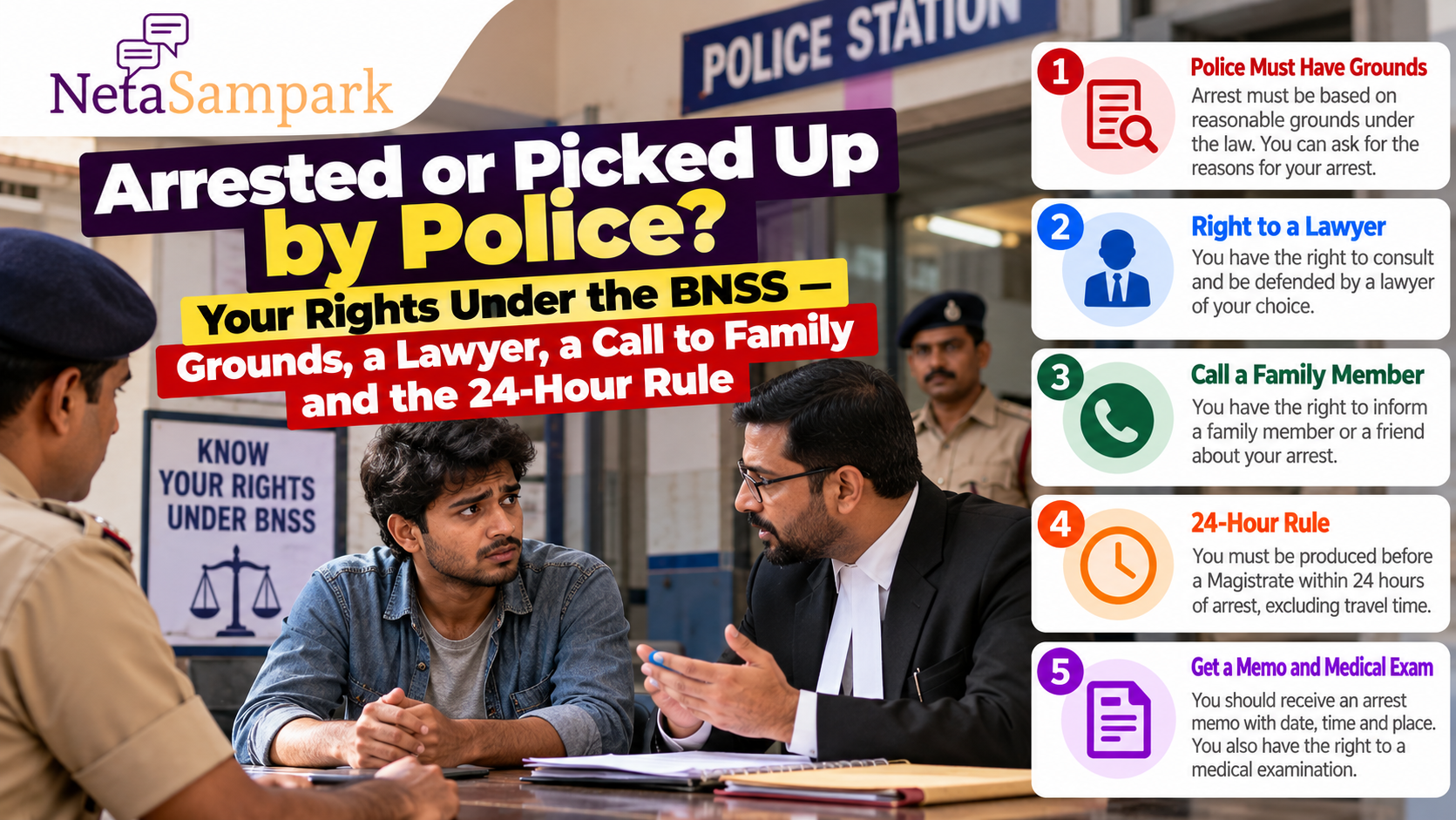
Arrested or Picked Up by Police? Your Rights Under the BNSS — Grounds, a Lawyer, a Call to Family and the 24-Hour Rule
Being taken to a police station can be frightening, especially when you do not know whether you are being questioned, detained or formally arrested.
India's criminal procedure is now governed by the Bharatiya Nagarik Suraksha Sanhita, 2023 (BNSS), which replaced the Code of Criminal Procedure (CrPC) from 1 July 2024. The BNSS sets out safeguards governing arrest, information about the grounds of arrest, access to a lawyer, informing a relative or friend, medical examination and production before a Magistrate. BPRD
There is also an important constitutional protection: Article 22 of the Constitution says an arrested person must be informed of the grounds of arrest, cannot be denied the right to consult and be defended by a legal practitioner of their choice, and generally must be produced before the nearest Magistrate within 24 hours of arrest, excluding the time necessary for the journey to the court. India Code
But the "24-hour rule" does not mean police can routinely keep someone at a station for 24 hours before deciding what to do. The law requires an arrested person to be taken before a Magistrate without unnecessary delay, and detention beyond the constitutional period requires judicial authority. India Code
First: "Picked Up" Does Not Always Mean "Arrested"
Police may ask a person to come to a police station for questioning or investigation without formally arresting them.
That distinction matters.
Under Section 35(3) of the BNSS, where arrest is not required, police are to issue a notice directing the person to appear before the police officer or at another specified place. If the person complies with the notice, they ordinarily should not be arrested for that offence unless the police officer records reasons for concluding that arrest is necessary. Sci API
In January 2026, the Supreme Court in Satender Kumar Antil v. CBI clarified that for offences punishable with imprisonment up to seven years, a Section 35(3) notice is the rule and arrest is an exception. The Court said arrest must be based on objective necessity, not simply because police want to ask questions. Sci API
So if someone says, "The police picked me up, but they haven't arrested me," the immediate question is:
Am I free to leave, or am I under arrest/detention?
If you are not free to leave, contact a lawyer or family member and establish your legal status as quickly as possible.
When Can Police Arrest Without a Warrant?
A police officer can arrest without a Magistrate's order or warrant in circumstances specified by Section 35 BNSS.
For a cognizable offence punishable with imprisonment of less than seven years or up to seven years, the law requires both:
- The officer has reason to believe, based on a complaint, information or suspicion, that the person committed the offence; and
- The officer is satisfied that arrest is necessary for one or more legally specified reasons.
These include preventing another offence, proper investigation, preventing destruction or tampering with evidence, preventing threats or inducements to witnesses, or ensuring the person's presence before court. The officer must record the reasons for the arrest in writing. Cytrain
For offences punishable with more than seven years or with death, Section 35 provides a different arrest threshold based on credible information and the officer's reason to believe the person committed the offence. Sci API
For non-cognizable offences, arrest generally requires a warrant or Magistrate's order, subject to the specific exceptions in the BNSS. Sci API
The important Supreme Court clarification
The Supreme Court's January 2026 ruling makes one principle particularly important:
Arrest is not supposed to be automatic merely because police have the power to arrest.
For offences punishable up to seven years, the Court said the police must consider whether arrest is actually necessary. A Section 35(3) notice is the rule; arrest is the exception. Sci API
1 You Have the Right to Know Why You Are Being Arrested
Section 47 BNSS requires the person arrested to be informed of the grounds of arrest and, where applicable, of the right to bail.
This is also a constitutional protection under Article 22(1). BPRD
You can calmly ask:
"What is the ground of my arrest and under which offence/sections am I being arrested?"
If you are being arrested in connection with a case, ask for the relevant FIR/case details and note the police station and investigating officer.
Do not physically resist the arrest. If you believe the arrest is unlawful, challenge it through your lawyer and the appropriate court.
2 You Have a Right to a Lawyer
Section 38 BNSS says an arrested person is entitled to meet an advocate of their choice during interrogation, although the lawyer does not have to be present throughout the entire interrogation. BPRD
Article 22(1) separately protects the right to consult and be defended by a legal practitioner of one's choice. India Code
If you cannot afford a lawyer, ask about free legal aid through the Legal Services Authorities.
Do not assume that asking for a lawyer means you are refusing to cooperate with the investigation. You can cooperate with lawful procedures while exercising your legal rights.
3 You Can Have a Relative or Friend Informed
Section 48 BNSS requires the police or other person making the arrest to inform a relative, friend or another person nominated by the arrested person about:
- The arrest; and
- The place where the arrested person is being held.
The arrested person must also be informed of this right when brought to the police station, and the police must make an entry recording who was informed. BPRD
So, if you are arrested, clearly nominate someone.
For example:
"Please inform my brother at this number that I have been arrested and tell him which police station I am being held at."
If you have a lawyer, give the police the lawyer's contact details as well.
4 Ask for the Arrest Memo
The arrest procedure under Section 36 BNSS requires the arresting officer to follow prescribed safeguards, including proper identification and preparation of a memorandum of arrest. BPRD
The arrest memo should establish important details such as:
- Identity of the arrested person
- Date of arrest
- Time of arrest
- Place of arrest
- Details/signature of the required witness
- Signature/countersignature as prescribed
Read it carefully before signing.
If something is incorrect, tell the officer and ask for the error to be corrected. Do not sign blank papers.
5 You Have a Right to a Medical Examination
Section 53 BNSS requires an arrested person to be examined by a government medical officer, or if unavailable, a registered medical practitioner, soon after arrest. Indian Kanoon
The medical examination should record:
- Injuries
- Marks of violence
- Approximate timing of injuries
A copy of the medical examination report must be furnished to the arrested person or the person nominated by them. JurisQuest.com
If you have an injury, pain or other medical problem, tell the doctor and make sure it is recorded.
This is particularly important if you allege that you were assaulted or injured before or during custody.
6 Police Must Take Reasonable Care of Your Health and Safety
Section 56 BNSS places a duty on the person having custody of an accused to take reasonable care of the person's health and safety. India Code
If you need:
- Regular medication
- Emergency medical treatment
- Treatment for an injury
- Mental-health medication
- Other urgent medical care
tell the police and your lawyer immediately.
A family member should also be informed about important medical requirements.
7 The 24-Hour Rule: What It Actually Means
This is one of the most important protections.
Article 22(2) of the Constitution says an arrested and detained person must be produced before the nearest Magistrate within 24 hours of arrest, excluding the time necessary for the journey from the place of arrest to the Magistrate's court. The person cannot be detained beyond that period without the authority of a Magistrate. India Code
The BNSS reinforces this through Sections 57 and 58.
Section 57 requires a police officer making an arrest without warrant to take or send the arrested person without unnecessary delay before the Magistrate having jurisdiction, subject to the bail provisions. Section 58 deals with detention beyond 24 hours. India Code
Example
Suppose someone is arrested at 4 PM on Monday.
The constitutional 24-hour period generally runs from the time of arrest, subject to the exclusion for necessary travel time to the Magistrate.
Police cannot simply say:
"We will produce you tomorrow evening."
If continued custody is required, the person must be brought before a Magistrate and the Magistrate must deal with the request for further detention according to law.
What Happens at the Magistrate?
Production before a Magistrate is not merely a formality.
The court can consider matters including:
- Whether the arrest and detention comply with law
- Whether further custody is sought
- Whether police custody or judicial custody is requested
- Whether bail is available or appropriate
- Whether the accused alleges ill-treatment
- Whether legal representation is available
If you were assaulted, threatened or denied basic safeguards, tell your lawyer and the Magistrate.
The Supreme Court has emphasised that Sections 57, 58 and 187 BNSS must be read together with Article 22(2), and that the requirement is production before the competent Magistrate within the constitutional period. Sci API
Can Police Keep You in Custody After 24 Hours?
Yes, but not merely because police want more time.
If investigation cannot be completed within the initial period, the law provides a judicial-remand mechanism under Section 187 BNSS.
The Magistrate decides whether further detention is authorised and under what form of custody, subject to the statutory limits and conditions.
The key distinction is:
Police custody without judicial authority is not a substitute for Magistrate-authorised detention.
What If Police Say "You Are Only Being Questioned"?
That can matter.
A person may be questioned during an investigation without being formally arrested. But if the person's liberty is actually being restrained, the legal position needs to be established.
Ask calmly:
"Am I under arrest?"
and:
"If not, am I free to leave?"
If the answer is unclear or you are not allowed to leave, contact a lawyer or trusted person immediately.
Do not physically resist police officers.
Women Have Additional Arrest Safeguards
The BNSS contains specific provisions concerning the arrest of women.
Under Section 43(5), ordinarily no woman shall be arrested after sunset and before sunrise. In exceptional circumstances, a woman police officer may make such an arrest after obtaining the prior permission of the Magistrate having jurisdiction over the place where the offence was committed or the arrest is to be made. BPRD
There are also specific safeguards concerning the manner of arrest and medical examination of women.
What Should You Do If Police Come to Your Home?
Stay calm.
You can ask:
- Who are you?
- Which police station are you from?
- Why are you here?
- Is there an FIR or case number?
- Am I being arrested or asked to appear?
- If I am being arrested, what are the grounds?
- Where will I be taken?
- Can I inform my family and lawyer?
If an arrest warrant or other court document is being executed, ask to see it where applicable.
However, remember that not every arrest requires a warrant. Section 35 BNSS specifically permits police to arrest without a warrant in the circumstances laid down by law. Sci API
Do Not Confuse a Notice With an Arrest
A Section 35(3) notice is not the same thing as an arrest.
If you receive such a notice:
- Read it carefully.
- Note the date and place of appearance.
- Attend as directed.
- Carry identification.
- Speak to a lawyer if the matter is serious.
- Keep a copy of the notice.
- Do not ignore it.
The Supreme Court has specifically held that where a person complies with a Section 35(3) notice, arrest is not supposed to become routine. If arrest later becomes necessary, the officer must record specific reasons. Sci API
What If the Police Arrest You Without Following These Safeguards?
Do not try to "win" the argument at the police station.
Instead:
1. Contact a lawyer
Give the lawyer:
- Police station name
- Officer's name
- FIR/case number, if known
- Sections invoked
- Time and place of arrest
- Arrest memo details
- Medical examination details
2. Inform your family
Make sure someone knows exactly where you are being held.
3. Preserve documents
Keep copies or photographs, where lawfully possible, of:
- Notice
- Arrest memo
- FIR
- Bail documents
- Medical report
- Court/remand order
4. Tell the Magistrate
If there was unlawful detention, assault, coercion or denial of legal safeguards, inform the Magistrate during production.
5. Use the appropriate court remedy
Depending on the circumstances, a lawyer may advise seeking bail, challenging the arrest, seeking appropriate directions, or pursuing other remedies.
If You Cannot Afford a Lawyer
Do not assume that being unable to pay means you must face the criminal process alone.
India's legal-aid system provides assistance to eligible persons through the National Legal Services Authority (NALSA) and State/District Legal Services Authorities.
At the police station or before the Magistrate, ask about legal aid if you cannot afford private representation.
What You Should NOT Do
If police arrest or detain you:
Do not:
- Physically fight or resist.
- Threaten the police.
- Sign blank papers.
- Destroy or hide evidence.
- Delete messages or files.
- Give false information.
- Guess answers to questions you do not understand.
- Share your lawyer's advice with other suspects unnecessarily.
- Ignore a lawful notice.
Instead, stay calm, ask for the grounds, contact your lawyer/family, preserve records and use the court process.
Quick Arrest-Rights Checklist
If you or a family member is arrested, remember:
- Grounds: Ask why you are being arrested.
- Lawyer: Ask to consult your lawyer.
- Family: Nominate a relative/friend to be informed.
- Arrest memo: Check the date, time and place.
- Medical exam: Ensure injuries are recorded.
- 24 hours: Track the time of arrest and Magistrate production.
- Bail: Ask your lawyer whether the offence is bailable and what remedy is available.
- Magistrate: Tell the court about unlawful detention, assault or denial of safeguards.
- Records: Keep copies of every important document.
One More Important Point: Arrest Does Not Mean Guilt
Being arrested is not the same as being convicted.
The criminal justice process distinguishes an allegation, investigation, arrest, prosecution, trial and conviction.
The presumption of innocence and the right to legal representation remain fundamental protections.
The Supreme Court's January 2026 decision also stressed that arrest is a discretionary investigative power and should not be treated as automatic. For offences punishable up to seven years, a Section 35(3) notice is the rule and arrest is the exception, with arrest requiring the statutory conditions and necessity safeguards. Sci API
Bottom Line
If the police take you to a station, stay calm and establish your legal status.
If you are formally arrested, remember the core protections:
Know the grounds → contact a lawyer → have a relative/friend informed → check the arrest memo → get a medical examination → track the 24-hour Magistrate-production deadline.
And if the allegation carries punishment of up to seven years, remember the important January 2026 Supreme Court clarification: a Section 35(3) notice is the rule, while arrest is an exception that must be objectively necessary and legally justified. Sci API
If this is happening right now, prioritise contacting a criminal lawyer or legal-aid service and informing a trusted family member. This article is general legal information, not a substitute for advice on the specific facts of an arrest.