
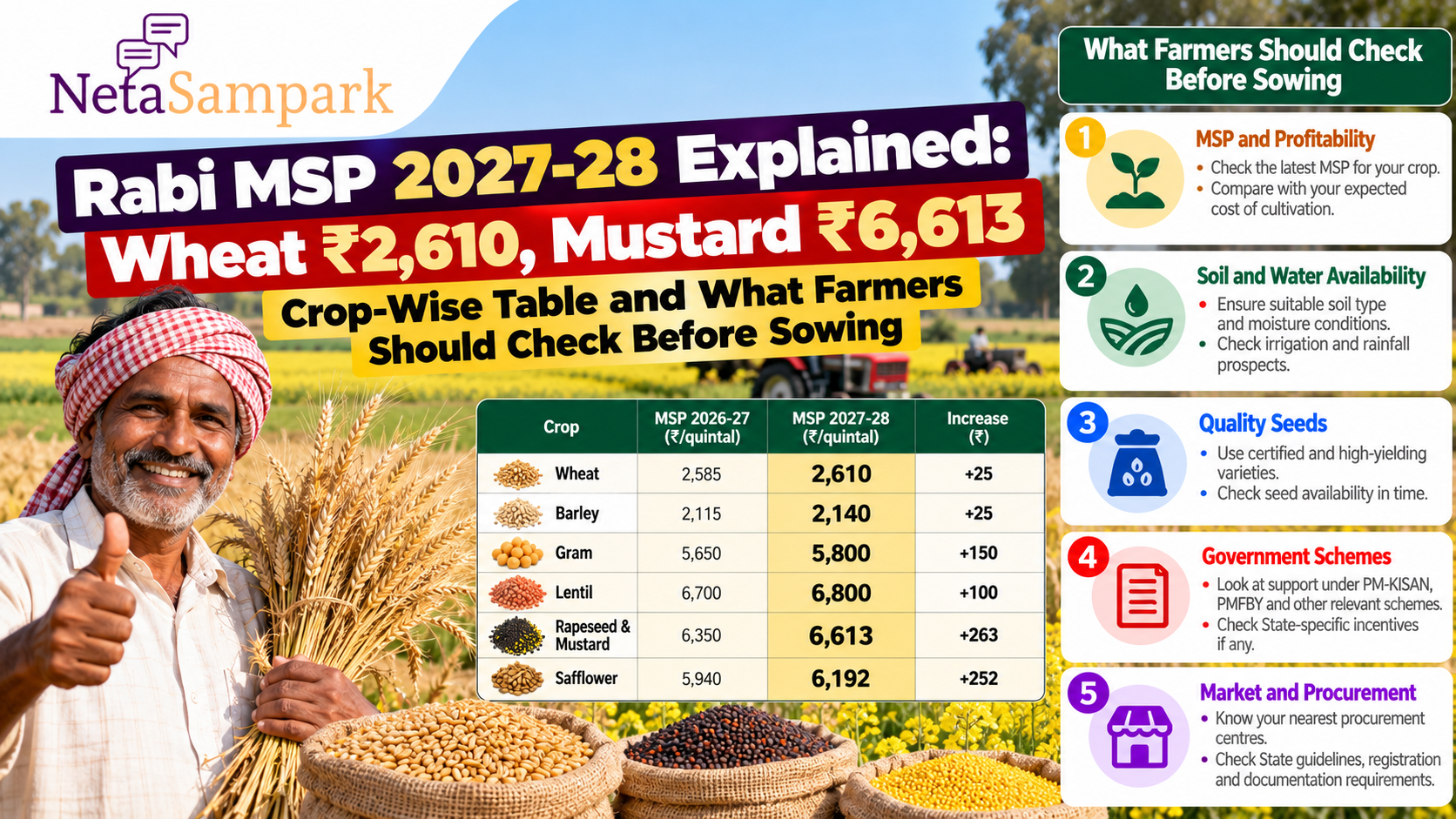
Rabi MSP 2027-28 Explained: Wheat ₹2,610, Mustard ₹6,613 — Crop-Wise Table and What Farmers Should Check Before Sowing
The Union government has approved the Minimum Support Prices (MSP) for six mandated Rabi crops for Marketing Season 2027-28.
The biggest increases are for safflower, rapeseed & mustard and lentil, while wheat gets a ₹25-per-quintal increase. The new MSPs apply to the 2027-28 Rabi Marketing Season, so farmers planning their Rabi crop should look at the MSP alongside local procurement arrangements, cultivation costs, water availability and expected market prices—not as the only factor in deciding what to sow. Press Information Bureau
Rabi MSP 2027-28: Crop-Wise Table
The Cabinet Committee on Economic Affairs approved the following MSPs on 30 September 2026:
| Rabi crop | MSP 2026-27 | MSP 2027-28 | Increase |
|---|---|---|---|
| Wheat | ₹2,585 | ₹2,610 | ₹25 |
| Barley | ₹2,150 | ₹2,286 | ₹136 |
| Gram (Chana) | ₹5,875 | ₹5,958 | ₹83 |
| Lentil (Masur) | ₹7,000 | ₹7,390 | ₹390 |
| Rapeseed & Mustard | ₹6,200 | ₹6,613 | ₹413 |
| Safflower | ₹6,540 | ₹7,215 | ₹675 |
All figures are ₹ per quintal. Press Information Bureau
Which crop got the biggest increase?
Safflower received the largest absolute increase: ₹675 per quintal, taking its MSP to ₹7,215.
It is followed by:
- Rapeseed & mustard: +₹413
- Lentil: +₹390
- Barley: +₹136
- Gram: +₹83
- Wheat: +₹25
So while wheat remains one of the most important Rabi crops, the percentage increase in its MSP is relatively modest compared with oilseeds and pulses. Press Information Bureau
What Does ₹2,610 MSP for Wheat Actually Mean?
The new wheat MSP is ₹2,610 per quintal, compared with ₹2,585 for the previous marketing season.
That is an increase of ₹25 per quintal, or ₹250 for every 10 quintals.
For example, at the announced MSP:
- 10 quintals → ₹26,100
- 20 quintals → ₹52,200
- 50 quintals → ₹1,30,500
- 100 quintals → ₹2,61,000
These are simple calculations using the announced MSP. They are not a guarantee of the farmer's final net income, because actual earnings depend on quantity, quality, procurement eligibility, deductions where applicable, transport and other costs.
Mustard MSP Rises to ₹6,613
Rapeseed and mustard receive one of the largest increases.
The MSP rises from ₹6,200 to ₹6,613 per quintal, an increase of ₹413. Press Information Bureau
For a farmer selling 20 quintals at the MSP:
20 × ₹6,613 = ₹1,32,260
Again, this is the gross MSP value—not profit.
The farmer's actual return depends on the cost of cultivation and whether the produce qualifies for procurement under the applicable system.
Why the Government Gives MSPs Before the Rabi Season
MSP is intended to provide a price-support mechanism for notified crops.
The government says MSPs for the mandated crops are fixed on the recommendations of the Commission for Agricultural Costs and Prices (CACP) after considering inputs from State Governments and Central Ministries/Departments. Press Information Bureau
The government has also followed the policy announced in the 2018-19 Budget of keeping MSPs at least 1.5 times the all-India weighted average cost of production for mandated crops.
For 2027-28, the government's published cost and margin figures show:
| Crop | Government's 2027-28 cost figure | MSP | Margin over cost |
|---|---|---|---|
| Wheat | ₹1,264 | ₹2,610 | 106% |
| Barley | ₹1,447 | ₹2,286 | 58% |
| Gram | ₹3,751 | ₹5,958 | 59% |
| Lentil | ₹3,854 | ₹7,390 | 92% |
| Rapeseed & mustard | ₹3,367 | ₹6,613 | 96% |
| Safflower | ₹4,810 | ₹7,215 | 50% |
These are all-India weighted average cost figures used for MSP policy, not a statement of what every farmer in every district spends to grow a quintal. The government's cost calculation includes paid-out costs and the imputed value of family labour, among other components. Press Information Bureau
MSP Is Not the Same as a Guaranteed Sale at Your Village
This is one of the most important points for farmers.
An MSP announcement does not mean that every farmer can automatically take unlimited quantities of every crop to any government centre and receive MSP.
Procurement operates through designated agencies, notified procurement periods, applicable quality specifications and State-level arrangements.
The government says cereals and coarse cereals are procured through FCI and designated State agencies, while pulses and oilseeds are procured under the Price Support Scheme (PSS) of PM-AASHA, in consultation with the concerned State Government when the applicable conditions are met. Press Information Bureau
For Rabi crops, this distinction is particularly important for farmers growing mustard, gram, masur and safflower.
Wheat Procurement Works Differently From Mustard and Pulses
For wheat, government procurement is generally carried out through FCI and State agencies under the applicable procurement arrangements.
For pulses and oilseeds, the government uses the PM-AASHA framework, including the Price Support Scheme.
The government has said procurement of pulses, oilseeds and copra under PSS is undertaken when market prices fall below MSP, in consultation with the concerned State Government and subject to the scheme's conditions. Press Information Bureau
So before sowing a crop primarily because its MSP looks attractive, ask:
"Where will I actually sell it at MSP in my district?"
That question can be more useful than simply comparing the headline MSP numbers.
Check Whether Your State Has a Procurement Centre
Before sowing, find out:
- Which agency will procure the crop?
- Where is the nearest procurement centre?
- Does your State require farmer registration?
- When will registration open?
- What documents are required?
- What is the procurement period?
- What quality specifications apply?
- Is there a limit or scheme-specific condition?
- How will payment be made?
The government says procurement centres are opened by State agencies based on production, marketable surplus, farmer convenience and logistics such as storage and transportation. Press Information Bureau
Don't wait until harvest to discover that the nearest notified procurement centre is far away or that pre-registration was required.
Mustard and Other Oilseeds: Check PM-AASHA Rules
Rapeseed and mustard are covered under the oilseeds component of PM-AASHA's Price Support Scheme.
The government says PSS procurement of notified oilseeds is undertaken through designated central nodal agencies in coordination with States, when the relevant market-price and scheme conditions are met. Press Information Bureau
Therefore, a mustard farmer should check the State's procurement notification for the relevant marketing season before assuming that the announced ₹6,613 MSP will automatically be available at every mandi.
What About the Market Price?
MSP should not be treated as the only price you can receive.
The government has stated that farmers are free to sell their produce in the open market if they obtain a better price than MSP. Press Information Bureau
For example, suppose a farmer has mustard that meets the relevant quality requirements and the market is offering ₹6,800 per quintal.
If that sale is genuine and practical, ₹6,800 is higher than the announced MSP of ₹6,613.
The farmer should compare:
Market price − transport − mandi/other applicable costs
against the net outcome from the government procurement route.
Don't Compare MSP Without Comparing Cultivation Cost
A crop with a higher MSP does not automatically mean a higher profit.
Before choosing between wheat, mustard, gram, masur or safflower, calculate your expected:
- Seed cost
- Fertiliser
- Pesticides
- Irrigation
- Diesel/electricity
- Machinery
- Hired labour
- Land rent, if applicable
- Harvesting and threshing
- Transport
- Interest on working capital
- Family labour
- Expected yield
Then calculate:
Expected gross return = expected yield × expected selling price
and:
Estimated net return = gross return − total cultivation and marketing costs
The MSP table gives you an important price reference, but it does not replace a farm-level cost calculation.
Check Water Availability Before Choosing the Crop
Rabi crop selection should also depend on your water situation.
Before sowing, check:
- Soil moisture after the Kharif crop
- Irrigation availability
- Number of assured irrigations
- Groundwater availability
- Expected winter rainfall
- Local weather outlook
- Crop duration
- Water requirement of the selected variety
A crop with a higher MSP can still be a poor choice if the farm cannot reliably support the crop through its critical growth stages.
Check Your Seed Before Sowing
Do not select seed simply because the crop has a high MSP.
Check:
- Whether the seed is certified/quality-assured
- Variety suitability for your area
- Recommended sowing period
- Disease resistance
- Expected duration
- Local availability
- Seed treatment requirements
- Recommended seed rate
Buy seed from an authorised source and preserve the bill or receipt.
Check the Procurement Quality Requirements
Government procurement is generally subject to prescribed quality specifications.
For wheat and other foodgrains, produce offered within the stipulated procurement period and meeting the applicable specifications can be purchased at MSP under the relevant procurement arrangements. Press Information Bureau
For pulses and oilseeds under PM-AASHA, Fair Average Quality (FAQ) requirements also matter. Press Information Bureau
Farmers should therefore ask the local procurement centre or State agriculture/marketing department about:
- Moisture limits
- Foreign matter
- Damaged grains
- Shrivelled grains
- Admixture
- Cleanliness
- Other crop-specific quality conditions
Don't discover quality requirements only after bringing a truckload of produce to the procurement centre.
Keep Your Farmer and Bank Records Ready
Depending on the State and procurement mechanism, farmers may need registration and supporting records.
Keep updated:
- Aadhaar
- Mobile number
- Bank account
- IFSC
- Land records
- Farmer registration details
- Cultivation/crop details where required
- Previous procurement records
- Mandi or procurement registration details
If your land record, bank account or mobile number has changed, correct it before the procurement season.
What If You Are a Tenant or Sharecropper?
Eligibility and registration requirements can differ depending on the procurement programme and State rules.
Do not assume that ownership of agricultural land is the only possible basis for participation—or that every procurement programme automatically accepts every tenancy arrangement.
If you cultivate leased or sharecropped land, check the State's current procurement notification for the particular crop and season.
Get the required cultivation/tenancy documentation in order before harvest.
What Farmers Should Check Before Sowing
A practical Rabi checklist:
1. Compare the MSP
Start with the official 2027-28 MSP:
- Wheat — ₹2,610
- Barley — ₹2,286
- Gram — ₹5,958
- Masur — ₹7,390
- Rapeseed & mustard — ₹6,613
- Safflower — ₹7,215 Press Information Bureau
2. Calculate your own cost
Don't use the government's all-India cost figure as your personal farm cost.
Calculate what your land, labour, irrigation and inputs are likely to cost.
3. Check local procurement
Find the nearest authorised procurement centre and the agency responsible.
4. Check registration
Some procurement arrangements require farmer registration before procurement. Find out the deadline.
5. Check quality standards
Know the acceptable moisture and quality specifications before harvesting.
6. Check the market
Compare MSP with local mandi prices and likely harvest-season prices.
7. Check schemes
Depending on the crop and State, also check whether you are eligible for schemes relating to:
- Crop insurance
- Input support
- Irrigation
- Farmer credit
- Seed distribution
- State-specific crop incentives
8. Keep documents ready
Don't wait until harvest to discover a mismatch in your bank or land records.
Does a Higher MSP Mean You Should Switch Crops?
Not necessarily.
For example, safflower has the highest announced MSP at ₹7,215 per quintal, but the government itself shows a 2027-28 all-India weighted average cost of production of ₹4,810 and a 50% margin over that cost. Press Information Bureau
A farmer should ask:
Can I grow it successfully?
What yield can I realistically expect?
Who will buy it?
Where is the procurement centre?
What are my transport costs?
What crop can I grow reliably with my soil and water?
The best crop for one district or farm may not be the best crop for another.
One Important Development for Pulses
The government has also been using procurement policy to encourage domestic pulse production.
Under the current PM-AASHA framework, procurement of specified pulses and oilseeds can be undertaken through the Price Support Scheme when applicable conditions are met. The government has separately stated that Tur, Urad and Masur are being procured from pre-registered farmers under the Mission for Aatmanirbharta in Pulses through 2030-31. Press Information Bureau
That makes the exact procurement notification for your State particularly important if you are considering masur.
MSP vs Mandi Price: A Simple Example
Suppose a farmer has 30 quintals of mustard.
At the announced MSP:
30 × ₹6,613 = ₹1,98,390
Now suppose the farmer receives an open-market offer of ₹6,750 per quintal:
30 × ₹6,750 = ₹2,02,500
The difference is:
₹4,110
But the farmer should compare the net price after transport, market charges and other applicable costs—not just the quoted rate.
If a government procurement centre is offering MSP but is substantially farther away, logistics can affect the final outcome.
The Bottom Line
The Rabi Marketing Season 2027-28 MSPs are now official:
Wheat ₹2,610 | Barley ₹2,286 | Gram ₹5,958 | Masur ₹7,390 | Rapeseed & Mustard ₹6,613 | Safflower ₹7,215 per quintal. Press Information Bureau
For farmers, however, the most useful number is not always the highest MSP.
Before putting seed into the ground, check your expected yield, cultivation cost, water availability, local market, procurement centre, registration requirements and quality standards.
And remember: MSP is a policy price-support mechanism, not a promise that every crop will be purchased from every farmer at that price without conditions. Procurement depends on the crop, State arrangements, notified period, quality requirements and applicable scheme rules. Press Information Bureau